
Dear Classical Wisdom Reader,
Should we turn the other cheek?
Nowadays, it is not a popular stance. The world rewards outrage and retaliation, thriving on division and an ever-present call to arms. We are told that silence is violence and that righteous anger is all the rage - not merely justified, but necessary.
But is that really the case? Should we fight back in the face of perceived injustice, or practice restraint and forgiveness?
Of course, regular readers will know this is not a new question, nor the first time humanity has contemplated how to respond to harm.
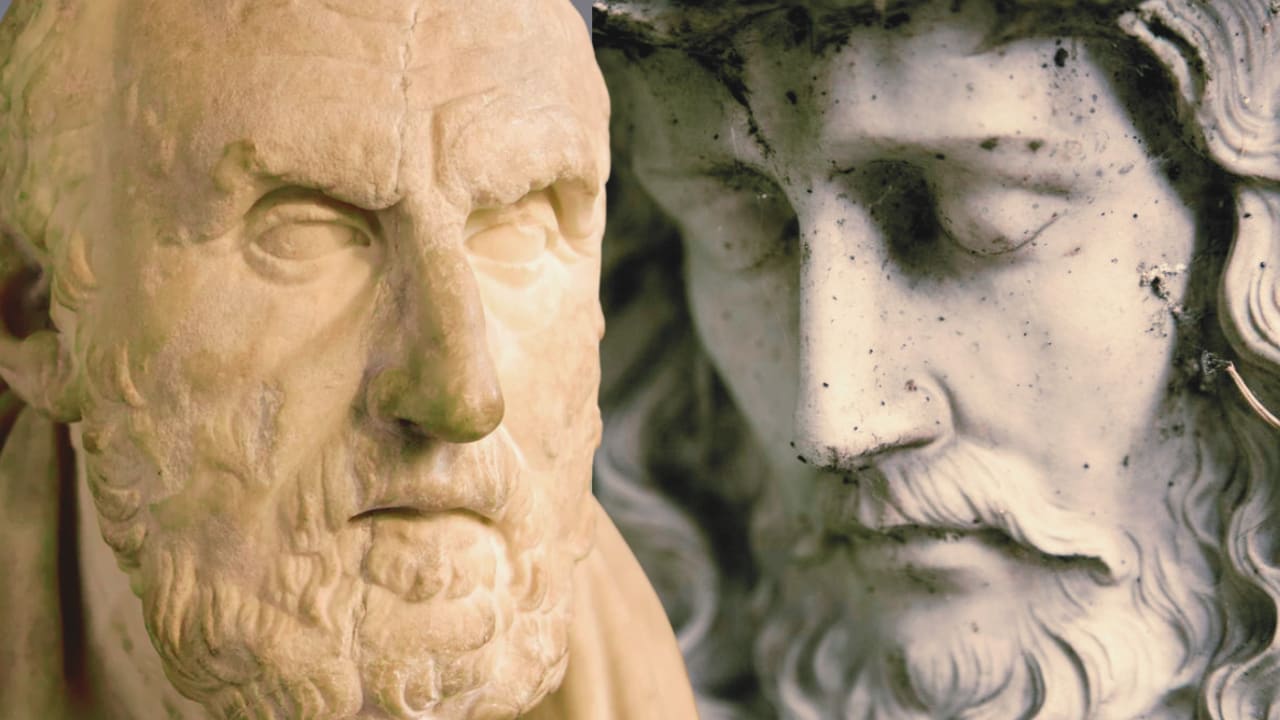
Indeed, the idea of non-retaliation sits at the very heart of Western culture. Most famously, it is embodied in the teachings of Christ, but it did not begin there. Long before the Sermon on the Mount, ancient philosophers, particularly the Stoics, were wrestling with the same moral challenge:
How should a rational, virtuous person respond when wronged?
What emerges is not a single tradition, but a shared inheritance, an enduring ideal that belongs as much to philosophy as to faith.
It is a place where ancient voices converge: philosophers and theologians, sages and skeptics, all grappling with the same enduring question...and all still deeply relevant today.
After all, modern life confronts us daily with conflict, whether online, at work, or within our closest relationships. The significance of this inquiry becomes unavoidable. To understand where these ideas come from is, perhaps, to better understand how we might live them.
So, this Easter Monday, let us take a moment to reflect on one of the most challenging ethical demands ever spoken: to forgive, to refrain, to turn the other cheek.
Some may dismiss this teaching as naïve, while others may embrace it as unquestioned truth. Either way, let us first step a little deeper into its origins. You may find that its roots run far wider, and far deeper, than you ever imagined...
All the best,
Anya Leonard
Founder and Director
Classical Wisdom
Turn the Other Cheek: The Stoic and Christian Ideal of Non-Retaliation
By Brittany Polat
It’s one of the most famous ethical scenes in the Bible. Jesus of Nazareth, just beginning his vocation as a faith healer and messenger of God, has been traveling around the countryside gathering his disciples and healing the sick. Everywhere he goes, “great multitudes” follow him.
Eventually he makes his way up a mountain and delivers what would later become known as the Sermon on the Mount: a series of stringent ethical teachings which begin with the Beatitudes (“Blessed are the poor in spirit, for theirs is the Kingdom of Heaven”), run through a series of homely analogies on inner purity (“You are the salt of the earth”), and exhort his listeners to forgive their enemies (“But I tell you, love your enemies, bless those who curse you, do good to those who hate you, and pray for those who mistreat you and persecute you”) and avoid retaliation (“I tell you, don’t resist him who is evil; but whoever strikes you on your right cheek, turn to him the other also”).
The message is clear. Jesus is commanding his followers to “be perfect, just as your Father in heaven is also perfect.”
Bring the Wisdom of the Ancient World into your inbox and into your life. Subscribe Today to enjoy even more Classical Wisdom:
For centuries the Sermon on the Mount, as narrated in Matthew 5-7, has challenged and inspired Christians toward compassion and brotherly love. It is an ethic requiring humility, mercy, forgiveness, charity, sincerity, and self-awareness—in short, moral perfection. But while many of Christ’s followers over the centuries have struggled to live up to this ideal, few have doubted that the call to love your enemies and turn the other cheek is a uniquely Christian message.
But is it?
Biblical scholars are increasingly finding areas of overlap between early Christianity and Greco-Roman philosophies such as Stoicism and Cynicism. Stoicism, in particular, seems to have made a mark on the early Christian communities, influencing the ethical teachings of the Apostle Paul as well as the texts that came to form the synoptic Gospels (Matthew, Mark, and Luke). While it’s unlikely that Jesus himself was influenced by the Greco-Roman tradition, the believers who later wrote down his words were living in a time and place where Stoicism was the dominant moral ideology.
The early church, therefore, was formed in an environment when Stoicism set the baseline expectation for what a system of ethics should encompass. As one theologian puts it, “Stoicism had spread throughout the empire before the birth of Jesus and there is little doubt that the soil from which the church sprang up had been watered by the Stoic philosophy.”
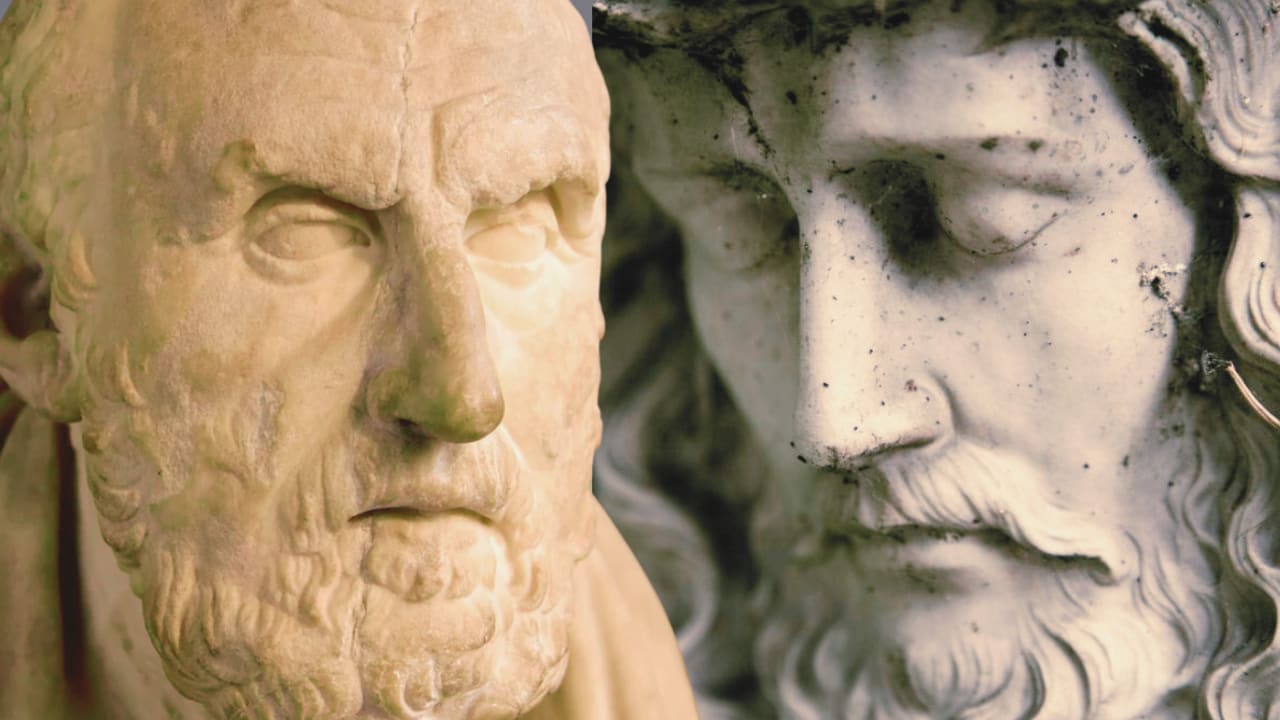
In this way, more than a few Stoic principles were absorbed into early Christianity. Perhaps none more so than those ethical ideals expressed in the Sermon on the Mount: love your enemies, turn the other cheek, don’t judge other people.
Stoicism was well known in antiquity for these same stringent demands. The Stoic Musonius Rufus, who was a contemporary of the Apostle Paul, was widely acclaimed as a sage and compared to Socrates and even the mythical (god-like) heroes Heracles and Odysseus. He was famous, among other things, for both practicing and preaching the doctrine of non-retaliation:
And I might mention many other men who have experienced insult, some wronged by word, others by violence and bodily harm, who do not appear to have defended their rights against their assailants nor to have proceeded against them in any other way, but very meekly bore their wrong.
And in this they were quite right. For to scheme how to bite back the biter and to return evil for evil is the act not of a human being but of a wild beast, which is incapable of reasoning that the majority of wrongs are done to men through ignorance and misunderstanding, from which man will cease as soon as he has been taught. But to accept injury not in a spirit of savage resentment and to show ourselves not implacable toward those who wrong us, but rather to be a source of good hope to them, is characteristic of a benevolent and civilized way of life.
Musonius and other Stoics advocated peaceful interactions with others under the banner of wisdom, justice, courage, and temperance—in other words, the cardinal virtues. The Stoic doctrine of oikeiōsis (appropriation) holds that humans are naturally primed to grow in wisdom and virtue throughout our lives.
Like other animals, we are born with an instinct for self-preservation, which, if allowed to grow in the wrong direction, can turn into anger and selfishness. Some people unfortunately choose to align themselves with these baser instincts, metaphorically turning themselves into the “wild beasts” Musonius cites in the passage above. But if we mature properly, we realize that harming others actually harms ourselves. We are much better off showing compassion and restraint to other people, even if we lose certain worldly advantages such as money or status. As Musonius says, “virtue is brotherly love and goodness and justice and beneficence and concern for the welfare of one’s neighbor.”
Biblical scholar Runar Thorsteinsson reminds us, however, that while Stoicism presents the most highly developed version of this ethic, the demand for non-retaliation had in fact been salient in the Greco-Roman tradition since the time of Socrates—who famously showed compassion and forgiveness to those who condemned him to death.
In the Sermon on the Mount, Thorsteinsson argues, Matthew’s goal was not to present an entirely new ethic, but to establish Jesus as a bona fide philosopher in this distinguished lineage:
When Jesus presents his moral teaching in the Gospel of Matthew, he is following in the footsteps not only of Jewish thinkers but also of Graeco-Roman philosophers, especially the Stoics. He is not presenting anything ‘new’; rather, Matthew is confirming that Jesus stands in a long tradition of learned moralists, whether Jewish or non-Jewish, as he verifies the moral teachings and improves them (‘You have heard…But I say to you…’). Matthew, it seems, wants to emphasize that Jesus is not inferior to such moralists. Other moralists may be better known and their ethical theory may be more elaborate, but the content of Jesus’ moral teaching is as powerful as theirs, if not more powerful, and his actions show that his way of life is wholly in accordance with his teaching.
According to this reading, the gospels (and Pauline letters) were innovative not in creating a new ethic of compassion and moral perfection but in combining an existing system of Greco-Roman ethics with the new Jewish tradition springing up around Jesus of Nazareth. With respect to the Sermon on the Mount, theologian Stanley Stowers maintains that the author of Matthew “inherited a Jesus who was known as a teacher but had no clear and elaborated ethical teachings that would make him like, or rather, superior to, the other great teachers of the culture.”
Therefore he turned to the ethical teachings of Stoicism—“the most prominent and widely respected philosophy of the day”—to create a picture of “Jesus the Judean sage.”
If this is true, it would not be the first or last attempt to integrate Judaism with Greco-Roman philosophy. Philo of Alexandria was a Jewish Neo-Platonist who also incorporated elements of Stoicism into his syncretic philosophy. Paul of Tarsus, who was responsible for shepherding the early church communities, “had ‘absorbed’ a great deal of the fundamental Stoic worldview into his own,” according to New Testament scholar Troels Engberg-Pedersen.
And Christ-followers would continue to present Jesus as a philosopher even a century after his death; as Pierre Hadot notes, “certain Christians presented Christianity not only as a philosophy, that is to say a phenomenon of Greek culture, but as the philosophy, the eternal philosophy.”
Of course, within a couple hundred years after the death of Jesus, the tables had been completely turned. As Christianity became the dominant belief system and the Greek philosophical schools receded from view, moral teachers and thinkers turned increasingly to the new Christian texts rather than the older philosophical ones for their spiritual instruction. And though educated theologians continued mining “pagan” books for wisdom and understanding, philosophy was now read through a Christian lens.
Congenial ideals that were once identifiably Stoic were now considered Christian teachings, not only in Biblical texts but through the ever-growing body of Christian exegetical writings, monastic tradition, and even spiritual exercises (as noted by Pierre Hadot).
However, careful readers have always recognized the affinity between Stoic and Christian ethical teachings. From early church fathers like Origen and Augustine, through Aquinas and other medieval thinkers, to Protestant reformers like Luther and Calvin, down to 20th-century theologians like Reinhold Niebuhr (commonly credited with writing the Serenity Prayer), Stoicism has consistently exerted a strong but unacknowledged influence on Christian ethics.
That lack of acknowledgement seems to be slowly changing as Stoic scholarship advances and as Stoicism continues to grow in popularity. At the same time, Christian scholars are suggesting that understanding Stoicism can help Christians to better interpret the Bible. Anyone interested in Western history, philosophy, and culture—as well as those seeking to better understand Biblical tradition—has much to learn from studying the parallels and intertwined histories of Christianity and Stoicism.
In this spirit, I’d like to close with four parallel texts that illustrate the overlap between Stoic and Christian ethics. The Biblical passages are all from the Sermon on the Mount (Matthew 5-7), and the Stoic passages come from four well-known Roman Stoics: Musonius, Seneca, Epictetus, and Marcus Aurelius.
The fact that Stoicism and Christianity both emphasize an ethic of non-retaliation does not take away or diminish the contribution of each—on the contrary, it underscores the importance of this ethical ideal in the long history of Western culture.
These passages urge us toward forgiveness, reconciliation, and non-judgment—in other words, toward the moral perfection so characteristic of these philosophers. My hope is that all readers, whatever their philosophical or religious persuasion, will be challenged and inspired toward their own version of inner peace and compassion toward other people.
Why do you see the speck that is in your brother’s eye, but don’t consider the beam that is in your own eye? Or how will you tell your brother, ‘Let me remove the speck from your eye,’ and behold, the beam is in your own eye? You hypocrite! First, remove the beam out of your own eye, and then you can see clearly to remove the speck out of your brother’s eye.
Matthew 7.3–5
~
Do not preach right-doing to people who are aware of your wrongdoing.
Musonius Rufus, Sayings, 32
You have heard that it was said, “An eye for an eye, and a tooth for a tooth.” But I tell you, don’t resist him who is evil; but whoever strikes you on your right cheek, turn to him the other also.
Matthew 5.38–39
~
It is not honorable to repay injuries with injuries…Revenge and retaliation are words people use and even think to be righteous, yet they do not greatly differ from wrongdoing, except in the order in which they are done: he who renders pain for pain has more excuse for his sin; that is all.
Seneca, On Anger, 2.32
If, therefore, you are offering your gift at the altar, and there remember that your brother has anything against you, leave your gift there before the altar, and go your way. First be reconciled to your brother, and then come and offer your gift.
Matthew 5.23–24
~
If we define the good as consisting in right moral purpose, then the mere preservation of our relationships becomes a good; and furthermore, the person who gives up some of their external things achieves the good. “My father is taking away my money.” But he is doing you no harm. “My brother is going to get the larger part of the farm.” Let him have all he wants. That doesn’t help him at all to get a part of your decency, does it, or of your fidelity, or of your brotherly love?
Epictetus, Discourses, 3.3, 8–9
You have heard that it was said, “You shall love your neighbor and hate your enemy.” But I tell you, love your enemies, bless those who curse you, do good to those who hate you, and pray for those who mistreat you and persecute you, that you may be children of your Father who is in heaven. For he makes his sun to rise on the evil and the good, and sends rain on the just and the unjust.
Matthew 5.43–45
~
If you can, correct those who do wrong; but if you cannot, remember that compassion is given to you for this purpose. The gods, too, are compassionate to such people, for sometimes they even help them obtain health, wealth, reputation. And it’s in your power to do the same; or tell me, who is stopping you?
Marcus Aurelius, Meditations, 9.11
About the Author
Brittany Polat is a philosophical writer and community organizer who shares Stoicism with people all over the world. Her new book Jesus and Stoicism: The Parallel Sayings, was recently published. Previous books include Stoic Ethics: The Basics (with Christopher Gill) and Journal Like a Stoic.
Más info en https://ift.tt/kbKGXdf / Tfno. & WA 607725547 Centro MENADEL (Frasco Martín) Psicología Clínica y Tradicional en Mijas. #Menadel #Psicología #Clínica #Tradicional #MijasPueblo
*No suscribimos necesariamente las opiniones o artículos aquí compartidos. No todo es lo que parece.
No hay comentarios:
Publicar un comentario