
Dear Classical Wisdom Members,
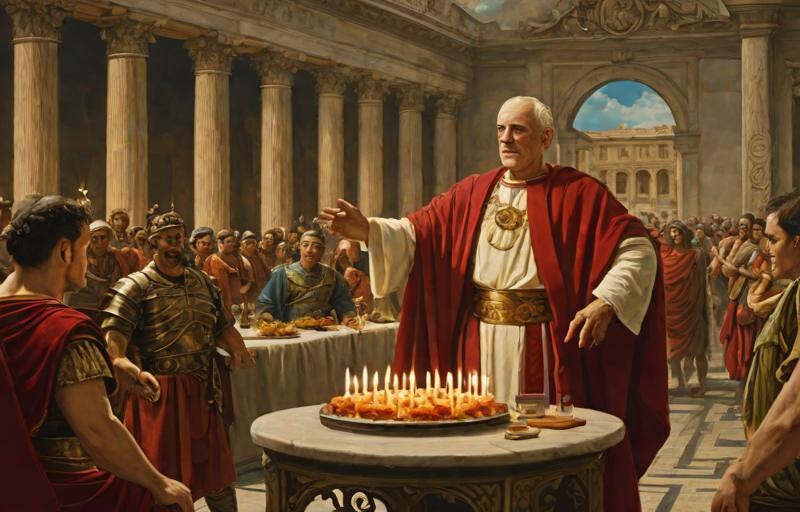
Happy Birthday Cicero!
Today the great Roman senator and orator would turn 2129... but surely don’t look a day over 2119... right?
I know I shouldn’t be biased, but actually Cicero is one of my more favorite ancient thinkers. In part because of his Eclecticism, which is personally something I can get behind. Seems tricky to find a system of ideas that you completely agree with…
But I won’t go into too much detail, because truth be told, today’s article does a much better job of it! In fact, you can delve into not only the philosophy of Cicero, but also the little known Paradoxa Stoicorum...
As someone who questioned everything, please enjoy Cicero’s thoughts on 6 famous Stoic sayings that appear to go against common understanding, below.
Classical Wisdom Members: Please enjoy the FULL Cicero experience in honor of the great ‘new’ man’s considerable contribution to both the ancient world and to every era afterwards.
After the article you can find both a Classical Wisdom Litterae Magazine as well as our Ebook: The Cicero Collection, which collects his greatest orations and letters - not an easy task!
Enjoy!
All the best,
Anya Leonard
Founder and Director
Classical Wisdom
While the classics can be considered a cornerstone of the Western world, it would not be a stretch to say that Cicero, the man, the legend, was a cornerstone of the classical age. Discover this great man with today’s Classical Wisdom Magazine and E-Book: The Cicero Collection
Cicero and the Stoics – the Paradoxa Stoicorum
By Visnja Bojovic
The legacy of Cicero towers over the ancient world: philosopher and politician, enemy of Mark Antony, and the Roman Republic’s great defender. His writings remain some of the most celebrated in Latin literature, and today we look at one of his more overlooked works – the Paradoxa Stoicorum. But first, a little background….
Cicero was quite eclectic in his beliefs, but he mostly embraced the beliefs of Academic Skepticism. As the Skeptics believed that there is no philosophy that can be entirely true, they mostly criticized belief systems. However, Skepticism allowed for embracing certain philosophies, just as long as one makes sure to carefully examine them and leaves oneself open to change in the face of good arguments.

This was suitable for Cicero, as he could advocate for the philosophical systems he found most useful. For Cicero, philosophy was subject to politics, as it served his political beliefs and interests. He believed that the reason that the Republic was weakening was the moral decay of Roman politicians. Therefore, he advocated for Stoicism (among other schools of thought), since the Stoics believed that one must be politically involved, as it is his duty as a Roman citizen. They did not advocate for political involvement due to self-interest, but rather as a moral duty.
However, Stoic sayings were often difficult to understand so that, as Cicero says, even the Stoics themselves called them ”paradoxes”. For this reason, he decided to perform a little exercise (or even a game) that consisted of exploring and translating six complex Greek Stoic sayings into his contemporary language and style of rhetorical Latin. This was the Paradoxa Stoicorum, today one of Cicero’s most fascinating but overlooked writings. Cicero also says that he is playing this game out of curiosity, to see if these principles can actually be applied in reality….

1. That moral worth is the only good
Have you ever thought about how strange it is that the property is also called ”goods”? In this section, Cicero wonders about this paradox, asking:
By what staircase did Romulus ascend heaven? By the ones that those people call ”goods” or by his deeds and virtues?
Cicero quickly answers this question with Bias of Priena‘s famous sentence:
Más info en frasco@menadelpsicologia.com / Tfno. & WA 607725547 Centro MENADEL (Frasco Martín) Psicología Clínica y Tradicional en Mijas Pueblo #Psicologia #MenadelPsicologia #Clinica #Tradicional #MijasPueblo
*No suscribimos necesariamente las opiniones o artículos aquí compartidos. No todo es lo que parece.

No hay comentarios:
Publicar un comentario