Psicoterapia Clínica cognitivo-conductual (una revisión vital, herramientas para el cambio y ayuda en la toma de consciencia de los mecanismos de nuestro ego) y Tradicional (una aproximación a la Espiritualidad desde una concepción de la psicología que contempla al ser humano en su visión ternaria Tradicional: cuerpo, alma y Espíritu).
“La psicología tradicional y sagrada da por establecido que la vida es un medio hacia un fin más allá de sí misma, no que haya de ser vivida a toda costa. La psicología tradicional no se basa en la observación; es una ciencia de la experiencia subjetiva. Su verdad no es del tipo susceptible de demostración estadística; es una verdad que solo puede ser verificada por el contemplativo experto. En otras palabras, su verdad solo puede ser verificada por aquellos que adoptan el procedimiento prescrito por sus proponedores, y que se llama una ‘Vía’.” (Ananda K Coomaraswamy)
La Psicoterapia es un proceso de superación que, a través de la observación, análisis, control y transformación del pensamiento y modificación de hábitos de conducta te ayudará a vencer:
Depresión / Melancolía Neurosis - Estrés Ansiedad / Angustia Miedos / Fobias Adicciones / Dependencias (Drogas, Juego, Sexo...) Obsesiones
Problemas Familiares y de Pareja e Hijos Trastornos de Personalidad...
La Psicología no trata únicamente patologías. ¿Qué sentido tiene mi vida?: el Autoconocimiento, el desarrollo interior es una necesidad de interés creciente en una sociedad de prisas, consumo compulsivo, incertidumbre, soledad y vacío. Conocerte a Ti mismo como clave para encontrar la verdadera felicidad.
Estudio de las estructuras subyacentes de Personalidad Técnicas de Relajación Visualización Creativa Concentración Cambio de Hábitos Desbloqueo Emocional Exploración de la Consciencia
Desde la Psicología Cognitivo-Conductual hasta la Psicología Tradicional, adaptándonos a la naturaleza, necesidades y condiciones de nuestros pacientes desde 1992.
Más info en https://ift.tt/bvPN9yG / Tfno. & WA 607725547 Centro MENADEL (Frasco Martín) Psicología Clínica y Tradicional en Mijas. #Menadel #Psicología #Clínica #Tradicional #MijasPueblo
*No suscribimos necesariamente las opiniones o artículos aquí compartidos. No todo es lo que parece.
On the first night he practiced the dhikr, flames rose from his chest to heaven.
Watch the video here:
Ala al-Dawla Simnani (1261–1336) was a companion of the Ilkhanid emperor Arghun — a man of court, of administration, of proximity to power in the empire that had replaced the Abbasid caliphate across the eastern Islamic world. In 1284, on a military campaign, something interrupted the ordinary course of his life. He records the experience without dramatic elaboration: a state descended. The life he had been living became impossible to continue. He sought out a Sufi master in Baghdad, a disciple of the Kubrawiyya lineage, who taught him the dhikr practice of the order. The first night he performed it, flames rose from his chest to heaven.
He put on the Sufi robe the next morning and began what would become, over the following fifty years, one of the most systematically documented inner lives in the tradition. The hagiographic sources report that he completed well over a hundred forty-day retreats across different khanaqahs — a number that, even if devotionally amplified in the telling, conveys something true about the nature of his practice. The forty-day retreat, the arba’in, carries its own weight in the tradition: Moses’s forty nights on the mountain before receiving the Torah, the hadith that forty days of sincere devotion cause wisdom to flow from the heart to the tongue, the Kubrawiyya’s formalization of this period as the minimum unit of serious interior work. For Simnani the khalwa was not occasional. It was the method. What he produced — the Risala-yi Nuriyya, the detailed color-diagnostics, the Latayif system itself — reads as accumulated observational data from decade after decade of darkness, breath, and watching what arose.
The Lineage of Light
The color-vision system Simnani developed did not originate with him. It belongs to the Kubrawiyya order, named after Najm al-Din Kubra (d. 1221) of Khwarezm, who died defending his city against the Mongols and who was known as wali tarash — the manufacturer of saints. Kubra’s primary work, Fawa’ih al-Jamal wa Fawatih al-Jalal (The Fragrances of Beauty and the Prefaces of Majesty), contains one of the earliest phenomenologies of inner light in any mystical tradition.
Kubra describes a sequence: lightning flashes appear first, brief and scattered; then something like stars distributed through the inner sky; then a steadier moonlike radiance; then what functions like an interior sun; and beyond that, at the apex of the progression, a black light — a darkness he identifies not as the absence of illumination but as its excess, as something that produces darkness in the viewer the way the sun produces darkness when you try to look directly at it. The faculty that would perceive it is overwhelmed by it. Black light is what the visionary capacity encounters when it reaches the edge of what forms can contain.
Kubra’s student Najm al-Din Razi continued the system in the Mirsad al-’Ibad (The Path of God’s Servants). Razi formalized the color progression and placed the black light above the white of purification — not as an endpoint of negation but as a threshold beyond which color-language no longer applies. The working principle across early Kubrawiyya texts is consistent: darker, more opaque colors indicate a soul still weighted by its lower nature; lighter, more transparent colors indicate purification in progress; white marks near-completion; the black light beyond it marks the approach to something the created faculties cannot receive as an image.
Simnani inherited this from his teacher, who stood three generations from Kubra, and transformed it. Where his predecessors mapped colors to stages of spiritual development in general terms, Simnani assigned each color to a specific subtle organ, and each organ to a specific prophet. The ladder became anatomical. The colors became localizable — not states that move through the whole person but events that occur at identifiable points within the body.
He also produced a complete Quran commentary in this lineage — the Ta’wilat al-Najmiyya — which Kubra had begun and Razi had continued. Simnani completed it. The three generations of the Kubrawiyya producing a single Quran commentary across a century is itself an index of what the order understood its work to be: not the exposition of ideas but the transmission of a way of reading.
The Seven Prophets of the Body
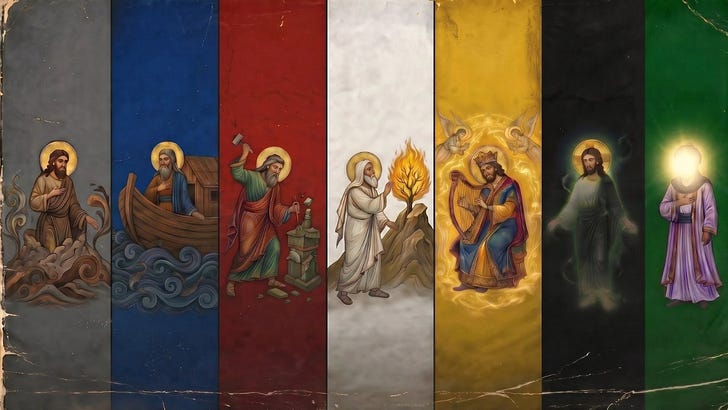
The Latayif are not arranged arbitrarily. They move from the body’s outermost surface to its innermost ground, and the prophets assigned to each center represent not symbols but operational modes — the specific function the center performs in the soul’s passage from density to transparency.
Qalabiya — Adam — matte black. The skin, the physical frame, the bare fact of being present in a body in the world. Adam came before any specific revelation and received only the raw condition of embodied existence. The matte black here is not the luminous black of the sixth center — it is the darkness before anything has risen. Simnani notes that a blockage here produces what he calls neglect of the world: the wayfarer becomes so absorbed in interior states that the conditions of ordinary life, the obligations owed to the creation, are abandoned. The body must be inhabited before it can be worked through.
Nafsiya — Noah — blue. The flesh itself, the tissue of appetite and ego-force. Noah’s function is navigation: the ark contained a flood without being destroyed by it. Simnani reads this as the precise function of this center — not the suppression of the passions but their containment, their redirection into something that can survive the inner weather and bring it somewhere. The blue in early Kubrawiyya texts marks the lower soul, the region still dominated by its own density.
Qalbiya — Abraham — red. Simnani writes in the Al-Urwa: “the light of the heart rises and its veil is red agate. Seeing that light, a great taste reaches the heart of the seeker and causes him to persevere in his behavior.” The veins, the blood, the heart’s own circulation. Abraham’s willingness to sacrifice is the mode here — the heart’s readiness to submit what it most wants to something beyond its own desire. The taste Simnani mentions is specific: a physical sensation of pleasure in the practice that sustains the wayfarer when intellectual conviction alone would not be sufficient. The red agate is not static. As the submission deepens, the color clears.
Sirriya — Moses — white. The innermost chamber of the heart — the part that cannot receive its knowledge through ordinary transmission, that cannot be reached by reasoning or inherited from a chain of narration. It receives through direct address, as Moses received on the mountain, in the conversation that had no other witnesses. Simnani notes that from this center “the green light emits and its shade is white” — the white of something cleared sufficiently to receive revelation directly rather than as a report of what others received.
Ruhiya — David — yellow. The spirit distributed through the whole body — not localized but permeating, present everywhere without a fixed seat. David’s mode is joy: the Psalms, the harp, the creature’s pleasure in its relationship with the Real. When this center opens, Simnani describes a physical sensation of warmth and expansion filling the chest — the body no longer resisting the practice but resonating with it. The yellow in Kubrawiyya color-grammar marks the higher registers of the spirit, a warmth that has moved past the heat of struggle.
Khafiya — Jesus — shiny black. The hidden within the hidden, the layer of the subtle body with no correspondence in ordinary religious instruction. Jesus ascending, dissolving into the divine depth before the apparent return. The shiny black is not the matte black of the first center. This is black because its light is too dense for ordinary vision to register — a darkness of excess rather than of absence. Simnani’s identification of this center with Jesus is deliberate: the ascension represents precisely the dissolution of the soul’s visible form into something that cannot be seen from outside.
Haqqiya — Muhammad — emerald green. The Reality itself — the seal of the prophets and the seal of the subtle body. The one in whom all previous prophets are contained, the end of the line that is also its origin. Simnani’s words for this color: “its greenness is a sign of the life of the tree of existence.” Not a metaphor but a physical description. The emerald green that floods the inner field when this center opens is the same green that vegetation borrows from the unseen. The beginning beyond endings: the soul is not merely reunited with the Real but recognized as what it was before the journey started.
The diagnostic logic is sequential and cumulative. If a single center becomes dominant while others remain dormant, specific spiritual pathologies result. The wayfarer in whom the Jesus center overdevelops while the Adam center remains blocked will have genuine ecstatic experiences and will neglect the world — the dissolution is real, the grounding is absent. Conversely, someone rooted only in the Adam center, dutiful and worldly, will have stability and no inner life. The ladder cannot be climbed by skipping rungs, and it cannot be worked from the top down.
The Sawing Breath
The method Simnani prescribes for activating the Latayif is a specific breathing practice he calls the Arra-yi Dhikr — the Sawing of the Breath. The instruction survives in his own words:
“The ideal formula for recollection is the credal statement: There is no god but God. This formula should be uttered in four beats: with all his strength, the mystic should exhale the ‘la’ from above the navel; he should then inhale the ‘ilaha’ to the right side of the breast; then exhale the ‘illa’ from the right side to the left; and then inhale the ‘Allah’ to the physical heart, which is on the left side of the breast.”
Four beats, four anatomical locations, traversing the torso in a circuit. The La — the negation — drawn upward from the navel with force, the exhalation carrying the denial of everything that is not God up through the body’s center. The Ilaha inhaled to the right breast. The Illa carried across. The Allah driven into the physical heart on the left. Then again.
The name — sawing — is accurate to the physical sensation of the practice. It is not gentle meditative breathing. The friction it generates produces what Simnani calls Hararat-e-Gharizi — Innate Heat — which he treats as the mechanism of the method rather than a side effect. He describes the ego-soul as a dense, cold substance. The breath-sawing thins this density through friction, changing the interior conditions until the Latayif, which are present throughout but occluded, become accessible to perception.
His diagnostics are specific and practical: cold heaviness in the limbs means the rhythm is too slow — the friction is insufficient to generate and sustain the heat. Scattered thoughts and lightheadedness mean the heat has become Hararat-e-Gharibeh — alien heat, displaced from the body’s center and rising too high. The correct rhythm is the one that generates sustained warmth in the chest without displacement upward or dissipation outward.
The Risala-yi Nuriyya
The Risala-yi Nuriyya — the Treatise on Lights — was written at the request of one of Simnani’s students to document the visions that arise during dhikr practice. It is not a theoretical text but a clinical one.
The detail that distinguishes it from other visionary literature is this: Simnani treats the lights and colors that appear in the inner field as markers of both spiritual states and spiritual illnesses. The distinction is his. Not every light indicates advancement. Some indicate blockage. Some indicate that the heat has become alien, that the soul has moved into fantasy rather than perception, that what appears to be vision is delusion produced by the same darkness the practice is designed to illuminate.
The treatise catalogs specific phenomena: sparks, smoke, the sensation of levitation, visions of buildings and animals. Simnani is systematizing an empirical body of data — his own practice over decades and the accounts of students who came to him describing their experiences. The function of the master in this system is partly that of a physician: the student reports the visions, and the master reads them diagnostically, locating the wayfarer on the ladder and prescribing the adjustment.
This is why the color distinctions matter at the level of precision Simnani insists on. Matte black and shiny black are not variations of the same phenomenon — they describe entirely different conditions of the inner field, one at the beginning of the journey and one at its most advanced approach. A muddy red in the third center indicates something different from a clear red. The Risala-yi Nuriyya is, among other things, a differential diagnosis.
The Mustard Seed
At the center of Simnani’s technical system is the Nuqta — the Point. He locates it within the physical heart at the size of a mustard seed. It is where the Qalb-e-Haqiqi — the real heart — is anchored inside the Qalb-e-Sanobari — the pine-cone-shaped physical heart that beats in the chest. One nested inside the other. The Nuqta is the place where they share the same location.
The practice instruction is minimal and exact: focus attention there until a needle-prick of light appears. Stay in it. Do not analyze it. If attention wanders and the sensation fades, the alignment is lost. Begin again.
What the Nuqta produces is a collapse of scattered attention into a single location. The ordinary mind distributes itself across a wide field of concerns simultaneously. The Nuqta practice draws this distribution to a point. When the concentration holds at that point, Simnani describes an aperture opening — the colors of the Latayif begin to rise in the inner field as the point of focus becomes a point of access.
The mustard seed is the smallest locatable thing — the minimum unit of focus. The work is not about expanding consciousness into a vast interior space. It is about contraction to a point fine enough to fit through a door that has no other key. The largeness, when it comes, comes from the inside of the point rather than from any widening of attention.
The Black Light
The most contested element of Simnani’s system is his interpretation of Nur-e-Siyah — the Black Light — at the sixth center.
Kubra and Razi had placed a transcendent darkness at the apex of the color sequence: the soul’s approach to something that cannot be represented by any created form. In this reading, black light is the absence of image rather than the absence of light — the threshold where the visionary faculties stop being useful.
Ayn al-Quzat al-Hamadani, a century before Simnani, had associated black light with the satanic principle — darkness as privation, the furthest point from divine illumination, the lower pole of the spectrum rather than the upper. His reading places the black at the bottom as a warning, not at the top as a destination.
Simnani reverses the Ayn al-Quzat reading entirely and deepens the Kubrawiyya one. He identifies Nur-e-Siyah as Nur-e-Dhat — the Light of the Essence. It appears black not because it is the absence of light but because it is light at an intensity the soul cannot receive as light. The faculty that would perceive it is overwhelmed by it. The soul standing before the black light is like someone trying to look at the sun: the blackness is the eye’s response to excess, not to absence.
To pass through it, the soul must stop trying to see it from outside. The perceptual structure that maintains the distance between observer and observed — the structure that makes vision possible in the ordinary sense — must dissolve. The soul does not approach the black light. It becomes it, until what rises from within is the emerald green of the seventh center. The transition from the sixth to the seventh is not arrival at a destination. It is the soul discovering that the ground it has been standing on was always already what it was seeking.
The Dispute with Ibn Arabi’s School
Simnani’s entire system rests on a specific metaphysical commitment, and he was willing to defend it against the most formidable opposing school of his time.
Ibn Arabi (d. 1240) had died twenty years before Simnani was born, but his legacy was alive and contested throughout Simnani’s career. The central question was wahdat al-wujud — the unity of being: the position, associated with Ibn Arabi’s followers, that God is the only existence and the created world is a manifestation of it, such that the mystic who reaches the highest stations perceives everything as God. The formula was hama ust — everything is He.
Simnani engaged this directly. Through a student, Iqbal-i Sistani, who met the leading Ibn Arabi commentator Abd al-Razzaq al-Qashani at Sultaniyya, a correspondence was initiated. When Qashani asked what Simnani thought of Ibn Arabi’s doctrine, the student replied that Simnani respected Ibn Arabi greatly but believed he was wrong about God as absolute existence. Qashani responded that this very doctrine was the basic principle of all mystical insight, and that it was strange for Simnani to disapprove of what all prophets and men of God had followed.
When this was reported to him, Simnani wrote his reply: “No one in any group or sect has ever expressed himself with such shamelessness. And if you look into the matter closely, you will find that the teachings of the naturalists and materialists are far better.”
The exchange continued through letters. Simnani’s counter-position was precise: wahdat al-wujud — everything is He — represents a real mystical experience but an early one, a station the soul passes through rather than the final destination. The highest stage is not the perception of identity between God and creation but the recognition of a specific relationship: hama az ust — everything is FROM Him. Not identical with God but proceeding from God, sustained by God, oriented toward God — distinct without being separate, created without being abandoned.
This is not a merely philosophical dispute. It is enacted in the Latayif system itself. Each center has its own specific prophetic mode, its own color, its own anatomical location. The God illuminating the seventh center is emerald green — a specific, particular color, not colorlessness. The destination of the ladder is not the disappearance of the soul into undifferentiated divine existence but the soul’s recognition of what it specifically, individually, is: a particular locus of theophany with a particular configuration, unrepeatable, fully inhabited.
The Retreat
Simnani’s 270 forty-day retreats were not preparation for the life of a mystic. They were the life. The Khilwa was his primary method of investigation, repeated over decades, producing the data on which the Risala-yi Nuriyya and the Latayif system are based.
His rules for the retreat are straightforward: complete darkness, silence, stillness, and the unbroken rhythm of the Arra-yi Dhikr. The logic is that the inner senses are ordinarily overwhelmed by external input. Eliminate the input entirely, and what has always been present in the inner field becomes perceptible.
Without the breath-work, he insists, the darkness produces delusions rather than visions. The retreat without the dhikr is isolation. The Arra-yi Dhikr provides the anchor — a sustained generation of innate heat that keeps the wayfarer oriented inside the sensory void. The distinction between vision and delusion in the retreat is not the content of what appears but the presence or absence of the heat. Demonic visions are cold. The colors of the Latayif arise warm.
The instruction throughout the retreat is not to analyze what arises but to remain in it. When a color floods the inner field, stay in it until it fills the vision completely. The movement to observation — the step back to watch the experience as an object — arrests the process. It re-establishes the observer-observed distance that the retreat is designed to dissolve. Simnani is clear about this because it is the most common way the practice fails: the wayfarer begins to watch the experience rather than inhabit it, and the color retreats behind the watching.
What Simnani Built
The system Simnani formalized — seven subtle centers, seven prophets, seven colors, the Arra-yi Dhikr, the Nuqta, the Risala-yi Nuriyya as clinical documentation — became one of the most widely transmitted frameworks in later Sufism. It passed into the Naqshbandi tradition through Ahmad Sirhindi, who condensed the seven centers to five while preserving the diagnostic logic; through Ali Hamadani, who brought Kubrawiyya teachings to Kashmir and seeded the Islamization of an entire region; through the generations of masters who carried the Risala-yi Nuriyya as a practical manual.
What Simnani added to the Kubrawiyya tradition was specificity: the mapping of general color-visions to precise locations, the identification of each location with a prophetic mode, the diagnostic distinction between states and illnesses, and the metaphysical insistence that the soul arriving at the seventh center does not dissolve into undifferentiated being but finds itself illuminated as a particular, distinct locus — a theophany with a specific face.
The dispute with Qashani over hama ust versus hama az ust is not a detour from the Latayif system. It is its philosophical ground. If everything is He, the body is ultimately an illusion to be seen through. If everything is FROM Him, the body is the vehicle of something that can never be replicated — a specific configuration of the seven prophets, in a specific person, living one specific life.
The ladder exists because each rung is real and different from the others. The emerald green of the seventh center would not be what it is if the matte black of the first were not also real.
“The wayfarer must become a blacksmith, and the heart a furnace.”
James Fleming, writing for Spiritualrelief, thank you and welcome 💚
Primary sources: Simnani’s Al-Urwa li-ahl al-Khalwa wa al-Jalwa, ed. Najib Mayil Hirawi (Tehran: Mawla, 1983); Chehel Majlis (Forty Sessions); Risala-yi Nuriyya (analyzed in Jamal Elias, “A Kubrawi Treatise on Mystical Visions,” The Muslim World 83, no.1, 1993, pp. 68–80). The Simnani-Qashani correspondence is preserved in Jami’s Nafahat al-Uns and discussed in the Wikipedia article on Wahdat al-Wujud (citing Landolt). Secondary sources: Jamal Elias, The Throne Carrier of God (SUNY Press, 1995); Henry Corbin, The Man of Light in Iranian Sufism (Shambhala, 1978); Annemarie Schimmel, Mystical Dimensions of Islam (UNC Press, 1975). Kubra’s color sequence is in the Fawa’ih al-Jamal, ed. Fritz Meier (Wiesbaden, 1957). The Encyclopaedia Iranica entry on Simnani (H. Landolt) is the authoritative biographical source.
Más info en https://ift.tt/bvPN9yG / Tfno. & WA 607725547 Centro MENADEL (Frasco Martín) Psicología Clínica y Tradicional en Mijas. #Menadel #Psicología #Clínica #Tradicional #MijasPueblo
*No suscribimos necesariamente las opiniones o artículos aquí compartidos. No todo es lo que parece.
¡Ojalá hubiese una docena de asociaciones como Plural-21 o mejores -con éste o con otros nombres- en cada ciudad, pues falta hacen! Pero nos tememos que no es así…
Además, consideramos (casi) un milagro seguir abiertos tras 30 años de ir contracorriente, sin patrocinadores, sin querer comisiones ni de oficialistas ni de alternativos, diciendo en cada momento lo que consideramos lo más correcto, cambiando cuando comprendemos que es necesario corregir o matizar lo que defendíamos… Y abiertos a nuevos temas y también, sólo faltaría, a profundizar las cuestiones que ya abordamos, pues somos conscientes de que “sabemos lo que sabemos y no-sabemos lo que no-sabemos, y lo que no-sabemos es mucho más que lo que sabemos”.
No conocemos otra asociación -y, de nuevo, ojalá que haya o hubiese muchas- que tenga una visión tan compleja, que investigue temas tan diversos e importantes, que aborde sus aspectos y cuestiones claves, que busque la documentación correspondiente, que se esfuerce por fecundarlos entre sí (con lo que se generan pluses de comprensión y de conocimiento), que ponga en práctica lo que descubre,…, y que busque combinar adecuadamente la dimensión horizontal (o profana o material o moderna) con la dimensión vertical (o sagrada o espiritual o tradicional)
Más info en https://ift.tt/bvPN9yG / Tfno. & WA 607725547 Centro MENADEL (Frasco Martín) Psicología Clínica y Tradicional en Mijas. #Menadel #Psicología #Clínica #Tradicional #MijasPueblo
*No suscribimos necesariamente las opiniones o artículos aquí compartidos. No todo es lo que parece.
It’s not often that you get to sit in on a conversation like this.
A truly exciting lineup, it will be an unique opportunity to hear some of the most brilliant minds in mythology and the Classics come together to discuss a deceptively simple question:
Why do myths matter?
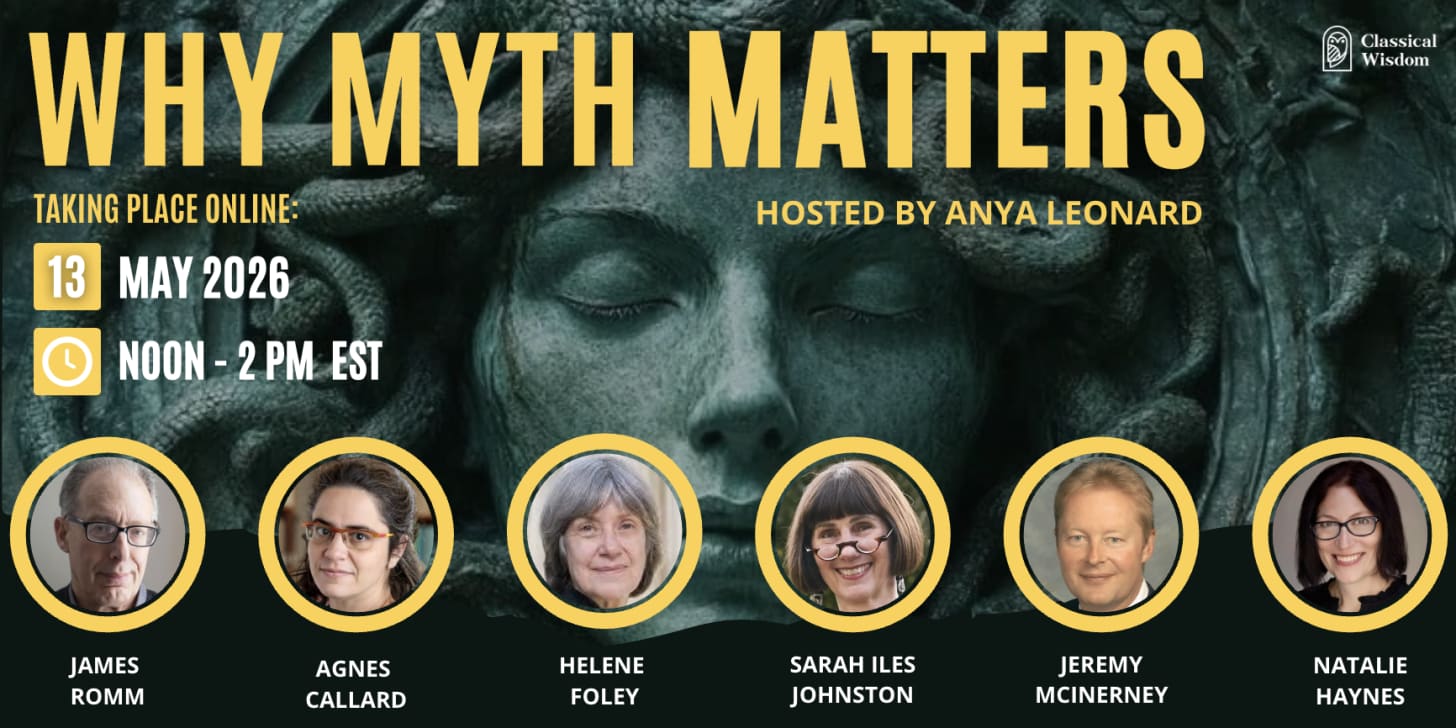
This May 13th you are invited to join us for this special event in which we will delve into the wonderful world of ancient myth, its meaning, and its continued importance in our here and now.
We’ll discuss what myth really meant to the Greeks and how it shaped their world, why figures like Medea continue to unsettle and provoke, and what Greek tragedy reveals about power, ethics, and human limits...
To explore this, we’ll be joined by an incredible group of prestigious philosophers, preeminent professors and best-selling authors, including:
James Romm
Agnes Callard
Natalie Haynes
Sarah Iles Johnston
Jeremy McInerney
Helene Foley
It’s rare to hear these voices in dialogue...especially together in this combination...
Across three conversations, we’ll explore myth as both a shared language of the ancient world and a way of confronting enduring human questions about responsibility, loyalty, suffering, and the limits of control... even to today.
I know these conversations will move in some interesting directions... and that it’s an opportunity not to be missed.
Make sure to reserve your place here to join us on May 13th:
Please join us - it will most certainly be a thoughtful and engaging event!
All the best,
Anya Leonard
Founder, Classical Wisdom
P.S. This incredible event is free to attend and we’ll send you a recording afterward if you’re not able to join live - as long as you register in advance. So secure your spot here.
Más info en https://ift.tt/bvPN9yG / Tfno. & WA 607725547 Centro MENADEL (Frasco Martín) Psicología Clínica y Tradicional en Mijas. #Menadel #Psicología #Clínica #Tradicional #MijasPueblo
*No suscribimos necesariamente las opiniones o artículos aquí compartidos. No todo es lo que parece.
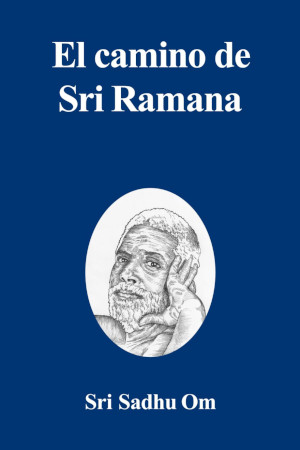
Bhagavan Sri Ramana Maharshi ha dado a conocer al mundo que la investigación de uno mismo, la búsqueda del conocimiento quién soy yo, es el único camino directo hacia la felicidad eterna e infinita, que es nuestra naturaleza real. Logró el conocimiento de sí mismo (ātma-jñāna) a sus 16 años, siendo un simple colegial, tras lo cual vivió durante 54 años en Tiruvannamalai ejerciendo de sadguru para un sinfín de personas de todos los rincones del mundo y de todas las religiones. El autor de este libro, Sri Sadhu Om, que alcanzó el culmen de la ausencia de deseo a una temprana edad, llegó hasta Bhagavan Ramana...
Más info en https://ift.tt/bvPN9yG / Tfno. & WA 607725547 Centro MENADEL (Frasco Martín) Psicología Clínica y Tradicional en Mijas. #Menadel #Psicología #Clínica #Tradicional #MijasPueblo
*No suscribimos necesariamente las opiniones o artículos aquí compartidos. No todo es lo que parece.
This essay first appeared as the Editorial in Volume 46 of Sacred Web, Winter 2020.Written in the aftermath of the ‘Prophet Cartoons’ controversy, it asks whether freedom can exist without limits — and what such limits might be.Probing beyond the tensions of modern tribalisms and sectarian conflicts which are often the pretext for limiting societal and personal freedoms, the article invites the reader to look beyond stereotypes and to examine what it means, and takes, to live in a free society.
We have bestowed dignity on the progeny of Adam.
— Holy Quran, 17:70
Is Islam opposed to free speech? It may certainly seem so when someone in the name of Islam kills another for publishing material deemed blasphemous or hateful to Muslims. Even more so when the retaliation is as shocking as a public beheading, as in the case of the French teacher, Samuel Paty, who was gruesomely murdered in a Paris suburb in October 2020 by a Muslim assailant for showing his students the incendiary ‘Prophet Cartoons’ which had earlier led to the Charlie Hebdo atrocities in 2015. And the impression was fortified when the Muslim ‘street’ appeared more outraged by President Macron’s defense of Paty’s right of free speech and by the displaying of the offensive Cartoons on French public buildings than by his odious killing.
Islam neither opposes free speech nor humane values.
In the aftermath of the 2015 killings and the recent ones, some have questioned whether there is something inherent in Islam that renders it intolerant of, or fundamentally incompatible with, Western liberal, if not humane, values. The conflating of the despicable killings and false stereotype of an intolerant Islam is particularly dangerous when it exploits ignorance about Islam for political ends. The reality is that Islam neither opposes free speech nor humane values. Those familiar with its teachings know that the religion of ‘peace’ and ‘self-surrender’ (both implied by the etymology of the term islam) respects both freedom and human dignity, seeing these as interconnected and mutually reinforcing values.
As is the case with many other faiths and philosophies, Islam does not regard any freedom as absolute, but as subject to metaphysical norms which we will discuss below. Every freedom is therefore enhanced by a respect for what the late Rabbi Jonathan Sacks has called ‘the dignity of difference’ so that the undermining of dignity erodes freedom, just as transgressive freedom undermines dignity. On this understanding, and without ascribing commensurability to the acts, both the publication of the provocative ‘Cartoons’ which intentionally profaned the Holy Prophet, and the retributive killing which sought to avenge his honor, violated the norms of human dignity.
The term ‘dignity’, denoting ‘value’ or ‘worth’, has deep metaphysical roots, which links it with the notion of the sacred. Something is sacred because it resonates the transcendent wholeness of reality which metaphysics, philosophy and religion term the ‘Absolute’ or ‘Truth’ or ‘God.’ Sacredness contains the idea of what William Blake referred to (in Auguries of Innocence) as seeing ‘a world in a grain of sand’ and ‘a heaven in a wild flower’, or of what Gerard Manley Hopkins (in God’s Grandeur) called ‘the dearest freshness deep down things.’ It is the meeting point of the immanent and the transcendent, a visionary threshold of dignity and compassion found in the innermost core, or ‘Heart’ of Man.
The Holy Quran teaches that humanity, having been created from ‘a single soul’ (an-nafs wahida) (4:1), is endowed with a primordial nature, al fitra, residing in the Heart, and that the true purpose of religion is to conform to this intrinsic nature, ‘the natural disposition which God has instilled into Man’ (30:30), thereby honouring the primordial covenant between God and Man (7:172). This all-embracing sacred nature, which is endowed with moral intelligence (al-furqan) (3:4), is the source of human perfectibility because, as imago Dei, it is a reflection of the Divine Nature, denoted by the Quranic term rahma, Loving and Compassionate Mercy, as affirmed in God’s declaration ‘I have inscribed rahma upon My Self as a law’ (kataba ‘ala nafsihi rahma) (6:12). Man’s primordial disposition is the basis of the Quranic claim that he is created in ‘the best of moulds’ (ahsani taqweemin) (95:4), intrinsically noble, intelligent, loving and humane, and is thereby the bearer of dignity (karama). But Man, who also possesses free will, is ‘created weak’ (4:28) and is susceptible to corruption; through the pursuit of the world and his passions, he can cover up his true nature, and thereby squander this gift of inherent dignity. That is why the Holy Quran repeatedly emphasizes the importance of using one’s free will to cultivate awareness of God (taqwa) (7:201), to call upon God by heart and tongue (dhikr) (2:152), and to conform one’s egoic nature to one’s God-given nature (30:30) through self-surrender to God (islam) (6:125) and through virtuous deeds manifesting as beauty (ihsan) (2:195). Thus, the Holy Quran states, ‘Verily, God is with those who have spiritual awareness and who do what is beautiful’ (16:128). Faith and virtue, then, are the only prerequisites for salvation in Islam (18:88) and one is free either to choose the Straight Path or to reject it (4:79) because faith is not a matter of compulsion but of personal choice.
Freedom exists for a purpose greater than itself: it exists for the sake of love.
Here we see the central purpose in Islam of free will: the ennobling of Man through self-transcendence. While Man is free to follow his own egoic desire (hawa) (30:29) and the biddings of the sinful self (an-nafs al-ammara) (12:53), he is also free to exercise spiritual intelligence (iman) and thereby to come to know and love God. The Holy Quran makes it clear that God did not choose to create humans as automatons (36:66-67), rather He created Man in the Adamic prototype as a morally intelligent creature with the freedom to know and love Him. It is only through freely given love – only through the voluntary submission of the lover to the Beloved – that love and life itself become meaningful.
This is the core teaching of Islam. Hence the famous Quranic adage, ‘no compulsion in matters of faith’ (2:256). Any compulsion would violate not only the soul’s freedom but also the grace of its dignity, for the soul’s true worth lies in its potential to freely love. Freedom exists for a purpose greater than itself: it exists for the sake of love. So, as the Indian sage and Nobel Laureate, Rabindranath Tagore stated in his book, Fireflies, ‘I am able to love my God because He gives me the freedom to deny Him.’
Individuality, and the freedom that goes with it, can never legitimately operate outside this matrix of wholeness.
Freedom and dignity are therefore optimized through love and the natural constraints it implies. These constraints, which are implied not only by the Quranic notion of the human ‘bond with God’ (‘ahd Allah) inscribed in human nature (2:27, 13:25) but also in the ordained limits of the Divine Nature, which is circumscribed by love or rahma (6:12, 6:54), and do not curb, but rather enhance, selfhood. To be true to oneself (as Polonius counsels his son, Laertes, in his farewell homily in Shakespeare’s Hamlet) enables one thereby to be true to all men. To conform to al-fitra, in Quranic terminology, does not demand the erasure of one’s individuality but, to the contrary, it enhances individuality by embracing it within a relationship of wholeness that fosters human dignity. Individuality, and the freedom that goes with it, can never legitimately operate outside this matrix of wholeness. When it overreaches by ignoring the matrix to pursue egoic desires, it inevitably encounters limits. Literature and mythology are filled with examples of overreaching transgressors: Prometheus, Orpheus, Psyche, Icarus, and Faust, to name a few. Religion too teaches of freedom’s limits and the consequences of transgression: the disobedience of Iblis, of Adam and Eve, and of Lot’s wife, are examples. Freedom, therefore, has natural bounds, and the notion of limits is neither capricious nor arbitrary but has metaphysical roots in the substance of love. The threshold is liminal and points to transcendence.
One of the hallmarks of modernism has been its individualism which, in secularist countries such as France, is prized as ‘Liberty’, an element of the Revolutionist’s tripartite motto of ‘Liberté, égalité, fraternité.’
the individual’s Liberty is subject to the dignity inherent in affirming the Equality of others and the relational bonds of Fraternity.
But even here, the other elements of the slogan suggest that Liberty is bounded by certain limits: the individual’s Liberty is subject to the dignity inherent in affirming the Equality of others and the relational bonds of Fraternity. This view of human freedom resonates with Quranic ideas, as we can see. It is only in the absolutizing of freedoms – decoupling Liberty from its relational elements – that individuality becomes transgressive and can be labeled as ‘individualism.’ Similarly, Equality cannot be interpreted in the language of political correctness to suppress individuality, precisely because the dignity of each individual resides in their uniqueness, in their difference; hence, ‘the dignity of difference.’ And so too, Fraternity cannot be emphasized at the cost of individuality; it cannot be reduced to an imposed communalism, rather it has to spring from a fostered sense of genuine community, of serving the common good. These ideas – respecting individuality, human dignity, and our common humanity – are all values which lie at the heart of Islam.
Returning now to the questions which have emerged from the Charlie Hebdo and Paty incidents, it will be apparent that Islam, while not opposed to free speech, does not condone offensive and hurtful expression; as the Holy Quran states, ‘God does not love the public utterance of hurtful speech’ (4:148). The emphasis here is on respecting the natural bounds of human dignity, on not absolutizing the freedom of speech to the point that it becomes transgressive.
the Holy Prophet is clearly on the side of those who would ‘speak truth to power’
Most countries, while respecting free speech in the interests of the rights of individuals to express views critical of the State or its institutions and to engage in the legitimate exchange of ideas, have nevertheless enacted laws to curb hateful or transgressive speech. Admittedly, the curbs can sometimes be heavy-handed, intended to muzzle legitimate dissent by writers and journalists, and while such heavy-handedness is evident today even in certain parts of the Muslim world, this is contrary to the spirit of free expression in Islam. On this score, the Holy Prophet is clearly on the side of those who would ‘speak truth to power’, as can be seen, for example, in the following Hadiths: ‘Tell the truth, even if this be unpleasant’ and ‘Speak truth to a tyrannical ruler.’
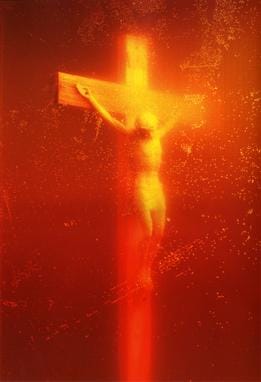
In terms of the limits of free expression, there are gray areas, particularly in the domain of what is termed ‘art’, where curbs on expression are often regarded as a form of unwelcome censorship. In the secular West, there is a greater indulgence of ‘art’, particularly though its subjectivist expressions, even where it offends the norms of human dignity. An example of this can be seen in the case of the photograph by Andres Serrano of a crucifix depicting Christ immersed in the artist’s own urine, and titled ‘Immersion (Piss Christ)’, which garnered both awards and controversy when it was displayed in the late 1980s.
The controversial ‘Piss Christ’.
Serrano, a devout Catholic, regarded his work as Christian art, and he was defended by, among others, Sister Wendy Beckett, the Catholic nun and respected art historian. This degree of tolerance to a controversial image of Christ will be contrasted with the Muslim reaction to the satirizing of their Holy Prophet. Underlying the debate about freedom of expression are deeper questions relating to the nature of ‘art’ and about its relationship to the sacred, which are beyond the scope of this essay. However, the ‘Prophet Cartoons’ contained undoubtedly hateful images which, unlike Serrano’s photograph, clearly profaned the Prophet in the eyes of all Muslims, not just the Islamicist terrorists. Slanderous and almost pornographic, the images provoked outrage. While Paty may not have intended the mischief which the originators of the Cartoons may have recklessly, if not intentionally, provoked, his decision to show the images to his students in the name of free speech was ill-advised, to say the least. It was also insensitive to universal norms of decency and the respect for human dignity. So too was the decision of French authorities to later display those images on public buildings in the aftermath of Paty’s killing, in a show of solidarity for French values and for the man who, in President Macron’s words, ‘embodied’ them. Paty’s murder, like the subsequent stabbings at a basilica in Nice, was an indefensible act of terrorism which was justly condemned by Muslim groups, and others, worldwide.
But because of the reaction of the Muslim ‘street’ to President Macron’s purported defense of free speech in this case, and due to the insensitive displaying of the offensive Cartoons subsequently, the false impression has been created that Islam encourages retaliatory killings because it does not tolerate free speech. As will be evident from the earlier part of this essay, this is completely false. The ethos of Islam is founded on compassionate love (rahma) and the sacredness which springs from metaphysical oneness (tawhid).
The Prophet himself is regarded as a model of tolerance and compassion among those who have studied the Seerah. He was an early champion of pluralism (as in the Constitution of Medina) and religious tolerance (as in the Prophet’s Covenants, which guaranteed the protection of religious minorities), and he was also an advocate for social reforms far in advance of the norms of his era, for example, with regard to the rights of women and of slaves. In his personal life, he exemplified the Quranic dictum, ‘Repel evil with conduct that is better’ (41:34), and his character was known to be imbued with tolerance, patience, mildness, consideration and compassion. Those were not qualities displayed by the promoters of free speech beyond the bounds of decency and dignity nor by the vengeful killers in Paris and Nice. To avoid such tragic incidents in the future, it would be best if Muslims and non-Muslims alike reflected on the true ethos of the Holy Quran and the character of its beloved Prophet, focusing on the underpinning of human dignity that in reality unites both Muslims and those who espouse secular liberal values.
Más info en https://ift.tt/GQHWALi / Tfno. & WA 607725547 Centro MENADEL (Frasco Martín) Psicología Clínica y Tradicional en Mijas. #Menadel #Psicología #Clínica #Tradicional #MijasPueblo
*No suscribimos necesariamente las opiniones o artículos aquí compartidos. No todo es lo que parece.
This was the assignment given to me by a podcast interviewer, one that I must admit became quite an all-consuming exercise.
It seemed initially like a simple enough task. My mind immediately raced to all my favorite reads over the years, the ones I devoured or savored at different moments in my life. It felt like it would just be a matter of whittling them down.
But then it really struck me... Just because I had liked a book, didn’t necessarily mean it shaped me. Sometimes, in fact, the books you don’t enjoy at the time linger the longest...perhaps because of the difficulties they present, whether in the challenge of finishing them or the painful truths they reveal.
And then again, what “me” are we even talking about?
After all, completely different books influenced me in my childhood, as a teenager, or as a university student. And are those versions of me still me?
Like the paradox of the Ship of Theseus, the ancient hero’s boat which was replaced plank by plank until it became an entirely new vessel, I have continuously changed in my decades. Perhaps the parts of me impacted by my youthful literary choices are no longer relevant to the Anya of today?
In high school, for instance, I was obsessed with Kurt Vonnegut, Chuck Palahniuk, Joseph Heller and Douglas Adams. I loved absurdity and dark humor, the almost sarcastic and sardonic lens through which they approached the difficult realities of life and history. That sensibility works well when you’re a teenager… but I can’t really say that those stories, as deeply as I once adored them, still impact me in any meaningful way.
And so, with that parameter acknowledged, I determined to limit my selection to books that have shaped the person I am today. If I choose something from my youth, there needs to be a thread that has persisted, a tangible continuation from that version of the self to the one I recognize in the mirror now.
But then arose another issue, once more tied to the premise of defining ‘me.’
How can we determine the many versions of ourselves?
We all contain many versions of ourselves, depending on the situation, location, and relationship. Who I am as the writer of these humble pages is vastly different to who I am as a daughter, a mother, or a wife. My friends see other variations still, shaped by when and where we met and the nature (and profundity) of our friendship.
My daughter has neatly summarized this as, among other personalities, “Podcast Mommy,” “Dinner out Mommy” and “Pajama Mommy”... she likes the last one most.
Thus, still somewhat adrift in the question of who I really am, I returned to my task at hand: selecting the books that helped make me so. As I mentioned, I spent a great deal of time thinking about this (and I’ll certainly share the podcast once it’s out), but I also wanted to expand on both the process and my choices...to commit these reflections to the written word.
Now, you may be wondering what this has to do with the Classics... I always appreciate your inquisitive questions, dear reader! Of course, some of the books below are from the ancient world or influenced by it. I would be remiss in understanding myself to leave out such a critical element. However, there are also others that have nothing to do with the Classics, only to do with my own life.
Some, perhaps, might surprise you...
The fact of the matter is that I enjoyed this exercise immensely, so much so I wanted to share it with you. It was a wonderful opportunity to truly live many ideas that are discussed and proposed by the ancient philosophers: to take part in the examined life.
What better way to reflect upon oneself than through great texts? Not only was it a perfect excuse to revisit the books so dear to me, it was also a welcome pause... a moment to contemplate who I have been, who I am, and who I wish to be.
All and all, quite Socratic!
Perhaps this same question may inspire you to take a similar journey into your literary past - to discover a little more about who you are and what works along the way have made you you.
You don’t need to read my own selections below. This exercise is, by its nature, quite personal. If you prefer to step away and scan your own library, I fully understand and applaud your commitment to the task! My list may serve as an example, or perhaps offer a few suggestions for future reading.
If you do continue, I’d like to note that some of my selections may seem a bit obvious. As I admitted to the interviewer, I was a little worried they might appear cliche. But then again, they are truthfully the books I choose. Great books are great for a reason, exactly because they resonate so deeply for so many readers.
I imagine many of you might have similar titles on your own lists, though no doubt for different reasons. That’s what great literature does.
So I begin below...
Discover the books that have inspired thousands throughout the millennia… The foundational texts from the ancient world: the Essential Greeks.
This May 5th, we will begin this year’s Essential Greeks Course to understand and appreciate these great works, the minds behind them and the context in which they were created.
See how they will shape you…
Our Essential Greeks Course Begins May 5th, make sure to secure your spot before then:
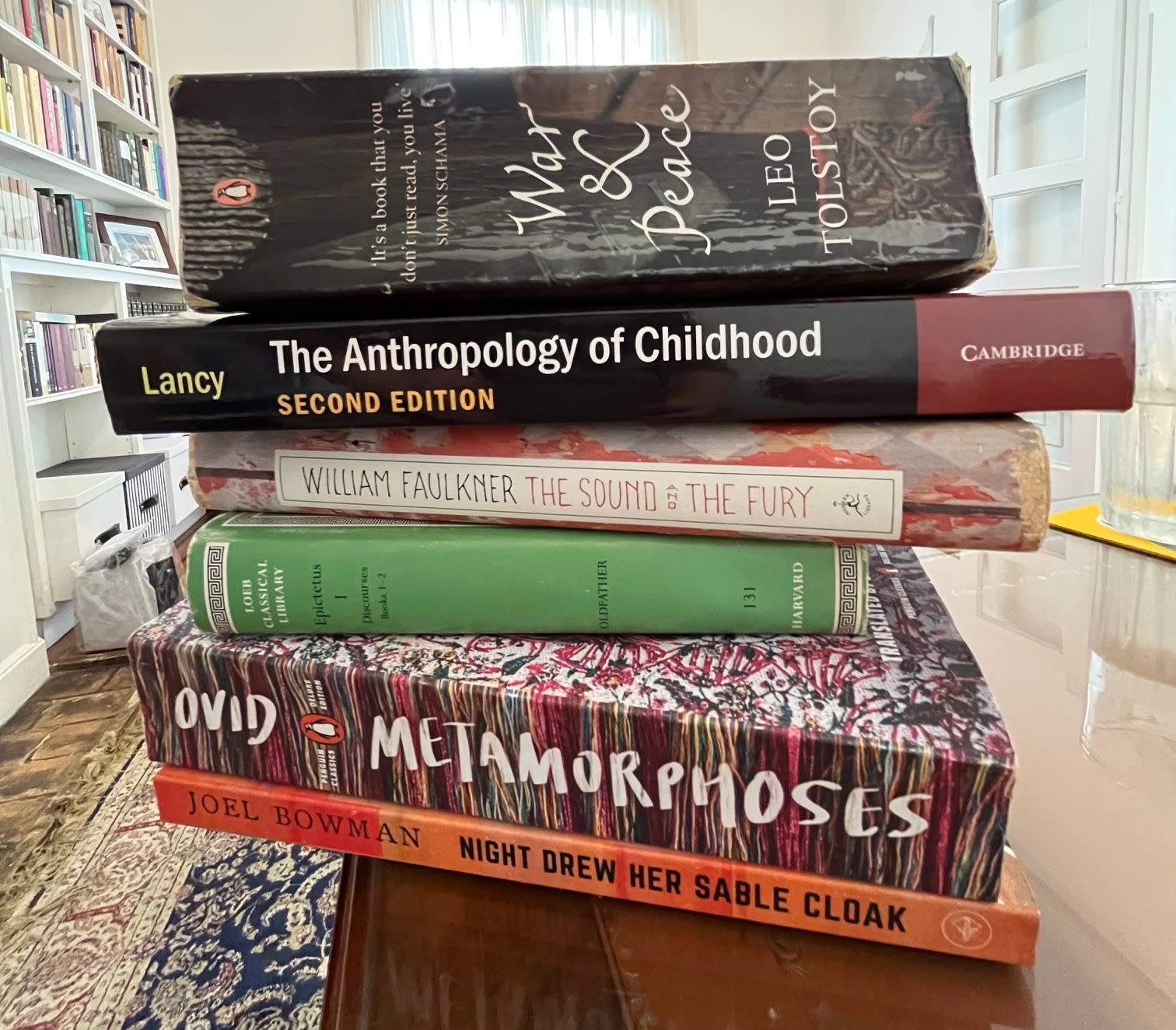
In seventh grade, I wrote a short story in which I imbued a character (who, incidentally, was not a heroine) with all the traits I believed defined a sophisticated woman. She wore a long floral dress, drank Earl Grey tea, and read War and Peace. To my younger self, Leo Tolstoy’s masterpiece, depicting numerous Russian families grappling with the realities of the Napoleonic Wars, was not merely a book, but something transformative.
Simply put, I wanted to be the kind of person who reads War and Peace.
So it is actually surprising that it took me so long to do so. I had even lived in Russia in my early twenties, and was a self described Russophile, studying the language and immersing myself in the many brilliant works found in that deep culture. I remember clearly reading Brother’s Karamazov from my father’s apartment overlooking the Kremlin, obscured only by the furious torrents of snow outside the window. Perhaps at that time, the introspective contemplations of Fyodor Dostoevsky resonated more deeply with my self-centered youth, mirroring my own emotional obstacles and anxieties; Leo Tolstoy’s sweeping perspectives on history felt less immediate, less relatable.
More likely, I was scared and intimidated.
I assumed it would be difficult, and I worried I wouldn’t understand it. But then, in my late twenties, I found myself with a long stretch of time alone...the perfect moment for such an undertaking. I’m so very glad I did.
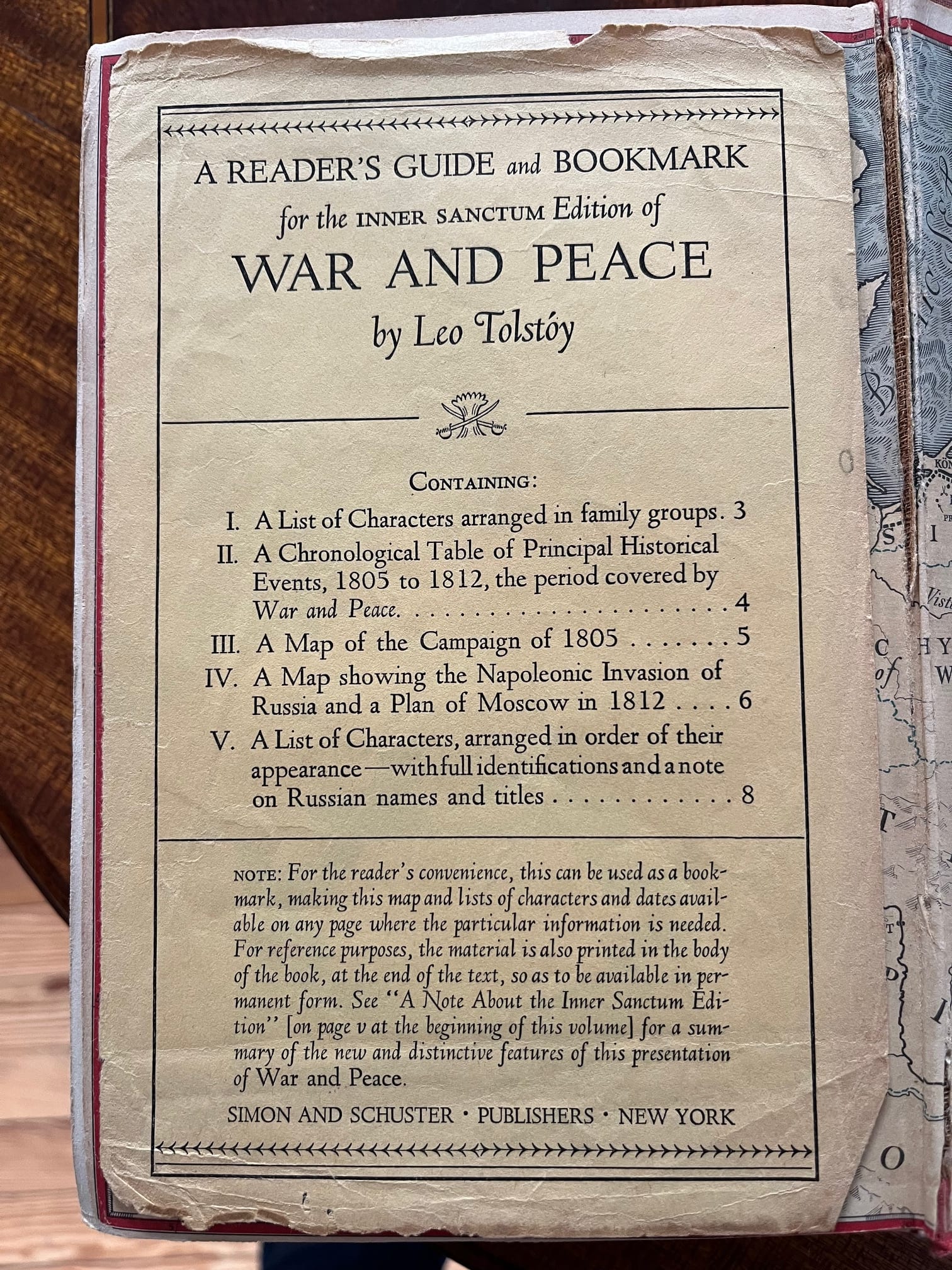
From the very first page I was elated, shocked, by just how good it was. It wasn’t difficult to follow; it was engaging, even a page-turner. Of course, I didn’t want to squander the opportunity, so I committed to reading it daily, using spare moments to review the characters and plot in my mind. I also relied on my grandmother’s “cheat sheet” - a wonderful insert from a 1942 Inner Sanctum edition that I had saved for just this purpose.
The cover page of the original insert and bookmark which sadly has lost the rest of its contents.
In the end, War and Peace shaped me in ways that went far beyond its symbolism as a vehicle for becoming the person I aspired to be. It also offered a profound perspective on how history unfolds. The mighty Napoleon Bonaparte, revered and feared as a man capable of changing the course of history, witnesses the brutal battles unfold below him, committed yet ultimately powerless before the countless individual actions that determine victory or defeat.
Tolstoy frames this question beautifully in the novel’s second epilogue:
Are figures like Napoleon the tugboat guiding the great ship of history, or merely a small boat trailing behind it?
How is the course of civilization truly charted?
Do individuals meaningfully navigate the vast momentum of culture, of war, and of peace?
It is a question I return to often, both when examining the past and when trying to make sense of our present.
2. The Anthropology of Childhood: Cherubs, Chattel Changelings by David F. Lancy
Childbirth was not easy. My daughter came into this world two months early, resulting in a month in the NICU for her and a week in the ICU for me. My first meeting with her included tubes, IVs, beeping monitors, and attentive nurses for us both. And while I am deeply grateful to modern medicine for keeping us alive, it was not what anyone would call a “natural” experience.
The aftermath of such a clinical beginning is complicated, nuanced, and rarely discussed. There is a traditional narrative of childbirth and childrearing and honestly, it can be difficult when your own experience does not align with the story we are so often told. I had no framework to make sense of our own journey, and felt quite lost because of it.
It was at this moment that The Anthropology of Childhood was instrumental for me, demonstrating that there is no real ‘normal’ when it comes to birth or raising children. Reading with an infant in arms, I was struck by the sheer diversity in experiences across the globe and throughout history. It helped me realize that what I had expected was not purely biological or instinctual, but, in many ways, cultural.
As such, I did not need to grieve the loss of experiencing a ‘traditional’ birth...Nor did I need to follow the model of any other tribe, nation, or ethnic group. I was free to write my own story for me and my daughter, to create our own traditions and culture, and to make sense of her entry in the world in our own way. This realization, so early on in motherhood, has shaped me profoundly.
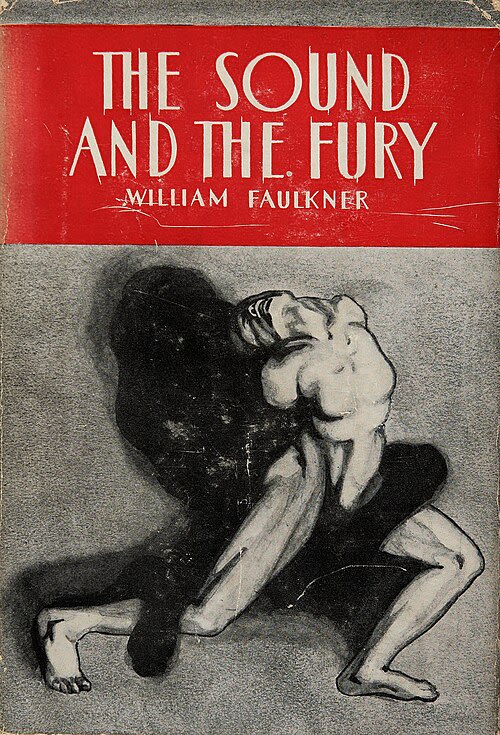
3. The Sound and The Fury by William Faulkner
Those of you who have had the pleasure of raising a small child may recall the effects of sleep deprivation. Your mind dissipates, your attention cracks and your reality fractures. It may last only a short while, if you are lucky, or stretch for many years if you happen to have the dubious honor of raising a poor sleeper. I fell into the latter category, an issue compounded by the fact that it was clearly a genetic trait inherited from... me.
So it was quite some time before I felt ready to read something... difficult. But when I finally did, I was overjoyed. It felt like I had my brain back, that I had returned to a sense of self so often questioned and tested in early parenthood.
This was a critical moment for me and the book was The Sound and the Fury.
William Faulkner’s famed work is unlike any other. Absolutely revolutionary in its time (and to this very day), it is divided into four equal sections, each offering a different perspective on the life and struggles of the Compson family in Mississippi.
The first section presents the reader with a genuine challenge: it is told through the lens of a cognitively disabled young man. The narrative is disorienting, shifting between past and present, blending memory with immediate experience. Written in a stream-of-consciousness style, it can be frankly difficult to follow, especially at the beginning.
While it may seem off-putting at first, it is, in truth, an exercise in intellectual humility. It is confusing, but you must continue, to sit within that disorienting reality and accept, like Socrates, that you do not know what is happening. For some, this is a difficult, even painful practice, but it is also essential. If we can not be comfortable in not knowing, we can not learn. This is true of any new book, journey, course, destination, or challenge: we must begin by acknowledging that we do not know.
What is wonderful about The Sound and The Fury is that your efforts and perseverance are rewarded. While the subsequent sections are similarly structured, each recounting a single day through the mind of a different narrator, every new perspective brings greater clarity. As the novel unfolds, the underlying reality gradually emerges, offering a deeply satisfying sense of recognition and understanding.
It feels fitting that my return to a more engaged intellectual life began with a lesson in not knowing.
4. Discourses by Epictetus
This was my most difficult selection, because I naturally wanted to choose an ancient text—but there are so many that have shaped me. Perhaps it should have been the Odyssey, which my mother read to me and my brothers when we were young... Or Antigone, the work that first drew me, independently, into the world of the Classics... Or even Plato’s Apology, on which I wrote my first paper while studying at St. John’s College...
All of these would have been strong choices (and perhaps they still are) but in the end, I felt that the person I am today has been most deeply shaped by Discourses, particularly by one line.
Those familiar with the Stoics, and with Epictetus, will not be surprised. This is a foundational text of Stoicism, emphasizing ethics, self-discipline, and rational judgment. While it offers a practical guide to resilience and inner freedom, there was one moment of encounter that I still remember vividly.
It happened one night about five years ago. As I’ve already revealed, I am prone to poor sleep and bouts of insomnia, and during one such period I found myself regularly awake at 4am. After abandoning my attempts to return to slumber, I began the habit of getting up to read and found Epictetus’ work to be the calming balm I so desperately needed.
It was in that quiet, still hour that I read:
“For what is the professed object of reasoning? To state the true, to eliminate the false, to suspend judgment in doubtful cases.” Book 1.7 - Epictetus Discourses
Regular readers or listeners may recall that I have quoted this line many times. To me, it beautifully captures an approach to understanding the world. Its simplicity is its strength, offering clarity where all too often obscurity reigns.
Bring the Classics into your life! Become a Classical Wisdom Member today:
What I value most is the reminder to suspend judgement. In our ready-fire-aim culture of opinions, reserving space for thoughtful consideration is as rare as it is essential.
This book set my own thoughts on a course of contemplation and perspective that I continue to follow today.
Side Note: I think it would be a good idea to start a 4am Philosophy Club...
5. Metamorphoses by Ovid
From a broader perspective, it is nice to include another ancient text, one dedicated to mythology and from a Roman author. There is a certain sense of balance in that selection... but that is not actually why I picked it. While I do appreciate symmetry, I took this exercise seriously and aimed to reflect the full scope of ‘me’, rather than simply assemble a top-five reading list.
I choose Metamorphoses because it is a book that is shaping the person I am working on, the one I wish to become. The title is truly felicitous.
Ovid’s work has inspired countless artists, poets, philosophers, and writers throughout the centuries.
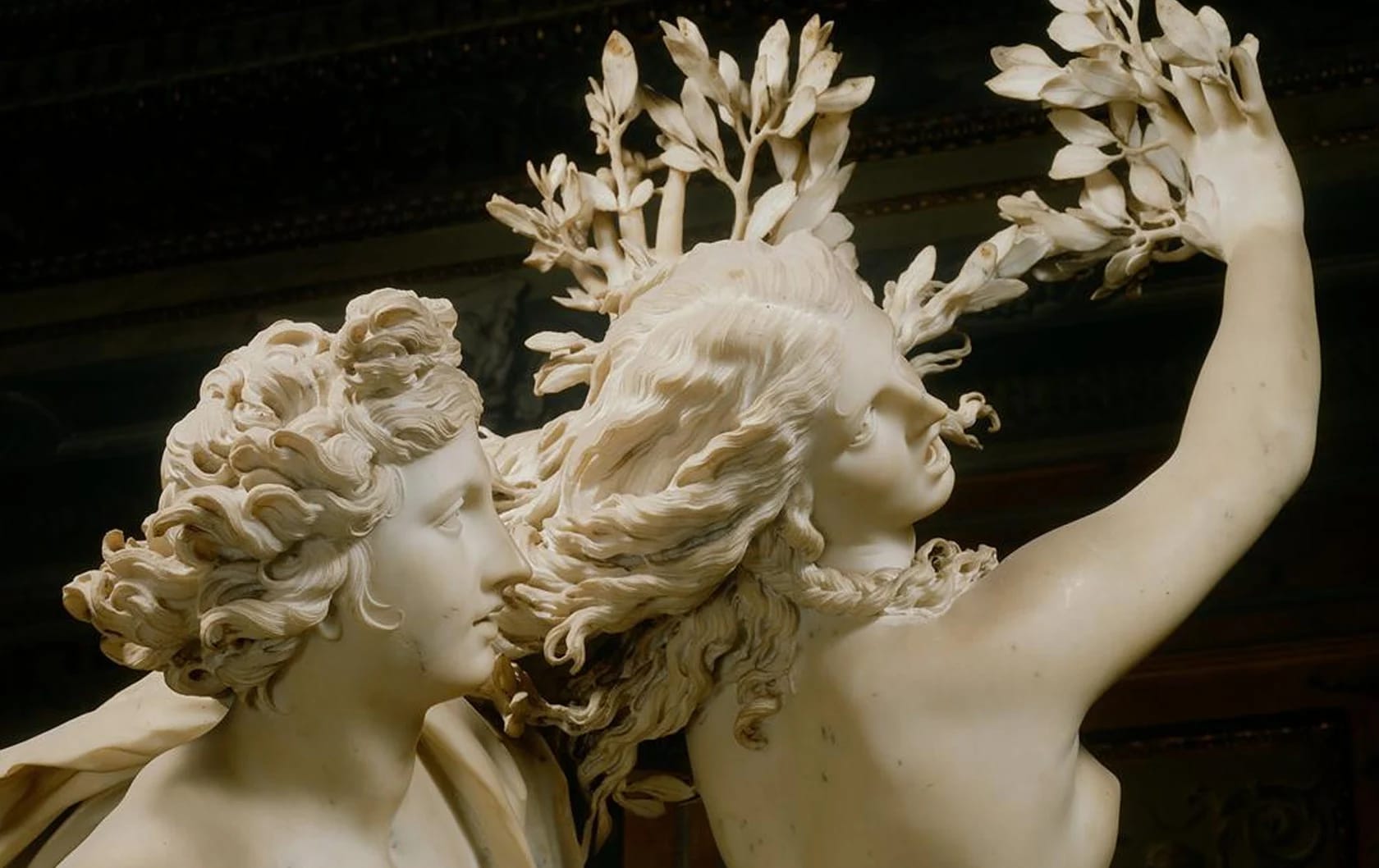
Of course, Ovid’s epic poem collecting over 250 myths centered on transformation is an immensely important text in the ancient world and onwards. It includes many of the most beloved stories, featuring figures such as Daphne, Narcissus, and Pygmalion. For millennia, it has inspired artists and authors, philosophers and psychologists, and not without reason.
It is also a major source of inspiration for me now. I’m embarking on a new project: writing a book of my own. I’m pairing ancient myths, many drawn from Ovid’s opus magnus, with ancient philosophies so that the story can help illuminate and make the ideas stick. Like Ovid, I hope to employ these powerful narratives to convey the great wisdom of some of the ancient world’s greatest philosophers.
I’m grateful and honored that St. Martin’s Essentials will publish Socrates and the Sphinx: Ancient Greek Myths that Make You Think in 2027. In the meantime, there is a lot of work to do, and I am fortunate to have Ovid, among many others, guiding me along the way.
Bonus: Night Drew Her Sable Cloak by Joel Bowman
Now, perhaps you think I’m cheating. After all, the task was to choose three to five books, and here I am trying to slip in a sixth. But please, a little sympathy, dear reader! It was simply too difficult, and I am only human!
And so, as a special bonus, I present Night Drew Her Sable Cloak. It weaves together three distinct narratives, three generations of heroines, from the Midwest to the Far East, spanning the breadth of the twentieth century. Interlaced throughout are the philosophical ideas explored in these pages, particularly those of the brilliantly enigmatic pre-Socratic philosopher Heraclitus.
This choice is, in truth, a deeply personal one. In the spirit of full transparency, the author who has crafted this stunningly beautiful work is my husband of twenty years. It is exquisitely written. Today, it might be categorized under the increasingly antiquated label of “literary fiction”... a term once synonymous with simply reallygood writing.
But it is more than that. This book occupies a category of its own, because in many ways, it is less about shaping me and more about reflecting me. It tenderly traces many of the twists and turns of my own life, including near death experiences, the very ones echoed in the books I’ve chosen above.
For that reason, it felt fitting for it to be both the final selection and the bonus. In a sense, it completes the picture and answers the question of which books have made me who I am.
***
And so, I turn once more to you, dear reader. If you are here, reading these reflections, I suspect that books matter deeply to you as well.
There are no doubt many that have impacted your life, redirected your own course, or offered comfort or perspective when you needed it most. Likewise, your many varied versions, your different sense of selves, have been cultivated by the words you encountered at distinct moments of your life. So I ask you:
What were they?
Which works have affected you most?
And which books, still waiting to be read, might shape who you are yet to become?
Please take part in our beautiful community and share your thoughts in the comments below. You never know who you might inspire...
Más info en https://ift.tt/GQHWALi / Tfno. & WA 607725547 Centro MENADEL (Frasco Martín) Psicología Clínica y Tradicional en Mijas. #Menadel #Psicología #Clínica #Tradicional #MijasPueblo
*No suscribimos necesariamente las opiniones o artículos aquí compartidos. No todo es lo que parece.
El Camino Directo, en esencia, es una invitación a percibir lo que ya es —aquí y ahora— sin esfuerzo, sin preparación y sin pertenecer a ninguna tradición espiritual. Apunta directamente al corazón de nuestra experiencia: que la presencia esencial e irreducible que podríamos llamar «consciencia» o «yo» es la esencia misma de toda experiencia. Esta consciencia no está oculta, ni pertenece a ninguna práctica o creencia en particular. Es lo que ve, conoce y es todo en este mismo momento. Esta consciencia es indivisible. No depende de condiciones, rituales o caminos para estar presente. De hecho...
Más info en https://ift.tt/GQHWALi / Tfno. & WA 607725547 Centro MENADEL (Frasco Martín) Psicología Clínica y Tradicional en Mijas. #Menadel #Psicología #Clínica #Tradicional #MijasPueblo
*No suscribimos necesariamente las opiniones o artículos aquí compartidos. No todo es lo que parece.
El Camino Directo, en esencia, es una invitación a percibir lo que ya es —aquí y ahora— sin esfuerzo, sin preparación y sin pertenecer a ninguna tradición espiritual. Apunta directamente al corazón de nuestra experiencia: que la presencia esencial e irreducible que podríamos llamar «consciencia» o «yo» es la esencia misma de toda experiencia. Esta consciencia no está oculta, ni pertenece a ninguna práctica o creencia en particular. Es lo que ve, conoce y es todo en este mismo momento. Esta consciencia es indivisible. No depende de condiciones, rituales o caminos para estar presente. De hecho...
Más info en https://ift.tt/GQHWALi / Tfno. & WA 607725547 Centro MENADEL (Frasco Martín) Psicología Clínica y Tradicional en Mijas. #Menadel #Psicología #Clínica #Tradicional #MijasPueblo
*No suscribimos necesariamente las opiniones o artículos aquí compartidos. No todo es lo que parece.
Spring mornings are quite special and soft. Light fills the room, the air feels fresh, and everything seems to begin again in a quiet, gentle way. This collection of calm classical music captures that peaceful start to the day.
Delicate melodies and balanced harmonies create a light and refreshing atmosphere, perfect for easing into your morning without rush. The music feels like open windows, soft sunlight, and the simple comfort of a new day.
Ideal for reading, studying, enjoying breakfast, or simply taking a moment for yourself before the day begins.
Let these melodies welcome the morning with calm, clarity, and a sense of renewal 🌿
𝐏𝐋𝐀𝐘𝐋𝐈𝐒𝐓
--------------------
00:00:00 Edvard Grieg - Peer Gynt Suite No. 1, Op. 46: I. Morning Mood
00:04:20 Nikolai Rimsky-Korsakov - Scheherazade, Op. 35: III. The Young Prince and The Young Princess
00:14:08 Edward Elgar - Serenade for String Orchestra, Op. 20: II. Larghetto
00:19:25 Sergei Rachmaninoff - Symphony No. 2, Op. 27: III. Adagio
00:32:16 Alexander Borodin - Prince Igor - Polovtsian Dances: I. Introduzione, Andantino
00:34:48 Maurice Ravel - Boléro, M. 81
00:50:40 Pyotr Ilyich Tchaikovsky - The Nutcracker, Op. 71, Act II, Scene 3: No. 13, Waltz of the Flowers
00:57:34 Nikolai Rimsky-Korsakov - String Quartet in F Major, Op. 12: II. Andante moderato
01:02:47 Sergei Prokofiev - Romeo and Juliet, Suite No. 1, Op. 64: III. Madrigal
01:08:37 Pyotr Ilyich Tchaikovsky - Serenade for Strings in C Major, Op. 48: III. Elegia. Larghetto elegiaco
01:16:41 Edvard Grieg - Piano Concerto in A Minor, Op. 16: II. Adagio
01:23:09 Johannes Brahms - Piano Concerto No. 2 in B-Flat Major, Op. 83: III. Andante
01:36:12 Ludwig van Beethoven - Piano Concerto No. 5, Op. 73: II. Adagio Un Poco Mosso (attacca)
01:43:22 Nikolai Rimsky-Korsakov - String Quartet in F Major, Op. 12: I. Moderato alla breve
01:51:40 Richard Wagner - Siegfried-Idyll, WWV 103
Performers
----------------------
(1) Academic Symphony Orchestra of the Saint Petersburg Philharmony
(2) Chamber Orchestra of the Saint Petersburg Conservatory
(3) Orchestra New Philharmony Saint Petersburg
(4) Rimsky-Korsakov Quartet
(5) Saint Petersburg Orchestra of the State Hermitage Museum Camerata
(6) Saint Petersburg Radio and TV Symphony Orchestra
(7) Tbilisi Symphony Orchestra
Please follow and subscribe to our channel. We appreciate your support.
🔔 Click the bell to stay updated on the great classical songs
🎧 Essential Classics is dedicated to sharing and promoting classical music. We strive to present the best classical music for you! Our hope is to make your days more beautiful and peaceful with classical music.
All audio and visual content on Essential Classics is created by Cugate AG a well-known music company. We have all legal rights of the audiovisual materials used in this video and our music is protected by copyright laws. If you have any questions regarding copyright or cooperation, please contact us.
Más info en https://ift.tt/FOu2bDY / Tfno. & WA 607725547 Centro MENADEL (Frasco Martín) Psicología Clínica y Tradicional en Mijas. #Menadel #Psicología #Clínica #Tradicional #MijasPueblo
*No suscribimos necesariamente las opiniones o artículos aquí compartidos. No todo es lo que parece.
You may be familiar with the beginning of this symphonic masterpiece, but can you recognize it by its ending? Here’s a hint: the musicians are the West-Eastern Divan Orchestra, conducted by Daniel Barenboim. But who composed the piece? And what is the title? You’ll find out the answer on Friday on this channel. Good luck!
Más info en https://ift.tt/FOu2bDY / Tfno. & WA 607725547 Centro MENADEL (Frasco Martín) Psicología Clínica y Tradicional en Mijas. #Menadel #Psicología #Clínica #Tradicional #MijasPueblo
*No suscribimos necesariamente las opiniones o artículos aquí compartidos. No todo es lo que parece.
En este nuevo encuentro de "Conversaciones en la niebla", nos sumergimos en una de las temáticas más complejas y dolorosas de nuestra sociedad actual: la anorexia. Sin embargo, fieles al espíritu de Plural 21, no nos quedamos en la superficie del síntoma alimenticio. Exploramos la anorexia como una forma de lenguaje no verbal; aquello que el individuo no osa decir con palabras, lo manifiesta a través de su propio cuerpo y su comportamiento.
A través de las ideas de pensadores como René Girard y la biología de Hamer, analizamos cómo las vivencias en la etapa preverbal (aquella donde sentimos pero no tenemos aún criterios ni argumentos para defendernos) dejan huellas que se manifiestan años después. ¿Es la anorexia una estrategia de "perfeccionismo" para sobrevivir en un entorno familiar o social hostil?
Temas destacados en esta charla:
- La sumisión como claudicación: Cómo la falta de autonomía emocional nos lleva a somatizar conflictos de rabia y rencor en el seno familiar.
- Modelos Miméticos: El análisis de figuras históricas como Sissi Emperatriz y Romy Schneider, y cómo el "furor por la delgadez" se convierte en una anorexia verbal de negarse a recibir lo bueno de la vida.
- Control Social e Identidad: Reflexionamos sobre cómo se construye una sociedad sumisa e hipocondríaca. El miedo y la cobardía, trabajados sistemáticamente, eclosionaron en 2020, transformando etiquetas médicas en cárceles de identidad.
El camino hacia la sanación pasa por transitar de lo preverbal a lo argumental. Recuperar nuestra capacidad de defender nuestro territorio y nuestra existencia a través de la palabra y la Verdad, alejándonos de las modas e ideologías impuestas.
Si buscas comprender el origen profundo de los trastornos de identidad y cómo recuperar tu libertad soberana, este vídeo es para ti.
¡Suscríbete a Plural 21 y apoya nuestra labor por la Vida y la Verdad!Visítanos en: www.plural-21.org
00:00:00 Introducción: René Girard y la anorexia como síntoma.
00:03:15 La etapa preverbal: El cuerpo habla cuando falta la palabra.
00:07:20 El perfeccionismo como mecanismo de defensa ante entornos crueles.
00:14:05 Sissi y Romy Schneider: El espejo del deseo mimético.
00:28:10 Rebeldía vs. Sumisión: La claudicación del ser.
00:45:30 El peligro de las etiquetas y los diagnósticos médicos.
01:10:20 De la sumisión personal a la sumisión social: Lecciones de 2020.
01:17:15 La sociedad hipocondríaca: El miedo como herramienta de control.
01:24:00 Recuperar el deseo verdadero: De lo preverbal al argumento vital.
01:28:10 Conclusiones y cierre.
Grabado el 2 de febrero del 2026
Recuerda que te puedes hacer socio de Plural 21 en https://plural-21.org/alta-nuevos-socios
Si quieres hacer alguna aportación a Plural 21 ahora puedes hacerlo a través de diferentes sistemas:
- BIZUM. En la opción "Donación a una ONG" utiliza el código: 07672
- A través de Youtube podéis: utilizar la herramienta "Gracias/Thanks" de Youtube
- a la vieja usanza: podéis hacer una transferencia a Plural-21 Caixa d’Enginyers cuenta nº ES55 3025 0004 3514 3326 6836
Más info en https://ift.tt/FOu2bDY / Tfno. & WA 607725547 Centro MENADEL (Frasco Martín) Psicología Clínica y Tradicional en Mijas. #Menadel #Psicología #Clínica #Tradicional #MijasPueblo
*No suscribimos necesariamente las opiniones o artículos aquí compartidos. No todo es lo que parece.
Whether it’s brother against brother, or teacher against student…
The ancient world can be an extremely competitive place.
And, well, so can the Weekly Wisdom Quiz!
Before we get into it though, just a quick reminder that our popular video course The Essential Greeks is enrolling now.
Through a combination of videos, live webinars, quizzes and more, we’ll be taking an in-depth look at some of the world’s greatest ever writers and thinkers.
Including the likes of Socrates, Homer, Plato, Aristotle, Sophocles and more besides…
So this is your chance to cut out the noise and truly deepen your knowledge of the Classics and the ancient world.
**This course is suitable for both newcomers AND long-standing fans of the Classics.**
Sign up today and you’ll get 10% off the full price.
Class starts May 5th. So don’t miss out: enroll now!
Now, as always, all questions in the Weekly Wisdom Quiz are based on articles and resources published this week here at Classical Wisdom.
A full round up of them all is available just after the quiz, along with the answers.
Are you ready?
1. Which Roman god was said to be the father of Romulus and Remus?
A. Jupiter
B. Neptune
C. Pluto
D. Mars
2. The ancient Greek statesman Demosthenes was best known for his...
A. Military victories
B. Eloquent and persuasive speeches
C. Philosophical writings
D. Opposition to Athenian democracy
3. The Pantheon was initially commissioned during the rule of which Roman emperor?
A. Augustus
B. Caligula
C. Vespasian
D. Hadrian
4. Who won the Battle of Chaeronea?
A. Macedonians under Philip II
B. Macedonians under Alexander the Great
C. Athens under Demosthenes
D. Romans under Augustus
5. Aristotle’sPoeticswas in part written to respond to Plato’s writings on poetry in which of his dialogues?
A. Crito
B. The Republic
C. Phaedo
D. Symposium
6. Which Roman historian wrote that Romulus mourned his brother and gave him an honorable burial?
A. Livy
B. Tacitus
C. Cassius Dio
D. Suetonius
7. How did Demosthenes die?
A. Executed by Philip II’s forces
B. On a battlefield from his wounds
C. From a long-term illness
D. Poisoned himself rather than be taken prisoner
8. Which philosopher wrote: “Learning things gives great pleasure not only to philosophers but also in the same way to all other men”?
A. Plato
B. Marcus Aurelius
C. Aristotle
D. Epictetus
B) Eloquent and persuasive speeches(Democracy’s Last Defender)
A) Augustus (The Secret of the Roman Pantheon)
A) Macedonians under Philip II(Democracy’s Last Defender)
B)The Republic (Can Poetry ‘Fix’ Us?)
A) Livy(Happy Birthday Rome!)
D) Poisoned himself rather than be taken prisoner(Democracy’s Last Defender)
C) Aristotle(Can Poetry ‘Fix’ Us?)
🏛️ The Wisdom Scale:
🧠 0-2 correct: Novice Philosopher – The journey of wisdom begins with a single step. Keep reading!
📜 3-4 correct: Aspiring Sophos – You’re on your way! More scrolls and symposiums await you.
🏛 5-6 correct: Agora Adept – Your grasp of ancient wisdom is growing. The ancients would nod in approval.
⚡7-8 correct: Master of the Classics – You are a true sage! The spirits of Plato and Aristotle smile upon you.
So, how did it go? As always, let us know in the comments below!
Más info en https://ift.tt/FOu2bDY / Tfno. & WA 607725547 Centro MENADEL (Frasco Martín) Psicología Clínica y Tradicional en Mijas. #Menadel #Psicología #Clínica #Tradicional #MijasPueblo
*No suscribimos necesariamente las opiniones o artículos aquí compartidos. No todo es lo que parece.