
On the first night he practiced the dhikr, flames rose from his chest to heaven.
Watch the video here:
Ala al-Dawla Simnani (1261–1336) was a companion of the Ilkhanid emperor Arghun — a man of court, of administration, of proximity to power in the empire that had replaced the Abbasid caliphate across the eastern Islamic world. In 1284, on a military campaign, something interrupted the ordinary course of his life. He records the experience without dramatic elaboration: a state descended. The life he had been living became impossible to continue. He sought out a Sufi master in Baghdad, a disciple of the Kubrawiyya lineage, who taught him the dhikr practice of the order. The first night he performed it, flames rose from his chest to heaven.
He put on the Sufi robe the next morning and began what would become, over the following fifty years, one of the most systematically documented inner lives in the tradition. The hagiographic sources report that he completed well over a hundred forty-day retreats across different khanaqahs — a number that, even if devotionally amplified in the telling, conveys something true about the nature of his practice. The forty-day retreat, the arba’in, carries its own weight in the tradition: Moses’s forty nights on the mountain before receiving the Torah, the hadith that forty days of sincere devotion cause wisdom to flow from the heart to the tongue, the Kubrawiyya’s formalization of this period as the minimum unit of serious interior work. For Simnani the khalwa was not occasional. It was the method. What he produced — the Risala-yi Nuriyya, the detailed color-diagnostics, the Latayif system itself — reads as accumulated observational data from decade after decade of darkness, breath, and watching what arose.
The Lineage of Light
The color-vision system Simnani developed did not originate with him. It belongs to the Kubrawiyya order, named after Najm al-Din Kubra (d. 1221) of Khwarezm, who died defending his city against the Mongols and who was known as wali tarash — the manufacturer of saints. Kubra’s primary work, Fawa’ih al-Jamal wa Fawatih al-Jalal (The Fragrances of Beauty and the Prefaces of Majesty), contains one of the earliest phenomenologies of inner light in any mystical tradition.
Kubra describes a sequence: lightning flashes appear first, brief and scattered; then something like stars distributed through the inner sky; then a steadier moonlike radiance; then what functions like an interior sun; and beyond that, at the apex of the progression, a black light — a darkness he identifies not as the absence of illumination but as its excess, as something that produces darkness in the viewer the way the sun produces darkness when you try to look directly at it. The faculty that would perceive it is overwhelmed by it. Black light is what the visionary capacity encounters when it reaches the edge of what forms can contain.
Kubra’s student Najm al-Din Razi continued the system in the Mirsad al-’Ibad (The Path of God’s Servants). Razi formalized the color progression and placed the black light above the white of purification — not as an endpoint of negation but as a threshold beyond which color-language no longer applies. The working principle across early Kubrawiyya texts is consistent: darker, more opaque colors indicate a soul still weighted by its lower nature; lighter, more transparent colors indicate purification in progress; white marks near-completion; the black light beyond it marks the approach to something the created faculties cannot receive as an image.
Simnani inherited this from his teacher, who stood three generations from Kubra, and transformed it. Where his predecessors mapped colors to stages of spiritual development in general terms, Simnani assigned each color to a specific subtle organ, and each organ to a specific prophet. The ladder became anatomical. The colors became localizable — not states that move through the whole person but events that occur at identifiable points within the body.
He also produced a complete Quran commentary in this lineage — the Ta’wilat al-Najmiyya — which Kubra had begun and Razi had continued. Simnani completed it. The three generations of the Kubrawiyya producing a single Quran commentary across a century is itself an index of what the order understood its work to be: not the exposition of ideas but the transmission of a way of reading.
The Seven Prophets of the Body
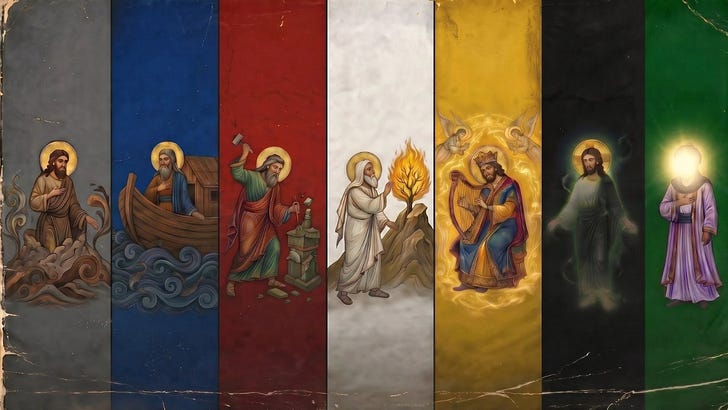
The Latayif are not arranged arbitrarily. They move from the body’s outermost surface to its innermost ground, and the prophets assigned to each center represent not symbols but operational modes — the specific function the center performs in the soul’s passage from density to transparency.
Qalabiya — Adam — matte black. The skin, the physical frame, the bare fact of being present in a body in the world. Adam came before any specific revelation and received only the raw condition of embodied existence. The matte black here is not the luminous black of the sixth center — it is the darkness before anything has risen. Simnani notes that a blockage here produces what he calls neglect of the world: the wayfarer becomes so absorbed in interior states that the conditions of ordinary life, the obligations owed to the creation, are abandoned. The body must be inhabited before it can be worked through.
Nafsiya — Noah — blue. The flesh itself, the tissue of appetite and ego-force. Noah’s function is navigation: the ark contained a flood without being destroyed by it. Simnani reads this as the precise function of this center — not the suppression of the passions but their containment, their redirection into something that can survive the inner weather and bring it somewhere. The blue in early Kubrawiyya texts marks the lower soul, the region still dominated by its own density.
Qalbiya — Abraham — red. Simnani writes in the Al-Urwa: “the light of the heart rises and its veil is red agate. Seeing that light, a great taste reaches the heart of the seeker and causes him to persevere in his behavior.” The veins, the blood, the heart’s own circulation. Abraham’s willingness to sacrifice is the mode here — the heart’s readiness to submit what it most wants to something beyond its own desire. The taste Simnani mentions is specific: a physical sensation of pleasure in the practice that sustains the wayfarer when intellectual conviction alone would not be sufficient. The red agate is not static. As the submission deepens, the color clears.
Sirriya — Moses — white. The innermost chamber of the heart — the part that cannot receive its knowledge through ordinary transmission, that cannot be reached by reasoning or inherited from a chain of narration. It receives through direct address, as Moses received on the mountain, in the conversation that had no other witnesses. Simnani notes that from this center “the green light emits and its shade is white” — the white of something cleared sufficiently to receive revelation directly rather than as a report of what others received.
Ruhiya — David — yellow. The spirit distributed through the whole body — not localized but permeating, present everywhere without a fixed seat. David’s mode is joy: the Psalms, the harp, the creature’s pleasure in its relationship with the Real. When this center opens, Simnani describes a physical sensation of warmth and expansion filling the chest — the body no longer resisting the practice but resonating with it. The yellow in Kubrawiyya color-grammar marks the higher registers of the spirit, a warmth that has moved past the heat of struggle.
Khafiya — Jesus — shiny black. The hidden within the hidden, the layer of the subtle body with no correspondence in ordinary religious instruction. Jesus ascending, dissolving into the divine depth before the apparent return. The shiny black is not the matte black of the first center. This is black because its light is too dense for ordinary vision to register — a darkness of excess rather than of absence. Simnani’s identification of this center with Jesus is deliberate: the ascension represents precisely the dissolution of the soul’s visible form into something that cannot be seen from outside.
Haqqiya — Muhammad — emerald green. The Reality itself — the seal of the prophets and the seal of the subtle body. The one in whom all previous prophets are contained, the end of the line that is also its origin. Simnani’s words for this color: “its greenness is a sign of the life of the tree of existence.” Not a metaphor but a physical description. The emerald green that floods the inner field when this center opens is the same green that vegetation borrows from the unseen. The beginning beyond endings: the soul is not merely reunited with the Real but recognized as what it was before the journey started.
The diagnostic logic is sequential and cumulative. If a single center becomes dominant while others remain dormant, specific spiritual pathologies result. The wayfarer in whom the Jesus center overdevelops while the Adam center remains blocked will have genuine ecstatic experiences and will neglect the world — the dissolution is real, the grounding is absent. Conversely, someone rooted only in the Adam center, dutiful and worldly, will have stability and no inner life. The ladder cannot be climbed by skipping rungs, and it cannot be worked from the top down.
The Sawing Breath
The method Simnani prescribes for activating the Latayif is a specific breathing practice he calls the Arra-yi Dhikr — the Sawing of the Breath. The instruction survives in his own words:
“The ideal formula for recollection is the credal statement: There is no god but God. This formula should be uttered in four beats: with all his strength, the mystic should exhale the ‘la’ from above the navel; he should then inhale the ‘ilaha’ to the right side of the breast; then exhale the ‘illa’ from the right side to the left; and then inhale the ‘Allah’ to the physical heart, which is on the left side of the breast.”
Four beats, four anatomical locations, traversing the torso in a circuit. The La — the negation — drawn upward from the navel with force, the exhalation carrying the denial of everything that is not God up through the body’s center. The Ilaha inhaled to the right breast. The Illa carried across. The Allah driven into the physical heart on the left. Then again.
The name — sawing — is accurate to the physical sensation of the practice. It is not gentle meditative breathing. The friction it generates produces what Simnani calls Hararat-e-Gharizi — Innate Heat — which he treats as the mechanism of the method rather than a side effect. He describes the ego-soul as a dense, cold substance. The breath-sawing thins this density through friction, changing the interior conditions until the Latayif, which are present throughout but occluded, become accessible to perception.
His diagnostics are specific and practical: cold heaviness in the limbs means the rhythm is too slow — the friction is insufficient to generate and sustain the heat. Scattered thoughts and lightheadedness mean the heat has become Hararat-e-Gharibeh — alien heat, displaced from the body’s center and rising too high. The correct rhythm is the one that generates sustained warmth in the chest without displacement upward or dissipation outward.
The Risala-yi Nuriyya
The Risala-yi Nuriyya — the Treatise on Lights — was written at the request of one of Simnani’s students to document the visions that arise during dhikr practice. It is not a theoretical text but a clinical one.
The detail that distinguishes it from other visionary literature is this: Simnani treats the lights and colors that appear in the inner field as markers of both spiritual states and spiritual illnesses. The distinction is his. Not every light indicates advancement. Some indicate blockage. Some indicate that the heat has become alien, that the soul has moved into fantasy rather than perception, that what appears to be vision is delusion produced by the same darkness the practice is designed to illuminate.
The treatise catalogs specific phenomena: sparks, smoke, the sensation of levitation, visions of buildings and animals. Simnani is systematizing an empirical body of data — his own practice over decades and the accounts of students who came to him describing their experiences. The function of the master in this system is partly that of a physician: the student reports the visions, and the master reads them diagnostically, locating the wayfarer on the ladder and prescribing the adjustment.
This is why the color distinctions matter at the level of precision Simnani insists on. Matte black and shiny black are not variations of the same phenomenon — they describe entirely different conditions of the inner field, one at the beginning of the journey and one at its most advanced approach. A muddy red in the third center indicates something different from a clear red. The Risala-yi Nuriyya is, among other things, a differential diagnosis.
The Mustard Seed
At the center of Simnani’s technical system is the Nuqta — the Point. He locates it within the physical heart at the size of a mustard seed. It is where the Qalb-e-Haqiqi — the real heart — is anchored inside the Qalb-e-Sanobari — the pine-cone-shaped physical heart that beats in the chest. One nested inside the other. The Nuqta is the place where they share the same location.
The practice instruction is minimal and exact: focus attention there until a needle-prick of light appears. Stay in it. Do not analyze it. If attention wanders and the sensation fades, the alignment is lost. Begin again.
What the Nuqta produces is a collapse of scattered attention into a single location. The ordinary mind distributes itself across a wide field of concerns simultaneously. The Nuqta practice draws this distribution to a point. When the concentration holds at that point, Simnani describes an aperture opening — the colors of the Latayif begin to rise in the inner field as the point of focus becomes a point of access.
The mustard seed is the smallest locatable thing — the minimum unit of focus. The work is not about expanding consciousness into a vast interior space. It is about contraction to a point fine enough to fit through a door that has no other key. The largeness, when it comes, comes from the inside of the point rather than from any widening of attention.
The Black Light
The most contested element of Simnani’s system is his interpretation of Nur-e-Siyah — the Black Light — at the sixth center.
Kubra and Razi had placed a transcendent darkness at the apex of the color sequence: the soul’s approach to something that cannot be represented by any created form. In this reading, black light is the absence of image rather than the absence of light — the threshold where the visionary faculties stop being useful.
Ayn al-Quzat al-Hamadani, a century before Simnani, had associated black light with the satanic principle — darkness as privation, the furthest point from divine illumination, the lower pole of the spectrum rather than the upper. His reading places the black at the bottom as a warning, not at the top as a destination.
Simnani reverses the Ayn al-Quzat reading entirely and deepens the Kubrawiyya one. He identifies Nur-e-Siyah as Nur-e-Dhat — the Light of the Essence. It appears black not because it is the absence of light but because it is light at an intensity the soul cannot receive as light. The faculty that would perceive it is overwhelmed by it. The soul standing before the black light is like someone trying to look at the sun: the blackness is the eye’s response to excess, not to absence.
To pass through it, the soul must stop trying to see it from outside. The perceptual structure that maintains the distance between observer and observed — the structure that makes vision possible in the ordinary sense — must dissolve. The soul does not approach the black light. It becomes it, until what rises from within is the emerald green of the seventh center. The transition from the sixth to the seventh is not arrival at a destination. It is the soul discovering that the ground it has been standing on was always already what it was seeking.
The Dispute with Ibn Arabi’s School
Simnani’s entire system rests on a specific metaphysical commitment, and he was willing to defend it against the most formidable opposing school of his time.
Ibn Arabi (d. 1240) had died twenty years before Simnani was born, but his legacy was alive and contested throughout Simnani’s career. The central question was wahdat al-wujud — the unity of being: the position, associated with Ibn Arabi’s followers, that God is the only existence and the created world is a manifestation of it, such that the mystic who reaches the highest stations perceives everything as God. The formula was hama ust — everything is He.
Simnani engaged this directly. Through a student, Iqbal-i Sistani, who met the leading Ibn Arabi commentator Abd al-Razzaq al-Qashani at Sultaniyya, a correspondence was initiated. When Qashani asked what Simnani thought of Ibn Arabi’s doctrine, the student replied that Simnani respected Ibn Arabi greatly but believed he was wrong about God as absolute existence. Qashani responded that this very doctrine was the basic principle of all mystical insight, and that it was strange for Simnani to disapprove of what all prophets and men of God had followed.
When this was reported to him, Simnani wrote his reply: “No one in any group or sect has ever expressed himself with such shamelessness. And if you look into the matter closely, you will find that the teachings of the naturalists and materialists are far better.”
The exchange continued through letters. Simnani’s counter-position was precise: wahdat al-wujud — everything is He — represents a real mystical experience but an early one, a station the soul passes through rather than the final destination. The highest stage is not the perception of identity between God and creation but the recognition of a specific relationship: hama az ust — everything is FROM Him. Not identical with God but proceeding from God, sustained by God, oriented toward God — distinct without being separate, created without being abandoned.
This is not a merely philosophical dispute. It is enacted in the Latayif system itself. Each center has its own specific prophetic mode, its own color, its own anatomical location. The God illuminating the seventh center is emerald green — a specific, particular color, not colorlessness. The destination of the ladder is not the disappearance of the soul into undifferentiated divine existence but the soul’s recognition of what it specifically, individually, is: a particular locus of theophany with a particular configuration, unrepeatable, fully inhabited.
The Retreat
Simnani’s 270 forty-day retreats were not preparation for the life of a mystic. They were the life. The Khilwa was his primary method of investigation, repeated over decades, producing the data on which the Risala-yi Nuriyya and the Latayif system are based.
His rules for the retreat are straightforward: complete darkness, silence, stillness, and the unbroken rhythm of the Arra-yi Dhikr. The logic is that the inner senses are ordinarily overwhelmed by external input. Eliminate the input entirely, and what has always been present in the inner field becomes perceptible.
Without the breath-work, he insists, the darkness produces delusions rather than visions. The retreat without the dhikr is isolation. The Arra-yi Dhikr provides the anchor — a sustained generation of innate heat that keeps the wayfarer oriented inside the sensory void. The distinction between vision and delusion in the retreat is not the content of what appears but the presence or absence of the heat. Demonic visions are cold. The colors of the Latayif arise warm.
The instruction throughout the retreat is not to analyze what arises but to remain in it. When a color floods the inner field, stay in it until it fills the vision completely. The movement to observation — the step back to watch the experience as an object — arrests the process. It re-establishes the observer-observed distance that the retreat is designed to dissolve. Simnani is clear about this because it is the most common way the practice fails: the wayfarer begins to watch the experience rather than inhabit it, and the color retreats behind the watching.
What Simnani Built
The system Simnani formalized — seven subtle centers, seven prophets, seven colors, the Arra-yi Dhikr, the Nuqta, the Risala-yi Nuriyya as clinical documentation — became one of the most widely transmitted frameworks in later Sufism. It passed into the Naqshbandi tradition through Ahmad Sirhindi, who condensed the seven centers to five while preserving the diagnostic logic; through Ali Hamadani, who brought Kubrawiyya teachings to Kashmir and seeded the Islamization of an entire region; through the generations of masters who carried the Risala-yi Nuriyya as a practical manual.
What Simnani added to the Kubrawiyya tradition was specificity: the mapping of general color-visions to precise locations, the identification of each location with a prophetic mode, the diagnostic distinction between states and illnesses, and the metaphysical insistence that the soul arriving at the seventh center does not dissolve into undifferentiated being but finds itself illuminated as a particular, distinct locus — a theophany with a specific face.
The dispute with Qashani over hama ust versus hama az ust is not a detour from the Latayif system. It is its philosophical ground. If everything is He, the body is ultimately an illusion to be seen through. If everything is FROM Him, the body is the vehicle of something that can never be replicated — a specific configuration of the seven prophets, in a specific person, living one specific life.
The ladder exists because each rung is real and different from the others. The emerald green of the seventh center would not be what it is if the matte black of the first were not also real.
“The wayfarer must become a blacksmith, and the heart a furnace.”
James Fleming, writing for Spiritualrelief, thank you and welcome 💚
Primary sources: Simnani’s Al-Urwa li-ahl al-Khalwa wa al-Jalwa, ed. Najib Mayil Hirawi (Tehran: Mawla, 1983); Chehel Majlis (Forty Sessions); Risala-yi Nuriyya (analyzed in Jamal Elias, “A Kubrawi Treatise on Mystical Visions,” The Muslim World 83, no.1, 1993, pp. 68–80). The Simnani-Qashani correspondence is preserved in Jami’s Nafahat al-Uns and discussed in the Wikipedia article on Wahdat al-Wujud (citing Landolt). Secondary sources: Jamal Elias, The Throne Carrier of God (SUNY Press, 1995); Henry Corbin, The Man of Light in Iranian Sufism (Shambhala, 1978); Annemarie Schimmel, Mystical Dimensions of Islam (UNC Press, 1975). Kubra’s color sequence is in the Fawa’ih al-Jamal, ed. Fritz Meier (Wiesbaden, 1957). The Encyclopaedia Iranica entry on Simnani (H. Landolt) is the authoritative biographical source.
Más info en https://ift.tt/bvPN9yG / Tfno. & WA 607725547 Centro MENADEL (Frasco Martín) Psicología Clínica y Tradicional en Mijas. #Menadel #Psicología #Clínica #Tradicional #MijasPueblo
*No suscribimos necesariamente las opiniones o artículos aquí compartidos. No todo es lo que parece.

No hay comentarios:
Publicar un comentario