
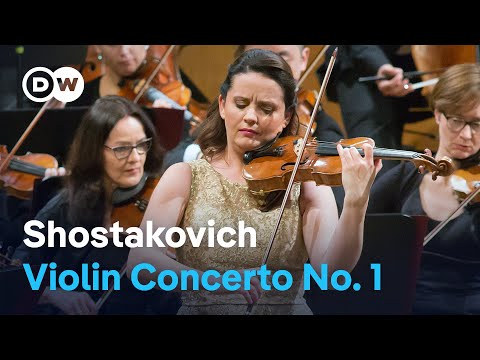
From the very first notes of Dmitri Shostakovich's Violin Concerto No. 1 in A minor, Op. 77, it's clear that this work does not tell a story of peace, but rather about threat and grief. In this recording, the violin concerto features Baiba Skride as soloist and the Gewandhaus Orchestra under the baton of Andris Nelsons. The concert took place on May 17, 2019, in Leipzig's Gewandhaus.
I. Nocturne: Moderato
II. Scherzo: Allegro
III. Passacaglia: Andante – Cadenza
IV. Burlesque: Allegro con brio – Presto
The Violin Concerto No. 1 in A minor, Op. 77 was composed during one of the most difficult and darkest periods in the Russian composer's life. Shostakovich began work on it in July 1947 and continued in 1948, while experiencing a second wave of persecution. At the behest of the Central Committee of the Communist Party of the Soviet Union, the newspaper Pravda published a devastating article accusing Shostakovich — along with other composers — of being "too formalistic" and writing music that the public could not connect to. The condemnation came after a scathing review of his opera Lady Macbeth in 1936 which had left him humiliated. As a result, Shostakovich was loathe to show the score of this violin concerto to anyone other than a few friends, one of whom was the famous Russian violinist David Oistrakh.
It was only after the death of dictator Joseph Stalin and with the onset of the so-called Khrushchev thaw period in the Soviet Union that Shostakovich presented his Violin Concerto No. 1 to the world. It premiered on October 29, 1955, under the baton of Yevgeny Mravinsky at the Leningrad Philharmonic, and the concert was a triumph. The soloist was the famous Russian violinist David Oistrakh, to whom the work is also dedicated.
In terms of seriousness, expressiveness and concentration, the concerto can easily compete with any of Shostakovich's symphonies. It is also often referred to as a "concert symphony" or "symphony for violin and orchestra." In contrast to the symphonies, however, the same suffering hero, embodied by the solo violin, is present in all four movements (Nocturne, Scherzo, Passacaglia and Burlesque).
According to Oistrakh, Shostakovich gave the violin a "very masculine character." Perhaps a self-portrait in the form of a violin concerto? That may well be the case, according to numerous Shostakovich researchers. Regardless, one of the main ideas of the concerto is that one can overcome difficult circumstances and strokes of fate. It is no coincidence that Shostakovich took inspiration from Bach's music in the Passacaglia, which represented the pinnacle of spiritual meaning for him. Bach was one of the composer's idols.
The concerto exists in two versions — the original from 1948 and the 1955 version, which differs from the first in that it has a slightly altered instrumentation in the finale. Baiba Skride, the Gewandhaus Orchestra and Andris Nelsons perform the 1948 version here.
Andris Nelsons is a Shostakovich fan and connoisseur: "For me, he is one of the greats — alongside Strauss, Mahler and Beethoven," said Nelson in an interview with DW in May 2025. "Not a single note is superfluous, not a single note is boring. His music touches you immediately. And it is so human!"
© 2019 Accentus Music
Find more information on Dmitri Shostakovich here: https://www.dw.com/de/schostakowitsch-50-jahre-todestag-komponist-russland/a-73274472
Watch more great concerts here: https://www.youtube.com/playlist?list=PL_SdnzPd3eBV5A14dyRWy1KSkwcG8LEey
And find more violin music in this playlist: https://www.youtube.com/playlist?list=PL_SdnzPd3eBWJ5t7LxFkBRlcTu4qHdo67
Subscribe to DW Classical Music:
https://www.youtube.com/dwclassicalmusic
#shostakovich #violinconcerto #violinmusic
Más info en https://ift.tt/B249MgA / Tfno. & WA 607725547 Centro MENADEL (Frasco Martín) Psicología Clínica y Tradicional en Mijas. #Menadel #Psicología #Clínica #Tradicional #MijasPueblo
*No suscribimos necesariamente las opiniones o artículos aquí compartidos. No todo es lo que parece.

No hay comentarios:
Publicar un comentario