
Dear Classical Wisdom Reader,
It’s one of ancient Greece’s greatest legacies.
The statues of ancient Greece loom large in how we think about antiquity. You look at a history book about the ancient world and it’s very often a statue on the front cover!
So today we’re taking a look at the life and work of one of ancient Greece’s most celebrated sculptors, Pheidias. To say his work was considered important is a massive understatement; his enormous statue of Zeus at Olympia is considered one of the seven wonders of the ancient world!
His life was also touched by scandal as well. His association with the famed Athenian statesman Pericles brought him his share of enemies, leading to a dramatic downfall.
Yet his reputation as an artist remains beyond reproach. While many of his works have been lost over the centuries, some survive on indirectly, through copies by other sculptors.
In a strange way, its as if his work has achieved a legitimate immortality. It’s living on, even after being destroyed. You can read all about it just below.
A few weeks back I quoted Herman Hesse’s novel Narcissus and Goldmund in these pages. A significant part of the novel deals with the creation of sculptures so I thought it was fitting to share another quote, this time about a wandering sculptor being moved by the austere statues in an abandoned church…
“Strict and deaf they stood there in their narrow niches, inaccessible to any request or question. And yet they were an infinite consolation, a triumphant victory over death and despair as they stood in their dignity and beauty, surviving one dying generation after another.”
All the best,
Sean Kelly
Managing Editor
Classical Wisdom
Never miss a post! Become a Member and keep up to date on all of our articles, webinars, events and more!
Ancient Greece’s Master Sculptor
By Jocelyn Hitchcock
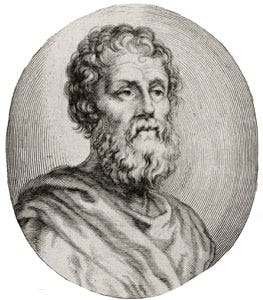
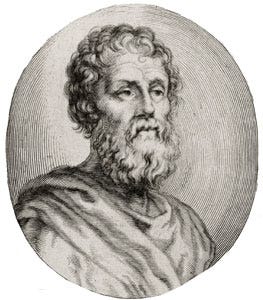
Considered one of the greatest sculptors of all time, and producing pieces that are considered masterpieces even today, Phidias’ (or Pheidias) work continues to tantalize our imaginations. Due to the fact that we can only reconstruct some of his works from copies and descriptions, we can truly only imagine the immense impression that his art must have created for the ancient audience. Outlining the life of Phidias proves to be quite entertaining, peppered with a rise to fame, favoritism, scandal, bribery, and even exile.
Pheidias’ Early Life
As with most historical figures in antiquity, exact dates are unknown. However, Phidias is expected to have been born around 490 BCE in Athens. He was the son of Charmides and was trained by other Athenian sculptors. Probable teachers in his early life were Hegias of Athens and Ageladas of Argos. Ageldas, or Hageladas, is suspected to be the reason behind the Dorian style exhibited in some of Pheidias’ work.
Pheidias’ Career and Prominence
In contrast to the scarcity of information detailing Pheidias’ life, we know a great deal about his career and his works. Around 449 BCE, Pheidias was placed in charge of a large building program that was initiated by the Athenian statesman Pericles. This was after the Persian Wars had swept through Greece but preceding the Peloponnesian Wars in the later half of the 5th century. As a part of this mega building project in Athens, Pheidias’ was commissioned for three different works on the Parthenon: the Athena Promachos, the Lemnian Athena, and the Athena Parthenos.
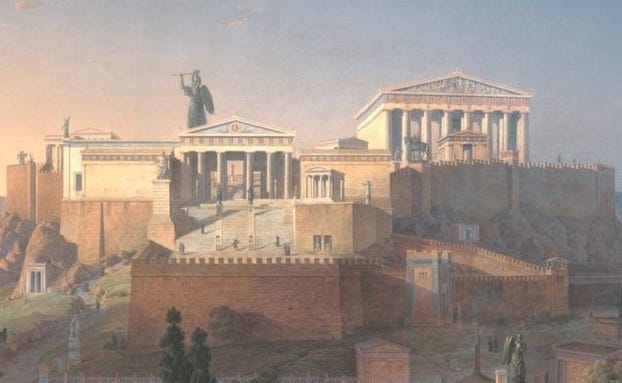
Athena Promachos, or Athena who “fights in the front line,” is thought to be one of Pheidias’ earliest works. It was placed on the Acropolis around 456 BC, measuring around 30 feet high. While the statue itself does not remain, we do have a description from Pausanias who tells us that the statue was set up in the open, behind the Propylaea, with her helmet and tip of her spear visible to sailors approaching Athens from around Cape Sounion. The statue itself may have been erected to commemorate the battle of Marathon, in which Athens delivered a surprising blow to the Persian army in 490 BC. Incredibly, we have parts of the base and inscription that Athena Promachos rested on. The statue was destroyed in 1203 AD, but its form has been discovered on a few Attic coins that were minted during the Roman period. For one of Pheidias’ earliest works, it certainly did not lack any amount of sophistication or craftsmanship.

Another statue that was erected on the Acropolis and credited to Pheidias was the Lemnian Athena. Originally worked in bronze, the statue was dedicated and paid for by Lemnos, an Athenian colony, in 451 BC. Again, the original statue has been lost, but we do have a few Roman copies: a head recovered from Bologna and two statues in Dresden. Together, they give us the sense of what the original may have looked like.
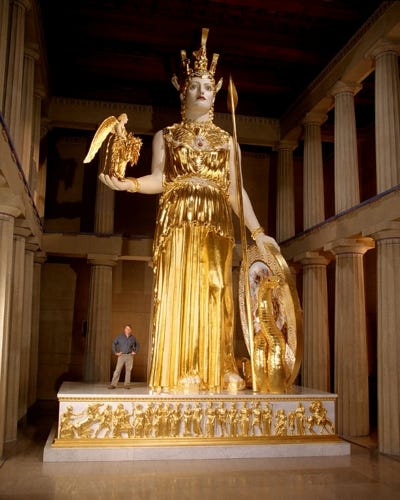
However impressive these two preceding statues were sure to have been, little compares to the colossal works that Pheidias produced: Athena Parthenos and Zeus at Olympia. Athena Parthenos was completed and dedicated in 438 BC, and was placed inside the Parthenon. She was made of gold and ivory and stood roughly 38 feet tall. And while we still don’t know much about Pheidias’ personal life at the time, we do see him and Pericles represented in the shield that Athena Parthenos holds… a fact that becomes integral to his downfall in the years to come. Again, the original no longer exists, but Roman copies and coinage give us the image of Athena Parthenos that we have today.
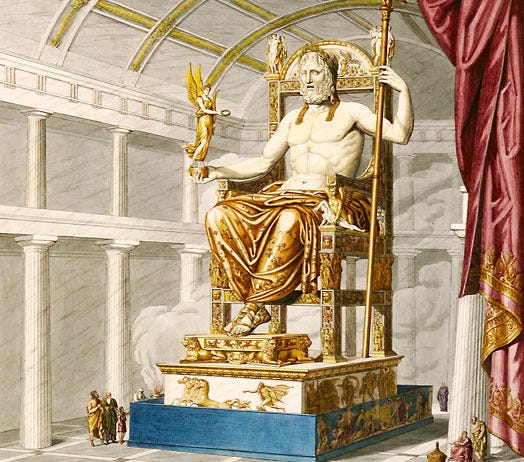
The statue of Zeus at Olympia was Pheidias’ final major project and was completed around 430 BC for the temple of Zeus at Olympia. It too was colossal, clothed in gold, and with a body made of ivory. It was about 42 feet high and took up the entire height of the temple, with some questioning how the statue even got in the temple in the first place, seeing as the statue came second. The statue of Zeus was highly decorated and painted, and it is considered to be one of the seven wonders of the ancient world, even though the original no longer survives.
Pheidias’ Death and Legacy
After the statue of Zeus at Olympia, Pheidias seems to have quickly left the public eye as a result of scandal. Likely due to his close association with Pericles, the Athenian statesman (who certainly had his fair share of enemies), Pheidias became a target for plots. One of the reported attacks on Pheidias came in 432 BC when he was accused by Pericles’ enemies of stealing gold from Athena Parthenos during construction. He was able to defend himself from this accusation and nothing much came of it. Yet just a few years later, Pheidias was accused of impiety. This was on the basis of his personal representation (along with Pericles’) on the shield of Athena. For this charge, he was thrown in prison and then likely exiled to Elis. His actual place of death is disputed, with Plutarch writing he died in prison in Athens, while Aristophanes quotes Philochorus saying he died at the hands of the Eleans after he finished the statue of Zeus.
Although we know so little about Pheidias’ life, and most of his original work has been lost, he is still considered one of the greatest sculptors of all time. He produced monumental works that took up prominent places, so his exposure seemed to be far above his contemporaries. Pheidias is thought to have ushered in a true change in sculpture style into the classical from any leftover Archaic style. He represents a time of wealth and prosperity in Athens, but also serves as a reminder of the rampant political tensions, which ultimately lead to his death.
Still, his work lives on, even that which has been lost, through copies and influence. In the fullness of time, maybe there’s no greater fate for an artist.
Más info en frasco@menadelpsicologia.com / Tfno. & WA 607725547 Centro MENADEL (Frasco Martín) Psicología Clínica y Tradicional en Mijas Pueblo #Psicologia #MenadelPsicologia #Clinica #Tradicional #MijasPueblo
*No suscribimos necesariamente las opiniones o artículos aquí compartidos. No todo es lo que parece.

No hay comentarios:
Publicar un comentario