
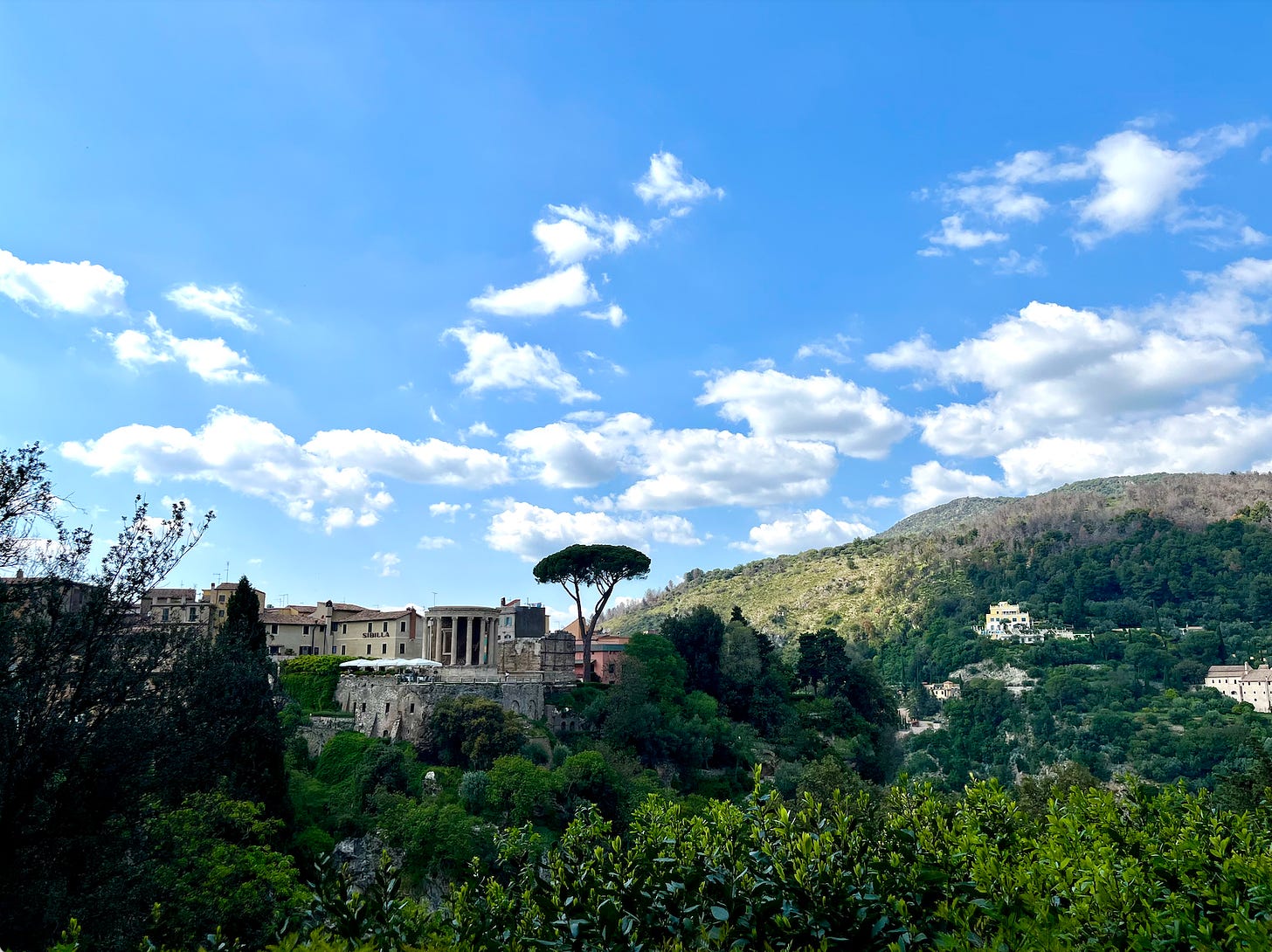
"In the last few days I have been to Tivoli and I have seen one of the first wonders of nature. The waterfalls, the ruins and the overall landscape belong to those objects, the knowledge of which enriches our most inner souls."
Dear Classical Wisdom Reader,
It was Goethe’s opinion of the site that first welcomed us as we entered Villa Gregoriana... and enriched the soul it did.
You see dear reader, after a not so short voyage, including two overnight flights, a 16 hour layover in Miami and two train trips, we arrived in our temporary residence for the next month: Tivoli, Italy.

Of course we initially contemplated staying in Rome for all the obvious reasons... but unfortunately history has a way of repeating itself and the Eternal City has once more been overrun. While they aren’t quite sacking and looting, the throngs of tourists, following brightly colored umbrella standards, certainly don’t make for a relaxing trip.
This small town of 50,000 souls (of whom we have already met quite a few), however, is more our speed. Plus, it's not like Tivoli isn’t lacking in history.
Originally named Tibur, the city was founded by Catillus the Arcadian, a son of Amphiaraus, who escaped the slaughter at Thebes, Greece. In the Etruscan times, it was the seat of the Tiburtine Sibyl, and to this very day stands two small temples above the magnificent falls, the Temple of Vesta and the Sibyl of Tibur.
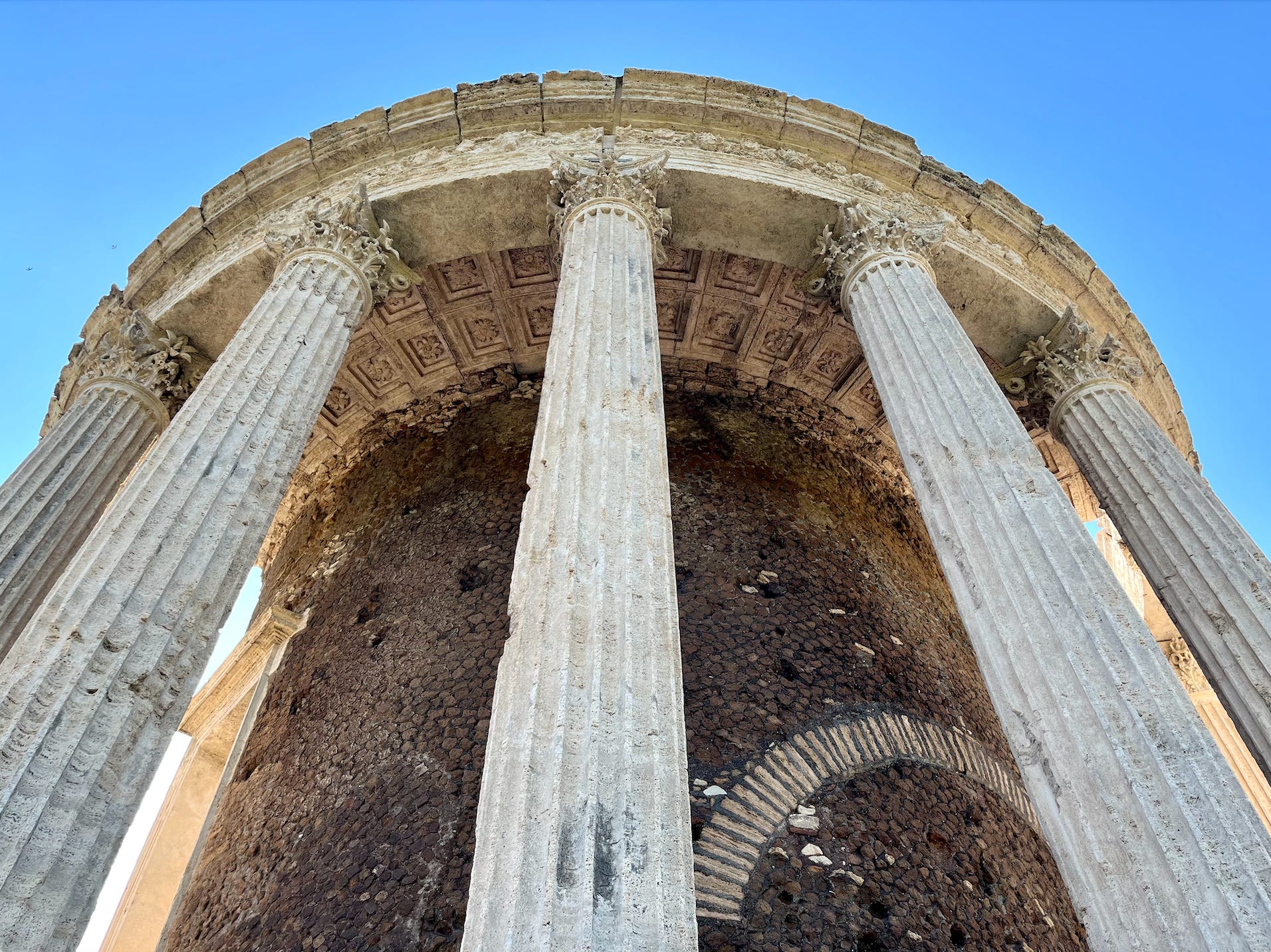
But it’s also its Roman age for which the city is renowned. Having acquired Roman citizenship in 90 BC, Tibur became a resort area famed for its stunning beauty and thermal waters, and the wealthiest and most powerful Romans built villas, including Gaius Cilnius Maecenas (c. 70 – 8 BC) friend and political advisor to Octavian as well as Octavian himself. The most famous of the structures, however, is Hadrian’s Villa and its splendid fountains have lured great artists, writers, and composers throughout the centuries. From the aforementioned Goethe and Chateaubriand to Turner and Listz, the natural landscape combined with its rich history truly inspires.
The great Roman lyric poet, Quintus Horatius Flaccus (aka Horace), also had a modest villa near the falls of the Aniene river... and it was from this residence he contemplated the fall of the Roman Republic. Indeed, it is a perfect place to meditate on the cycles of governments, states, and individuals wielding power. Close enough to power to know what’s happening, but removed enough for perspective. Just an hour outside Rome, you can imagine that the residents of this fair town would have seen the smoke as the capital burned in 476 AD.
And it is this image that brings me to this week’s question. It is one that brilliant minds have discussed and debated since that fateful day in September 1,547 years ago.
Why did Rome fall? Did it commit suicide? Or was it murdered? Did it crumble from within or simply fall from the natural cycles of power?
It is a question with serious implications, of course. It is essential to try to understand history, so that we may learn from it, and try - if we may - not to repeat it.
You can write to me at anya@classicalwisdom.com or reply to this email and I’ll publish your responses next week.
In the meantime, I’ve got plenty of UNESCO sites to explore... to film and to write about! In fact, I’d love to take you with me. As such, later this month I’ll arrange a few Live tours, especially for our members. So, if there is one specific site you’d like me to take you on, please let me know:
In fact, if you are not already a member, make sure to sign up. For less than two dollars a week, you can get access to our archived materials and magazines, exclusive invitation to live events and webinars, plus interviews with professors and much more besides. Join our growing community of inquiring minds and enjoy even more Classical Wisdom HERE.
Now, for a short mailbag below, an eclectic offering on Greek terms, the Minotaur and more...
All the best,
Anya Leonard
Founder and Director
Classical Wisdom and Classical Wisdom Kids
Monday Mailbag
On Ancient Greek Terms:
Hi Anya
I loved this topic and totally agree with the words you chose. As I am currently studying Ancient Greek I would like to propose a few more words and phrases that I feel are relevant today.
We should all be able to live in a ἀσφαλής (safe, secure) world of εἰρήνη (peace) and ἐλευθερία (freedom) for everyone. We need to have a lot more συγγνώμη (forgiveness) and φιλέω (love) for each other, and learn to ἐπέχω (restrain, check) our ὕβρις (aggression, violence).
We also need to βοήθεια (help) those around us and live a more μέτριος (moderate, reasonable) lifestyle, understanding when ἱκανός (sufficient, enough) is ἱκανός. Finally, if we can γέλασμα (laugh) a lot more, have the ἀνδρεία (courage) to do the things we are good at, and ensure you are always a πιστός (reliable, trustworthy, faithful) person, then perhaps this could be a βίος βιωτός (life worth living) after all.
Regards
Andy
BA (Honours) Humanities with Music
BA (Honours) Classical Studies
-
I don't know whether you allow feedback or not, but in checking the derivation of the word "obscene" today I found it came from a term used by Greek dramatists--ob scena, something like that--which literally meant "off the stage." Could be sexual, or "anxiety producing." Anyway, not to be spoken on stage.
Celinda S., Indiana, PA
On the Minotaur:
I will say I much enjoyed your article on the Minotaur. Yes, we are all familiar with his image but you make known that which is beneath, which is so needed in this world where interpretation often floats away. It does represent a dark side of us, but also of beauty: the bull was very beautiful. I now think does such an image signify a flaw when the Dionysian and Apolllian combine to be one rather than dualistic? Symbolically or semiotically, I am not yet sure what interpretation comes forth, but you do have me thinking. Thank you for the article.
Herman H.,San Francisco
On How can we see our blindspots?
I thought it was pretty clear that Objectivism wasn't a robust philosophy and more of an ideology, fitting into the https://en.wikipedia.org/wiki/Not_even_wrong corner of not being comparable to real philosophers because Rand never made salient points, only wrote weird fantasies that had no rigor outside of a fantasy. And plenty of people do connect Nietzsche for instance with Nazism etc. but there's just a lot more there to think about.
Nick K.
[Editor’s Note: I have been thinking about this issue quite a bit... as I have seen a few comments regarding Rand’s work as ideology rather than philosophy. It prompted me to ask: What is the difference between ideology and philosophy? And does this label preclude us from having discussions on the work? I brought this question on the Substack Notes feature, feel free to add your thoughts on this topic here:
Hello Anya,
I hope this finds you well. Been a while since I've communicated with you, but your email of this past Monday piqued my interest - the announcement of the conference on "Ayn Rand and Stoicism" on April 26. This will be a fun one, I'm sure.
I went through an Ayn Rand phase a few years ago and devoured everything she wrote. I love her views on economics, specifically. She got her "Objectivist" philosophy straight out of Aristotle, who she was a big fan of and quoted often. She furthered his views on nature being "objective" (identifiable) and non-contradiction in logic ("A is A" - something cannot be simultaneously true and false) and the idea that nature is malleable - man can achieve great heights by using the natural forces available to him, etc.
Dave H.
Más info en frasco@menadelpsicologia.com / Tfno. & WA 607725547 Centro MENADEL (Frasco Martín) Psicología Clínica y Tradicional en Mijas Pueblo #Psicologia #MenadelPsicologia #Clinica #Tradicional #MijasPueblo
*No suscribimos necesariamente las opiniones o artículos aquí compartidos. No todo es lo que parece.

No hay comentarios:
Publicar un comentario