

Dear Classical Wisdom Reader,
The experiment continues!
After the positive response to last week’s quiz, we’ve got another set of questions for you to test your knowledge of the ancient world.
Once again, these all based on material we published this past week. We also have our regular roundup just below, just in case you want to refresh your memory.
We’re thinking of making these quizzes a regular fixture, but we want to hear what you think about them first!
Be sure to comment below, and don’t forget to share your score.
Now, let’s get to it…
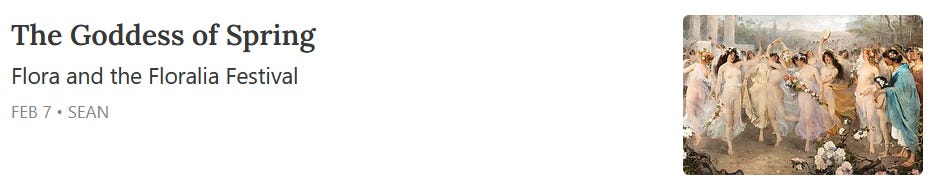
1. The Roman goddess Flora was honored in which festival?
A) Saturnalia
B) Lupercalia
C) Floralia
D) Bona Dea
2. According to Plato’s Cratylus, what is one philosophical debate surrounding names?
A) Whether names hold intrinsic meaning or are assigned arbitrarily
B) If names should only be given by the gods
C) Whether names influence fate and destiny
D) If names should always include a reference to one's lineage
3. The Roman festival of Floralia was associated with which symbolic aspect of life?
A) The underworld and spirits of the dead
B) The renewal of nature and fertility
C) Military victories and conquests
D) The power of the Senate
4. According to the podcast discussion with Joel Christensen, what is one way Homeric poetry can be understood?
A) As a structured yet evolving tradition shaped by many generations
B) As the work of a singular poetic genius
C) As a fixed, unchanging text from antiquity
D) As purely a religious scripture rather than literature
5. In what way does Heraclitus describe language in relation to reality?
A) Language is fixed and unchanging
B) Language, like the world, is in constant flux
C) Only divine beings can create true language
D) Language is separate from human perception
Now we’re going to take things up a level… Here are three extra-challenging bonus questions to truly test your wisdom!
6. What was one significant reason the Romans associated Flora with fertility and renewal?
A) She was considered the mother of all Roman gods
B) She was linked to agricultural prosperity and the reproductive cycles of plants
C) Her temple housed Rome’s most sacred fertility rites
D) She was believed to have personally blessed Romulus and Remus
7. What biological analogy does Joel Christensen use to describe how myths and stories evolve?
A) They function like DNA, adapting within different cultural ecosystems
B) They are like extinct species, permanently fixed in history
C) They can only be created by a singular storyteller
D) They operate like rigid laws, never subject to change
8. In Classical philosophy, what was Protagoras' stance on the relationship between names and reality?
A) He argued that names were divinely assigned and unchangeable
B) He believed truth and meaning depended entirely on human perception
C) He maintained that names were purely logical constructs devoid of meaning
D) He rejected the use of names altogether as a flawed human invention
Need to refresh your memory? Check out this week’s resources just below…
Exclusive Podcast Don’t miss this week’s fantastic episode of Podcasts with Professors, featuring Joel Christensen talking to Anya about the history of Homer and the ‘biology of epics’

Answers
-
C) Floralia (The Roman festival honoring the goddess Flora)
-
A) Whether names hold intrinsic meaning or are assigned arbitrarily (Plato’s Cratylus debate on names)
-
B) The renewal of nature and fertility (Floralia celebrated fertility and spring)
-
A) As a structured yet evolving tradition shaped by many generations (Homeric poetry developed over time)
-
B) Language, like the world, is in constant flux (Heraclitus' perspective on language)
Here are the answers to the three extra-challenging questions:
-
B) She was linked to agricultural prosperity and the reproductive cycles of plants (Flora was a fertility goddess associated with plant life and renewal)
-
A) They function like DNA, adapting within different cultural ecosystems (Joel Christensen's analogy of myths evolving)
-
B) He believed truth and meaning depended entirely on human perception (Protagoras’ famous relativist stance: “Man is the measure of all things”)
The Wisdom Scale
So, how did you do? Check your score and claim your title.
0-2 correct: Novice Philosopher – Your journey has just begun. Time to revisit the scrolls!
3-5 correct: Aspiring Sophos – You’re making progress! Keep reading and reflecting.
6-7 correct: Agora Adept – Your wisdom is strong. The ancients would be impressed!
8 correct: Master of the Classics – You are truly one with the philosophers. Socrates himself would be proud!
Which one are you? Make sure to let us know if you’d like to see more of these in the future. We hope you had fun!
All the best,
Sean Kelly
Managing Editor
Classical Wisdom
Más info en https://ift.tt/WYqpU1L / Tfno. & WA 607725547 Centro MENADEL (Frasco Martín) Psicología Clínica y Tradicional en Mijas. #Menadel #Psicología #Clínica #Tradicional #MijasPueblo
*No suscribimos necesariamente las opiniones o artículos aquí compartidos. No todo es lo que parece.

No hay comentarios:
Publicar un comentario