
Welcome to our newsletter, dear reader,
• We begin our monthly selection with a choice of pages from Eric Gill on the spirituality and theology of craft, art and everyday work. These reflections, at once very practical and profound, give the measure of Gill’s metaphysical penetration, and of the kinds of philosophical concerns that are raised even by the most apparently trivial modern-life experiences.
To say that philosophy and religion are the effective motive in human works, works of love no less than works of power, of beauty no less than of usefulness, is simply to say that God is the instigator of all good works, and that the good workman is the man of God, and this is, in an especial manner, true in respect of those works whereof beauty is the formal cause… The human act of begetting is a type of divine creative power. The act of the artist in the creative imagination is, as the schoolmen pointed out, the nearest human counterpart.
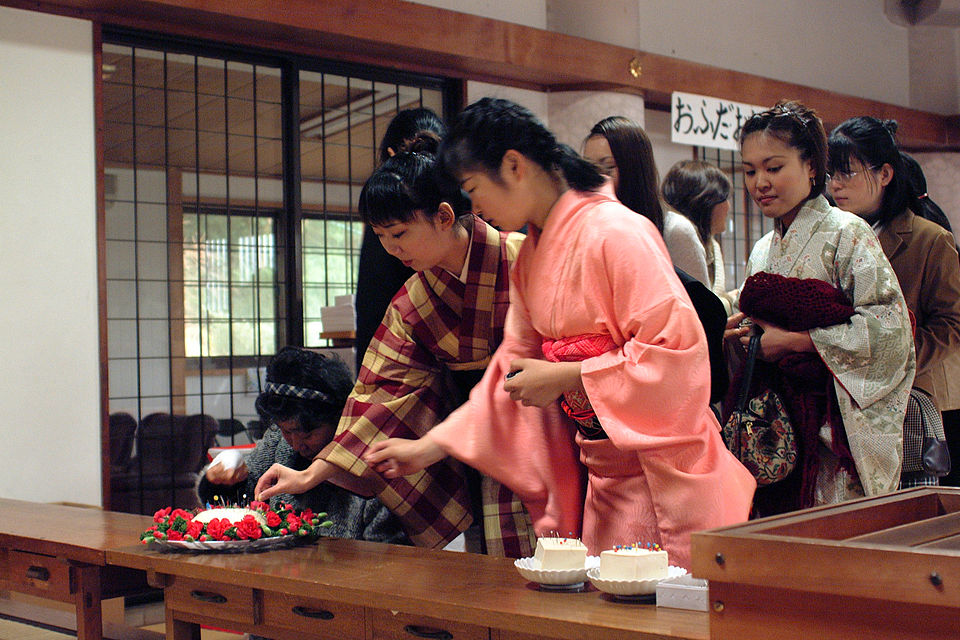
• Next we have an article on the Japanese practice of hari kuyo (the memorial rite for needles), one of the oldest and best known examples of kuyo rites for objects, particularly for the tools used in traditional crafts. The practice of hari kuyo, enriching as it does our sensitivity towards everyday objects, may affect our understanding of what we now call recycling. As a social set of rituals, it shows some of the familiar features of religion in Japan, combining elements of Buddhism, Shinto, and folk traditions. .
Mortuary rites for inanimate objects might seem out of place in today’s world, inconsistent with the demythologized universe of our electronic age. We might try to explain these rites by referring to the Japanese Buddhist idea of somoku jobutsu (literally, “the enlightenment of grasses and trees”), and it is important to note that this phrase is commonly understood to refer to all inanimate objects, not just plants.
Needle memorial at Awashima Shrine. (Wikimedia Commons)
• We conclude with an article on the esoteric Daoist techniques of “imbibing” the essences of the Five Natural Energies through sophisticated meditation practices. In very characteristically Daoist fashion, we are strongly reminded in these pages of the inextricable continuum between body and soul, including all the subtle intermediary “layers” upon which act the different kinds of spiritual medicine and alchemy.
Most importantly, however, we should note that curing illness was merely returning the body to its proper condition, so one could begin working towards salvation. A healthy body was a precondition for religious endeavor. Daoists viewed mundane medical techniques as treating merely external symptoms. True health that could lead to longevity, and eventually transcendence, entailed direct communication with the Dao by cultivating and refining one’s own bodily qi.
We take this opportunity to wish our readers a blessed, healthy new year.
The post Holy Work, Funerals for Needles, and Imbibing the Universe first appeared on The Matheson Trust.
Más info en https://ift.tt/35gbqxs / Tfno. & WA 607725547 Centro MENADEL (Frasco Martín) Psicología Clínica y Tradicional en Mijas. #Menadel #Psicología #Clínica #Tradicional #MijasPueblo
*No suscribimos necesariamente las opiniones o artículos aquí compartidos. No todo es lo que parece.

No hay comentarios:
Publicar un comentario