
Dear Classical Wisdom Reader,
With the panic button securely grasped in my hand, they started to wheel me in. The last thing I saw through the slotted head coil was a forest scene on the ceiling, illuminated to convey reality, a window into the woods to contemplate before I entered the small white tube.
After overcoming the initial shock of the enclosure, I closed my eyes and leaned into the stillness. Even breathing became a rebellion.
Then the noises began. First, a loud electronic bass...in my head, it’s the beginning of the Black Eyed Peas’ “I Gotta Feeling.” It shifts in tone and frequency, and suddenly I am recalling playing Operation as a child. It speeds up and begins to vibrate like a small plane about to take off. Soon I am in a meditative trance, deep under the sea, slowly breathing in and out as the wonders of the ocean surround me.
When the body is completely immobile, the mind wanders freely.
And before I know it, I’m confronted with one of the most ancient philosophical problems...
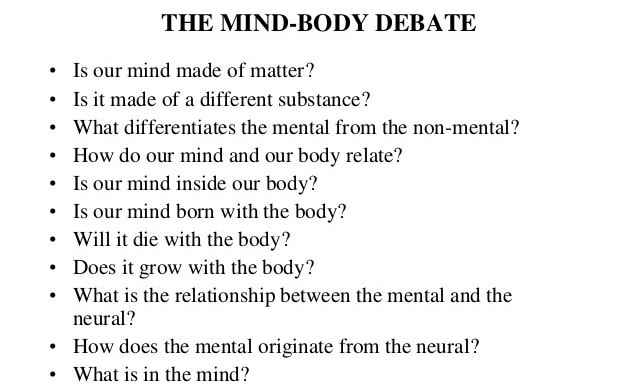
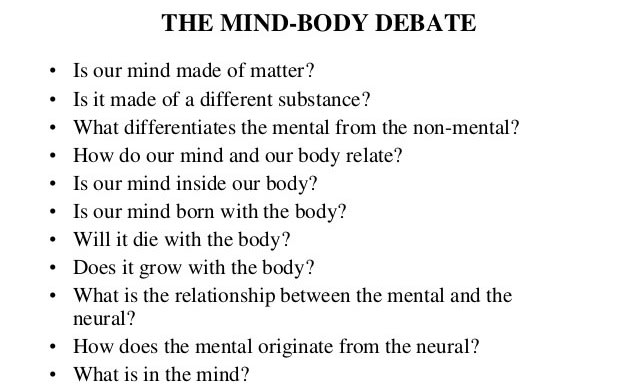
It was incredibly apt. After all, when your very physical brain is being scanned, mapped, and measured...you are forced to confront an unsettling question: where, exactly, do your thoughts come from? Are they merely the byproduct of neural activity, or something altogether different? Is the mind simply what the brain does, or does it possess a nature distinct from flesh and matter? And if our thoughts are material, where do imagination, memory, intention, and meaning reside?
Yes, dear reader, we have stumbled upon the ancient Mind–Body Problem.
This enduring debate, which examines the relationship between mind and matter, belongs to the realms of metaphysics and the philosophy of mind. It has raged for thousands of years, provoking inquiry from Plato and Aristotle, Lucretius and Descartes, to name only a few.
Are mind and body one substance, or two? Does consciousness emerge from matter, or does it precede it? Can the immaterial act upon the material...or is that very distinction illusory?
And yet, even with our newest technologies, DTIs, CAT scans, and MRIs, as experienced by your dear editor, the problem continues to inspire and confound modern minds. For all our ability to see the brain in exquisite detail, we still struggle to explain how subjective experience arises from objective tissue.
Today, we will pay our own mental respects to the Mind–Body Dilemma by delving into first causes and first principles in the article below. After all, if we are to truly inquire into the state of the world, we must begin at the very beginning: on the nature of thinking itself.
So momentarily leave behind the urgent and embrace the necessary. We will seek the signal amongst the noise and attempt to understand how our minds and bodies relate.
For whether or not you must lie very still for a very long time, it is certainly something to think about...
Read on and let us know your thoughts below. I’ll meet you in the comments section…
All the best,
Anya Leonard
Founder and Director
Classical Wisdom
Cultivate the Mind with the Wisdom of the Ancients. Subscribe today to join our growing community in time for our Special Saturnalia Issue…coming out this week!
Mind, Matter, and Monism
By Jacob Bell
Mind and matter or physical and mental – these are distinctions that we are familiar with. We needn’t have studied philosophy extensively or have had any type of specialized training in order to recognize these terms.
An example of this is when we hear the phrase “mind over matter,” and we understand the implications of such a phrase, namely the mental overcoming the physical or the power of our will to overcome physical obstacles.
But what do these terms refer to, what are they attempting to distinguish, and… what exactly does it all have to do with ancient Greek philosophy?
I’m glad you asked…
The concepts of mind and matter, philosophically speaking, are explored within the branches of metaphysics and philosophy of mind.
Metaphysics is a branch of philosophy which is interested in exploring the nature of existence, being, and the world. According to Aristotle, metaphysics deals with, “first causes and the principles of things.” It tries to get at the essence of existence, and asks questions such as “what is the nature of reality?”
Philosophy of mind is intertwined with metaphysics, and seeks to understand the nature of the mind, consciousness, and mental events. A fundamental question that philosophy of mind asks is “how does the mind relate to the body?”
Or, in other words, “how does physical stuff and mental stuff interact with one another?” This is termed the mind-body problem.
Traditionally, the mind has referred to those things which cannot be objectively observed, and do not contain physical qualities such as mass or extension in space. This might include thoughts and conscious experience.
Say, for example, you eat an orange. Sure, we experience the sensation of taste, but this experience of tasting the orange isn’t an objectively observable or quantifiable event.
Now, you may be thinking to yourself… “What about brain scans? Can’t they show the experience?”
And you may be right!
There are a great many neuroscientists attempting to squash this part of the debate with modern technology. Some claim that an MRI can observe and record the experience, while others argue that they aren’t actually observing the subjective experience itself, and that the data from the scan is simply evidence for the biological underpinnings of the experience. They claim that the experience itself is something over and above this data.
Matter, on the other hand, refers to the physical-material stuff that the objects of our everyday world are made up of. The orange exists in space and time and has physical properties which can be scientifically measured.
Let’s say that I tell you two things about the orange. One thing being related to the physical properties of the orange, the second being related to the conscious experience or mental aspect of the orange.
Let us also imagine that I am a pathological liar.
First, I tell you that the orange weighs 38 grams. You can verify the weight of the orange for yourself, simply by putting it on the scale. You weigh it and find out that it actually weighs 42 grams.
Second, I tell you that the orange tasted great to me. I say that it was refreshing and sweet, but what I actually experienced was disgust and I thought that it tasted repulsive.
You cannot verify the truth of my statement in the second instance. There is nothing you can objectively test or observe to see if I am telling the truth. It was an inner experience of subjectivity that you do not have access to.
And thank Zeus for this – I am sure we have all told a similar white lie during a holiday gathering, when we eat something our dear aunt made with love, but which tastes like last year’s leftovers…
Seek Signal, Not Noise… Let the Wisdom of the ancients guide you to flourish:
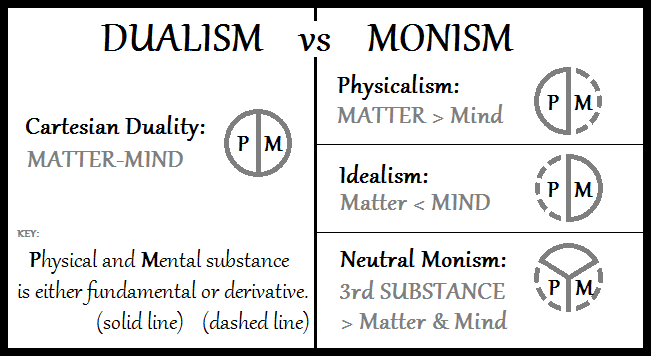
This idea of mind and matter as separate phenomena is called dualism. It is the default theory for most of us because our culture has embedded such distinctions into everyday life.
But this wasn’t always the case. The pre-Socratics were monists. A monist, for those who want a recap, believes that there is a single underlying substance for everything in the cosmos. They hold an opposite perspective from the dualist.
Thales believed water was the single underlying substance from which everything was made up of, Anaximenes believed it was air, Anaximander argued that it was apeiron (the undefined infinite), Heraclitus argued in favor of fire, and Democritus claimed that it was all atoms.
Interestingly, Democritus’ theory of atoms is related to the modern monist theory of physicalism. Physicalism argues that everything is made up of physical-material stuff, such as atoms. It states that the mind, consciousness, thoughts, and sensations will eventually be explained in reference to the physical. But back to the ancients…
It wasn’t until Plato that dualism became a prominent theory within metaphysics and subsequently the philosophy of mind. Plato’s theory of forms indicates the separation of the material world and the world of the mind.
For Plato, concepts, thoughts, and the ideal forms are more real than the material world. The material world is simply an imperfect shadow of the perfect and ideal world of forms. Though formally categorized as a dualist, Plato’s theory has leanings related to a type of monism, called idealism, which claims that everything is mental. (So the exact opposite of the modern physicalists).
According to this theory, our mind actively arranges the sense data in a particular and intelligible order, essentially making the world around us a product of our mind. If all that can be known is our mental representations of the world, a physical reality outside of our mental representations cannot be said to exist.
The most widespread modern theory of metaphysics and philosophy of mind, which has imbedded itself into our very language and culture, is Cartesian dualism. Descartes has been extremely influential, and it is no surprise, seeing how he is often considered to be the father of modern philosophy.
Descartes claimed the mind and body were distinct entities. He argued that the mind was immaterial and could be separated from the body, which was material. He claimed that the immaterial mind and material body interacted with one another, and this is what came to be known as the mind-body problem.
It’s a problem because if the mind is immaterial and the body is material, how do they causally interact? This is a problem that philosophers and scientists alike are attempting to solve to this very day.
So, what do you think? Is everything made of one fundamental kind of stuff? Is that stuff mental or physical? Is the nature of reality dualistic, and so there exists two fundamentally different types of stuff? Or, perhaps the true nature of reality is unlike any of these theories…
Más info en https://ift.tt/AqCGJfi / Tfno. & WA 607725547 Centro MENADEL (Frasco Martín) Psicología Clínica y Tradicional en Mijas. #Menadel #Psicología #Clínica #Tradicional #MijasPueblo
*No suscribimos necesariamente las opiniones o artículos aquí compartidos. No todo es lo que parece.

No hay comentarios:
Publicar un comentario