
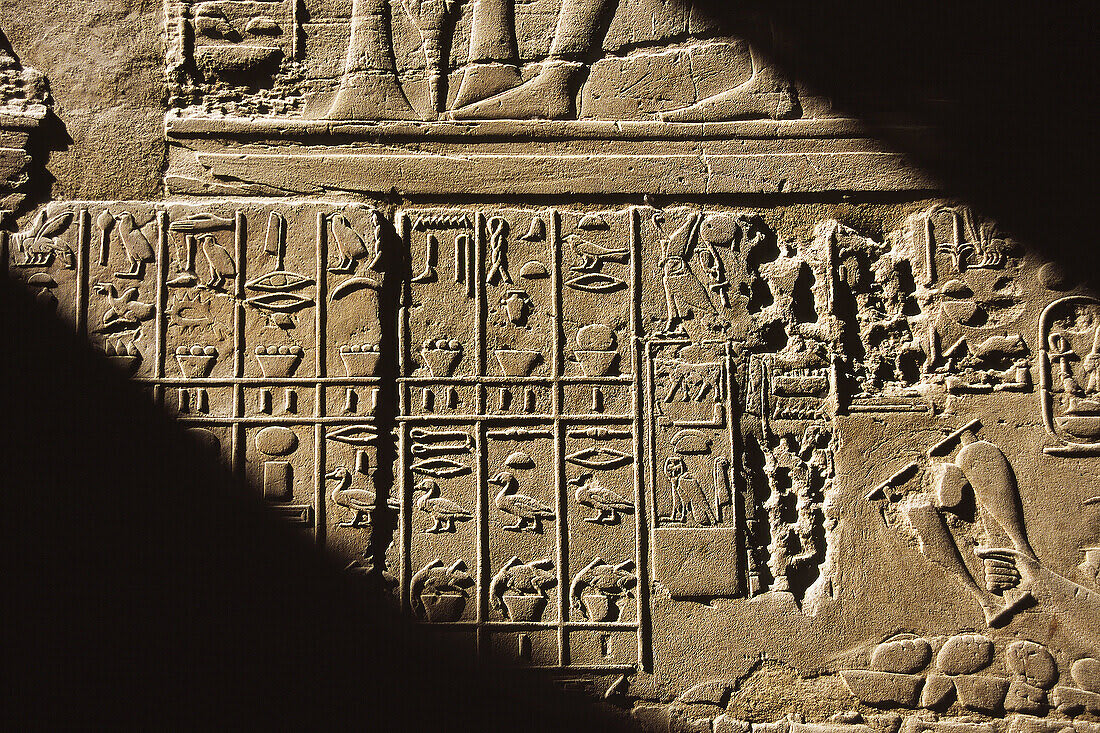
Dear Classical Wisdom Reader,
Why start with Greece? Didn’t the Egyptian and Mesopotamian cultures precede the maturity of the Greek contribution to Western Civilization?
It was one of the first questions asked during Friday’s event on the history of Western civilization, and it was a good one. Sure, many place the birth of Western civilization squarely in Greece and Rome. After all, Athens gave us philosophy and democracy. Rome gave us law, engineering, and the faint but persistent feeling that roads should last forever. We are prone to picture marble temples bathed in Mediterranean sunlight and imagine that surely this is where it all began...
But did all that just spring up from nowhere? Of course not! Just as we find inspiration in those who came before us, the Greeks and Romans likewise turned to the past when they wanted wisdom, legitimacy, or ancient authority...
Indeed, to the Greek imagination, Egypt was not just another culture, it was antiquity itself. Herodotus traveled there and came back wide-eyed, half reporter, half tourist. Plato wove Egypt into his philosophical myths as a land whose wisdom survived floods, catastrophes, and the forgetfulness of time. Greek legends insisted that lawgivers, mathematicians, and philosophers had studied with Egyptian priests, listening to teachings preserved in temple shadows long before Homer sang a single line.
The Romans, for their part, were even more enthralled. They imported Egyptian obelisks the way modern cities import luxury brands and planted them proudly in their forums. Cleopatra’s Egypt captivated Rome not just politically, but psychologically. After all, Egypt was exotic, mysterious, and ancient in a way Rome desperately wanted to claim.
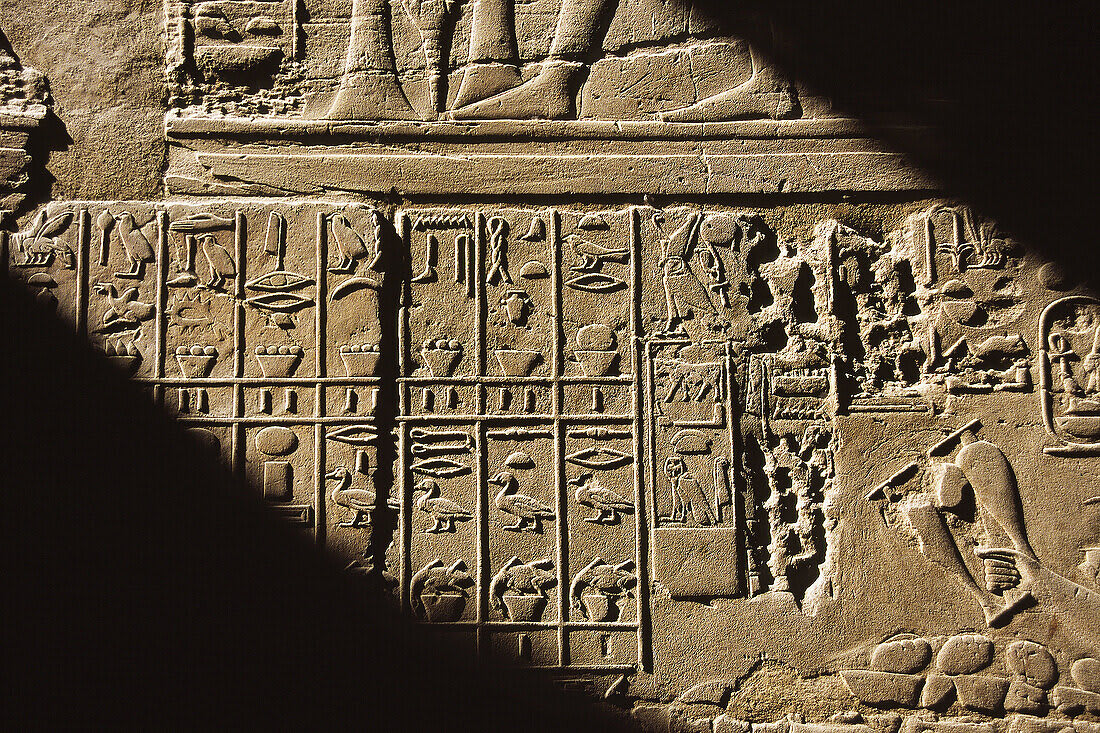
Which raises an irresistible question: what else did Greece and Rome borrow from Egypt?
Could the stance of your favorite Greek statue, the structure of Roman administration, or even the way ancient people thought about the afterlife owe more to the Nile than to the Aegean?
Read on to discover some of the more surprising influences from ancient Egypt...And ask if the story of the classical world begins on the Acropolis, in the Roman Forum, or along the Nile...
All the best,
Anya Leonard
Founder and Director
Classical Wisdom
P.S. Whether you are into the ancient world or the very ancient world, Classical Wisdom has you covered for 2026!
Our first voyage leaving in January will trace the Nile to the further roots of civilization... Discover the temples, obelisks, and the life-giving river that inspired millions for millenia… and check out the brand new Grand Egyptian Museum! Please note: This trip will leave very shortly! So if you are interested, you really have to act immediately.
If the Greco world inspires you more, or if you simply need more time to prepare for your next journey, our Sea of Homer voyage with Emily Wilson will literally be EPIC. Cruise the wine dark seas, from the sacred island of Delos to the storied spires in Istanbul, departing the first of July.
8 Ways the Egyptians Inspired the Classical World
If you wander through the ruins of the ancient Mediterranean, past toppled columns, fractured statues, and half-erased inscriptions, you might assume Greece and Rome sprung fully formed from their own genius. After all, the classical world has long been cast as the birthplace of Western civilization, the cradle from which philosophy, democracy, law, and monumental art emerged.
But travel a little farther south, just beyond the deserts and into the lush ribbon of the Nile... you discover an older story... A much older story. One that quietly, profoundly, and sometimes surprisingly shaped Greek and Roman civilization. Egypt, with its millennia-old temples, sophisticated scribes, and divine kings, didn’t just predate the classical world; it helped inspire it.
In fact, the Greeks themselves often said so!
Today, we often forget just how intertwined these civilizations were. So let’s pull those threads back together. What follows is an exploration...not just of the major influences Egypt had on Greece and Rome, but also of the surprising, non-intuitive echoes that crossed the Mediterranean and helped shape the classical world.
1. Mathematics, Measurement, and the Geometry of Civilization
When the Nile flooded each year, it erased field boundaries like a celestial housekeeping ritual. And yet the Egyptians always restored them precisely, consistently, ingeniously. This necessity gave birth to a practical geometry long before the word “geometry” existed in Greek.
It’s no wonder, then, that Greek thinkers reportedly traveled to Egypt in search of knowledge. Thales, according to legend, learned how to measure the height of a pyramid by observing its shadow. Pythagoras, whose name now forever accompanies a certain triangular relationship, was said to have studied in Egyptian temples. Whether these tales are literal or literary embellishments, they reflect a Greek belief: Egypt was a place where numbers were ancient, sacred, and powerful.
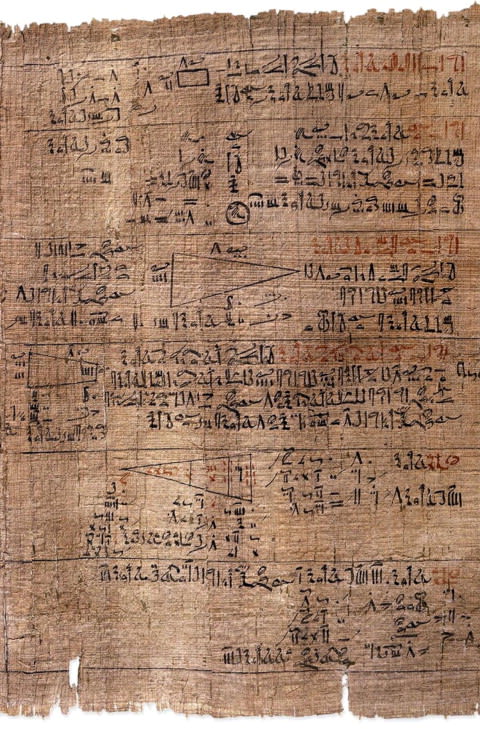
But here’s a lesser-known twist: Egyptians developed an early form of bureaucratic data management. Exciting, right? While the details of it are more humdrum than fabulous, there was a real impact in their approach. They tracked grain yields, worker output, tax obligations, and geographic changes with astonishing precision. This habit of measuring and recording, something we might call proto-statistics, would later reappear in Roman census practices, administrative reforms, and the empire’s relentless love of paperwork...
It had to start somewhere...
2. Gods Across the Sea: Religion, Ritual, and the Theatrics of the Sacred
If there is one Egyptian influence the Greeks and Romans embraced with enthusiasm, it was religion... especially mystery cults. The goddess Isis, once a purely Egyptian deity, embarked on a Mediterranean tour that would make even modern pop icons jealous. By the time of the Roman Empire, her worship stretched from Britain to Syria. Her temples dotted Rome; her rituals attracted senators and slaves alike. Fans of Cleopatra might recall it was her favorite goddess too...
But beyond the obvious borrowing, Egypt introduced subtler ideas:
-
Divine kingship. The idea that the pharaoh was a living god did not quite take root in Greece, but in the Hellenistic world. Especially under the Ptolemies, rulers began adopting Egyptian modes of sacred authority. Romans, ever adaptable, later applied similar concepts to their emperors, whose images and cults echoed pharaonic propaganda.
-
Afterlife morality. The Egyptian belief in judgment before Osiris influenced Greek philosophical texts, Orphic traditions, and even Plato’s myths. The notion that one’s soul could be weighed, evaluated, purified, or punished had a long life in later Mediterranean thought.
-
Public theatricality. Egyptian festivals were elaborate, communal, almost cinematic. Greek and Roman civic religious spectacles bear unmistakable similarities: processions, symbolic dramatizations, mass participation, and the blurring of sacred and social life.
3. Medicine, Anatomy, and the Accidental Classroom of Mummification
Greek writers consistently praised Egyptian physicians. They noted with admiration that Egyptian doctors specialized. Some treated eyes, others stomachs, still others fractures or fevers. This specialization was far more systematic than anything in early Greek medicine.
Egyptian medical papyri reveal an empirical, case-based approach: diagnose, observe, treat, record. The Greeks expanded and formalized this logical structure, but the roots are visible.
It’s also important to note the importance of mummification.
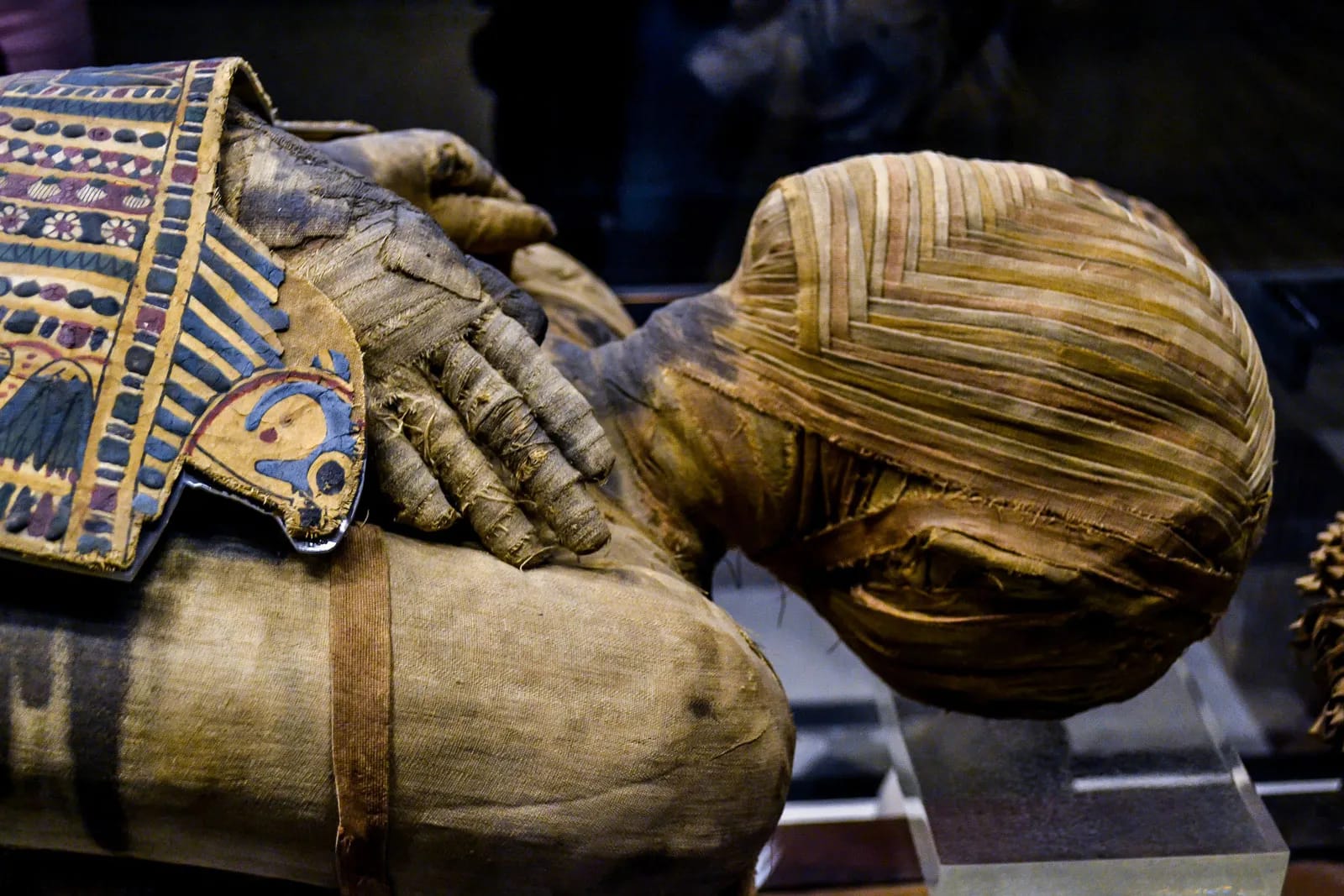
While Egyptians did not study anatomy in the Greek scientific sense, their funerary practices gave them an unavoidable familiarity with the human body. Handling organs, understanding tissue, learning how decomposition works...all of this created a kind of practical anatomical knowledge long before Alexandrian scientists like Herophilus began formal dissections.
4. Writing, Administration, and the Invention of the State on Paper
Egypt was a scribal civilization. From the moment hieroglyphs emerged, writing became a tool of statecraft: a way to collect taxes, store grain, track labor, legitimize rule, and, perhaps most importantly, shape collective memory.
The Greeks admired this, even as they developed their own alphabet and literary traditions. But the Romans went further: they inherited Egypt’s love of administrative order, magnified it, and spread it across an empire.
5. Art, Proportion, and the Quiet Egyptian Presence in Greek Sculpture
Stand a Greek kouros beside an Egyptian standing statue and a peculiar resemblance emerges: the rigid posture, the forward-facing body, the left foot stepping ahead, the symmetrical design. The Greeks took inspiration from Egypt’s artistic canon, but then something magical happened. They softened it, humanized it, animated it. Yet that early Egyptian imprint never vanished completely.
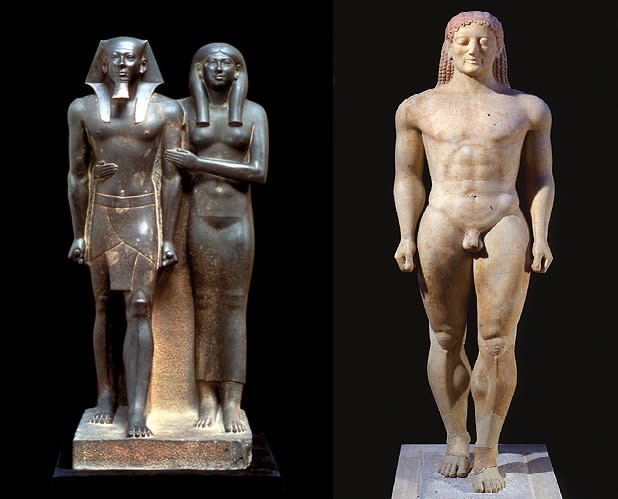
The canon of proportions, the serene expression, even certain divine iconographies speak to this shared heritage.
6. Architecture and Monumentality: Thinking in Stone
Egypt mastered monumental architecture thousands of years before Rome began laying bricks. Their temples were engineered with mathematical precision; their columns imitated palms, papyrus stalks, and bundled reeds; their obelisks reached skyward as monuments of cosmic symbolism.
The Greeks borrowed certain columnar ideas and the general sense of stone-built grandeur. But the Romans went positively Egyptian in their enthusiasm... They imported obelisks as trophies, filled their forums with them, and incorporated Egyptian motifs into imperial architecture.
Even Roman city planning shows faint echoes of Egyptian axiality...the love of straight, ceremonial lines that guide movement and meaning.
7. Philosophy, Mysticism, and the Allure of Ancient Wisdom
For many Greek philosophers, Egypt was not merely old; it was ancient, a place where wisdom predated memory itself. This belief may not reflect historical reality, but it shaped Greek and Roman thought profoundly.
Plato uses Egypt as a narrative device: a realm where truths survive catastrophes, where myths carry philosophical weight, where writing preserves cosmic secrets. Later, as Greek and Egyptian cultures intertwined under the Ptolemies, a new body of esoteric texts emerged, the Hermetica, which blended Egyptian theology with Hellenistic philosophy. These works would captivate Roman intellectuals and influence religious and mystical traditions for centuries.
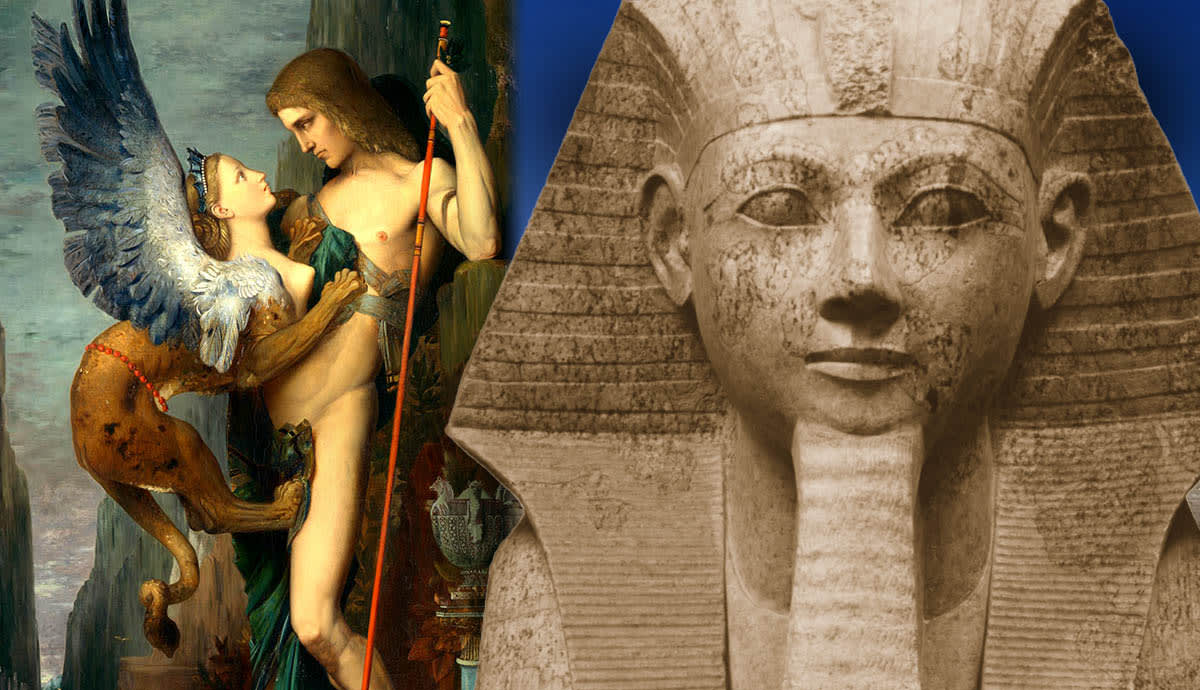
Crucially, Egyptian temple culture functioned on levels of secrecy. Knowledge was tiered, guarded, revealed only through initiation. Greek mystery religions, and later Roman ones, operated in much the same fashion. This structure of sacred secrecy may be one of Egypt’s most subtle but enduring philosophical exports.
Subscribe today and let the wisdom of the ancients AND the very ancients guide you!
8. Papyrus, Perfume, and the Everyday Technologies of Life
Not all Egyptian influence was grand or cosmic. Some of it lived in the mundane: the page you wrote on, the scent you wore, the glass you drank from.
For instance, Papyrus was Egypt’s botanical gift to the literate world. Without it, Greek literature and Roman administration would have looked very different. Perfumery and cosmetics flowed north across the Mediterranean. The Romans adopted Egyptian fragrances with enthusiasm; Cleopatra herself was famed for her perfume workshops. Glassmaking saw major innovations in Egypt before influencing Greek and then Roman industries.
Even beer brewing and food-preservation techniques traveled outward from the Nile, woven into the quiet tapestry of daily life.
An Inheritance Written in Stone and Water
Greece and Rome did not copy Egypt. They transformed it, debated it, sometimes misunderstood it, often admired it. Cultural exchange is rarely a straight line; it’s a river that meanders, floods, carves new paths, and leaves fertile ground behind.
And so, as we study the classical world, it’s worth remembering that its roots extend far beyond the Aegean and the Tiber. They reach deep into the soil of the Nile Valley, nourished by a civilization that long before Socrates questioned anything or Caesar conquered anyone had already built cities, temples, bureaucracies, mythologies, and knowledge systems of astonishing complexity.
To understand Greece and Rome fully, remember that the story of the ancient Mediterranean has beginnings in Egypt... where the Nile carved not just a landscape, but a legacy.
Más info en https://ift.tt/a2nBZAW / Tfno. & WA 607725547 Centro MENADEL (Frasco Martín) Psicología Clínica y Tradicional en Mijas. #Menadel #Psicología #Clínica #Tradicional #MijasPueblo
*No suscribimos necesariamente las opiniones o artículos aquí compartidos. No todo es lo que parece.

No hay comentarios:
Publicar un comentario