
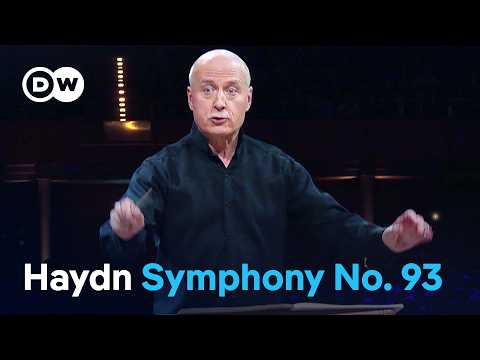
Do you know the symphony with the farting bassoons? That's noneother than Joseph Haydn's Symphony No. 93 in D major, (Hoboken I/93). It was performed here by the Deutsche Kammerphilharmonie Bremen under the baton of Paavo Järvi on July 3, 2023, at the Musik- und Kongresshalle Lübeck as part of the Schleswig-Holstein Music Festival.
(00:00) I. Adagio – Allegro assai
(07:17) II. Largo cantabile
(12:14) III. Menuetto. Allegro
(16:20) IV. Finale. Presto ma non troppo
Joseph Haydn (1732–1809) was one of the most influential composers of the Viennese Classical period, not least because he wrote more than 100 symphonies! Symphony No. 93 in D major (Hoboken I/93) is one of Haydn’s so-called "London symphonies." Between 1791 and 1795, the Austrian composer spent two extended periods in London, where his works delighted local audiences. Twelve of his symphonies were written at least in part during these visits or were premiered in the English capital; together, they have come to be known as the London symphonies.
Before his first trip to England, Wolfgang Amadeus Mozart (1756–1791) is said to have remarked to Haydn that he did not speak any English. Haydn’s now-legendary reply was that his language would be understood all over the world. This proved true of his musical language, which captivated London audiences. Symphony No. 93 was especially well received and was performed several times during Haydn’s stay in the city.
Since the manuscript of the Symphony No. 93 is considered lost, it was only later established — through reconstruction — that the work was most likely composed during Haydn’s first stay in London in 1791 and premiered there on February 17, 1792. The success of the Symphony in D major is also probably connected to the broader development of the symphonic genre. Although the genre had begun to take shape earlier, it was Haydn who brought it to full maturity and defined its classical form. A "classical symphony" is typically a four-movement orchestral work, consisting of an opening movement in sonata form, followed by a slow movement, a minuet and a fast finale. While later composers adopted this basic framework and then departed from it in countless ways, Haydn largely preserved the form itself. Within this structure, however, he composed with remarkable creativity and playfulness. By engaging with and subtly subverting listeners’ expectations, he introduced inventive surprises that delighted audiences and gave his music a distinctly cheerful character.
The most striking example of Haydn’s compositional humor in Symphony No. 93 occurs in the second movement, the largo cantabile. A tender, gallant theme is developed with mounting suspense, leading listeners to anticipate a final drumbeat that never arrives. Instead, the other instruments seem to grope awkwardly for a conclusion, growing ever quieter — until the bassoons abruptly interject with a loud, coarse note. Its unexpected and peculiar sound propels the movement forward once more (11:10–11:42). It's thanks to this that people still laugh about the "farting bassoons" of Haydn’s Symphony No. 93.
Text: Rita Kass
© 2023 C Major Entertainment
Watch more concerts in your personal concert hall: https://www.youtube.com/playlist?list=PL_SdnzPd3eBV5A14dyRWy1KSkwcG8LEey
in our playlist with famous symphonies: https://www.youtube.com/playlist?list=PL_SdnzPd3eBXvpOWNmQ1AUBPQeyNanpxY
and in our playlist with masterpieces from the classical period: https://www.youtube.com/playlist?list=PL_SdnzPd3eBX17Jic5IUJQle18jrnZAof
Subscribe to DW Classical Music: https://www.youtube.com/dwclassicalmusic
#haydn #symphony #classicalperiod
Más info en https://ift.tt/PBEJyTC / Tfno. & WA 607725547 Centro MENADEL (Frasco Martín) Psicología Clínica y Tradicional en Mijas. #Menadel #Psicología #Clínica #Tradicional #MijasPueblo
*No suscribimos necesariamente las opiniones o artículos aquí compartidos. No todo es lo que parece.

No hay comentarios:
Publicar un comentario