
Dear Classical Wisdom Reader,
Last week, I accidentally took the family to the wrong city...and by family, I don’t just mean my small trio, but my in-laws as well.
You see, we are currently exploring Japan, a place I hope we can all agree is a very easy place to get lost. Unfortunately for our group, as the only one possessing the necessary data on my phone, I was the navigator by default. It was assumed that I knew where to go...the only problem was, I didn’t.
And so, instead of directly returning to our accommodation in Osaka, we ended up in Kyoto. Our 40 minute journey became two and half hours...
You can imagine how popular that made me!
To be fair, this was not the first time. On my first trip to Edinburgh, I somehow found myself in Glasgow. On another occasion, I arrived at Luton Airport when I was meant to be at Stansted. And there was that time dear husband and I planned to drive directly from Larissa to Athens, only to find ourselves unexpectedly exploring rural villages far west of our destination, “driven time and again off course,” as Homer himself might report it.
Of course, this is all part and parcel of the travel experience. No matter how carefully you plan and organize, things inevitably go wrong. The well-seasoned traveler anticipates this, rolls with the punches and even budgets a certain amount of chaos into the program.
This is because at the heart of traveling is the acceptance of not knowing. It is impossible to know in advance all of the factors of a place we’ve never been to before. Whether it’s the next town, state, province, or country, upon arriving in a new place, we position ourselves as novices, open up our minds, and happily embrace that which we do not know.
In this way, traveling becomes a short cut to an essential philosophical premise, one that famously goes back to Socrates himself.
Bring the wisdom of the ancients into your life… Subscribe to unlock all our resources, including in-depth articles, podcasts, magazines and more:
Regular readers will recall the origin story of the gadfly of Athens. It began, like many ancient tales, with the Oracle of Delphi. The Pythian prophetess said that there was not a man wiser than Socrates, a prophecy he could not understand. He knew that the gods don’t lie, but at the same time he was aware of possessing no wisdom “great or small”. And so he began his journey to solve the divine paradox and questioned the politicians, the poets, and the craftsmen of Athens... often with comical results.
Socrates ultimately concluded that the oracle was indeed correct. The so-called ‘wise people’ he interviewed were not wise like he was, claiming as they did to know that which they simply did not know.
As he famously explains in Plato’s Apology:
“I am wiser than this man; it is likely that neither of us knows anything worthwhile, but he thinks he knows something when he does not.”
It is important to note that this is not quite the popular refrain, “I know that I know nothing.” Socrates does possess knowledge and wisdom. He knows that he knows something, as he carefully demonstrates in the dialogues. What he refuses to do is claim knowledge he does not have. As he says in the Apology, “I do not suppose that I know what I do not know.”
These discussions were immortalized in Plato’s dialogues, where, with consummate wit and philosophical precision, Plato portrays his teacher humbly accepting his limitations. This intellectual humility becomes a model for students and readers alike. Only once we acknowledge what we do not know can we open our mind and begin to learn.
It was an important lesson not only for Socrates and Plato, but also for later thinkers. The slave-turned-Stoic philosopher Epictetus remarks in Discourses (Book II, Chapter 17):
“It is impossible for a man to learn what he thinks he already knows.”
This seems evident, a common sense phrase that should not need further investigation... and yet, we live in a culture that does not embrace “I don’t know.” Indeed, it is the exact opposite! Fueled by social media, 24/7 media cycles, and polarised politics, we are encouraged to have a strong position right away, without much (or any) knowledge on the subject at hand. The social pressure to change an icon to a certain flag, stance or phrase is immense, a contagion urging us to react, not reflect.
This dynamic is intensified by the public and permanent nature of our declarations. Opinions are posted instantly for all to see. But these widespread announcements, which can live forever online, make it hard to subsequently change opinions, even as new information comes to light.
It means the important conversations, ones geared towards understanding and a shared telos – or goal of truth – don’t take place.
And the tragic part in all of this is that those who have the least knowledge are often the loudest. In the words of Charles Darwin, The Descent of Man:
“Ignorance more frequently begets confidence than does knowledge.”
Today we recognize this as a cognitive bias known as the Dunning-Kruger effect, in which individuals with limited competence in a particular domain dramatically overestimate their own ability.
It is perfectly explained in this brilliant chart:
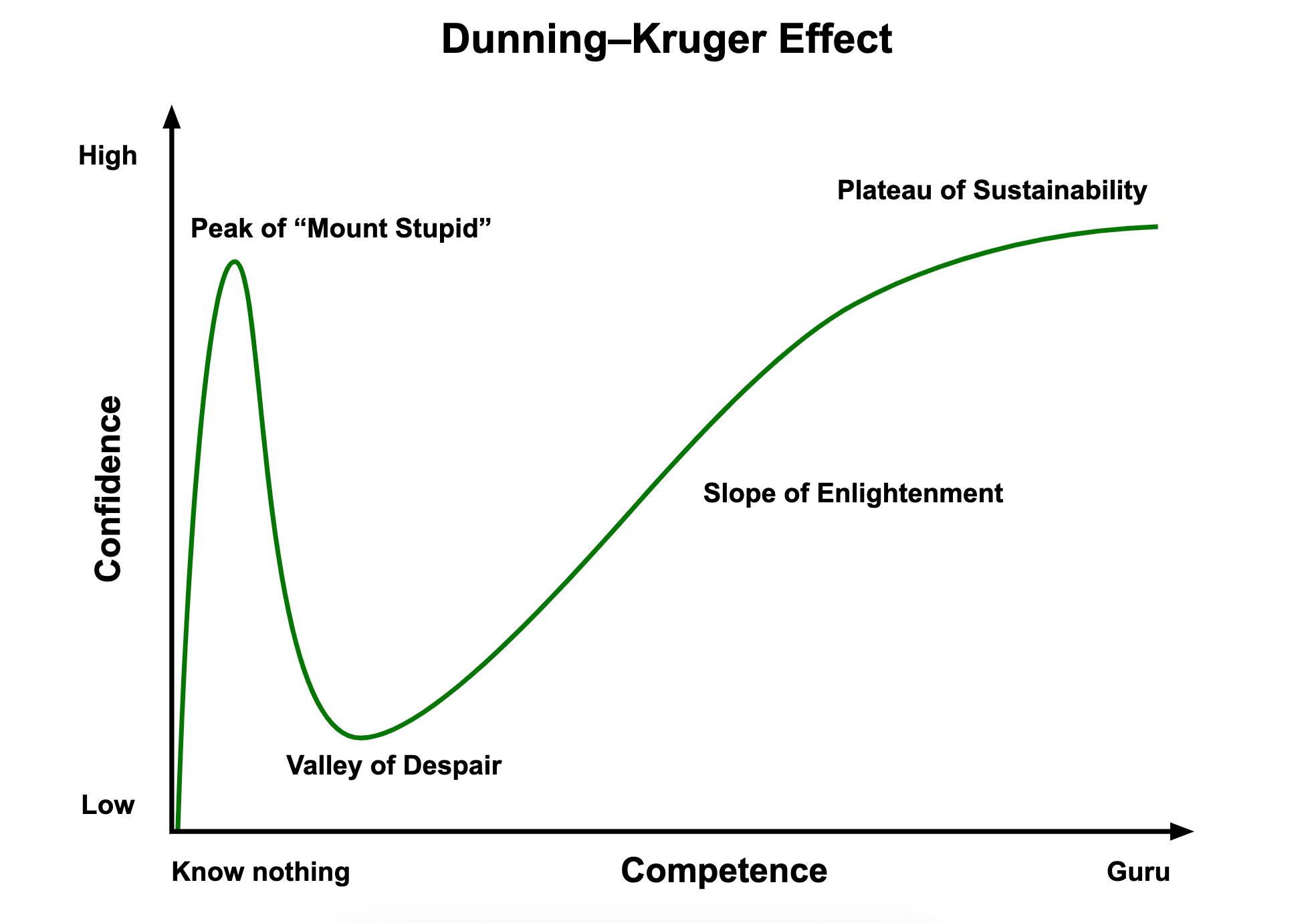
This occurrence stems from a lack of “metacognition”, the ability to recognize one’s own lack of knowledge. If you are currently thinking of a neighbor or associate to whom this applies, resist the temptation to feel too smug! It actually happens to everyone, especially (and somewhat paradoxically) intelligent people. That is, those who excel in one area often assume they possess similar expertise in others, despite lacking the requisite knowledge and skills.
We see this frequently when celebrities, brilliant within their own field, confidently opine on complex political or economic matters far removed from their expertise, often with predictable results.
So how do we become okay with not knowing? How can we be like Socrates, comfortable not claiming that which we don’t know? After all, the reality is that not knowing something can be very frustrating. It is an exercise in discomfort.
Whenever we leave our comfort zones, either physically or mentally, we are allowing ourselves to learn more. I usually like to compare this experience with reading William Faulkner’s The Sound and the Fury. Upon opening the first page, the reader will be completely lost and confused. Instead of fully trying to make sense of it, it is best to simply wade in and allow oneself to be immersed in the words. As the book unfolds, so too does the meaning and understanding... as well as the reward.
Support bringing ancient wisdom to modern lives. Subscribe today and be a part of the Classics Comeback!
The same is true when it comes to navigating a new place. Walking down an unfamiliar street becomes an adventure, an onslaught of new stimuli, sounds, sights, and scents. Attempting to figure out the hot water heater or the elaborate toilets in Japan is hard, but also, once you lean into it, fun. Daily life become a puzzle, a riddle, a brain teaser. Each small task, whether purchasing metro tickets or procuring cheesecake from a vending machine, begins with the admission that you do not yet know how this works.
And that’s ok!
It may become easier as familiarity grows, but either way it offers a splendid opportunity to practice the Socratic art of intellectual humility.
Being lost is uncomfortable. Making peace with not knowing is difficult. But it is also the very first step toward wisdom.
At least that is what I will be telling myself shortly, as I attempt to navigate the Tokyo metro. Wish me luck!
Más info en https://ift.tt/urm89xE / Tfno. & WA 607725547 Centro MENADEL (Frasco Martín) Psicología Clínica y Tradicional en Mijas. #Menadel #Psicología #Clínica #Tradicional #MijasPueblo
*No suscribimos necesariamente las opiniones o artículos aquí compartidos. No todo es lo que parece.

No hay comentarios:
Publicar un comentario