
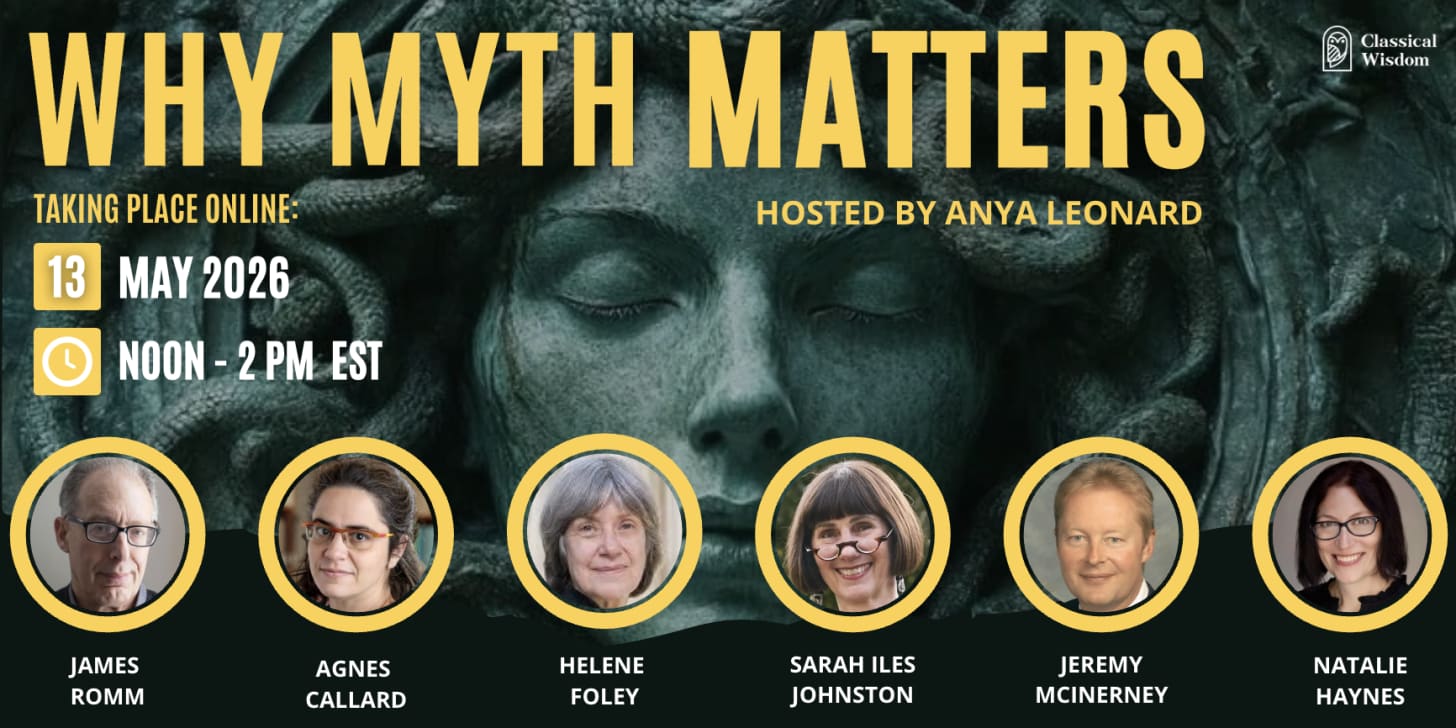
<p>Dear Classical Wisdom Reader,</p><p>It is easy to explain to a child why myths matter.</p><p>These ancient stories are brimming with brave heroes, clever princesses, and terrifying monsters that captivate the imagination. Like sweet ambrosia for the mind, they offer an irresistible escape from the mundane, with characters who embody both lofty ideals and relatable complexity.</p><p>And yet, somehow, trying to explain to adults why legends forged thousands of years ago are so critical and profound is trickier: they have often lost the wonder and sympathy that brings the characters and their hardships alive...</p><p>Indeed, we have entered an era in which myths have lost their central place in modern society...or at least the myths of the ancient world have. As early as the 18th century, there was a purposeful divergence from religious and mythological explanations of the world toward more scientific and rationalist frameworks.</p><p>Myth came to be seen in contrast to the rationality of the Enlightenment, and so the stories of the ancients lost their prominence in education and discourse, along with their deeper meanings.</p><p>Nonetheless, the fundamental need for myth in all its multifaceted forms, as social cohesion and as embodiments of human hopes, dreams, and fears, still remains. We continue to seek archetypes and binary plots in superhero films, pop culture icons, and graphic novels.</p><p>The study of myth is still profoundly relevant today, even if most are not aware of it.</p><p><strong>But how were they created in the first place? And importantly to us today, how were they preserved?</strong></p><p><strong>Today’s in-depth member’s article delves into the origins of myth, the ancient memory technique that built civilization and a fascinating lesson from Albania...</strong></p><p>In fact, it’s a great precursor to our exciting event taking place next week.</p><p>Featuring an incredible lineup, we’ll be hosting three conversations that cover the full breadth of ancient myth and meaning. We’ll begin with myth in the ancient world, its role in society and its purpose then and now, before exploring the sordid story of Medea and concluding with how tragedy explores ethics and moral psychology.</p><div><figure><a href="http://why-myth-matters.eventbrite.ie"></a><div><a href="http://why-myth-matters.eventbrite.ie"></a><source type="image/webp"><a href="http://why-myth-matters.eventbrite.ie"><img src="https://substackcdn.com/image/fetch/%24s_!VbGu!,w_1456,c_limit,f_auto,q_auto:good,fl_progressive:steep/https%3A%2F%2Fsubstack-post-media.s3.amazonaws.com%2Fpublic%2Fimages%2Fb9c46b0f-5748-4b4c-98ec-a1b8bedf379e_1732x866.png" width="1456" height="728" alt=""></a></source><a href="http://why-myth-matters.eventbrite.ie"></a><div><a href="http://why-myth-matters.eventbrite.ie"></a><div><a href="http://why-myth-matters.eventbrite.ie"></a></div><a href="http://why-myth-matters.eventbrite.ie"></a></div><a href="http://why-myth-matters.eventbrite.ie"></a></div><a href="http://why-myth-matters.eventbrite.ie"></a></figure></div><p>It is a unique opportunity to hear from this impressive collection of philosophers, professors, and authors... and one we hope you won’t miss.</p><p>Make sure to secure your spot here:</p><p><a href="https://why-myth-matters.eventbrite.ie/"><span>Why Myth Matters</span></a></p><p>I hope you can join us!</p><p>All the best,</p><p>Anya Leonard</p><p>Founder and Director<br>Classical Wisdom</p><p>Classical Wisdom Members will receive the full recording of our upcoming event, including all three discussions with James Romm, Agnes Callard, Helene Foley, Natalie Haynes, Sarah Iles Johnston and Jeremy McInerney. </p><p>Members can also enjoy the transcript of the entire event. </p><p><em><strong>If you aren’t a member yet, make sure to subscribe today to access all our Classical Wisdom Resources:</strong></em></p><p><a href="https://classicalwisdom.substack.com/subscribe?"><span>Subscribe now</span></a></p><div><hr></div><h1><strong>How Myth Survived Before Writing</strong></h1><p><em>By Anya Leonard</em></p><p>Nowadays, we live a literate existence; over 87% of the world can read, a remarkable accomplishment in civilization.</p><p>Back in the Bronze Age, however, when many of the important codified myths were being created and first inscribed, the literacy rate was exceedingly low, likely under 1–2% of the population. For many of those ancient societies, such as those in Mesopotamia, Egypt, or the Aegean, literacy was primarily used for practical purposes, accounting, inscriptions, bureaucracy, and the like, rather than storytelling.</p><p>The existence of the oral tradition, in fact, meant literacy was not essential for the mass of the population.</p><p>By the Athenian Classical period, the literacy rate had improved to 10–20% of the population, but it would have consisted mostly of elite men, predominantly in urban areas. So while we see an uptick in those who could read and write (a trajectory that only increased in the Hellenistic and Roman eras), the majority of people, the ones telling stories to their children, passing long evenings with friends and family, or maintaining rituals far from urban centres, still relied on the oral tradition.</p><p>As literacy improved, the need to memorize the details of legends, characters, and plots subsided. Just as we rely on computers, calculators, and online resources today, so too did our ancestors outsource the cognitive demand to pen, paper, and papyrus.</p><p>Today, oral traditions still exist, but they are often fragmented and faded, replaced by cartoon and pixelated visions, or hidden away in remote places...vestigial communities sought out by anthropologists looking for well-preserved rituals and windows into our past.</p><p>Indeed, it was the British philosopher and logician Bertrand Russell who suggested that we can, in fact, travel in time by traversing distances. As described in his <em>Skeptical Essays</em> (1928):</p><blockquote><p>“A European who goes to New York and Chicago sees the future, the future to which Europe is likely to come if it escapes economic disaster. On the other hand, when he goes to Asia he sees the past. In India, I am told, he can see the Middle Ages; in China he can see the eighteenth century.”</p></blockquote><p>The modern traveler who marvels at the streets of the Pudong district in Shanghai or cautiously explores South Shore will no doubt attest to the fact that Mr. Russell’s coupling of countries and centuries is comically outdated...</p><p>Nonetheless, his observation that different eras can still be found around the world rings true, and so, with that in mind, we will take a trip to the Balkans... or rather, we will accompany two professors on their journey 100 years ago to travel back two and a half millennia.</p><h3><strong>Lessons from Albania</strong></h3><p>One can only imagine the looks of confusion and surprise borne by the local farmers in the remote mountain villages of Bosnia, Macedonia, Hercegovina, and Croatia when, in 1933, a pair of young Americans came to town.</p><p>The then 31-year-old Milman Parry from California and his 21-year-old assistant, Albert Lord of Massachusetts, carried with them a strange device: flat phonographs made entirely of aluminum.</p>
<p>
<a href="https://classicalwisdom.substack.com/p/the-ancient-memory-technique-that">
Read more
</a>
</p>
<p><a href="https://classicalwisdom.substack.com/p/the-ancient-memory-technique-that" target="_blank">- Enlace a artículo -</a></p>
<p>Más info en https://ift.tt/mfd60ku / Tfno. & WA 607725547 Centro MENADEL (Frasco Martín) Psicología Clínica y Tradicional en Mijas.
#Menadel #Psicología #Clínica #Tradicional #MijasPueblo</p>
<p>*No suscribimos necesariamente las opiniones o artículos aquí compartidos. No todo es lo que parece.</p>

No hay comentarios:
Publicar un comentario