
Dear Classical Wisdom Reader,
What does it really mean to be free?
Today, freedom is often wrapped up in choice, such as where we live, what we buy, what we say online. We are prone to view it in superficial and tangible terms, things outside ourselves... But for Epictetus, a man born into bondage around 55 AD in the Roman Empire, freedom had nothing to do with external circumstances. Freedom was the ability to control your own mind, your judgments, and your actions.
Indeed, Epictetus describes a scene where a slave holds back a sneeze while his master gorges himself greedily, and asks who really has control?
So today we’ll investigate what is truly freedom, and how it can be achieved, according to Epictetus.
And of course, I’m always eager to hear from you! Does Epictetus’ definition of freedom hold up? Is it simplistic, idealistic, reactionary to his circumstances, or an important world view that can help us all? Read on below and comment if you think his ancient approach is applicable in our modern lives...
All the best,
Anya Leonard
Founder and Director
Classical Wisdom
Find freedom within yourself. Subscribe to the Classics and let the wisdom of the ancients guide you:
Epictetus: The Stoic-Slave Who Taught the World to Be Free
By Edward Whelan
Stoicism was one of the most influential schools of thought in the ancient world—and remarkably, its influence still resonates today. From military strategy to modern psychology, Stoic ideas continue to shape how we think about life, virtue, and resilience. Among its greatest voices stands Epictetus, a man born into bondage who went on to become one of the clearest and most practical minds in the history of philosophy.
The Life of a Stoic
Epictetus was born around 55 AD in Phrygia, in what is now southern Turkey. At some point in his early life, he became a slave. Records suggest he was owned by Epaphroditos, a wealthy and powerful freedman in the court of Emperor Nero. Although a former slave himself, Epaphroditos held great sway in Roman society...an irony not lost when we consider Epictetus' later views on true freedom.
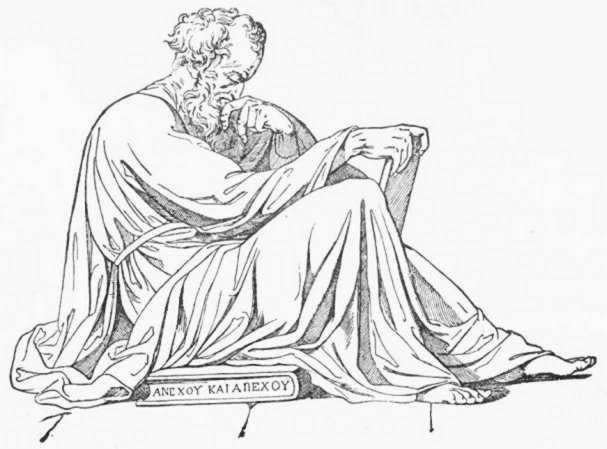
According to one story, Epictetus was crippled by a cruel master. Others say he was born with a disability. Either way, he walked with crutches and bore a physical reminder of life’s harshness. Yet, despite his lowly status, Epaphroditos allowed Epictetus to study under the Stoic philosopher Musonius Rufus. When his master died, Epictetus was freed and began teaching philosophy himself.
His timing, however, was not ideal. In 93 AD, Emperor Domitian expelled philosophers from Rome, forcing Epictetus into exile. He settled in Epirus, in northwestern Greece, and established a school that soon attracted students from across the empire. Even emperors were said to seek his counsel.
Though admired by the elite, Epictetus lived modestly. He shunned wealth, status, and comfort, preferring to be alone, surrounded not by riches but by reason.
The Stoic Message
What made Epictetus’ philosophy so powerful wasn’t just his clarity—it was his insistence that philosophy had to be lived, not just studied. His teachings, preserved by his student Arrian in the Discourses and the Enchiridion, center on one core idea: Know what is within your power, and let go of what is not. He writes:
“Some things are in our control and others not. Things in our control are opinion, pursuit, desire, aversion, and, in a word, whatever are our own actions. Things not in our control are body, property, reputation, command, and, in one word, whatever are not our own actions.” ~ Epictetus, Enchiridion
It’s deceptively simple advice. Focus only on what you can change: your thoughts, your choices, your actions. Accept everything else as fate. For Epictetus, this wasn’t passive resignation...it was a call to develop inner strength. We cannot control the role we’re given in life, but we can choose how we play it. To live in harmony with nature and reason is to live in accordance with the divine order.
This belief in a rational cosmos, where each person has a role, formed the heart of his ethical vision. If we respond to life with reason rather than emotion, we rise above misfortune. If we master our inner world, we are truly free—regardless of our outer circumstances.
“You may be unconquerable,” he said, “if you enter into no combat in which it is not in your control to conquer.”

Philosophy in Practice: The Three Disciplines
Epictetus was not interested in abstract speculation or clever metaphysics. For him, philosophy was a tool, a way to live better, to suffer less, and to become truly free. Ideas alone were not enough. Wisdom had to be lived, tested, and practiced. To that end, he outlined three essential disciplines that formed the backbone of Stoic training. These weren’t just mental exercises; they were guides for daily life, a way of aligning thought and action with nature and reason.
The Discipline of Desire
At the heart of this discipline is a simple but powerful insight: not everything we want is worth wanting. According to Epictetus, true peace comes when we learn to desire only what is good, meaning, what is virtuous and within our power. Craving things we can’t control, whether it’s fame, fortune, or someone else’s approval, only invites disappointment and inner turmoil. A wise person learns to trim their desires to fit the shape of reality, not the other way around.
The Discipline of Action
Next comes the question of how we live in the world. While we cannot dictate outcomes, we can choose how we act. Epictetus urged his students to act with purpose, guided not by the promise of results but by the integrity of their intentions. Whether in daily chores or public duties, it’s not success or failure that defines us; it’s whether we remain faithful to our values. Right action, not perfect results, is the aim.
Act Now! Support the Classics!
The Discipline of Assent
Finally, there is the matter of judgment; how we interpret what happens to us. Events themselves are neutral, but the meaning we give them can lift us up or weigh us down. Epictetus taught that we must be cautious with our first impressions. An insult, for instance, is only harmful if we agree that it is. Mastering the discipline of assent means pausing before we react, examining our thoughts, and choosing which ones deserve our agreement. In doing so, we gain control not only of our responses, but of our inner life.
Lasting Influence
Epictetus’ legacy is far-reaching. Many believe he crafted the most practical and coherent version of Stoicism. His ideas profoundly influenced Marcus Aurelius, the philosopher-emperor whose Meditations still guide leaders and thinkers today.
The Enchiridion was translated into Latin during the Renaissance and embraced by Christian humanists who found it surprisingly compatible with their faith. Thinkers like Pascal and Descartes admired his clarity, and his work has inspired generations of soldiers, scholars, and psychologists alike. In fact, Cognitive Behavioral Therapy, a cornerstone of modern mental health care, owes much to Epictetus’ insights on belief, emotion, and control.
But perhaps his greatest legacy is the message that freedom isn’t granted by others or dictated by circumstance. It lies within. Epictetus, once a slave, became one of history’s most powerful advocates for self-mastery. He taught that the path to true liberation doesn’t begin with political revolution or material success...it begins with the mind.
“But, for your part, don’t wish to be a general, or a senator, or a consul, but to be free; and the only way to this is a contempt of things not in our own control.”
In a world still chasing power, status, and control, Epictetus reminds us that the most important conquest is the one within.
Más info en https://ift.tt/SOw7TD4 / Tfno. & WA 607725547 Centro MENADEL (Frasco Martín) Psicología Clínica y Tradicional en Mijas. #Menadel #Psicología #Clínica #Tradicional #MijasPueblo
*No suscribimos necesariamente las opiniones o artículos aquí compartidos. No todo es lo que parece.

No hay comentarios:
Publicar un comentario