
Dear Classical Wisdom Reader,
It’s a way of life, really.
There’s a tendency these days to think of philosophy as something very removed from our day-to-day lives, little more than dusty books lying forgotten on a shelf.
Yet nothing could be further from the truth.
Philosophy is reflected in how we live, the choices we make, and what we do. Philosophy is our day to day lives.
And Hipparchia is a perfect example of this. She was an ancient philosopher who refused to let her life be limited by the conventions of her time.
You could say she’s something of a female Diogenes: much like the famed barrel-dwelling philosopher, Hipparchia was a Cynic, and they both lived their lives in a way that directly reflected that philosophy.
Which is to say, they both lived very colorful lives.
She was also a key figure in the history of Stoicism, directly meeting and influencing the movement’s founder, Zeno of Citium.
And while certain stories about her life may seem a little, shall we say, extreme, the story of Hipparchia shows philosophy not as something abstract, but rather hardwired into our lives.
And it remains so today: For a look at how ancient philosophy can tell us about the modern world, Members can check out our exclusive podcast on Why Plato Matters Now with Professor Angie Hobbs, a Classical Wisdom regular and frequent guest on the much-loved In Our Time BBC radio series.
She discusses with Anya how Plato speaks across the centuries to our current cultural moment, in ways that are eye-opening, surprising, and even alarming!
It’s a fascinating discussion about the essential and enduring nature of philosophy, so don’t miss out.
Now, to find out how to live your philosophy…
All the best,
Sean Kelly
Managing Editor
Classical Wisdom
Hipparchia: The Female Philosopher Who Defied Convention
Written by Ed Whelan
Many women have made an important contribution to philosophy, and one of the most famous female philosophers is Hipparchia (fl. 300 B.C.). Married to a leading Cynic philosopher, Hipparchia greatly contributed to the development of Cynicism and helped popularize it in the Classical world.
Ancient Cynics sought ‘peace of mind’ by living according to nature. They rejected contemporary civilization and society and also all comforts and amenities. They believed that living a natural life was the only way to live ethically, as civilization was corrupt. They taught that humans only needed the basics required for survival.
Cynics abandoned all material possession and only wore simple clothes. They begged for their food, and mocked those who lived a conventional lifestyle, especially the rich. They aimed to live their philosophy, and in so doing teach people to live in accordance with nature.
Hipparchia’s Life
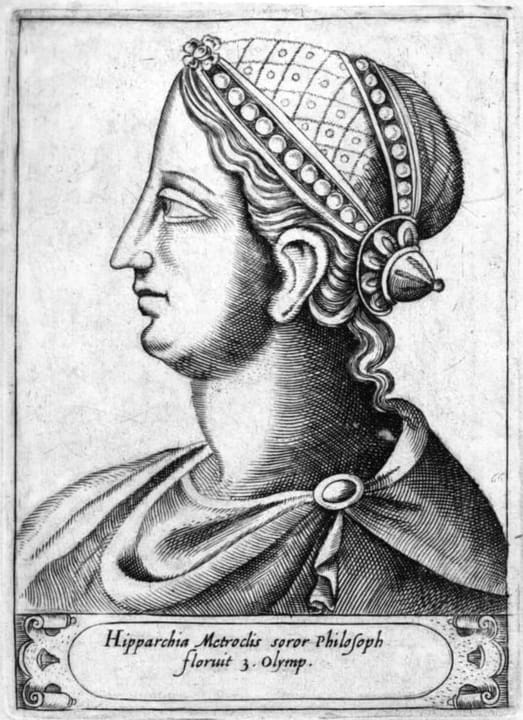
Hipparchia was born sometime between 340-320 BC. Her family hailed from Maroneia, which is in Thrace, and were members of the local aristocracy. According to ancient sources (which may have sensationalized her life), she refused to conform and was something of a rebel. Her younger brother Metrocles was sent to Athens to study rhetoric and philosophy, where he became attracted to the Cynic school. He introduced his sister to it, who then embraced their doctrines.
Around this time she came into contact with Crates, an Athenian, who is widely seen as one of the greatest of all the Cynic thinkers. Hipparchia fell madly in love with Crates and she demanded that they marry, which was very unconventional. He was reluctant, and he only agreed to marry her when she threatened suicide.

According to one source, the couple consummated their marriage in public, which was in keeping with the Cynics’ call to live naturally. The marriage was unconventional because, contrary to Greek norms, Hipparchia was very independent and appeared with her husband in public. She had several children with Crates and also managed the household.
Hipparchia also attended public debates and argued for the equality of the sexes. In many ways, she was a liberated woman in a society that was patriarchal, and even misogynistic. It is believed she raised her children to also live according to Cynic teachings. She was famous in her own time, with Diogenes urging her native city of Maroneia to change its name to Hipparchia in her honor.
The Philosophy Of Hipparchia
It is recorded that Hipparchia wrote many philosophical works, but they have all been lost. Indeed, almost all we know about this remarkable female philosopher comes from later Greek and Byzantine sources. It appears that Hipparchia helped to refine important aspects of Cynic thought.
She was known for her brilliant use of the rhetorical trope known in Greek as spoudogeloion. This was a syllogism that used humor to reveal some idea or argument and was often used to discredit conventional beliefs. Hipparchia used these to refute arguments about the natural inferiority of women.
Want to discover more ancient philosophy?
Become a Member! Discover Why Plato Matters Now in our exclusive podcast with Professor Angie Hobbs.
You’ll also gain access our VAST library of e-books, magazines, in-depth articles, as well as our previous episodes of the ‘Podcasts with Professors’ series.
So don’t miss out!
She was also famous for her promotion of the Cynic concept of anaideia (shamelessness). The Cynics believed that shamelessness was necessary so that people could overcome conventions and live as natural as animals and birds. Hipparchia embodied the concept of anaideia, as she refused to act like a ‘respectable’ woman. A good example of her anaideia was when she won a debate and her opponent tried to strip her naked. She did nothing and was quite happy to be seen naked, which was contrary to all social norms. Hipparchia came to personify Cynic doctrines. Her commitment to poverty and a life of simplicity won her many admirers, even among those who denounced the philosophies.
The Influence Of Hipparchia
Across history, many writers and philosophers have been fascinated by Hipparchia. Her views on the need to live in harmony with nature influenced Zeno of Citium, the founder of Stoicism. Indeed, Zeno was reported to have praised the wife of Crates in one of his lost writings. Of course, Stoicism went on to become influential in Hellenistic and later Roman civilization, and has become a cultural phenomenon in recent years.
Moreover, the life and thought of Hipparchia inspired many female philosophers, especially in the 20th and 21st century. She proved that philosophy was not just a male pursuit in the classical world. She made important contributions to the development of Cynicism. She embodied the very essence of the teachings, and she challenged the conventions of her time.
A butterfly, the Hipparchia, has been named after her. Considering her strong affinity with nature, she would have likely found this to be a great honor.

Más info en https://ift.tt/VBFWwCk / Tfno. & WA 607725547 Centro MENADEL (Frasco Martín) Psicología Clínica y Tradicional en Mijas. #Menadel #Psicología #Clínica #Tradicional #MijasPueblo
*No suscribimos necesariamente las opiniones o artículos aquí compartidos. No todo es lo que parece.

No hay comentarios:
Publicar un comentario