
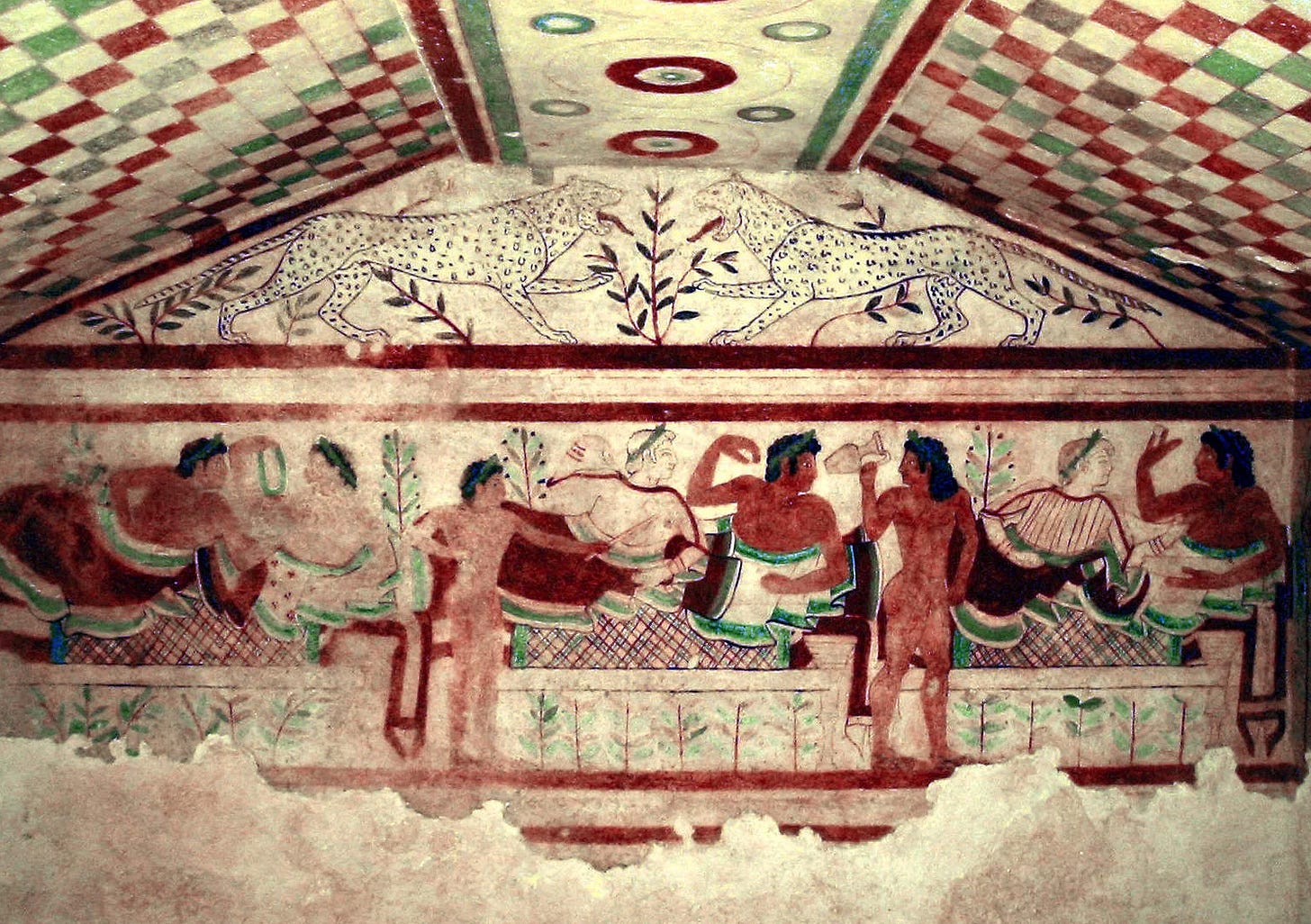
<p>Dear Classical Wisdom Reader,</p><p>The Romans really stole the spotlight from the Etruscans. </p><p>With their impressive empire, gory gladiators, swashing swords and sandals, perhaps it’s not surprising that Romans positioned themselves as history’s headline act, reducing those that came before them to a mere supporting position, a prelude to the main attraction.</p><p>Some go so far as to denote the Etruscans as proto-Romans!</p><p>But this does them a grave disservice...</p><p>The Etruscans, the peoples who lived by the Tiber river, had a fascinating and enigmatic culture. Their mysterious language and exotic ways capture the imagination both today and in the ancient world. Indeed, the Greeks thought them controversial and provocative, while the Romans found their predecessors alluring and inspirational.</p><p>So who were the Etruscans? What do we really know about them? And what has vanished with time?</p><p>Tragically much of their history has been lost, however, incredibly fascinating elements of the Etruscans still remain... in their cities of the dead.</p><p>Read on to discover the vibrant lives of the Etruscans found in their vast and vivid tombs in today’s Members article on Etruria: Life Among the Dead.</p><p>All the best,</p><p>Anya Leonard</p><p>Founder and Director<br>Classical Wisdom</p><p>~ Classical Wisdom Members can enjoy today’s full article, an in-depth look at the Etruscans and their impressive legacy… You might be surprised by just how much they influenced the Romans! </p><p>If you aren’t a member yet, but would like to access all our resources, such as our ebook library, Classical Wisdom Litterae Magazines and exclusive podcasts, then join today:</p><p><a href="https://classicalwisdom.substack.com/subscribe?"><span>Subscribe now</span></a></p><div><hr></div><h1><strong>Etruria: Life Among the Dead</strong></h1><p><em>By Mary Naples, author of<a href="https://www.amazon.com/Unsung-Heroes-Women-Ancient-World/dp/B0D49228ZD"> Unsung Heroes: Women of the Ancient World</a></em></p><p>Vividly painted figures recline at banquets, while prancing musicians fill the air with cheerful tunes on double flutes. A cast of characters imbibes and enjoys the domestic spaces of the home. But where are we, and what are we witnessing?</p><p>This scene unfolds in the sixth-century BCE necropolis of Tarquinia–located fifty miles (eighty kilometers) northwest of Rome. Tarquinia (Etruscan <em>Tarch’na</em>) was once a powerful city-state of the Etruscan League where approximately six thousand graves are carved into the tufa hillsides. </p><p>The tombs are opulent, adorned with wall paintings that unexpectedly celebrate life. They depict a vibrant realm filled with mystical creatures—leaping dolphins, gliding birds, and bearded serpents—accompanied by jugglers, musicians, dancers, and hunters engaged in festive banquets–-all breathing life into one of the most mysterious of ancient necropolises.</p><div><figure><a href="https://substackcdn.com/image/fetch/%24s_!vk1I!,f_auto,q_auto:good,fl_progressive:steep/https%3A%2F%2Fsubstack-post-media.s3.amazonaws.com%2Fpublic%2Fimages%2F2d4a3919-7942-4e90-afbe-c0fc0dcdaf30_1484x1046.png"></a><div><a href="https://substackcdn.com/image/fetch/%24s_!vk1I!,f_auto,q_auto:good,fl_progressive:steep/https%3A%2F%2Fsubstack-post-media.s3.amazonaws.com%2Fpublic%2Fimages%2F2d4a3919-7942-4e90-afbe-c0fc0dcdaf30_1484x1046.png"></a><source type="image/webp"><a href="https://substackcdn.com/image/fetch/%24s_!vk1I!,f_auto,q_auto:good,fl_progressive:steep/https%3A%2F%2Fsubstack-post-media.s3.amazonaws.com%2Fpublic%2Fimages%2F2d4a3919-7942-4e90-afbe-c0fc0dcdaf30_1484x1046.png"><img src="https://substackcdn.com/image/fetch/$s_!vk1I!,w_1456,c_limit,f_auto,q_auto:good,fl_progressive:steep/https%3A%2F%2Fsubstack-post-media.s3.amazonaws.com%2Fpublic%2Fimages%2F2d4a3919-7942-4e90-afbe-c0fc0dcdaf30_1484x1046.png" width="1456" height="1026" alt=""></a></source><a href="https://substackcdn.com/image/fetch/%24s_!vk1I!,f_auto,q_auto:good,fl_progressive:steep/https%3A%2F%2Fsubstack-post-media.s3.amazonaws.com%2Fpublic%2Fimages%2F2d4a3919-7942-4e90-afbe-c0fc0dcdaf30_1484x1046.png"></a><div><a href="https://substackcdn.com/image/fetch/%24s_!vk1I!,f_auto,q_auto:good,fl_progressive:steep/https%3A%2F%2Fsubstack-post-media.s3.amazonaws.com%2Fpublic%2Fimages%2F2d4a3919-7942-4e90-afbe-c0fc0dcdaf30_1484x1046.png"></a><div><a href="https://substackcdn.com/image/fetch/%24s_!vk1I!,f_auto,q_auto:good,fl_progressive:steep/https%3A%2F%2Fsubstack-post-media.s3.amazonaws.com%2Fpublic%2Fimages%2F2d4a3919-7942-4e90-afbe-c0fc0dcdaf30_1484x1046.png"></a></div><a href="https://substackcdn.com/image/fetch/%24s_!vk1I!,f_auto,q_auto:good,fl_progressive:steep/https%3A%2F%2Fsubstack-post-media.s3.amazonaws.com%2Fpublic%2Fimages%2F2d4a3919-7942-4e90-afbe-c0fc0dcdaf30_1484x1046.png"></a></div><a href="https://substackcdn.com/image/fetch/%24s_!vk1I!,f_auto,q_auto:good,fl_progressive:steep/https%3A%2F%2Fsubstack-post-media.s3.amazonaws.com%2Fpublic%2Fimages%2F2d4a3919-7942-4e90-afbe-c0fc0dcdaf30_1484x1046.png"></a></div><a href="https://substackcdn.com/image/fetch/%24s_!vk1I!,f_auto,q_auto:good,fl_progressive:steep/https%3A%2F%2Fsubstack-post-media.s3.amazonaws.com%2Fpublic%2Fimages%2F2d4a3919-7942-4e90-afbe-c0fc0dcdaf30_1484x1046.png"></a><figcaption>Confronted leopards above a banqueting scene in the Tomb of the Leopards, c. 480–450 BC.</figcaption></figure></div><p>Today, if the Etruscans are considered at all, it is for their funerary monuments; they have endured the ravages of time. Was this civilization, recognized for its banquets and celebratory feasts that are brightly depicted on the walls of their necropolises, obsessed with the notion of death? </p><p>Or is it simply that their funerary culture survives at the expense of their richly lived one? </p><p>How might our understanding of the Etruscans differ if their writings and buildings had survived as well as their tombs?</p>
<p>
<a href="https://classicalwisdom.substack.com/p/life-among-the-dead">
Read more
</a>
</p>
<p><a href="https://classicalwisdom.substack.com/p/life-among-the-dead" target="_blank">- Enlace a artículo -</a></p>
<p>Más info en https://ift.tt/prbs5Dj / Tfno. & WA 607725547 Centro MENADEL (Frasco Martín) Psicología Clínica y Tradicional en Mijas.
#Menadel #Psicología #Clínica #Tradicional #MijasPueblo</p>
<p>*No suscribimos necesariamente las opiniones o artículos aquí compartidos. No todo es lo que parece.</p>

No hay comentarios:
Publicar un comentario