

Frithjof Schuon repeatedly emphasized that the primary distinction in
universal metaphysics is that between Atma and Maya, between theAbsolute and the Relative. Like René Guénon before him, he explained
how the Divine Essence or ‘Beyond-Being’ alone is Absolute, and that ‘Being,’ the first auto-determination of Beyond-Being, is already relative. Whereas ‘Beyond-Being’ is God ‘Unqualified’ or ‘Unconditioned’ (Brahma nirguna in Sanskrit), ‘Being’ is God ‘qualified’ or ‘conditioned’ (Brahma saguna).
God as ‘Beyond-Being’ is the Supra-Personal God; God as ‘Being’ isthe Personal God (the Creator, Helper, and Judge). Unlike the Supra-Personal God (the Divine Essence), the Personal God is the Interlocutorwith Whom man can speak, and to Whom he can pray. Following
Vedantic doctrine, Schuon notes that Atma is Beyond-Being, ‘pure’ Maya is Being, and ‘impure’ Maya is Existence.[[1]] We have thus reached the classic ternary: Beyond-Being, Being, Existence. The first is absolute; the second and the third are relative.
the principle of Existence is Being, and the principle of Being is Beyond-Being … the primal distinction in question is known to the metaphysicians of all the great religions
God as Being, although already Maya (the relative), is nevertheless
the summit of Maya (or ‘pure’ Maya). This being so, Frithjof Schuonhas applied to Being the paradoxical term ‘the relative Absolute’, forthe good reason that the Personal God (who both judges and saves) isabsolute in relation to man. Every metaphysician who, intellectually,discerns Beyond-Being must nevertheless, humanly, obey the Personal
God. As expressed on the words of Christ, ‘No man cometh to the Father (Beyond-Being) but by Me (Being).’ Schuon has also designated ‘Being’, the ‘relatively Absolute’, as ‘the prefiguration of the relative in the Absolute’ – and thus, precisely, as the Creator.
To recapitulate in other terms; the principle of Existence is Being, andthe principle of Being is Beyond-Being.In expounding this basis of metaphysics, Schuon followed above allthe supreme Hindu metaphysician, Shankara (c. 788-820 A.D.); but theprimal distinction in question is known to the metaphysicians of all the
great religions. In Christianity, Meister Eckhart (c. 1260-1327), who loved paradoxical expressions (no matter how shocking or dangerous) said: ‘If I had to choose between God and Truth, I would choose Truth.’ Eckhart knew, not only that the Divine Essence is Truth, but above all
that ‘God’, in the sense in which he used the term, is ‘Being’, and therefore relative, whereas ‘Truth’ — again in the sense in which he used this term — is ‘Beyond-Being’ (die Gottheit), and therefore absolute.
In the Eastern Church, the same fundamental discernment also existed, and was expressed in its mystical theology. Nowhere does this emerge more clearly than in the writings of St. Gregory Palamas (1296-1359). Schuon examines Palamitic theology in detail in the first edition of his first book.[[2]]
The theology of St. Gregory Palamas — essentially apophatic and
antinomian — distinguishes between ‘God as He is in Himself' (kath’ ‘eautón) or the ‘Divine Essence’ (hyparxis) and ‘God as Being’ (Ousiá)
or the ‘Divine Energies’ (dynameis) — the latter being the uncreated attributes or powers through which Being acts and makes itself known.
This distinction corresponds exactly to that between ‘Beyond-Being’ and ‘Being’, as outlined above.
In ordinary Greek, the meaning of these terms fluctuates: ousiá is some-
times used to mean ‘essence’, and hyparxis is sometimes used to mean ‘life’, ‘existence’, or ‘substance’. However, in Palamitic theology, ousiásignifies, not the Divine Essence (the Absolute), but Divine Being (Godthe Creator). The Divine Essence, or ‘Beyond-Being’, on the other hand,
is kath’ ‘eautón, or hyparxis.
In the writings of St. Gregory Palamas, therefore, we encounter thesame fundamental metaphysical distinction that we find in Shankara,
Meister Eckhart, and Ibn 'Arabi.
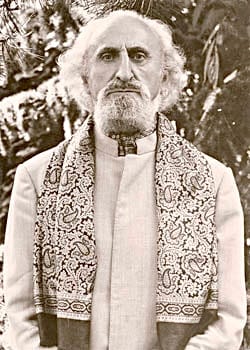
Schuon summarizes three different manners of envisaging the Trinity: one ‘vertical’ and two ‘horizontal’
In one of his most brilliant passages[[3]], Frithjof Schuon summarizes three different manners of envisaging the Trinity: one ‘vertical’ and two ‘horizontal’. The ‘vertical perspective’ envisages the three fundamental degrees of Reality (Beyond-Being, Being, and Existence); the ‘supremehorizontal perspective’, which starts from unity and perceives a trinity
within it, corresponds to the Vedantic ternary Sat-Chit-Ananda (‘Being-
Consciousness-Bliss’ or ‘Object-Subject-Union’); and the ‘non-supremehorizontal perspective’, which starts from a trinity and perceives a unitybehind it, envisages the three fundamental aspects or modes of PureBeing, namely, Being, Wisdom, and Will. This last is the Christian Trinity (Father, Son, and Holy Spirit), as conceived by ‘ordinary’ (i.e., non-metaphysical, non-mystical) theology.
for the Orthodox, God the Father is the sole causal principle of the procession of the Persons or Hypostases
One of the best known Russian Orthodox theologians of the 20th century was Vladimir Lossky (1903-1958), who spent much of his life asprofessor at the Orthodox Institute of Paris. In his writings on the Trinity,[[4]] Lossky espouses two separate Trinitarian doctrines, one in keeping with the ‘vertical perspective’, and one that sticks firmly to the ‘non-supreme horizontal perspective’ (in the terminology of Schuon).
According to Lossky, the Palamitic doctrine of the divine Being (Ousiá) — or the ‘Divine Energies’ (dynameis) — has a bearing on, but is
nevertheless distinct from, the customary Orthodox theological doctrineof the Trinity. Whereas, according to Catholic doctrine, the Holy Spiritproceeds from the Father and from the Son (ex Patre Filioque), according to Orthodox doctrine, the Holy Spirit proceeds from the Father alone (ek mónou tou Patròs, a Patre solo). In other words, for the Orthodox, God the Father is the sole causal principle of the procession of the Persons or Hypostases.
At the same time, Lossky (following Palamas) says that God the Father is the principle of the ‘self revelatory procession of the Energies in the Holy Spirit through the Son’. This is something quite different, and Lossky himself makes a cardinal distinction between these two operations: ‘Personal or hypostatic procession’ (which he views in the ‘horizontal’ manner of ordinary Eastern Orthodox theology) and ‘Energetic procession’ (which he views in the ‘vertical’ manner of Palamitic theology).
(Per Lossky) ‘The Father reveals His nature through the Son, and the Godhead of the Son is manifested in the Holy Spirit’
However, he arbitrarily attributes primacy to the former and, in its regard, speaks — most ‘unmetaphysically’ — of ‘the self-existence of the Trinity’ in which there is ‘an absolute identity of Essence and an absolute diversity of Persons’. According to Lossky, this absolute diversity of the Persons is nevertheless ‘covered’ or ‘safeguarded’ by the underlying ‘mon-archy’ of the Father, who is the sole principle of Son and Holy Spirit alike — something that is made clear by the Greek expression ek mónou tou Patròs (a Patre solo), namely the procession of the third Person of the Trinity ‘from the Father alone.’ For Lossky, this is the basic doctrine, and it is only from the starting-point of this conception that one may proceed to the second-mentioned mode of the Trinity, namely, the ‘self-revelation’ of God through His ‘Energies’. From this Palamitic point of view of ‘Energetic procession’, he allows that the Godhead is revealed in the Holy Spirit ‘through the Son’ (dià Hyiou, per Filium), and states: ‘The Father reveals His nature through the Son, and the Godhead of the Son is manifested in the Holy Spirit’. He continues: ‘In the order of divine manifestation, it is possible to establish the order (táxis) of the Persons.’ Here the Persons obviously constitute a hierarchy, and are not equal to each other.
Lossky clearly retains a ‘vertical’ conception of the Trinity; but ... he illogically subjects this to the other mode of the Trinity, that of ‘Personal procession’
In his exposition of ‘Energetic self-manifestation’, therefore, Losskyclearly retains a ‘vertical’ conception of the Trinity; but, as mentionedabove, he illogically subjects this to the other mode of the Trinity,that of ‘Personal procession’, which he views in a purely ‘horizontal’ manner: here the Persons are equal, there is no priority orposteriority amongst them, and there is absolute diversity betweenthem. One is tempted to say that as far as ‘Energetic procession’ isconcerned, Lossky retains Palamas's apophatic point of view, butwhen he comes to deal with ‘Personal procession’, he gets caught inthe snares of ‘ordinary’ Eastern Orthodox theology — to no less adegree than the non-metaphysical Western theologian gets caught inthe snares of ‘ordinary’ Catholic theology.[[5]]In seeking to excuse these logical contradictions, Lossky, like manyother theologians, takes refuge in the unconvincing stratagem of attributing them to the ‘mystery’ of the Christian revelation — as if Divine mystery were a justification for illogic. Illogic does not ‘safeguard’ mystery, but dishonors it. Divine mystery is greater than logic, not less than it. The error is to think that illogic can in some way ‘symbolize’ this fact.One can nevertheless be grateful to Lossky for his exposition of the
Palamitic doctrine of Energetic procession, even though he seeks immediately to upstage it with the ‘ordinary‘ theological viewpoint on Personal procession — a reflex (and quite unnecessary) failure of nerve and of logic only too familiar in confessional theology. On Energetic procession, Lossky expounds St. Gregory Palamas well, even if, unfortunately, he feels compelled to stifle the implications of his apophatism and antinomianism.

The theological knots are marvelously unraveled by Schuon, who, on
the subject of the Filioque, writes:
“As regards the divergences between Latins and Greeks, we would maintain that the two opposing conceptions are equally true, as always happens in the case of what one might call ‘extrinsic heresies’, i.e. of doctrines which in themselves are orthodox, but which appear ‘heretical’ in relation to another equally orthodox doctrine; thus, the Filioque of the Latins is justified, since the Father has nothing which he does not share with the Son, and on the other hand, the rejection of the Filioque by the Greeks is justified because the Son, as such, is not the Father; indeed their distinction is affirmed precisely by the different modes of ’procession’ of the Holy Spirit: the Holy Spirit ‘proceeds’ from the Son in so far as the Son is God, but is only ‘delegated’ by the Son in so far as the latter is an ‘internal mode’ of the Divinity so that the Son's ‘delegation’ of the Holy Spirit is nothing other than a mode of His procession from God. St. John of Damascus expressly affirms: ‘We say that the Holy Spirit proceeds from the Father, and we call Him Spirit of the Father; we in no wise say that the Spirit proceeds from the Son, but only that He is Spirit of the Son.’ To say that the Holy Spirit also proceeds from the Son amounts in a certain sense to saying that the Son is the Father; if the Latins have not hesitated to attribute the procession of the Spirit also to the Son, it is because, as Essence, the Son is indeed identical to the Father. We say ‘as Essence’ and not ‘as God’ because God is not uniquely Essence, but also comprises ‘modes’ or ‘degrees’ known in theological language as ‘Persons’; the term ‘Essence’ consequently docs not designate the whole Divine Reality, otherwise the Trinity would not be God.”
“Let us also note here that religious schisms — which must not be confused with heresies in the absolute sense — always arise from the inability of the religious point of view to synthesize two divergent — but complementary — perspectives within the framework of one and the same integral truth.”[[6]]

Still on the divergence between the Greek ek mónou tou Patròs (‘from
the Father alone’) and the Latin ex Patre Filioque (‘from the Father and
from the Son’), Schuon brilliantly illuminates both by means of a geometrical image. Schuon refers to God as ‘Absolute-Infinite-Perfect.’ The Absolute can be represented by a point, the Infinite by the radii emerging from that point, and the Perfect by a circumference, which the radii pierce.
This image also serves to express the Christian Trinity: the Father isthe point; the Holy Spirit is the radii; and the Son is the circle (through
which the radii pierce).
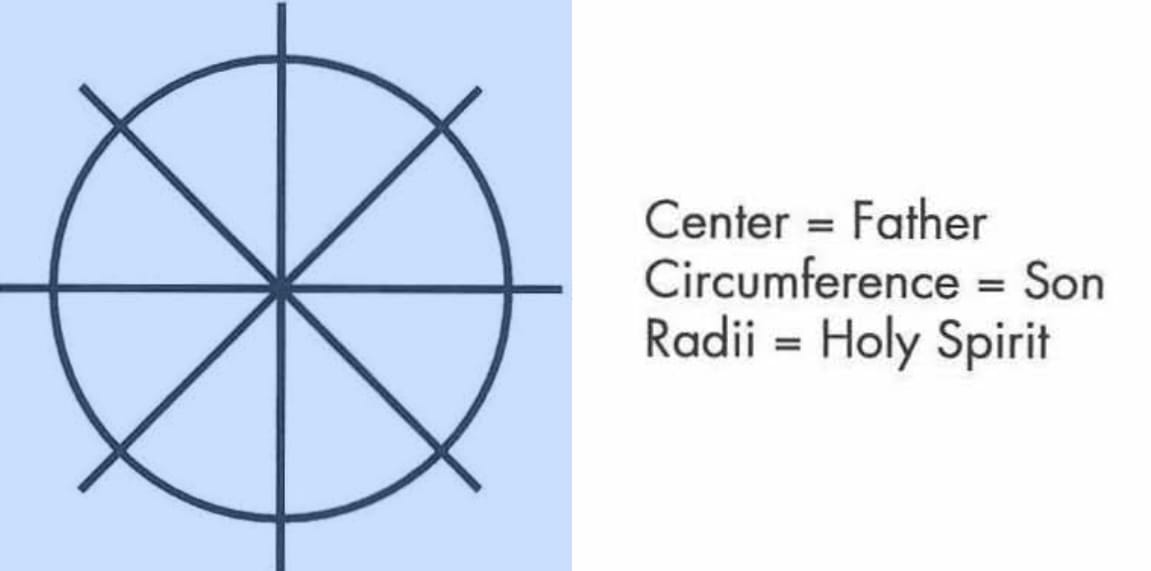
On the basis of this image, the two divergent views on Procession canbe expressed as follows: The Greeks look at the radii proximal to thecircle and perceive that they proceed from the Father alone; the Latinslook at the radii distal to the circle and perceive that they do indeed
proceed form the Father but that, passing through the Son, they ipso
facto proceed from Him also; hence the reason for, and the meaning of,
the Filioque.[[7]]

The Eastern Church has always been unhappy with what it calls Western ‘innovations’
The Eastern Church has always been unhappy with what it calls Western ‘innovations’ — from the Filioque of the early centuries down to the declaration of Papal infallibility at the Vatican Council of 1870. The Eastern Orthodox Church accepts the principle of infallibility, but does not believe that it is invested solely in the occupant of the See of Peter (Rome), whom it recognizes only as primus inter pares, but not as possessing final authority.
The Filioque did not appear in the ancient creeds, but was promotedby the Franks and the Spanish from the 6th century onwards. From thevery beginning, it was opposed by the Greeks as an innovation and,from their point of view, theologically unsound. Its official acceptancein 1014 by the See of Rome was the formal cause of the ‘Great Schism’ between the Eastern and Western ‘ecumenical’ or ‘general’ councils,which took place prior to the split, but not the subsequent councils,which were the affair of Rome alone. By the same token, the EasternChurches do not recognize Roman canonizations subsequent to theSchism, not even that of a St. Francis of Assisi. Nor does Rome recognize subsequent Orthodox canonizations, for example, that of the greaticon painter St. Andrew Rublyóv (c. 1360-1440).At least as regards the outward history of the Christian church, the
year 1054 is the most important of all dates. From the beginning, through the sack of Constantinople in the 13th century, down to the present day, the Filioque has been the source of irresolvable conflict. The critical and dangerous ‘fault line’ that runs north and south through Eastern Europe (for example, through Ukraine and Yugoslavia) is the result of the Filioque.
[[1]]: See Frithjof Schuon, ‘The Five Divine Presences‘ in Dimensions of Islam, Allen & Unwin, London, 1969
[[2]]: Frithjof Schuon, The Transcendent Unity of Religions, 1st edition, Faber, London, 1953, pp.176-178
[[3]]: See Frithjof Schuon, Understanding Islam, World Wisdom Books, Bloomington Indiana, 1991, p.53
[[4]]: See ‘The Procession of the Holy Spirit’ in The Eastern Churches Quarterly (London), 1952, pp.41-49; The Mystical Theology of the Eastern Church, Clarke, London, 1957, pp.65-68 of the French original; and ‘Tradition and the Traditions’, p.16, in The Meaning of Icons, St. Vladimir's Seminary Press, Crestwood, New York, 1983
[[5]]: If the Latin formulation ex Patre Filioque (‘from the Father and from the Son’) referred only to ‘Energetic procession’, it would be consonant with Greek Trinitarian doctrine, but, as an expression of ‘Personal or hypostatic procession’, it is obviously at variance with it. Herein, precisely lies the fundamental divergence between Eastern and Western theologies. In total opposition to the Filioque, the Greek view on the procession of the Persons is expressed in the words ek mónou tou Patròs (a Patre solo), a formula which emphasizes the monarchy (or sole causality) of the Father as the unique Principle of hypostatic procession. At the level of outward expression, Greek theology appears
to approach Latin theology in its formula dia Hyiou (per Filium); however this, as mentioned above, refers not to Personal or hypostatic procession, but only to Energetic procession, namely, the ‘self-revelation of the Father in the Holy Spirit, through the Son‘. See Frithjof Schuon, ‘Mysteres Christiques’ (in Études Traditionelles, Paris, July-August, 1918, p. 197, note 1)
[[6]]: ‘Dogme trinitaire et Trinite metaphysique’ (unpublished)
[[7]]: See ‘The interplay of the hypostases’, pp.40-42, in From the Divine to the Human, World Wisdom Books, Bloomington, Indiana, 1982


Más info en https://ift.tt/Wp9fTki / Tfno. & WA 607725547 Centro MENADEL (Frasco Martín) Psicología Clínica y Tradicional en Mijas. #Menadel #Psicología #Clínica #Tradicional #MijasPueblo
*No suscribimos necesariamente las opiniones o artículos aquí compartidos. No todo es lo que parece.

No hay comentarios:
Publicar un comentario