
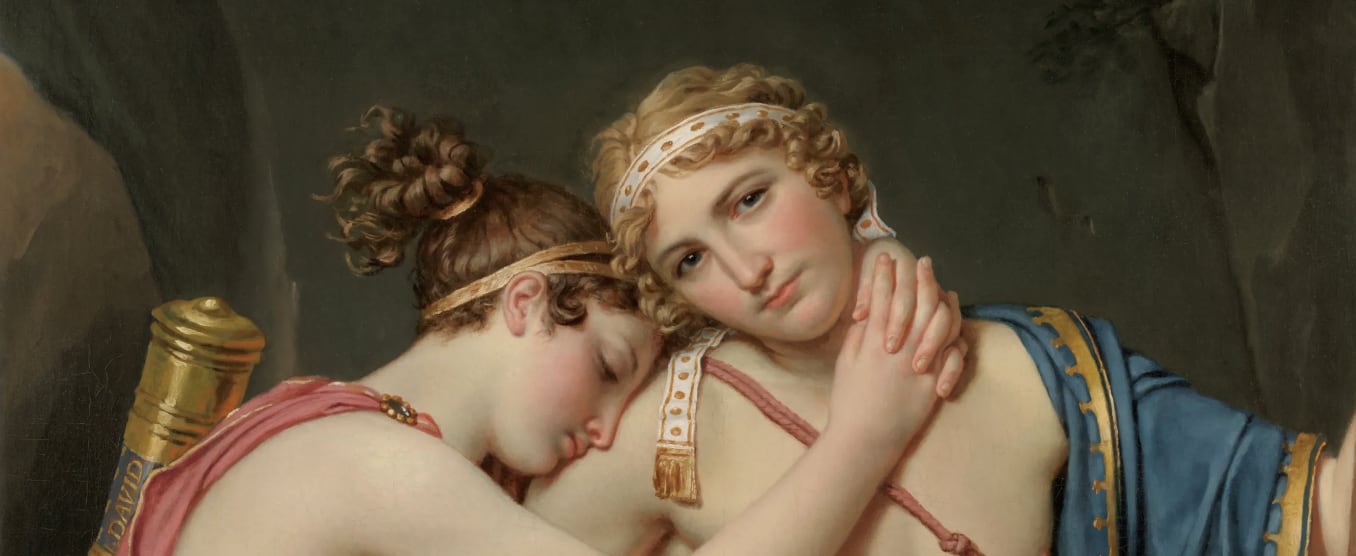
Dear Classical Wisdom Reader,
You are cordially invited to join our mental, virtual symposium, dear reader. Feel free to don your finest robes (ideally purple), pour a libatious drop (mixed obviously with the appropriate amount of water), and find a thinking couch on which you can recline.
We are going to recreate Plato’s famed Symposium, just in time to celebrate the 3rd-century Roman saint who secretly married Christian couples during the Roman Empire. (Don’t you just love how everyone connects Valentine’s day to the Roman Empire? Oh wait...)
This week we’ll delve into that most powerful of emotions, feelings, actions and ask what exactly is it? How can we understand this essential and yet nebulous thing, a word we use everyday, but certainly not always in the same way: LOVE.
Fascinatingly, the ancient Greeks had about 30 different words for love... For a quick recap of those who love to delve into love (and who have the love of words), let us turn to Ben Potter:
EROS
Eros, is what we would most easily recognise as February 14th style love. Though it was possible for eros (named after the Greek equivalent of the Roman’s Cupid) to be a part of a holistic, romantic, spiritual and beautiful love between two twinned souls, it could not exist in isolation from (usually very strong) sexual desire.
PRAGMA
Even if eros is the most common type of love to initiate a romantic relationship, many would agree with the Greeks’ assertion that pragma is what sustains one. Pragma was a love not of the loins, nor the heart, but of the head. It was the foundation block that we can recognise in the most successful of long-term relationships; a willingness for give-and-take, a tolerance, a mutual-understanding and, of course, a certain... pragmatism.
PHILIA
Philia (despite being a modern English suffix often denoting sexual desire) was what we would refer to as a platonic love shared between friends, comrades and even the community at large. The point of philia was not that it was less deep or less important than eros, quite the reverse; it was a love so special that one did not desire any sexual gratification out of it.
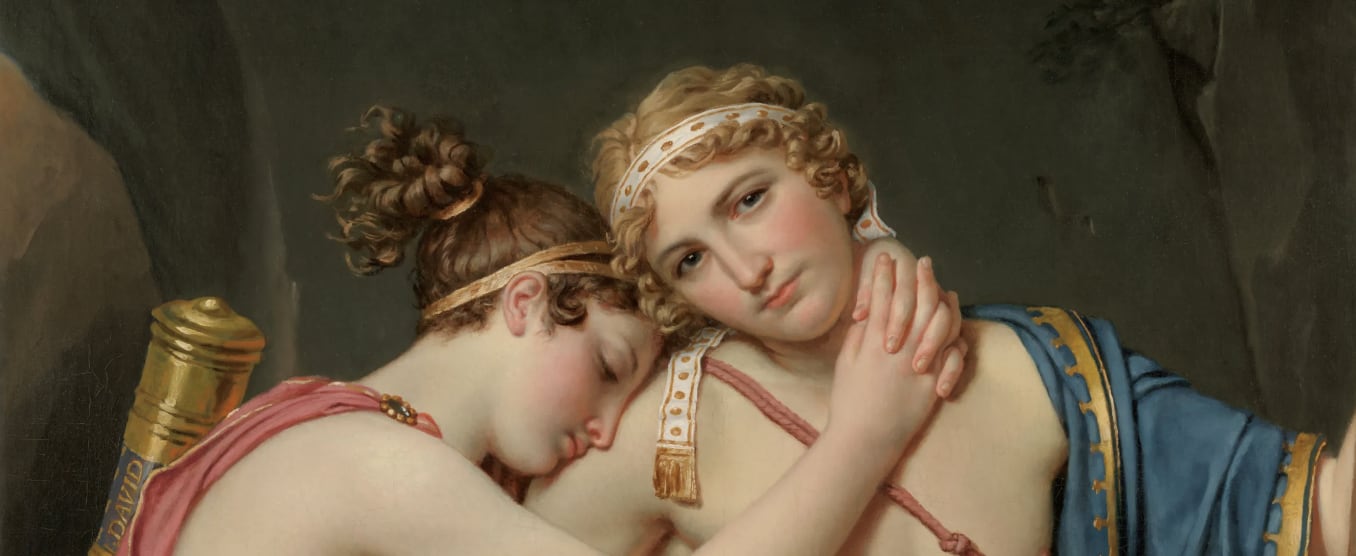
STORGE
Meanwhile, love between family members, though in most respects similar to philia, was often classified separately as storge (pronounced store-gay) and assumed an element of instinctual, rather than acquired, affection.
AGAPE
Agape represented a selfless and universal love that could be felt for strangers or wider society. It was a love that required no acknowledgement or reward; it was a desire to do good, or see good done, to one’s fellow creatures. C.S. Lewis considered agape to be the purest and best of all types of love, being the optimum form for a good Christian to aspire to.
LUDUS
Ludus was a playful, free-spirited frivolousness; an almost child-like joy of easy-going and uninhibited fun – the easy bonhomie of when you’re had exactly the perfect amount to drink!
PHILAUTIA
Much like eros, philautia was a double-edged kind of love; more specifically it was a double-edged kind of self-love. In true Aristotelian fashion, philautia was considered best when practiced in moderation. The story of Narcissus, the beautiful boy who fell in love with his own reflection and drowned/starved as a consequence, is a cautionary tale of this love’s destructive power.
However, for the plus side of what seems like an inherently selfish pursuit, we can again turn to Aristotle who said in his Ethics that “All friendly feelings for others are an extension of a man’s feeling for himself. A man is his own best friend”. Here, Aristotle was defending the virtues of philautia against its detractors with what can be boiled down to a rather trite, but no less true for that, maxim:
“you must love yourself before you can love others”.
So there we have some, but by no means all, the language the Greeks used to express love…
~
But dear reader, we are not in the habit of simply reading the ancients, but in engaging with their ideas (something which we have written about earlier this week),
So I’d like to turn it to you…
What is love? Do these terms still hold up or do we need new ones to reflect our changing societal norms?
And what of the root causes? Where does love originally come from?
Comment below!
Classical Wisdom Members: You can enjoy the full Member’s in depth article on Ancient Amour as well as our “Eros Collection” - an anthology of love as written by both the poets and the philosophers - here:
Let me know your thoughts on all things LOVE this Valentine’s Day…
Enjoy!
All the best,
Anya Leonard
Founder and Director
Classical Wisdom
Become a Member and access the Classics! From our Magazines and our in-depth articles to our Ebooks, like our Eros collection above. Never miss an issue again:
Más info en https://ift.tt/YOzIfj0 / Tfno. & WA 607725547 Centro MENADEL (Frasco Martín) Psicología Clínica y Tradicional en Mijas. #Menadel #Psicología #Clínica #Tradicional #MijasPueblo
*No suscribimos necesariamente las opiniones o artículos aquí compartidos. No todo es lo que parece.

No hay comentarios:
Publicar un comentario