
Dear Classical Wisdom Reader,
We’re a little bit early with this one…
But, I suppose, it’s always a good time for love.
With Valentine's Day just around the corner, today we're looking at Plato's Symposium, the ancient philosophical dialogue about the nature of love.
It’s philosophy’s most famous dinner party, featuring a who’s who of the ancient world including: the philosopher Socrates, the famed general Alcibiades, and the comedic playwright Aristophanes.
And they're all talking about love.
But today we're focusing in one one of its most celebrated sequences: the origins of humankind, as told by Plato’s Aristophanes. It’s a story which seeks to explain the yearnings of the human heart, and why we feel the way we do when we meet someone special.
It’s a deeply romantic vision that has captivated minds for centuries.
Members can read Plato’s full text, along with bonus material from Classical Wisdom contributors, in our exclusive e-book edition.
Not A Member? Join today to unlock ALL our resources, including podcasts, in-depth articles, magazines, our library of e-books and more!
So, in the end, I suppose it’s fitting: Plato’s dialogue about love has itself become one of the ancient world’s best-loved works of philosophy.
All the best,
Sean Kelly
Managing Editor
Classical Wisdom
Plato’s Symposium: Why Do We Feel Love?
by Nickolas Pappas
There’s a story about love in Plato’s Symposium that captures the feeling of romantic love superbly, like a Valentine to everyone who’s ever had that experience. This may be why the story is one of those pieces from a Platonic dialogue (like the Atlantis legend) that people know about, even if they don’t know it’s from Plato.
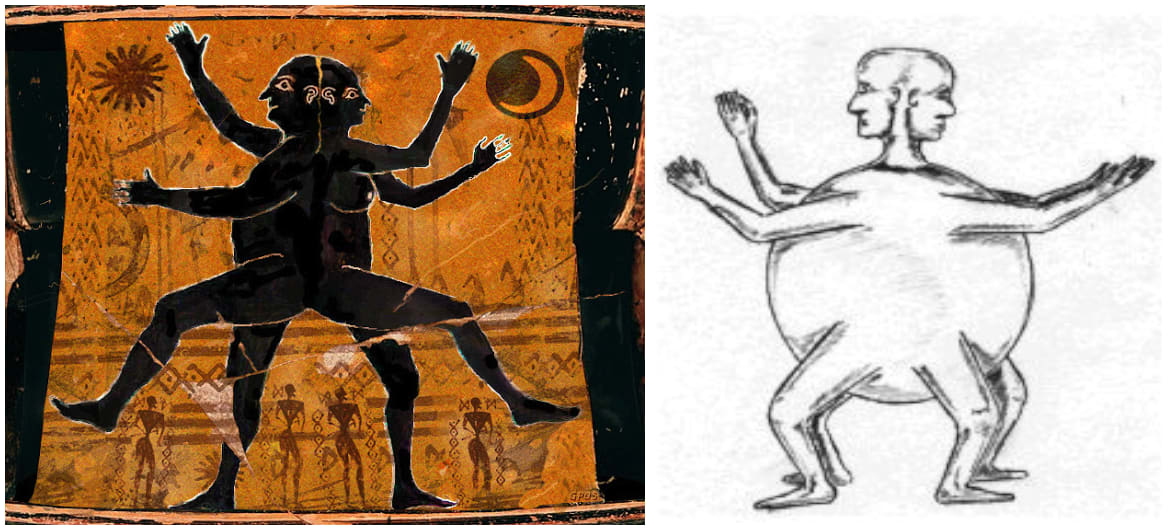
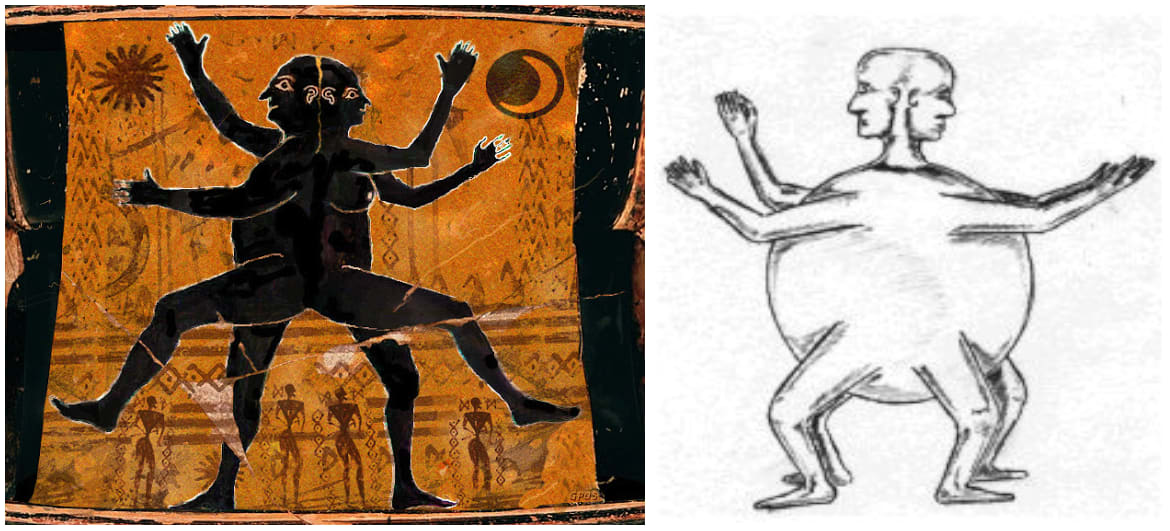
Within the Symposium the story is told by Aristophanes, in real life a comic playwright. In this dialogue, he is a guest at a dinner-party with Socrates and others, all discussing the nature of love. He says the first human beings were double creatures: a big head on each one, with two faces looking in opposite directions, and a spherical, four-legged, four-armed body.
These first people were contented, but they thought they could conquer the gods, and to punish them for their arrogance, the gods decided to weaken them. Zeus and Apollo cut every happy four-legged double-faced human into a pair of single-faced bipeds. Needless to say, they were unhappy. Misery defines existence for people like them (which is to say, people like us). You have had half of you amputated. You’re all phantom pain.
The story slides out of mythical past into the literal lives of those hearing it. You’re only half alive until you come upon that one that you used to be joined to. No wonder you embrace each other, trying to go back to your original condition.
Sex is part of that reunion. The gods planned it that way by moving humans’ genitals around to their front sides, so people could stimulate each other as they hugged and find some relief. When those first beings were cut in half, Apollo stitched them up leaving only one scar, the navel, and he turned their faces so that they would always look down at themselves and see this reminder of their old separation.
And yet, as Aristophanes tells the other guests at this dinner party, sex isn’t everything even in this earthy tale. These couples want something else when they find each other. They may not have the words for their yearning, but what they most crave (isn’t this romantic?) would be to find themselves reconnected into a single being.
There are other notable details in the story. It seems to acknowledge sexual orientation as few works did before the modern age. But even though Plato is unembarrassed by same-sex desire, the taxonomy of sexual identities is an addition to the story, whose main message is that love comes from a crisis long ago. You used to be half of a large complete person, and you never will be again.
Later in the Symposium Socrates offers an alternative theory about thoughtful lovers’ redirecting their erotic desire to worthier objects like social institutions, and then every species of learning, on up to the philosophical understanding of beauty itself.
Want to read the original? Become a Member today!
Members can access our exclusive e-book edition of Plato’s Symposium, featuring the complete dialogue as well as bonus material from Classical Wisdom contributors.
Membership unlocks ALL our resources, including podcasts, in-depth articles, our e-book library and more, so join today!
But even without this theory, Plato’s readers have dashed cold water on the fantasy from Aristophanes. How would you ever find that Ms or Mr Right, if this were true? You don’t know what to look for. It’s impractical to try embracing everyone in the world to see if it will give both of you that special spark.
Let’s say you find someone special. You might reach for words that justify your love – witty, kind, sings like an angel – but according to this story, they’re excuses. The vital decision of whom to join with for life is a decision you made for no other reason than that this is your missing half. Maybe this explains why some long-time couples can only shrug and say they grew up together.
That seems to be the end of it: some recognition of romantic passion on one side, unsexy common sense as the alternative. The true romantic isn’t really silenced by these reasonable objections, because after all, everyone knows the right person is hard to find. (What else would it mean for there to be a right person?) You can still go on dreaming the dream of romance. There’s no law that says you have to be reasonable.
Sure, it’s impractical to think that there is a single person just right for you. Yet Plato reminds us that the legacy of romantic love remains an enduring element of human life.
Más info en https://ift.tt/ChqgAw8 / Tfno. & WA 607725547 Centro MENADEL (Frasco Martín) Psicología Clínica y Tradicional en Mijas. #Menadel #Psicología #Clínica #Tradicional #MijasPueblo
*No suscribimos necesariamente las opiniones o artículos aquí compartidos. No todo es lo que parece.

No hay comentarios:
Publicar un comentario