
Dear Classical Wisdom Reader,
This week our readers up north will be preparing for the annual food feast known as Thanksgiving. You can picture the scene easily (even if you’ve never partaken)...
A crowded Thanksgiving table, a slightly overcooked turkey, and that moment when someone reaches, perhaps a little too eagerly, for a second (or third) glass of wine.
Suddenly, everyone becomes a philosopher, a poet, or at the very least, passionately opinionated about politics, pumpkin pie, or Aunt Linda’s life choices.
Sound familiar? If so, you’re already closer to ancient Rome than you think.
The Romans, it turns out, didn’t just drink wine...they built entire philosophies, poetic careers, and emotional breakdowns around it. For them, wine was never just a beverage; it was a muse, a medicine, a social glue, and occasionally, a catastrophe…
And their greatest poets? They had quite a lot to say about that humble, dangerous, delicious cup.
So before you raise your glass this Thanksgiving (or just this Thursday) and toast to gratitude, family, or sheer survival, you might want to meet the Roman poets Horace, Propertius and Tibullus who believed that every great thought, and every spectacular mistake, began with wine…
All the best,
Anya Leonard
Founder and Director
Classical Wisdom
Bring the wisdom of the ancients to your table… and your inbox. Subscribe today and let the ancients guide you:
Wine and Roman Poets
By Visnja Bojovic, Contributing Writer, Classical Wisdom
When we think of wine in the ancient world, the first thing that comes to mind is the Romans and their luxurious banquets. We know that wine was an important part of Roman culture; there were even precise rules for the way and quantity in which it was to be consumed.
However, while we do know that wine played an enormous part in the life of the ancient Romans, we have to bear in mind that most of the information we have about wine and drunkenness in Roman society come from literary sources. As such, the information we get from these sources is entirely susceptible to the requirements of the genre.
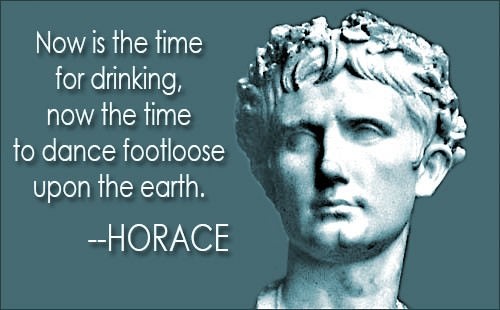
Horace
If you wanted to find the most ardent fan of wine, look no further – you have found a man who not only resorts to wine for pleasure, but claims that his work itself entirely depends on it:
No poetry could ever live long or delight us
That water-drinkers pen. Since Bacchus enlisted
Poets, the barely sane, among his Fauns and Satyrs,
The sweet Muses usually have a dawn scent of wine.
The most important role that Horace attributes to wine is that of a source of inspiration, and he claims that he cannot write until directed to by Bacchus, the god of wine. He does not know where Bacchus will take him, but this direction also depends on Horace’s mood, as well as the type of wine that he is drinking.
We all know the famous line “seize the day”. What some of us may not know, however, is that Horace uses wine more than anything else to demonstrate the importance of this attitude. He says that there is no way to know what gods have in store for us, so the solution is: “Be wise, strain the wine, and trim your long hope into a brief space … seize the day, trusting as little as possible in the next.”
It is not useful to spend time thinking about bad things, and to get rid of these earthly cares, we should resort to wine.
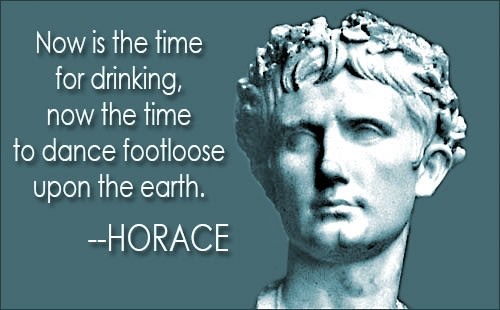
Another important feature of wine, according to Horace, is its inability of being connected to the war in any way. He thinks that Bacchus brings only harmony, and that there is no place for war in the wine-drinking world. What is important to note, however, is the fact that Horace emphasizes the importance of moderation in drinking, and warns of the dangers if this moderation is not achieved.
Propertius
As mentioned above, the exaggerated appraisal of wine that can be found in the works of these poets should not be taken literally. That is to say that, most probably, they were not such passionate wine-drinkers in their private lives. This is especially true when it comes to Propertius. We know almost for sure that Propertius the man would not allow himself to fall under the temptations caused by excessive intake of wine.
Propertius, the poet, on the other hand, continues the elegiac tradition in the best way possible….
Bring poetry - as well as philosophy, mythology, history and inspiration - into your life with the Classics:
He uses wine to emphasize the passion in his poems, and it is an almost inevitable feature of the lovers’ encounters. Similar to Horace, for Propertius, wine is the source of inspiration, his muse. However, Propertius is a bit more realistic, taking into account that wine does not only solve lovers’ problems, but it also creates them. In his prayer to Bacchus, Propertius says: Through you lovers are joined, through you they are broken up.
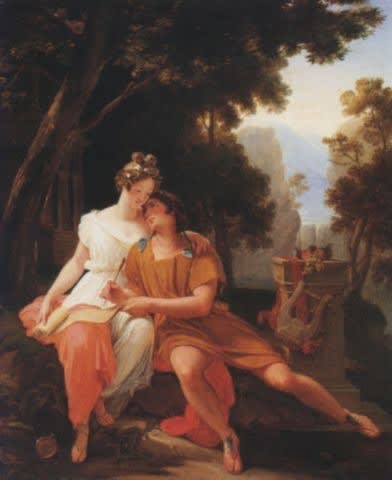
The poet’s ambivalent approach to wine can also be seen in the following verses:
Perish the man who discovered undiluted grapes and
first corrupted good water with nectar! … Beauty dies by wine, youth is broken by wine,
often a mistress does not know her own man because of wine
Tibullus
The two greatest passions of Tibullus are his lover and the countryside. For him, wine is an instrument that he uses to emphasize the importance of both, as it is not only related to love affairs, but also to the celebration of nature. When it comes to love though, he is a bit more moderate than his two colleagues. He takes Horace’s stance that wine can dissolve earthly cares, but he also agrees with Propertius that it is not always the case.
Tibullus was in love with a married woman named Delia. You can imagine how much suffering this situation can cause, especially for an elegy poet. Therefore, only wine and sleep can provide him with a temporary relief:
Add merum, and restrain new grief with wine,
so that victorious sleep might occupy the eyes
of a tired man.
On the other hand, wine can also help him seduce Delia, or bring sleep to her husband, leaving some lovers’ time to them. This poet’s stance on wine was very ambivalent, which usually depended on the nature of the relationship in question.
When he was suffering, not even the countryside could soothe his sadness. When things were going well, however, there was nothing better than enjoying wine outside:
Let the wines celebrate the day: There is no shame
in dripping with wine on a feast day, and clumsily moving
wobbly feet
Even though we know for sure that these poets were merely conforming to the requirements of the genre, we can still learn a lot of actual wine facts from them, and take great pleasure in reading about their struggles and passions.
After all, we have all been there, haven’t we?
Más info en https://ift.tt/yth7euQ / Tfno. & WA 607725547 Centro MENADEL (Frasco Martín) Psicología Clínica y Tradicional en Mijas. #Menadel #Psicología #Clínica #Tradicional #MijasPueblo
*No suscribimos necesariamente las opiniones o artículos aquí compartidos. No todo es lo que parece.

No hay comentarios:
Publicar un comentario