
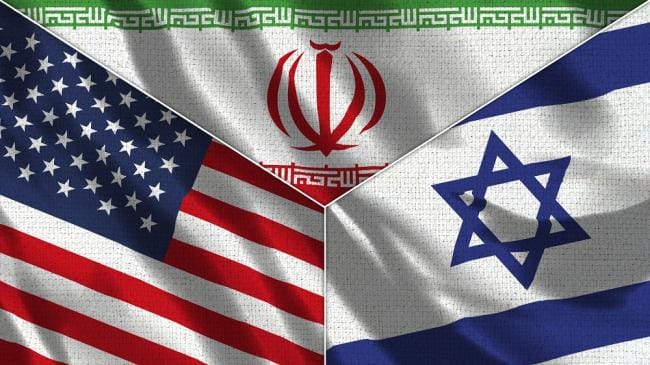
Three Satans haunt the Iranian people. The first, the reader will have no difficulty identifying, is the ‘Great Satan’ of the anti-US demonstrations famous in the Middle East. The second demon is also not difficult to identify: it is the ally of the latter, Zionism, Jewish ultranationalism. These two entities are presently embodied by the American president and the Israeli prime minister. The third ‘Satan’ will surprise some. The demon that has haunted Iranians for almost five decades, since when, in 1979, Ayatollah Khomeini and his faction of mullahs more interested in politics than in Islamic wisdom and spirituality took power. The third ‘Satan’ of this trio is none other than Grand Ayatollah Khomeini himself, later reincarnated in his beloved disciple, Ayatollah Khamenei, and today in his son, and in the political regime that followed in their steps, what I will call here political Islam, or ‘Khomeinism’.
Trump, Netanyahu and the Ayatollah(s). Or imperialism, Zionism, and political Islam. The global left will say that only the first two are evil; the global far-right, on the contrary, that only the third embodies evil, that despite the brutal suffering inflicted on the civilian population of the Persian country, Trump and Netanyahu are ‘good’. However, if we look at reality objectively and without bias, it will not be difficult to see that the Persian people are confronting these three formidable demons today: it is not because imperialism and Zionism are what they are that the Ayatollah’s regime is innocent or just. It is not because Trump and Netanyahu are evil that the mullahs are good. ‘Paradise is where there are no mullahs’, as Mughal Prince Dara Shukoh remarked a long time ago.
What good can one derive from fundamentalism/ political Islam/ Khomeinism if it opposes modern secularism outwardly while capitulating to it inwardly?
A widespread error in the West, especially among the self-styled ‘progressivists’, claims that the Iranian revolution was an awakening of Islam, or that it somehow has its roots in religion. No, in reality it was not the rebirth of traditional wisdom, but of ethnic and cultural ultranationalism born from an inferiority complex in the face of the modern ‘West’. This nationalism displays religion and spirituality only as an outer shell for its extreme formalism, exclusivism, and moralism, as Frithjof Schuon pointed out in his book Christianity Islam.
On the one hand, this ethnic, cultural, and religious nationalism belligerently exaggerates its own value and, on the other hand, based on this same inferiority complex, aims to surpass the technologically and economically prosperous (but morally and culturally decadent and corrupted) modern West in the very terms of a Western perspective. Adapting a rhetorical question posed by the late professor Rusmir Mahmutćehajić in the pages of the print journal Sacred Web: What good can one derive from fundamentalism/ political Islam/ Khomeinism if it opposes modern secularism outwardly while capitulating to it inwardly?
It is worth remembering that St. Thomas Aquinas taught that the best political regime is the one that best aligns with ultimate ends (De Regno, Book I, Chapters 14-15). Political Islam, or Khomeinism, does not fit this description. On the contrary, the commitment to religion is diminishing yearly in Iran, especially among younger generations, and in a reactionary way, thanks to the revolt of the Iranian people against the cruel, inhumane and abusive excesses of their Islamist regime, which are in fact contrary to the peaceful and humane teachings of Islam. It is also worth remembering in this context the teaching of Jesus Christ: ‘what good is it to gain the whole world, if we lose our soul?’ (Mt 16:26) Many nowadays, in the thrall of modernist values, have in fact conquered the world, but lost their soul in the process – there is no doubt of this truth. This certainly applies to the modernist West, but couldn’t one say the same about radical Islamicists?
Khomeinism is as ‘Islamic’ as Trumpism is ‘Evangelical’ or Zionism is religiously ‘Jewish’
Some will take our argument as unfounded, or even absurd, especially in the global left, because the fight against imperialism and Zionism is what matters for them, and, adopting their lens of ideological power, the Islamicists would be fully justified. But this shows a deep anti-humanist insensitivity, typical of socialist ideology, because it fails to prioritize the suffering of millions of Iranians who were forced to seek exile abroad due to political persecution and/or economic hardship caused by the regime's incompetence and corruption.
It is false to see Islamic prototypes in the mullahs' regime; its Islamism resides only in the outermost shell. It is a false claim, says Schuon, to affirm that Islam ‘awakened’ with the Iranian Revolution, for what ‘awakened’ was not traditional wisdom and culture, but nationalism, which, incidentally, finds its nemesis in its Zionist counterpart. Khomeinism is as ‘Islamic’ as Trumpism is ‘Evangelical’ or Zionism is religiously ‘Jewish’.
Being critical of Zionism is no more antisemitic (as many Jewish people have pointed out in their opposition of the Gaza genocide or of the coercive takeover of Palestinian territories to further a ‘Greater Israel’ agenda) than being anti-Crusaderist is anti-Christian (as many Christians have pointed out in their opposition to the US’s war on Iran as a religious duty to usher in the Armageddon that precedes the Second Coming) or than being anti-Islamist is anti-Islam (as many Muslims have pointed out who are appalled at the profane acts being undertaken in the name of their faith). What is important here is to look to the core of the faith traditions which uphold humane principles and to distinguish them from their tribalistic violations carried out in the name of their religions, which are thereby defamed.
Finally, as for the causes and motivations of the Revolution that shook Iran and the entire Middle East in 1979, and in its aftermath, these remain the subject of heated debate, even among supporters of the regime. It seems that there was, nevertheless, an element of collective hysteria on the part of the students and young people who took to the streets of Tehran, Isfahan, and other cities in this country of nearly 100 million inhabitants (one of the rare nations in the world to boast a distinct historical civilizational continuity spanning millennia, alongside with India, China, Japan, and Egypt), blindly following Khomeini's suggestions and insinuations (for he was considered a master in psychic manipulation); on the part of Khomeini, there was also an undeniable element of personal ambition and resentment against Shah Reza Pahlavi, who had ordered his exile in 1964. From then on, Khomeini lived in Turkey and Iraq and finally, for a very brief period, in France, from where he triumphantly returned to Tehran in 1979, to a land steeped in a messianic culture, where a crowd of more than three million people awaited in the streets and hailed him as the saviour of the homeland. The rest, as they say, is history.
________________________________________
Mateus Soares de Azevedo holds a Master's degree in History of Religions from the University of São Paulo, Brazil, and a postgraduate degree in International Relations from the George Washington University (USA). He is the author of Sufi Orders in Islam (S. Paulo, 2020) and Men of a Single Book: Fundamentalism in Islam, Christianity and modern thought (World Wisdom, 2011), among others.
Más info en https://ift.tt/90Vhb8w / Tfno. & WA 607725547 Centro MENADEL (Frasco Martín) Psicología Clínica y Tradicional en Mijas. #Menadel #Psicología #Clínica #Tradicional #MijasPueblo
*No suscribimos necesariamente las opiniones o artículos aquí compartidos. No todo es lo que parece.

No hay comentarios:
Publicar un comentario