
Dear Classical Wisdom Reader,
The Stoics really didn’t like Epicurus. I know much has been made of their rivalry over the millennia, and perhaps the competition has been exaggerated, but nonetheless it certainly existed.
Indeed, our main biographer of the ancient philosophers, Diogenes Laërtius, dedicated the first page of Epicurus’ story not to his accolades or life, but to the egregious slander he endured at the hands of the Stoics.
The Stoics in the crowd are no doubt uncomfortable with the list of injustices committed by Zeno of Citium’s followers. Lascivious letters written in Epicurus’ name traceable to Chrysippus, claims that he taught grammar school (of all things!) and that his brother was a pimp. Even Epictetus, according to the third century CE biographer, abused him savagely, calling him a “foul-mouthed bastard”.
Yet despite this hostility, the philosophical distance between them was not as vast as their rhetoric might suggest. Really, it’s a shame, because there are a great many ideas on which the Stoics and Epicureans could have agreed: a simple and thoughtful life being at the core of their philosophies.
Both the Stoics and Epicureans emphasized the life of the mind, that philosophical inquiry is essential to achieving a tranquil and well-ordered life…Let the wisdom of the ancients be a part of your life & subscribe today:
Of course, there were plenty of points on which they were fundamentally at odds, which was no doubt the source of their great mutual dislike. We specifically outlined one of them in a recent column: the need to be political... or not. This is one that still inspires enthusiastic debate among thinkers to this very day!
But beyond questions of civic engagement, there were even deeper disagreements between the two schools of thought, huge differences in belief, ones that would shape their long-term reception in society, particularly in matters of religion.
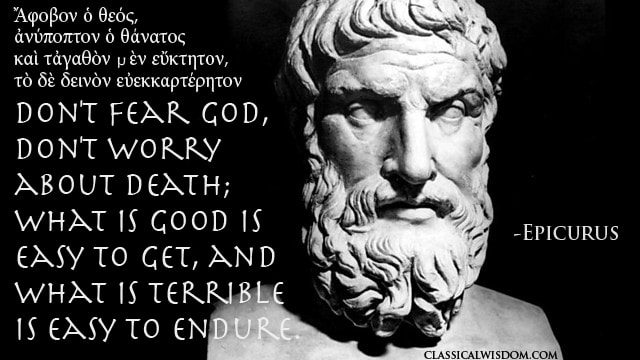
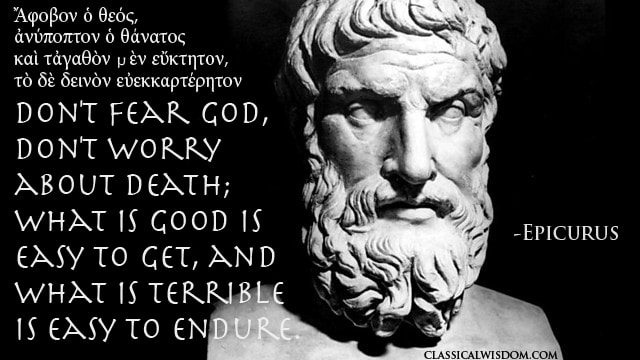
You see, the Epicureans were famously skeptical of the role of the gods, positing as one of their main tenets that we should not fear them, a concept that won them later approval of scientists and thinkers of the enlightenment. While Epicurus did not deny the existence of gods outright, he argued that they were at the very least indifferent to human affairs, neither punishing nor rewarding us. As such, fear of divine intervention was, in his view, both irrational and harmful to human tranquility.
In contrast, the Stoics allowed more for a ‘god’ figure within their philosophical framework. For them, the universe itself was imbued with divine reason, or logos, a rational and providential force that ordered all things. God was not separate from the world, but rather identical with it: a kind of rational, living cosmos.
This perspective enabled their subsequent approval during the medieval and Renaissance periods, as their ideas could be more easily reconciled with emerging religious doctrines. Indeed, Thomas Aquinas engaged with Stoic ideas, particularly their emphasis on natural law and rational order. The fundamental Stoic view on elements of non-retaliation also found resonance in Christianity’s “turn the other cheek” mantra, another concept we touched upon recently.
And as Christianity spread and became the dominant cultural influence of the West, so too did the approval of Stoic ideas...and the corollary denunciation of Epicurean thought.
Yet their differences were not limited to theology or social acceptance. At an even more fundamental level, they diverged in how they understood the very structure of reality itself, particularly when it came to fate and human freedom.
Indeed, it is this core difference, of free will versus determinism, that I would like to speak about today…
For the Stoics, the world was fated, and this was not just an accidental or coincidental aspect, it was and still is fundamental to their belief system. Everything unfolds according to a rational and necessary order. This determinism is essential to their famous “dichotomy of control,” which teaches that while we cannot control external events, we can control our responses to them.
Accepting fate, later coined amor fati, or love of fate, allows the Stoic to live in harmony with the universe, finding peace not by changing the world, but by aligning one’s will with it.
While the Stoics arrived at determinism through their understanding of divine reason and cosmic order, the Epicureans approached the question from an entirely different direction: physics. As proponents of free will, the Epicureans attempted to explain this position through an remarkable logical process, which was well beyond their technological abilities at the time, using none other than atoms.
Epicurus drew inspiration from Democritus, who proposed that the universe is composed of indivisible atoms moving through the void in predictable ways. However, such a system seemed to leave no room for human freedom as everything would be mechanically determined. To resolve this, Epicurus introduced the idea of the “swerve” (clinamen), a spontaneous and unpredictable deviation in the motion of atoms. This tiny, random shift allowed for the possibility of free action, breaking the chain of strict determinism.
Centuries later, this intuition would find surprising resonance in modern science. Werner Heisenberg, one of the founders of quantum physics, demonstrated that at the subatomic level, events are not entirely deterministic but instead governed by probabilities. While not a direct confirmation of Epicurus’ theory, this indeterminacy has often been seen as lending philosophical support to his intuition.
Support Your Love of the Classics
This “swerve,” according to the Epicureans, proved free will...which was, and still is, a bit of a stretch. But whether it serves as proof or not, the idea of free will remains fundamental to the Epicurean worldview.
And so, despite centuries of debate, we find ourselves no closer to a definitive answer...which brings us back to today, dear reader. The jury is still out on the concept, after all, with both sides continuing to champion their position. So, I’d like to ask you as part of our wonderful and wonderfully thoughtful community:
Does free will exist? Do we have power over our actions and lives? Or is the world fated, determined from the start?
Comment below to join in the conversation.
All the best,
Anya Leonard
Founder and Director
Classical Wisdom
Más info en https://ift.tt/jFz4BuJ / Tfno. & WA 607725547 Centro MENADEL (Frasco Martín) Psicología Clínica y Tradicional en Mijas. #Menadel #Psicología #Clínica #Tradicional #MijasPueblo
*No suscribimos necesariamente las opiniones o artículos aquí compartidos. No todo es lo que parece.

No hay comentarios:
Publicar un comentario