
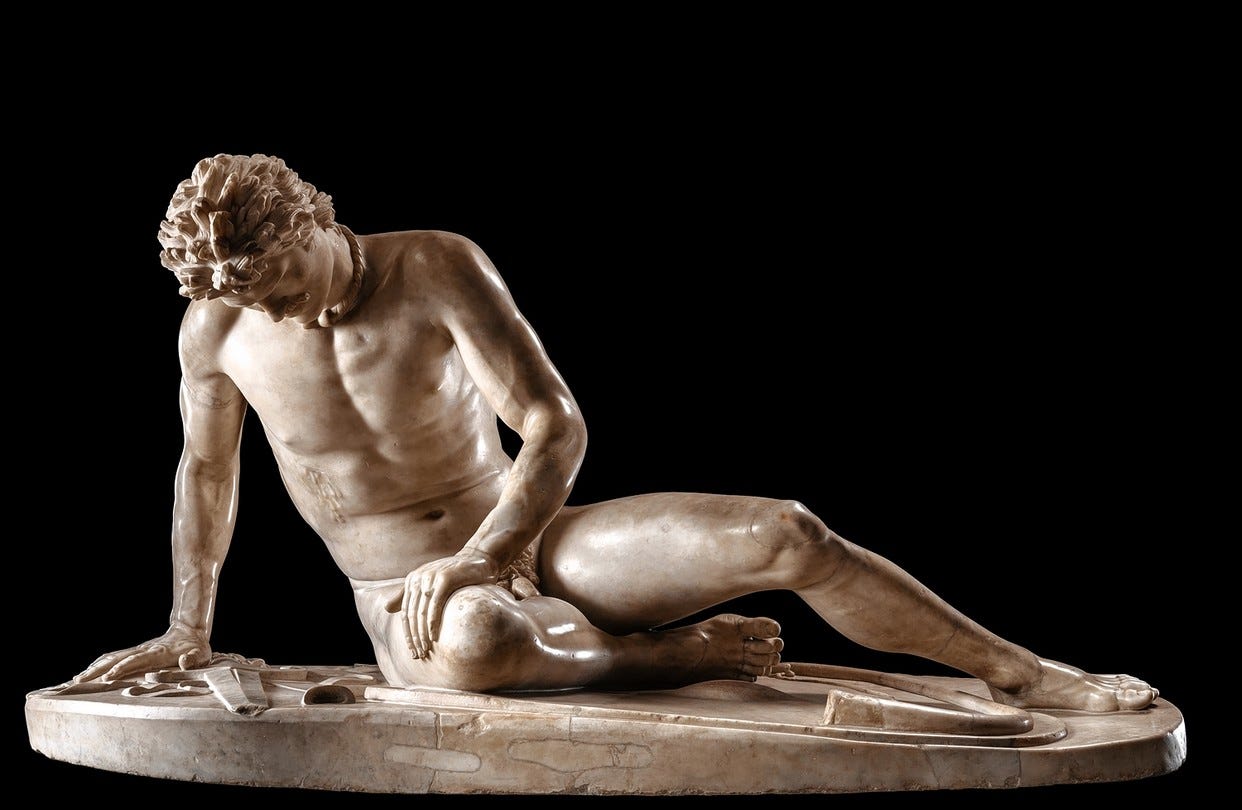
<p>Dear Classical Wisdom Reader,</p><p>It was one of the most painful moments of my life.</p><p>Not quite as bad as that treacherous food poisoning incident in Thailand... or Mexico... or Brazil.</p><p>And most definitely a long way behind childbirth.</p><p>But the second half of the old saying, <em><strong>Gain a child, lose a tooth</strong>, </em>definitely ranked up there...</p><p><em>(As an aside, the old wives’ tale may actually have some <a href="https://theconversation.com/do-women-gain-a-child-and-lose-a-tooth-43602">truth to it</a> – and as such, is part of my ongoing theory as to why Aristotle thought women had fewer teeth than men.)</em></p><p>Either way, it was a painful two-hour extraction… An enameled sacrifice for contributing to the human race.</p><div><figure><a href="https://substackcdn.com/image/fetch/%24s_!i29U!,f_auto,q_auto:good,fl_progressive:steep/https%3A%2F%2Fsubstack-post-media.s3.amazonaws.com%2Fpublic%2Fimages%2Fcfea57fd-9861-466e-8492-9b2c6f028238_1242x810.jpeg"></a><div><a href="https://substackcdn.com/image/fetch/%24s_!i29U!,f_auto,q_auto:good,fl_progressive:steep/https%3A%2F%2Fsubstack-post-media.s3.amazonaws.com%2Fpublic%2Fimages%2Fcfea57fd-9861-466e-8492-9b2c6f028238_1242x810.jpeg"></a><source type="image/webp"><a href="https://substackcdn.com/image/fetch/%24s_!i29U!,f_auto,q_auto:good,fl_progressive:steep/https%3A%2F%2Fsubstack-post-media.s3.amazonaws.com%2Fpublic%2Fimages%2Fcfea57fd-9861-466e-8492-9b2c6f028238_1242x810.jpeg"><img src="https://substackcdn.com/image/fetch/$s_!i29U!,w_1456,c_limit,f_auto,q_auto:good,fl_progressive:steep/https%3A%2F%2Fsubstack-post-media.s3.amazonaws.com%2Fpublic%2Fimages%2Fcfea57fd-9861-466e-8492-9b2c6f028238_1242x810.jpeg" width="1456" height="950" alt=""></a></source><a href="https://substackcdn.com/image/fetch/%24s_!i29U!,f_auto,q_auto:good,fl_progressive:steep/https%3A%2F%2Fsubstack-post-media.s3.amazonaws.com%2Fpublic%2Fimages%2Fcfea57fd-9861-466e-8492-9b2c6f028238_1242x810.jpeg"></a><div><a href="https://substackcdn.com/image/fetch/%24s_!i29U!,f_auto,q_auto:good,fl_progressive:steep/https%3A%2F%2Fsubstack-post-media.s3.amazonaws.com%2Fpublic%2Fimages%2Fcfea57fd-9861-466e-8492-9b2c6f028238_1242x810.jpeg"></a><div><a href="https://substackcdn.com/image/fetch/%24s_!i29U!,f_auto,q_auto:good,fl_progressive:steep/https%3A%2F%2Fsubstack-post-media.s3.amazonaws.com%2Fpublic%2Fimages%2Fcfea57fd-9861-466e-8492-9b2c6f028238_1242x810.jpeg"></a></div><a href="https://substackcdn.com/image/fetch/%24s_!i29U!,f_auto,q_auto:good,fl_progressive:steep/https%3A%2F%2Fsubstack-post-media.s3.amazonaws.com%2Fpublic%2Fimages%2Fcfea57fd-9861-466e-8492-9b2c6f028238_1242x810.jpeg"></a></div><a href="https://substackcdn.com/image/fetch/%24s_!i29U!,f_auto,q_auto:good,fl_progressive:steep/https%3A%2F%2Fsubstack-post-media.s3.amazonaws.com%2Fpublic%2Fimages%2Fcfea57fd-9861-466e-8492-9b2c6f028238_1242x810.jpeg"></a></div><a href="https://substackcdn.com/image/fetch/%24s_!i29U!,f_auto,q_auto:good,fl_progressive:steep/https%3A%2F%2Fsubstack-post-media.s3.amazonaws.com%2Fpublic%2Fimages%2Fcfea57fd-9861-466e-8492-9b2c6f028238_1242x810.jpeg"></a><figcaption>The suffering seen on the Dying Gaul, a copy of a now lost Greek sculpture from the Hellenistic period (323–31 BC)</figcaption></figure></div><p>The procedure was brutal; saws, pliers and heavy metal objects were employed. The dentist was woefully stingy with the anesthesia (the Greek word for “without sensation”), which gave me ample time to contemplate the deeper things in life, albeit punctuated by bouts of muffled screaming.</p><p>My first and foremost thought was thank goodness for modern medicine! Moments like these give us small glimpses into the, no doubt, pain-filled past.</p><p>Then I started to conjure up the Stoics. After all, they were experts at handling difficult situations, right? Surely this was the exact time when all that philosophizing would come in handy.</p><p>In the words of the Roman emperor Marcus Aurelius, as found in his personal reflections, “<em>Meditations</em>” (7.64, translated by Gregory Hays):</p><blockquote><p>“For times when you feel pain: See that it doesn’t disgrace you, or degrade your intelligence—doesn’t keep it from acting rationally or unselfishly. And in most cases what Epicurus said should help: that pain is neither unbearable nor unending, as long as you keep in mind its limits and don’t magnify them in your imagination. And keep in mind too that pain often comes in disguise— as drowsiness, fever, loss of appetite. . . . When you’re bothered by things like that, remind yourself: “I’m giving into pain.”</p></blockquote><p>Marcus Aurelius was very familiar with pain. His physical frailty was notorious, and of great concern to his subjects. We know that Marcus suffered from chronic chest and stomach issues, problems with sleeping, and poor appetite, among other symptoms. Around 174-175 AD, he was in such poor health that false rumors that he was dying, or already dead, actually spread throughout the empire and helped trigger the revolt of Avidius Cassius.</p><p>But Marcus Aurelius wasn’t the only Stoic to suffer.</p><p>Zeno of Citium, the founder of Stoic philosophy, survived a difficult shipwreck and loss of wealth.</p><p>Epictetus spent his childhood as a lame slave, perhaps crippled by his very master.</p><p>Seneca suffered from asthma, possibly tuberculosis, exile…and Nero.</p><p>And yet these pains did not stop them from pursuing philosophy. In fact, they may have done the exact opposite.</p><p>Now, that’s not to say the Stoics thought that pain itself was good... it was often considered something out of their control. Instead, they focused on how they responded to these hardships and saw them as opportunities to practice courage, patience, temperance and wisdom.</p><p>In our modern lives, however, we try to spend it pain free. We take pills for the smallest inconveniences, we trade our hard-earned resources for every comfort, and procedures are preceded by the expected and sufficient amount of numbing agents (except by a certain sadistic Argentine dentist).</p><p><strong>But what if the pain is good? What if it has something to teach us? Perhaps it is not only a chance to contemplate greater understanding and wisdom, but a necessary one?</strong></p><p>Of course, not everyone who experiences pain, gains wisdom... but can we truly comprehend the bigger questions if we never struggle? Can we appreciate the pain of others if we have never been hurt? Can we learn in endless comfort?</p><p>Now let’s consider the position of the hedonists, in particular Epicurus... the very philosopher Marcus Aurelius quoted above.</p><p>Epicurus posited that life should be in pursuit of pleasure as well as free of pain, specifically of disturbances of the mind, such as fear and anxiety. The famous Epicurean <em>tetrapharmakos</em>, or “fourfold remedy,” includes the reassurance that what is painful can be endured. Intense bodily pain is brief, while chronic pain can still leave room for pleasure. We should reduce suffering best we can and focus on the simple pleasures found in life.</p><p>Likewise, the Epicureans did not advocate a life completely free of pain. Some pains, they argued, are worth it if they result in further pleasures... a perspective that might even justify the trip to the dentist.</p><p><strong>So where does that leave us, dear reader? Should we be embracing pain? Is suffering essential for understanding? Or can we learn without enduring it in the first place?</strong></p><p>Add your thoughts in the comments below and take part in our weekly conversation!</p><p>Also, remember to join our discussion taking place on Thursday with Emily A. Austin (the philosopher, not the influencer), as we take Epicurus to the proverbial philosophical mat... </p><p>We’ll discuss his positions (the real ones, not the slanderous misrepresentations) and see whether they really hold up in modern life and provide a path to happiness.</p><p>You can still register here:</p><p><a href="https://www.eventbrite.ie/e/in-defense-of-pleasure-what-epicurus-really-taught-us-about-the-good-life-tickets-2003434425297?aff=oddtdtcreator"><span>In Defense of Pleasure</span></a></p><p>Members, you will automatically receive the link the day of the event. You will also get the recording as well as the transcript afterwards.</p><p>If you are not yet a member, but want to take advantage of our resources, including ebooks, Classical Wisdom Litterae magazines and exclusive podcasts and more, sign up today and bring the classics into your every day!</p><p><a href="https://classicalwisdom.substack.com/subscribe?"><span>Subscribe now</span></a></p><p>All the best,</p><p>Anya Leonard</p><p>Founder and Director</p><p>Classical Wisdom</p>
<p><a href="https://classicalwisdom.substack.com/p/do-we-need-pain-is-suffering-essential" target="_blank">- Enlace a artículo -</a></p>
<p>Más info en https://ift.tt/eYqku7i / Tfno. & WA 607725547 Centro MENADEL (Frasco Martín) Psicología Clínica y Tradicional en Mijas.
#Menadel #Psicología #Clínica #Tradicional #MijasPueblo</p>
<p>*No suscribimos necesariamente las opiniones o artículos aquí compartidos. No todo es lo que parece.</p>

No hay comentarios:
Publicar un comentario