

Dear Classical Wisdom Reader,
It’s a confusing time, to be sure. I mean, when I was a kid, the saying used to be ‘sticks and stones will break my bones... but words will never hurt me’.
Then words became violence? And then silence became violence!

So what happened with words? Are they the all powerful tools we wont to believe? To sway and motivate as well manipulate? Or are they only sounds, their strength determined by the listeners’ ears and mind?
And then, what to do with ancient words? The ones that began the great books? What to do with the word WORD?
Please enjoy today’s column delving into one of the most important concepts from the ancient world: Logos.
All the best,
Anya Leonard
Founder and Director
Classical Wisdom
P.S. I’ll return to our usual Monday mailbag next week, as I’m still hard at work helping Alan and Valerie handle the last of the holiday shipments.
Fortunately, there is just a little time left... so if you want to be part of the legacy, to own the book 100 years in the making, this is your last chance:
The Concept of Logos
Written by Visnja Bojovic
When I was a child, I was very confused by the sentence: ”In the beginning was the Word, and the Word was with God, and God was the Word.” What did it all mean? Why word? I was always a word lover, in fact, and I knew that words were powerful, but this was just too confusing.
My next encounter with this word was when I entered a high school of philology and found out that the word philologist meant a lover of words (φίλος+ λόγος). I was lucky enough to study ancient Greek as early as in high school, so I soon started learning that this concept of logos was much wider than simply meaning a word. In fact, I learned soon enough that Greek has a completely different word for it, derived from the same stem (λέξις).
Of course, words are meaningful per se and they are often omnipotent, but we have to do the justice to logos and try to shed some light on its insanely wide and complex nature.
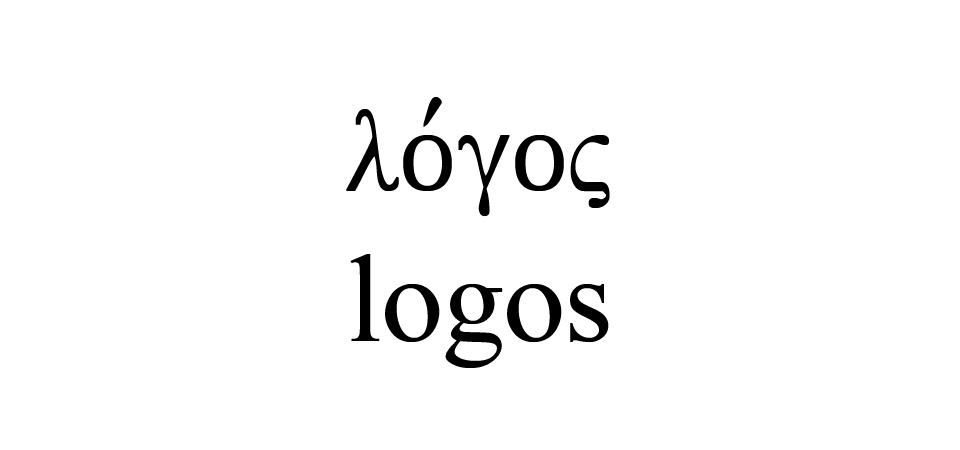
As with nearly all ancient Greek words, logos has many meanings, the most important of them being word, statement, story, thought, principle, reason and speech. It can be used in a technical, specialized sense or as a common term.
When used in a technical manner, the meaning will depend on the context, but there are two main distinctions to be made. It can either refer to a human reason/speech or to some kind of universal intelligence/principle.
The first one to use logos in a specialized sense was one of the pioneers of philosophy whom we all know: Pythagoras.
He believed that the world is based on three main principles. The first one he called Monad and it represented the unification of whole reality, the singularity of everything. The second one was called Dyad, a principle of diversification and differentiation. These principles may sound contradictory until you count in the third one, the one called Harmony. Harmony represents the relation of one thing to another, represented by the proportion between numbers, geometrical shapes or tones. This Harmony is based on logos, the role of which is uniting these two principles.
Heraclitus had a very peculiar doctrine that centered around logos in a specialized sense. Most readers probably know about Heraclitus’ famous assertion that you can’t step into the same river twice since everything constantly changes.
However, what we perceive as unchangeable is the principle that underlies Heraclitus’ ideas on change. For Heraclitus, this principle is logos. Thus, for him, the world is a collection of unified things that are in a structure arranged by logos. Human wisdom is tasked with understanding this principle as all our actions depend on the participation in this divine logos.
With Plato the story gets a bit more complex, since he had a variety of ways he used this term. Maybe the most straightforward one would be the understanding of logos as opposed to mythos (μῦθος), where logos is perceived as the true, analytical account.
In Phaedo, Plato explained that the characteristic of the true knowledge is the ability to give account, logos, of what one knows. In Theatetus, Socrates described logos as the distinguishable characteristic of a thing.
With Aristotle, we approach the definition of logos that is close to Latin ratio, as well as the modern notion of logos. Aristotle understood logos as the reason and rationality, especially in the ethical sense. We can see this in some English words such as rational or rationalism.
He also used it in the meaning of a mathematical proportion, which we can see in the English word ratio, but this can probably be traced back to Pythagoras.
Last but not least, we will look at the Stoic interpretation of this term. For the Stoics, the perception of logos is very similar to that of Heraclitus. It is a creative force in the universe, also material as Heraclitus perceived it, identifiable with fire, as well as nature and Zeus. There was also a Stoic linguistic theory that distinguished between the interior and exterior logos.
Judging by all these accounts, we can conclude that this mysterious ”word” in the biblical sentence was more than just a word, and it wasn’t a Christian invention, either. We see that logos was beyond words, but at the same time marking the power of words and human expression.
Become a Classical Wisdom Society Member and take your love of the classics to the next level…
Más info en frasco@menadelpsicologia.com / Tfno. & WA 607725547 Centro MENADEL (Frasco Martín) Psicología Clínica y Tradicional en Mijas Pueblo #Psicologia #MenadelPsicologia #Clinica #Tradicional #MijasPueblo
*No suscribimos necesariamente las opiniones o artículos aquí compartidos. No todo es lo que parece.

No hay comentarios:
Publicar un comentario