
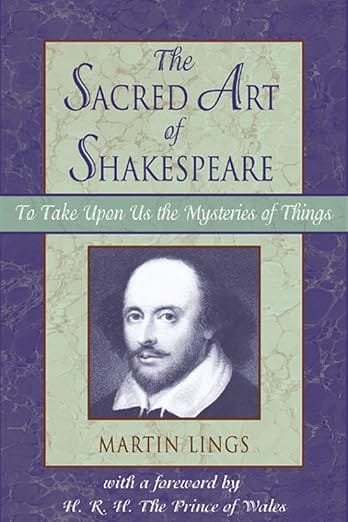
<div> <p> </p> <div> <div><div><i><em>This essay was first published in Sacred Web, Volume 30, Winter 2012, pp. 85-128.</em></i> It was researched and written by Professor Muna Al-Alwan during her sabbatical as scholar in residence at the University of Colorado. A list of works referenced in the essay by page numbers is appended at the end of the essay.</div></div> <p><i>“Just as Dante was a gift of Heaven to medieval Christianity, so Shakespeare is a gift of Heaven to all of Mankind, for every creed, in every age. … Shakespeare was a gift to the increasingly secularized closing centuries of this cycle of time, that is, to the seventeenth century onward, and to no period more than to the present.” <br>— (Martin Lings, The Sacred Art of Shakespeare, 12)</i></p> <p><i>“The universe has in fact been stamped with God’s signature;and that’s how the works of Shakespeare were born.” <br>— (G. Wilson Knight, Shakespeare and Religion, 239)</i></p> <p>These epigraphs show the tremendous significance of Shakespeare’s spiritual legacy in this troubled world of ours, where “the rupture between heaven and earth”[[1]] has never been so extreme amidst the clamour of materialism, cynicism, and violence.</p><blockquote>the central theme of these plays is not merely religion … but the very essence of religion</blockquote><p>Dr. Martin Lings, British writer, perennialist, Shakespearean scholar and poet, gives his assessment of the purpose of great art, which, “as it enchants us, also brings us closer to knowing the Divine.” Such art he calls “sacred art,” “a Divine Grace which can make easy what is difficult. Its function—and that is the supreme function of art—is to precipitate in the soul a victory for sainthood.”(Lings, <em>Sacred Art</em> 19) “If it be asked,” he says, “whether we have the right to place any of Shakespeare’s plays … in the category of sacred art, a powerful plea for yes is implicit in the fact that the central theme of these plays is not merely religion … but the very essence of religion.”(Lings, <em>Sacred Art</em> 13)It is this aspect of Shakespeare, his spirituality and its universal appeal, that is the theme of my study, which is intended to challenge the postmodern schools of literary criticism and their disregard of the metaphysical and universal dimensions of Shakespeare’s works. Stephen Greenblatt and his fellow New Historicists try to insert works of literature, like Shakespeare’s plays, back into the historical contextsfrom whence they came. They look at them as the product of the social politics of the time. In this sense, Shakespeare’s plays are seen as nothing more than a reflection of a particular culture and a particular social and political context. New schools of literary criticism have appeared to challenge New Historicism and the literary theory of the 1970s and 1980s. “Presentism,” “a deliberate strategy of interpreting texts in relation to current affairs, has emerged to challenge the dominant fashion of reading Shakespeare historically … in favour of embracing its true historicity as something irreversibly changing in time.” In this sense, “Presentism” presents Shakespeare as he is, stressing his “presence in the present.” (Ernie, 187)[[2]]</p><p>My long experience of teaching the Bard in Middle-eastern classes proves not only his long-enduring presence but also his universal appeal in different cultures and times. This is how the idea of my topic originated. My students and I felt quite at home in Shakespeare’s spiritual world when we discussed his religious and ethical values. In our discussions we were always reminded of verses from the Qur’an or from the<em> hadiths</em>. It was evident how the students opened up to Shakespeare, and their intimidation and fear of encountering this giant disappeared as they shared his moral and spiritual vision of life.</p>For many years I thought of writing about this aspect of Shakespeare in relation to Islam. I thought of the subject in terms of a dialogue between Islam and the West, a dialogue urgently needed in the current climate of suspicion, fear and rejection of the other.<p>When I first started thinking of this project, I thought of it as a study of biblical allusions in Shakespeare’s works and their counterparts in the Qur’an. But my scope widened to include more aspects of Shakespeare’s spirituality as I came across a great many recent studies dealing with Shakespeare’s spirituality, not only works regarded as classics of Shakespearean criticism like G. Wilson Knight’s <em>Shakespeare’s Religion</em>, Virgil Whitaker’s <em>The Mirror Up to Nature</em>, Peter Milward’s<em> Biblical Influences in Shakespeare’s Great Tragedies</em>, John F. Danby’s</p><br><em>Shakespeare’s Doctrine of Nature</em>, and others, but also recent studies, as Naseeb Shaheen’s <em>Biblical Allusions in Shakespeare’s Plays</em>, E. Beatrice Batson’s <em>Shakespeare and the Christian Tradition</em>, Ira Zinman’s <em>Shakespeare’s Sonnets and the Bible</em> and <em>Shakespeare’s Spirituality: A Perspective</em>, Roy F. Battenhouse’s <em>Shakespeare: A Christian Dimension: An Anthology of Commentary</em>, and Steve Marx’s recent collection of essays on <em>Shakespeare and the Bible</em>. Among the perennialist contributions, in addition to Zinman’s book on the Sonnets, the most interesting is Dr. Martin Lings’ mystical interpretation of Shakespeare in his book, <em>The Sacred Art of Shakespeare</em>. Also of note is Beryl Pogson’s <em>In the East my Pleasure Lies: An Esoteric Interpretation of Some of Shakespeare’s Plays</em>. No less enlightening to me was the discovery that before the end of the twentieth century, there has been a kind of a return to the spiritual even among the most ardent pioneers of postmodernism and post-structuralism.[[3]] Ewan Ernie’s <em>Spiritual Shakespeares</em>, a collection of essays by a group of recent scholars dealing with postmodern perspectives of spirituality, speaks of Jaccques Derrida’s and Stephen Greenblatt’s interest in spirituality in general, and in Shakespeare’s spirituality in particular. Derrida, Ernie says, “presents Shakespearean spirituality as powerfully threatening to the material status quo” and he “recasts all ethics as essentially spiritual.” The spirituality “he derives from Shakespeare involves conversion from a narrow investment in the self and what is, to an infinite openness” which he describes as “a ‘messianic’ expectation of what is always ‘to come’ and, elsewhere, as the experience of what we are unable to experience’.” (Ernie, 13–14) Discussing the ideas of other postmodern thinkers like Greenblatt, Badiou and Zizek, Ernie concludes: “for these thinkers as for Derrida, spirituality is a structure of experience and possibility, rather than a revelation of the one true dogma.” (Ernie, 16) It is “an experience of truth, and of living in accordance with truth.” (Ernie, 10) While these postmodern thinkers present a view of spirituality that may not be in accord with the perennialist view, it is nevertheless evident that they interpret Shakespeare as a writer whose works engage the reader to be open to transcendence.Generally, recent Shakespeare studies, using the words of Ewan Ernie, “have tended to miss spirituality’s investment in otherness and have, therefore, typically dismissed it as a form of essentialism that operates, at best, as a distraction from history and, at worst, as justification for pernicious hierarchies of race, gender and class.” But “such skepticism,” Ernie continues, “has resulted in serious neglect not only of important metaphysical dimensions of Shakespeare’s text, but also of ideas of emancipation and an alternative world that have real political potential.” (Ernie, 8)What I understand from this statement is that a deep understanding of the metaphysical and spiritual aspects of Shakespeare’s plays have the potential of emancipating us from the shackles of prejudice, selfish political interests, and excessive materialism. What Ernie describes as “an alternative world that [has] real political potential” is, in my opinion, a world where transcendent values lead to tolerance and unity rather than violence and division. Shakespeare’s spirituality could play a vital role in achieving this goal. Ernie rightly concludes: “Shakespearean spirituality … irresistibly breeds with the spiritual possibilities of our own time.” (Ernie, 18)<p>It is relevant to mention in this context Wilson Knight’s comment on the prayer scene in <em>Hamlet</em>, when Claudius “pathetically wants forgiveness, but is not prepared to alter his way of life. … He prays, by an act of will. … Try as he may, with his will, religion has not helped him.” Wilson Knight concludes: “The world is in that position today. Something has been forgotten. We must look deeper.” (Wilson Knight, 228) Wilson Knight’s words bring to mind the following words from the Qur’an:</p><p><em>After them [the believers] succeeded a generation: they inherited the Book, but they chose the vanities of the world</em>. (7:169) </p></div><p></p><p>Thus after exploring the wide field of studies on Shakespeare’s spirituality and his use of the Bible, the applicability of Muslim ideas and thoughts to his works, I came to realize that my real contribution in this field lies first in shedding light on the possibility and validity of an Islamic reading of Shakespeare’s works, and second in the comparison between biblical echoes found in Shakespeare (already explored by erudite scholars mentioned above as Naseeb Shaheen, Peter Milward and others) and their parallel Qur’anic echoes that keep coming to my mind as I read Shakespeare. This, as far as I know, hasn’t been done before.</p><blockquote>the true significance of our earthly existence lies within the context of the greater inner odyssey which we are called upon to perform</blockquote><p>In his Foreword to Martin Lings’ book, <em>The Sacred Art of Shakespeare</em>, HRH The Prince of Wales, comments:</p><p>“[Shakespeare’s] perspective insight into that other realm of human experience will assuredly strike harmonious chords in some people’s hearts and may open for them a door hidden in a corner of their being of which they may not have been aware. It may also transform their understanding and appreciation of Shakespeare’s plays and of his intuitive genius for comprehending that the true significance of our earthly existence lies within the context of the greater inner odyssey which we are called upon to perform.” (Lings, <em>Sacred Art</em> vii)</p><figure><img src="https://storage.ghost.io/c/26/b5/26b5a426-214e-4897-b490-fa1deaa9b7ae/content/images/2026/01/IMG_0933.jpeg" alt="" width="348"></figure><p>I could find no better expression of my “understanding and appreciation of Shakespeare’s plays” than this statement. That’s also one reason why Shakespeare appeals to Muslim audiences and readers.From this perspective, I dare say that Shakespeare is as much part of the Muslim heritage as he is of Western heritage. And through this cross-cultural encounter, I hope to create an understanding of Shakespeare within an Islamic framework.Generally speaking, most of the spiritual studies of Shakespeare’s plays, whether by earlier scholars like Wilson Knight and Whitaker, or by more recent authors, tend to see a more mature and intense spiritual vision in the later plays, those written between 1599 and 1611.[[4]] In these studies, we find two approaches; one is concerned with what Wilson Knight calls “Shakespeare’s religious sensibility” (Wilson Knight, 227) and the biblical influences in his plays. The other approach goes beyond the Bard’s use of the Bible to shed light on what is seen as his mystical vision. In my study, I intend to highlight both aspects, as they are illustrated in the later plays, mainly the late tragedies, and to deal with them from an Islamic perspective. </p><p>To speak of Shakespeare’s religion and biblical knowledge, one has to refer to what E.M.W. Tillyard calls the “Elizabethan World Picture” and the dominant Christian system of ethics at that time. By shedding light on this background to Shakespeare’s plays, the study aims at presenting a clear picture of Elizabethan religious and ethical world views and their similarity to Islamic world views.</p><h3>Christian and Islamic World Views</h3><p>The Elizabethans inherited the medieval system of ethics, which is acombination of Christian and Aristotelian ethics. This amalgam of ethicswas introduced by the famous medieval religious authority, ThomasAquinas, who was himself influenced by the Muslim philosopher,Averroes (Ibn Rushd).[[5]] In the words of Karen Armstrong, “Averroes,became an authority in the West among both Jews and Christians.During the thirteenth century he was translated into Hebrew and Latinand his commentaries on Aristotle had an immense influence on such</p><p>distinguished theologians as Maimonides, Thomas Aquinas and Albert the Great.” (Armstrong, 99). Thomas Aquinas’ masterpiece, the <em>Summa Theologiae</em>, is widely considered the most comprehensive exploration of philosophy and theology in the entire history of Christianity. Like Ibn Rushd in his Islamic reading of Aristotle, Aquinas was primarily concerned with finding a way of incorporating Aristotle’s rationalism into Christian theology. It is abundantly clear how indebted Thomas Aquinas was to Ibn Rushd, whom he quotes on numerous occasions. Both philosophers, Jacob Bender says, “dared to advance the notion that wisdom about the universe was not the exclusive property of one tradition, one people, one faith.” (Bender 2)[[6]]</p>In other words, Shakespeare and his contemporaries were greatlyinfluenced by the spiritual legacy of the Middle Ages, and, as Tillyardsays, “though there were various new things in the Elizabethan age tomake life exciting, the old struggle between the claims of two worlds<p>persisted and that to look on this age as mainly secular is wrong.” (Tillyard, 5) Shakespeare’s knowledge of the Bible and of the religious teachings of his day has been the subject of numerous studies.[[7]] Along with the Bible, the Book of Common Prayer and the Book of Homilies were among the best-known writings in Shakespeare’s day. Moreover, biblical language, ideas and imagery also entered Shakespeare’s works through Richard Hooker’s <em>The Laws of Ecclesiastical Polity</em>, the most popular book at that time.[[8]] All these sources were pillars of the English Reformation in the second half of the 16th century “and stake out the central zone of Shakespeare’s Biblical consciousness.” (Lupton, 2) </p><figure><img src="https://storage.ghost.io/c/26/b5/26b5a426-214e-4897-b490-fa1deaa9b7ae/content/images/2026/01/IMG_0934-1.jpeg" alt="" width="350"></figure><p>In <em>The Laws of Ecclesiastical Polity</em>, Hooker reflects the core of Elizabethan religion. First and foremost is Hooker’s affirmation of God the creator, redeemer, fulfiller of everything that is in heaven and on earth. Hooker affirmed this in describing the universe of laws, all proceeding from God, and first and second laws eternal. Briefly, Hooker’s book postulates the following notions:</p><p>The First Law Eternal: God is perfect and operates perfectly according to the law of perfection. In Hooker’s words, “God therefore is a law both to himself, and to all other things besides… God worketh nothing without cause. All those things which are done by him have some end for which they are done; and the end for which they are done is a reason of his will to do them.” (Hooker, 152)</p><p>This very same notion is prevalent in the Qur’an and recurs in many verses, for instance:</p><p>(25:2): “<em>It is He who created all things, and ordered them in due proportions</em>.”</p><p>(21:16): “<em>Not for idle sport did We create the heavens and the earth and all that is between</em>.”</p><p>Second Law Eternal: God’s law for the ranks of creation: the Chain of Being and hierarchies. Man must live within and respect the orders of degree. In Tillyard’s words, “Hooker’s version is of course avowedly<br>theological … but the order it describes is Elyot’s and Shakespeare’s.” (Hooker, 12) </p><p>Shakespeare’s plays abound in references to this concept. Thus Shakespeare has Ulysses proclaim:</p><p>The heavens themselves, the planet, and this centreObserve degree, priority and place,Insisture, course, proportion, season, form,</p><p>Office and custom, all in line of order. … (<em>Troilus and Cressida</em>, 1.3.86–89)</p><p>The ideal was order, harmony, concord, “sweet music.” The actual wasdisorder, disharmony, discord, “sour music,” and “they understood thisnot only on specific concrete terms but as effecting the universe: ‘Takebut degree away, untune that string, / And hark what discord follows!’(I.3.110–111)”. (Booty, 1)</p><p>The word “degree” brings to mind the word <em>darajaat</em> in the Qur’an. The concept of the Chain of Being with its multiple kingdoms of God’s creation, together with the idea of correspondences between them, is a</p>biblical concept but it also appears in several verses in the Qur’an. The<p>ladder of creation and the interdependence of God’s creations in the Chain of Being are parallel to the idea expressed in the following Qur’anic verses:</p><p>(43:32): “<em>It is We Who portion out between them their livelihood in the life of this world: and We raise some of them above others in ranks, so that some may command work from others</em>.”</p><p>(6: 83): “<em>We raise by degrees whom We will. Indeed your Lord is Wise and Knowing</em>.”</p><p>(6:165): “<em>He hath raised you in ranks, some above the others, that He may try you in the gifts He hath given you</em>.”</p><p>And the Elizabethan notion of correspondences between the kingdoms of creation finds a parallel in the following Qur’anic verse:</p><p>(6:38): “<em>And there is no creature on [or within] the earth or bird flying with its wings but they are communities like you. We have neglected nothing in the Book of our decrees. Then unto their Lord they will be gathered</em>.”</p><p>Nature and animal imagery abounds in the Qur’an whereby Allah explains his instructions to humankind. Correspondences between God’s creations are everywhere in the Qur’an. Sentences, like “<em>such are the similitudes which We propound to men that they may reflect</em>” (59:21), recur frequently.</p><p>In an article, “Existence<em> (Wujud) </em>and Quiddity<em> (Mahiyyah) </em>in Islamic</p>Philosophy,” Seyyed Hossein Nasr states that “for eleven centuries Islamic philosophers and even certain Sufis and theologians … have … had a deep influence upon Christian and Jewish philosophy.” Moreover, “the idea of gradation or the ‘chain of being’ … attributed in the West toAristotle, was not in fact completed in its details until the time of lbn Sina (Avicenna) [medieval Muslim philosopher and scientist] who in<p>his <em>Shifa</em>’ [<em>The Book of Healing</em>] dealt for the first time with the whole</p><br>hierarchy. … The idea of the hierarchy or ‘chain of being’ (<em>maratib al-<br>wujud</em>) was in fact central to his thought and to Islamic philosophy ingeneral, the doctrine of the hierarchy of beings having its roots in the<p>teachings of the Quran and Hadith.” (Nasr, 1–2)[[9]] The hierarchy of creation unfolds itself in countless spheres going upward to humanity. The Qur’an says: “<em>We have indeed created man in the best of moulds</em>” (95:4). Man was created perfect but, falling from the grace of God through disobedience, he separated himself from our celestial prototype. Jean Louis Michon in “The ‘True Man’: Myth or Reality?” quotes both the biblical statement, “<em>God created man in His own image</em>,” and the Qur’anic verse, “<em>We created man in the most perfect form</em>.” He comments that the concept of the perfect man, in Arabic <em>Al-Insan Al-Kamil</em>, “is a great subject for meditation in the three monotheistic religions, Judaism, Christianity, and Islam, especially among the mystics of these religions. Man in his prime pristine form is intimately close to God, an emanation and reflection of God’s boundless perfection.” (Michon, Sacred Web Conference 2006)</p><p>The Elizabethans shared the same ideas. As Tillyard states, “man sumsup in himself the total faculties of earthly phenomena.” For this reason</p><p>he was called the little world or microcosm. (Tillyard, 27) In the chain of being “the position of man was of paramount interest. … He was the nodal point, and his double nature, though the source of internal conflict, had the unique function of binding together all creation, of bridging the greatest cosmic chasm, that between matter and spirit.” (Tillyard, 66) These words bring to mind Hamlet’s famous definition of man:</p><p>What a piece of work is a man, how noble in reason, how infinite in faculties, in form and moving how express and admirable, in action how like an angel, in apprehension how like a god! the beauty of the world, the paragon of animals—and yet, to me, what is this quintessence of dust? (<em>Hamlet</em>, 2.2.303–312) </p><p>Hamlet’s speech, Tillyard comments, presents “Shakespeare’s version of the orthodox encomia of what man, created in God’s image, was like in his prelapsarian state and of what ideally he is still capable of being.” It also shows Shakespeare “placing man in the traditional cosmic settingbetween the / angels and the beasts. It was what the theologians have</p><p>been saying for centuries.”(Tillyard, 4) In the sixth chapter of the first book of Hooker’s <em>Laws of Ecclesiastical Polity</em>, it is said that man excels the angels in his power of learning, for his very imperfection calls forth</p>that power, while the angels as perfect beings have already acquired allthe knowledge they are capable of holding. This notion is very clearly<p>expressed in the Qur’an:</p><p>(2: 31–32): “<em>And He taught Adam the names of all things; then He placed them before the angels, and said: ‘Tell Me the names of these if ye are right.’ They said: ‘Glory to Thee: of knowledge we have none, save what Thou has taught us: in truth it is Thou Who are perfect in knowledge and in wisdom.’</em> ”</p><p>The Law of Reason: Another aspect of Elizabethan theology, as presented by Hooker, is the Law of Reason; God’s law for man only. Man strives for perfect reason. God gives man the faculty of reason and the will and volition which other creatures don’t possess. Man is held responsible. Hooker explains: “By reason man attaineth unto the knowledge of things that are and are not sensible… So that two principal fountains there are of human actions, Knowledge and Will: which Will, in things tending to any end, is termed Choice.”(Hooker, 169–170) </p><p>Hooker continues, “Reason therefore may rightly discern the thing which is good, and yet the Will of man not incline itself thereunto, as oft as the prejudice of sensible experience doth oversway.” (Hooker, 173) In Tillyard’s words, “the chief enemy is within ourselves and if we do not understand him we cannot be victorious. … To know yourself was not egoism but the gateway to all virtue. It is the great condition in the spiritual warfare.” (Tillyard, 72)This notion of the spiritual battle within man is the most significantaspect of life in Islam. Jeffery Lang, a professor at the University of Kansas, and an American convert to Islam, beautifully explains the</p><p>Islamic concept of “<em>jihad al nafs</em> (struggle within oneself)” in his book,</p><br><em>Struggling to Surrender</em>. He quotes the Prophet of Islam’s words to show “the breadth of the concept” of <em>Jihad</em> (holy war) in Islam:<p>After leading the troops back from battle, [the Prophet] called to those near him, “We go from the lesser <em>jihad</em> to the greater <em>jihad</em>.” When asked [about what he meant], he explained that by the greater <em>jihad</em> he had meant the <em>jihad al nafs</em> (the struggle within oneself). This is an eloquent summary of the view that an individual’s earthly life is essentially an unremitting personal struggle. (Lang, 187)[[10]]</p><blockquote>It is the conflict between “grace”, the spiritual part of man, and “rude will”, the animal part, that constitutes the tragic pattern of the plays. It is actually the battle between reason and passion.</blockquote><p>Shakespeare’s plays revolve around this “spiritual warfare.” In this context, Whitaker asserts, “if I were asked to find a passage in whichShakespeare states the Christian view of man which seems to informthe mature tragedies and to dictate their plot structure, I could find nobetter than Friar Laurence’s words before his first scene with Romeo …I take this [to be] Shakespeare’s way of making clear that this expository</p><p>speech applies generally to all mankind.” Friar Lawrence, speaking of the herb he intends to use to put Juliet to sleep, finds in it and in all creation the same conflicting qualities of “grace and rude will.” He concludes:</p><p>Two such opposed kings encamp them stillIn man as well as herbs, grace and rude will;And where the worser is predominant,Full soon the canker death eats up the plant. </p><p>(<em>Romeo and Juliet</em>, 2.3.15–30)</p><br>(See Whitaker, 113–114)<figure><img src="https://storage.ghost.io/c/26/b5/26b5a426-214e-4897-b490-fa1deaa9b7ae/content/images/2026/01/IMG_0935-1.jpeg" alt="" width="420"><figcaption><span>Romeo, Juliet and Paris in the tomb, discovered by Friar Laurence at the end of Shakespeare's play. circa 1820</span></figcaption></figure><p>Friar Laurence’s speech presents the basic idea in Shakespeare’s plays in general and in the tragedies in particular. It is the conflict between “grace”, the spiritual part of man, and “rude will”, the animal part, thatconstitutes the tragic pattern of the plays. It is actually the battle between reason and passion.The Qur’an highlights the significance of the use of reason and humanresponsibility. There are about 49 allusions to “reason” in the Qur’an. Inmany other verses the responsibility of the human being is emphasized:</p><p>(8:22): “<em>Indeed the worst of living creatures in the sight of Allah are the deaf and dumb who do not use reason</em>.”</p><p>(39:43): “<em>verily in this are Signs for those who reason</em>.”</p><p>(33:72): “<em>We offered the Trust (amanah) to the heavens and the earth and the mountains but they demurred from bearing it and feared to do so. It was man who bore it</em>…”</p><p>Charles Le Gai Eaton, in his book, <em>Islam and the Destiny of Man</em>, explains this verse about the Trust:</p>[The trust] represents those qualities which distinguish man from the rest of creation: reflexive consciousness, a will that is relatively free, the capacity to choose between good and evil, and an awareness to which no limit is set. The supreme trust was given to the open-eyed creature, capable of choice and, for that very reason, capable of betrayal. As such he receives the Revelation, and as such he is shown the law of his being, not as animals receive (through irresistible instinct) but as a guidance which he may freely accept or reject. (Gai Eaton, 83)The Prophet of Islam says: “God has not created anything better thanReason, or anything more perfect, or more beautiful than Reason; thebenefits which God giveth are on its account … and God’s wrath iscaused by disregard of it.”[[11]] And Imam Ali, the fourth Caliph in earlyIslam, cousin and son-in-law of the Prophet, the most enlightened andknowledgeable man after the Prophet, describes reason as “the chief ofvirtues and the spring of righteous behavior,” “the root of religion andthe pillar of life”, by which man can live in harmony with his fellow men. He also says: “The strongest man is whoever can make his reason conquer his passion.”[[12]]<p>Regarding human responsibility, the Qur’an says:</p><p>(2:281): “<em>Then every soul will be compensated for what it earned, and they will not be wronged</em>.”</p><p>(2: 286): “<em>Allah does not charge a soul except with that within its capacity. It will have the consequence of what good it has gained, and it will bear the consequence of what evil it has earned</em>.”</p><blockquote>Man alone can upset the order of nature and create chaos. When he misuses his reason and his will, he acts like animals</blockquote><p>Mankind’s responsibility is immense. On man depends the wellbeing of the universe as a whole. The Elizabethans seem to be obsessed with this notion and with the notion of order and disorder. Man alone can upset the order of nature and create chaos. When he misuses his reason and his will, he acts like animals. Hamlet refers to his mother’s hasty marriage in these terms:O God, a beast that wants discourse of reason</p><p>Would have mourn’d longer. (<em>Hamlet</em>, 1.2.150–151)</p><p>Tillyard comments: “Reason, man’s heavenly part, has been degraded<br>and he has sunk lower than the beasts themselves.” (Tillyard, 77) This notion is found in Shakespeare’s work in general, but particularly in the tragedies.</p><h3>Shakespeare between Christianity and Islam</h3><p>All the ideas and moral principles mentioned above permeate the works of Shakespeare and his contemporaries. Shakespeare incorporated these ideas into his plays; his treatment of the genres, particularly tragedy, is deeply coloured by the prevalent Christian concepts. Tragedy involves a universal system of ethical values crystallized in the ethical behaviour of the tragic hero. Shakespeare’s tragedy is called Christian tragedy simply because it embodies Christian ethics.[[13]]</p><blockquote>The <em>hamartia</em>, or tragic error, is the hero’s choice of desire over duty, of a lesser good over a greater good.</blockquote><p>Whitaker calls it “Quasi-Aristotelian” tragedy: “as heirs of the Christianintellectual tradition, Elizabethan dramatists inherited a habit of precisemoral analysis… Aristotle’s tragic error becomes a moral error—that is,an act of sin… The tragic hero’s error now consists in an act of will, towhich the reason consents, and in the overt deed which results from</p><p>the act of will.”(Whitaker, 135) The hero moves between two orders, the “order of nature”, or the physical world, and the “order of grace,” or the spiritual world, the world of body and the world of soul, or in other words, the world of desire and the world of duty. The <em>hamartia</em>, or tragic error, is the hero’s choice of desire over duty, of a lesser good over a greater good. In Hooker’s words, “For there was never sin committed, wherein a less good was not preferred before a greater, and that willfully.” (Hooker, 173)</p><p>Tragedy seems to ask two questions; the first deals with how the protagonist commits the <em>hamartia</em>, or, how he gets himself in a situation leading to his fall. The second question deals with how he reacts to it once he is in it. In classical tragedy the first question is more important, while in Christian tragedy the second gains more urgency. This question involves the protagonist’s soul, his reaction to his error. What matters in Christian tragedy is the spiritual world, the question of the salvation or damnation of the soul. In classical drama, the moral and religious world is equally important but the emphasis on the soul is more evident in Christian drama. Shakespeare combines both the crucial notions of Aristotle with the Christian view. <em>Hamartia</em> is thus translated into Christian terms: the question of losing or keeping the purity of the soul. Whitaker’s book, <em>The Mirror Up to Nature</em>, expresses these ideas thoroughly.</p>In his article, “Climbing Mount Purgatorio: Reflections from the Seventh Cornice,” Shaykh Hamza Yusuf explains the origin and meaning of the word “sin”:<p>The word “sin,” which, outside of the religious circle, has fallen out of favor in the modern world, is possibly related to a Saxon word that meant “to wander.” Sin is an English translation of the Hebrew term “<em>het</em>,” which like both its Arabic and Greek counterparts—<em>khati’ah</em> in Arabic and <em>hamartia</em> in the New Testament is originally an archery term that meant “to miss the mark.” (Yusuf, 10)</p><p>Though Yusuf speaks generally and does not refer here to Shakespeare or to tragedy, <em>hamartia</em> is actually the tragic error, a kind of moral sin,</p><br>when the protagonist misses the mark in aiming at what he thinks is right and good for him. Whitaker explains <em>hamartia</em> in the same terms,“missing the mark.”<p>Lings seems to agree with Hooker and Whitaker in this context; for him, “the cause of the Fall of man is traditionally represented as the choice of a forbidden thing loved for its own sake in preference to the whole treasury of Paradisal blessings that are lovable above all for the sake of God whose presence they manifest.” (Lings, <em>Sacred Art</em> 90) In other</p>words, it is the choice of a lesser over a greater good that causes the fall of the hero. It is relevant to mention here that the Qur’an and much of the literature of Islam are concerned with moral analysis, knowledgeof the self, and with man’s struggle in this world between the demandsof the body and the demands of the spirit.The great message of tragedy is the reaffirmation of our values upsetby the hero’s wrong choice and the subsequent chaos it creates. It is likea religious experience, like confession. The tragic hero is the scapegoatof our guilt and he dies for it. We project our mistakes and guilt in himand when he is punished, our values are reaffirmed and our sense of guilt is cleansed. He is the scapegoat for us and our sense of justice. Thisis the cathartic effect of tragedy, a kind of moral uplift for the audience.Whitaker examines the tragedies from this angle. So does Lings:<p>They saw how the world goes: a state of harmony, a fatal set of error or sin, growing discord, the passage from bad to worse, … retribution, and restoration of harmony. This was the rhythm that they had seen in the miracle plays and that they now saw in <em>Hamlet</em> and <em>King Lear</em>—to name only two of those mirrors that Shakespeare holds up to the great cycle of time. (Lings, <em>Sacred Art</em>, 99)</p>In this and other statements concerning the issue of moral choice and responsibility, Martin Lings’ argument is in harmony with Whitaker’s.<p>Lings’ contribution, however, lies in his emphasis on the mystical element in the moral path of the hero. Though, in his book, <em>The Sacred Art of Shakespeare</em>, he avoids using the word “Sufi,” he seems to apply the ideas he states in his other book, <em>What is Sufism?</em>, to his interpretation of Shakespeare’s plays. There are few indirect references to Islam and Sufism in <em>The Sacred Art of Shakespeare</em>, and only one very clear reference to the Sufi mystic Ibn ‘Arabi (Lings, <em>Sacred Art</em> 177). Lings clothes his interpretation in Dantesque terms. He sees the plays as displaying the same pattern of the Divine Comedy, which “presupposes salvation and deals with man’s purification and his ultimate sanctification or in other words his regaining of what was lost / at the Fall.” (Lings, <em>Sacred Art</em> 9–10) He sees a similar pattern in Shakespeare “in all the plays we have considered so far except <em>Macbeth</em>, … Shakespeare takes his heroes and heroines up the Mountain of Purgatory and through the final fire to that sleep, and sometimes to that dream of Paradise.” (Lings, <em>Sacred Art</em> 148) For Lings, “the central theme of these plays is not merely religion, … but the very essence of religion, namely the Mysteries.” (Lings, <em>Sacred Art</em> 12) In his book on Sufism, he defines mystics in the following words: “Mystics … —and Sufism is a kind of mysticism—are by definition concerned above all with ‘the mysteries of the kingdom of Heaven’ … ” (Lings, <em>Sufism</em> 12) His argument is convincing and illuminating. Martin Lings, also known as Abu Bakr Siraj Ad-Din, is himself a kind of bridge between Western and Islamic visions of life. A convert to Sufi Islam, he looks at Shakespeare from a mystical Sufi point of view—in fact from a perennialist perspective. His book on Shakespeare’s spirituality has been welcomed by Shakespearean scholars and readers all over the world.[[14]] The mystical vision he finds in the plays cannot be easily refuted as he provides convincing evidence from the plays. My argument does not in essence differ from Lings’. The mystical ideas are there to the perceptive spiritual reader, but I would like to highlight them in more direct Islamic terms. For me, Shakespeare’s analysis of the characters’ moral behaviour exemplifies the following Qur’anic verses:</p><p>(2:286): “<em>Allah does not charge a soul except with that within its capacity. It will have the consequence of what good it has gained, and it will bear the consequence of what evil it has earned</em>.”</p><p>(76:13): “<em>Indeed we have guided him to the way, be he grateful or be he ungrateful</em>.”</p><p>(79:37–40): “<em>So as for he who transgressed and preferred the life of the world, then indeed Hellfire will be his refuge. But as for he who feared his Lord and prevented the soul from unlawful inclination, then Paradise will be his refuge</em>.”</p><p>(4:135): “<em>So follow not your personal inclination lest you be unjust</em>.”</p>The above verses crystallize the most important idea of man’s life on earth and the moral choices he is expected to make; they postulate that man is responsible for his actions as he is endowed with reason and understanding, that he is destined to struggle and suffer and make choices, that his life on earth is transient, a stage to another life, the lifeto come. Lings’ “dying into life” refers to the characters who achieve<p>spiritual salvation before dying. (Lings, <em>Sacred Art</em> 130)</p><blockquote>In the late tragedies, Shakespeare presents the main protagonist passing through a stage of “spiritual warfare” either to be saved or lost at the end.</blockquote><p>This concept of man’s struggle on earth to reach the beatific stage, purification from sin, and the attainment of his final goal, Paradise, is in accord with the Christian principles stated by Hooker, and the Christian interpretation of Shakespeare’s plays presented by Whitaker, Wilson Knight and many others. In the late tragedies, Shakespeare presents the main protagonist passing through a stage of “spiritual warfare” either to be saved or lost at the end.The spiritual conflict varies from character to character. While it is at</p><p>its most intense in <em>Hamlet</em>, it is also there in <em>Lear</em>, <em>Othello</em> and <em>Macbeth</em>. As a philosopher and, using Lings’ words, a “supreme psychologist” (Ling, <em>Sacred Art</em> 45), Hamlet’s conflicts and agony, as he reasons his problems, loom larger than the other protagonists’. His way is indeed “the steep and thorny way to heaven” that Ophelia speaks about (<em>Hamlet</em>, 1.3.48). Shaheen compares these words to their biblical origin in <em>Matthew</em> (7.13–14): “<em>The gate is straite, and the way narrow that leadeth unto life</em>.” (Shaheen, 541)</p>In the Qur’an, the path to the gate of heaven is also described as<p>“straight” but “steep” and full of” toil and struggle”: “<em>Verily We have<br>created man into a life of toil and struggle</em>,” and “<em>shown him the two<br>highways</em>,” “<em>But he hath made no haste on the path that is steep</em>.”</p><br>(90:4–11) In another verse (3:142): “<em>Did you think that ye would enter heaven without Allah testing those of you who fought hard (in His cause) and remained steadfast?</em>”In Hamlet’s “to be or not to be” soliloquy, life is described as “a sea oftroubles.” Shaheen says that this expression “seems to have been fairlycommon in the sermons of Shakespeare’s day.” He quotes a sermonentitled ‘The Trial of the Righteous’: “you must goe through a sea of<p>troubles, and then that you shall come to a heauen of rest’.” (Shaheen, 489). Which is equivalent to the Qur’anic verse quoted above: “<em>Verily We have created man into a life of toil and struggle</em>.”</p>The plays also highlight the notion of Divine Providence. Man has freewill but Divine Providence directs it to His purposes. In Act 5, Hamletreturns to Denmark, a completely transformed being. He realizes thatDivine Providence is operating and directing things in such a way thatno matter how chaotic the state of the things could be, it turns out rightat the end. He tells Horatio: “There’s a divinity that shapes our ends /<p>Rough-hew them how we will”. (<em>Hamlet</em>, 5.2.4–5)</p>The Bible says:<p>(Prov.16:9): “<em>In his heart a man plans his course, but the Lord determines his steps</em>.”</p><p>(Jer. 10:23): “<em>I know, O Lord, that a man’s life is not his own; it is not for man to direct his steps</em>.”</p>This notion is stressed in the Qur’an:<p>(28:68): “<em>And your Lord creates what He wills and chooses; not for them was the choice</em>.”</p><p>(4: 132): “<em>And to Allah belongs whatever is in the heavens and whatever is on the earth. And sufficient is Allah as Disposer of affairs</em>.”</p><p>(13: 2): “<em>He arranges each matter. He details the signs that you may, of the meeting with your Lord, be certain</em>.”</p><blockquote>In Islam, the untamed <em>nafs</em> is both the single most destructive force in our world, and also the source of our special nature and distinction among other creatures; when refined and tempered, it can soar with the angels.</blockquote><p>This does not mean that man has no freedom of choice; God controls our lives and has a foreknowledge of the future but that does not hinder free will. This issue is as old as human thought and has occupied the minds of philosophers in world religions throughout the ages. The general conclusion, whether in Islam or Christianity, is that God has what might be called a controlling interest in the course of our living, an interest on which we can rely and with which we may in some real measure cooperate. In Hamlet’s words, “The readiness is all.” (<em>Hamlet</em>, 5.2 - see 219-224) Hamlet’s final awareness, that man’s destiny is shaped by Divine Providence and that man’s duty is to make the right choices and to put himself in God’s hands, is proof enough of the depth of his spiritual enlightenment after his painful trials.[[15]] The process of Hamlet’s move to this final stage of freeing himself from personal interests and passions and doing his duty in accordance with God’s plan, could be given an Islamic interpretation as the process of freeing the soul (<em>al nafs</em>) from its selfish worldly desires in order to be able to move to the stage of its ultimate purification and total dependence on God, to become, in Qur’anic terms, the peaceful soul (<em>al nafs al mutma’innah</em>). Shaykh Hamza Yusuf comments: “in the Islamic tradition, the root of … the pursuit of desire is the <em>nafs</em>, an Arabic word which can loosely be defined as the ego, but more appropriately is the tainted soul.” This “tainted soul resembles a wild animal. In Islam, the untamed <em>nafs</em> is both the single most destructive force in our world, and also the source of our special nature and distinction among other creatures; when refined and tempered, it can soar with the angels.” (Yusuf, 4)</p><p>According to the Qur’an, “the <em>nafs</em> has three phases”; the first is known</p><br>as “the compulsive or commanding soul (<em>al nafs al-ammaarah</em>)”; the<br>second is “the reproachful soul (<em>al nafs al lawwamah</em>)”; the third is<br>“the soul at peace (<em>al nafs al mutma’innah</em>).” Yusuf succinctly explainsthese three stages of the soul; the tainted compulsive soul leads to sin.The second stage of the soul is known in the Qur’an as “the reproachful”<p>or “upbraiding” soul (<em>al nafs al-lawwaamah</em>): it is “an introspective self</p>that does not commit wrongs willfully but always strives to do what is right, and if the self gets the better of a person in this stage, he or shefeels remorse and redresses the wrong.” (Yusuf, 10) The third and finalstage of a human’s spiritual development is designated in the Qur’an as<p>the soul at peace (<em>al nafs al-mutma’innah</em>). Yusuf concludes:</p><p>Christianity and Islam share the concept of the Beatific Vision: “Blessed are the pure at heart, for they shall see God” (<em>Matthew</em> 5:8). Maintaining the heart’s purity is a particular focus of the Abrahamic faiths. The Qur’an says, “On the Day of Judgment, nothing will avail a person, neither wealth nor children, only a pure heart” (26: 88–89). (Yusuf’, 15)</p>In his book on Prophet Muhammed, Lings explains the importance inIslam of the struggle for spiritual perfection in similar terms:<p>The soul of fallen man is divided against itself. Of its lowest aspect, the Koran says: <em>Verily the soul commandeth unto evil</em>. [XII.53] The better part of it, that is the conscience, is named the ever-upbraiding soul [LXXV.2]; and it is this that wages the Greater Holy War, with the help of the Spirit against the lower soul. (Lings, <em>Muhammad</em> 343)</p>The tragic hero’s moral path could be explained in these terms. In the case of Hamlet and Lear, the soul passes through these stages. Theyredeem themselves and achieve peace at the end. Hamlet and Lear passfrom a state of sin, under the influence of the “tainted soul” to a stateof self-reproaching, a realization of their tragic errors, a realization ofthe real meaning of life. It is interesting to notice that, in both, madnessplays a positive part. In an article entitled, “Holy Fools, Sacred Clownsand Demiurgic Tricksters,” Patrick Laude speaks of Hamlet’s madnessas “a catharsis and a mask”; he says, “as the only witness to Justice andTruth,” Hamlet puts on the mask of madness, “a madness that is in factsupremely ‘sane’.” Laude quotes Frithjof Schuon’s words that “in this<p>world of theatrical artificiality, which is society, the pure and simple truth is madness.”(Laude, 174) Whether real, as in the case of Lear, Ophelia, or even Lady Macbeth, or feigned as in the case of Hamlet and Edgar (Tom), madness is indeed, using Lings’ words, a kind of “spiritual retreat”, a “retreat in which [they] renounce all worldliness.” In the case of Lear, Edgar, and Hamlet, it is “the beginning of a spiritual path,” that would “unlock” “a door … onto wisdom.” (Lings, <em>Sacred Art</em> 44) Symbolically it represents “turning one’s back on worldly wisdom and embracing spiritual wisdom.” (Lings, <em>Sacred Art</em> 118)</p>Lings’ analysis of madness is definitely influenced by his Sufi trend of thought. Being completely absorbed by his inner life, the Sufi’s behaviour and his utterances are misinterpreted as madness. In the caseof Hamlet and Lear, their so-called “madness” leads them to truth andthe attainment of wisdom. Hamlet puts himself and others under closescrutiny. He blames himself all the time, whipping himself to action. He is fully aware of the evil around him and within him: “Virtue cannot<p>so inoculate our old stock but we shall relish of it” (<em>Hamlet</em>, 3.1.118–20). Lings explains: “It is no use plastering one or two superficial virtues over our old stock, that is, the original sin which permeates our nature, since in spite of all such virtues, we shall still continue to reek of the old stock.” (Lings, <em>Sacred Art</em>, 20) Hamlet is aware of his own shortcomings and keeps reproaching himself. After he kills Polonius, his immediate reaction is: “I do repent; but heaven hath pleas’d it so / To punish me with this, and this with me” (<em>Hamlet</em>, 3.4.158). His “reproachful soul” lashes against himself, his mother, and all offenders. It is this soul which leads him to see the true meaning of his life; his awareness of the all-embracing Divine Providence makes him defy “augury” and fills his heart with ‘resolution” to do his duty (“the readiness is all”), get rid of Claudius, and finally to exchange forgiveness with Laertes. When he dies, his soul attains the peace it has lacked all his life. Horatio’s words are the final benediction:</p>Good night, sweet prince,<p>And flights of angels sing thee to thy rest! (<em>Hamlet</em>, 5. 2. 37)</p>These lines sound like the following verse from the Qur’an:<p>To the righteous soul will be said: “<em>O (thou) soul, in (complete) rest and satisfaction! Come back thou to thy Lord, well pleased and well-pleasing unto Him! Enter thou, then, among My devotees! Yea, enter thou My Heaven!</em>” (89:27–30)</p>This interpretation of Hamlet’s end is in harmony not only with Martin Lings’ and Whitaker’s, but even with Ewan Ernie’s postmodern spiritual interpretation:<p>Once Hamlet has committed himself to ‘divinity’ rather than the furious spirit of his father, the play dramatizes the enabling power of a complete commitment. After his mystical experience, Hamlet … is willing to do whatever is required. … It is Hamlet’s engagement with the absolute that decidedly lifts him out of this system of differences and enables him to see and, more crucially, to act disinterestedly. (Ernie, <em>Spiritual Shakespeares</em> 204)</p>Hamlet’s famous speech, “there’s providence in the fall of a sparrow,”<p>with its final words, “The readiness is all” (<em>Hamlet</em>, 5.2.286), is always compared with Edgar’s “Men must endure / Their going hence, even as their coming hither. / Ripeness is all” (<em>Lear</em>, 5.2.9–11). The believer, and particularly the mystic, has to accept the adversities of life and be prepared to face death: “Since no man, of aught he leaves, knows what is’t to leave betimes, let be.” (<em>Hamlet</em>. 5.2.182–83)</p><p>The Qur’an describes the state of man: “<em>man is made of haste</em>” (21:37) and “<em>man is created weak</em>” (4:28), but those who have faith can return</p><br>to the right path. This idea is made clear in a well known <em>hadith</em>:<p><em>All of the sons of Adam make mistakes, and the best ones are the ones who repent</em>.</p><p>Shakespeare expresses the same idea in Mariana’s speech in the final scene of <em>Measure for Measure</em>:</p>Best men are moulded out of faults,And, for the most, become much more the better<p>For being a little bad. (<em>Measure</em>, 5.1.440)</p><p>These words definitely describe the main theme of the tragedies in particular, and Shakespeare’s spiritual drama in general.</p><blockquote>Gloucester’s words, “I stumbled when I saw,” apply to both himself and Lear. Both live blind and die seeing.</blockquote><p>Like Hamlet, Lear also passes through the three stages of the soul. Though he is not a thinker and is incapable of reasoning, and though his commanding tainted soul takes precedence over his reason, his suffering and temporary madness open a door to unveil the realities of the world and his existence in it; in his madness he rebukes himself for his former blindness, and his detachment from the miserable realities of life. Looking at the naked mad Tom, he says:</p><p>Poor naked wretches, wheresoe’er you are,That bide the pelting of this pitiless storm,How shall your houseless heads and unfed sides,Your loop’d and window’d raggedness, defend youFrom seasons such as these? O, I have ta’enToo little care of this! Take physic, pomp;Expose thyself to feel what wretches feel,That thou mayst shake the superflux to them,And show the heavens more just.</p><p>(<em>King Lear</em>, 3.4. 28–36)</p><p>His reproachful soul, (<em>al nafs al lawwammah</em>) purifies him and leads him to wisdom. Lear’s sympathy with the poor whom he has neglected,his desire to expose himself “to feel what the wretches feel”, signifies his</p><p>growing awareness of the vanity and transience of “pomp.” He intends to mend his own ways toward his fellow men and to “show the heavens more just.” Gloucester’s words, “I stumbled when I saw,” apply to both himself and Lear. Both live blind and die seeing. In his madness, Lear contemplates man’s existence and gives his memorable speech as he sees and hears the mad naked Tom:</p><p>Is man no more than this? Consider him well. Thou owest the worm no silk, the beast no hide, the sheep no wool, the cat no perfume. Ha! here’s three on’s are sophisticated! Thou art the thing itself: unaccommodated man is no more but such a poor bare, forked animal as thou art. Off, off, you lendings! come unbutton here. (<em>King Lear</em>, 3.4.97–102)</p><figure><img src="https://storage.ghost.io/c/26/b5/26b5a426-214e-4897-b490-fa1deaa9b7ae/content/images/2026/01/IMG_0937-1-1.jpeg" alt="" width="820"><figcaption><span>Lear in the Storm. Image from suziglass.tumblr.com</span></figcaption></figure><p>Taking off his clothes and exposing himself to the cruel elements, Lear deliberately reduces himself to the status of the poor. Symbolically, he ascends the spiritual ladder as he abandons the material trappings of pomp and the luxuries of life. In this he comes closer to the mystic.</p><p>Patrick Laude, discussing the Malamiyya Sufi order and their way of life, says that for “the ‘sick’ soul [to] be restored to spiritual health,” Sufi mystics recommend <em>faqr</em>, or spiritual poverty, as a kind of remedy or prescription for the cure. Laude defines <em>faqr</em> “as a state of perfect</p>awareness of one’s dependence upon God’s will.” In some respects, “the<p>station of <em>faqr</em> corresponds to the human side of the spiritual work,</p><br>since all that a man can do is acknowledge his own nothingness.” (Laude, <em>Malamiyya</em> 3) Laude concludes, “in a sick world, health can only appear in the guise of illness.” (Laude, <em>Malamiyya</em> 8) This self-emptying is what Lear does in the so-called “madness scenes.”<p>In <em>What is Sufism?</em> Martin Lings says that Sufis speak of themselves as ‘the poor’, ‘<em>al fuqara</em>’, plural of <em>faqir</em>, in Persian <em>dervish</em>, whence the</p><br>English ‘<em>fakir</em>’ or ‘<em>dervish</em>’: “The poverty in question is the same as in theBeatitude: ‘Blessed are the poor in spirit, for theirs is the Kingdom of<p>Heaven’. But the origin of the Sufi term is the verse of the Qur’an: <em>God<br>is the Rich and ye are the poor</em>.” (Lings, <em>Sufism</em> 47)[[16]]</p><p>One can also look at Lear’s speech, quoted above, from another angle:deprived of reason, human beings are worse than animals, Lear seems tosay. God has given animals gifts to protect themselves against nature’shardships. Man has nothing but his reason. Lear, pitying Tom, says: “Thou art the thing itself; unaccommodated man is no more but such a poor, bare, forked animal as thou art.” His realization of the nothingness of man without the gift of reason can be said to reflect his religious awareness.Both the Bible and the Qur’an describe this state of man in similar images:</p><p>(<em>Job</em> 11:12): “<em>But a witless man can no more become wise than a wild donkey’s colt can be born a man</em>.”</p><p>(Qur’an: 25:44): “<em>Or do you think that most of them hear or reason? They are but like cattle. Nay, they are even more astray in their way</em>.”</p>David Bevington thinks that “King Lear presents a formidable challenge to the teacher of Christian values” (Bevington, 9), that the characters<p>“scarcely invoke the gods at all” (Bevington, 10) and that “the qualities of charity and illusion-free candor … are … severely put to the test in this devastating play.” (Bevington, 18). He adds that “the Parliamentary act of 1606 forbidding the use onstage of ‘the holy name of God or of Jesus Christ, or of the Holy Ghost or of the Trinity’ provides only a mechanical answer to the question” and that “Cordelia and Edgar … practice their goodness not in the name of any formal religious creed”(Bevington, 10). But Bevington seems to contradict himself when he says: “Cordelia … does invoke the heavens in her plea to the ‘kind gods’ that they ‘cure this great breach’ in Lear’s ‘abused nature’ (<em>King Lear</em>, 4.7.14–16), and there is no reason to doubt the sincerity of this utterance, but this is the one time she speaks of the gods.” (Bevington, 15) One time, I would say, but proof enough of her awareness of the existence of the “kind gods.” </p><p>Moreover, Edgar acts as a spiritual guide to his father, leading him from despair to faith and patience: “Why I do trifle thus with his despair / Is done to cure it.” (<em>King Lear</em>, 4.6.34–35). His talk of the devil tempting his father to suicide is positively Christian. He tells his father that he was saved by divine intervention: “Think that the clearest gods, who make them honours / Of men’s impossibilities, have preserved thee.”(<em>King Lear</em>, 4.6.73–74). The blind Gloucester guided by the disguised Edgar, is described by Martin Lings in mystical or Sufi terms as “the novice … who is by definition blind, guided by his Master, the Seer.” (Lings, <em>Sacred Art</em>, 111). There is indeed a mystical transformation in Gloucester, made clear in the change from his speech, “As flies to wanton boys are we to th’ gods, / They kill us for their sport” (<em>King Lear</em>, 4.1.37–38) to his speech, “Henceforth I’ll bear / Affliction till it do cry out itself / “Enough, enough,” and die.” (<em>King Lear</em>, 4.6.76–78) As “poor Tom”, Edgar answers Lear’s question, “What’s your study?” in symbolic terms: “How to prevent the fiend, and to kill vermin” (<em>King Lear</em>, 3.4.128), a statement which is avowedly Christian in meaning. In the final Act and while they are in prison, Lear describes himself and Cordelia as “God’s spies,” spirits totally detached from the falseness of the material world:</p>So we’ll liveAnd pray and sing and tell old tales and laughAt gilded butterflies, and hear poor roguesTalk of court news; and we’ll talk with them too—Who loses and who wins, who’s in, who’s out—And take upon’s the mystery of thingsAs if we were God’s spies.<p>(<em>King Lear</em>, 5.3. 11–17)</p>Commenting on this speech and speaking of Cordelia, Lings remarks: “when her father’s purgatory is almost at an end, [she] comes to givehim a foretaste of paradise, and with it a foretaste of human perfection<p>… perfection compounded of humility, love and wisdom” together with a “detachment, and contemplative objectivity, the opposite of Lear’s former … undetached, and feverish subjectivity.” (Lings, <em>Sacred Art</em> 120) Lings takes from this speech the phrase, “To Take Upon Us the Mystery of Things”, and uses it as a subtitle to his book, <em>The Sacred Art of Shakespeare</em>, to signify the mystical interpretation of the plays. Lear’s speech concludes with the following lines: “Upon such sacrifices, my Cordelia, / The gods themselves throw incense” (<em>King Lear</em>, 5.3.20–21). To use M. Ali Lakhani’s words, “the quest for salvation is, at one level, a quest for peace, the freedom from change, but at another, it is a quest for creativity and freshness, the freedom from petrification.” (“Editorial”, <em>Sacred Web</em> 9). Agonizing as it is to the audience or readers of this play, Lear’s and Cordelia’s sacrifices signify the quest for salvation, for peace, for freedom from the petrifying temporal shackles of the world of matter; they open the door to the everlasting freshness of the world of the spirit. In other words, they “die into life.” Their deaths could be looked at in the light of the Qur’an and the Prophet’s <em>hadith</em>: Allah is on the side of those who are “slain wrongfully” without a “just cause” (Qur’an, 17:33). The Prophet of Islam is reported to have said: “<em>Whoever is slain wrongly in a just cause is a martyr</em>.”[[17]] </p><p>Lear and Cordelia die as martyrs for a good cause, in a war between the forces of good and the forces of evil. Though Lear dies in agony over Cordelia’s death, he does so after he achieves wisdom and the beatific vision. Whitaker rightly concludes that in “King Lear Shakespeare had to show both the way to dusty death and discipline for eternal life.” (Whitaker, 275) In other words, Lear dies like a mystic; for “the starting point of mysticism is that the soul has alienated itself from God through turning itself toward the world and that it must be reunited with Him.” (Lings,<em> Sacred Art</em>, 133)</p><figure><img src="https://storage.ghost.io/c/26/b5/26b5a426-214e-4897-b490-fa1deaa9b7ae/content/images/2026/01/IMG_0938.png" alt="" width="600"><figcaption><span>‘It is the cause, it is the cause, my soul’ (</span><i><em>Othello</em></i><span>, 5.2): Othello about to murder Desdemona, by Antonio Muñoz Degrain</span></figcaption></figure><p>In <em>Othello</em>, the “tainted soul” takes command; thus he is confounded by passion and lacks reason. His reasoning faculty fails to see through theevil mask of Iago, who dictates everything, even the method of killingDesdemona. In Othello’s mind it is a “heavenly sorrow” which is drivingthe act. It is a sacrifice and an act of love. He tries to convince himselfthat killing Desdemona is the only way to stop her from sinning and tokeep her purity. Unlike Macbeth’s, Othello’s struggle and conflicts as he is torn between his passionate idolatry of Desdemona and his passionate fits of jealousy, is given more emphasis. In the following lines, his agonized words, a clear reference to Job’s suffering and afflictions, show the intensity of his conflict:Had it pleas’d heavenTo try me with affliction, had they rain’dAll kinds of sores and shames on my bare head,Steep’d me in poverty to the very lips, …I should have found in some place of my soul</p><p>A drop of patience. (<em>Othello</em>, 4.2.47–53)</p><p>Lings argues that “almost the whole play is taken up with [Othello’s] descent into Hell: the soul … gradually plumbs the very depth of error, that is, of thinking that … falsehood is truth and truth falsehood. … Then follows Purgatory, with concentrated brevity. Although compressed into only a few lines, its anguish is so intense that it altogether convinces us of expiation and purification.” In other words, Othello’s “reproachful self” leads to expiation and purification. (Lings, <em>Sacred Art</em> 72) Dr. Lings’ analysis of the play’s spiritual dimensions is insightful but I cannot help disagreeing with him on this particular point. The following words by Othello truly ring of sincere sorrow and repentance and from a religious point of view, this could lead to penance and purification, but the suicide that follows creates a problem:</p>Speak of me as I am; nothing extenuate,Nor set down aught in malice: then must you speakOf one that loved not wisely but too well;Of one not easily jealous, but being wroughtPerplex’d in the extreme; of one whose hand,Like the base Indian, threw a pearl awayRicher than all his tribe; of one whose subdued eyes,Albeit unused to the melting mood,Drop tears as fast as the Arabian trees<p>Their medicinal gum. (<em>Othello</em>, 5.2.342–351)</p><blockquote>If, like Oedipus, Othello chooses to live and atone for his crime, his soul would be saved, but to choose suicide is a sign of despair, the kind of despair that would deprive him from attaining peace at the end of the soul’s journey</blockquote><p>Othello’s self-deception so overwhelms him that it is impossible for him to see the truth. It is this self-deception, which he describes as his sincere “heavenly sorrow,” together with his agonized realization of his crime that arouses pity in the audience. If, like Oedipus, Othello chooses to live and atone for his crime, his soul would be saved, but to choose suicide is a sign of despair, the kind of despair that would deprive him from attaining peace at the end of the soul’s journey. He cannot achieve the peace of <em>al nafs al mutmma’innah</em>. Othello himself predicts his spiritual deprivation:Where should Othello go?…O ill-starr’d wench!Pale as thy smock! when we shall meet at compt,This look of thine will hurl my soul from heaven,</p><p>And fiends will snatch at it… (<em>Othello</em>, 5.2.271–281)</p><p>A Christian and Islamic reading of <em>Othello</em> looks at Othello’s love for Desdemona as a form of idolatry. Julia Lupton detects a kind of biblical imagery in the play that “associates Othello with idolatry, the practice associated with foreign people in the Hebrew Bible. In a powerful and recurrent set of analogies, idolatry … [is] implicitly activated by Othello’s tragedy of both idolatrous adoration [of Desdemona] and iconoclastic destruction of his beloved.” (Lupton, 7–8) According to Christian ethics, Othello’s love for Desdemona is a kind of idolatry. He worships her like an idol; she is the joy of his soul, better to him than the joy in an afterlife:</p>…for I fearMy soul hath her content so absoluteThat not another comfort like to this<p>Succeeds in unknown fate. (<em>Othello</em>, 2.1.181–91)</p>Islamic ethics, as stated in the Qur’an, reflects the same idea:<p>(25:43) “<em>Have you seen the one who takes as his god his own desire? Then would you be responsible for him?</em>”</p><p>(28:87) “<em>And never be of those who associate others with Allah. And do not invoke with Allah another deity. … Everything will be destroyed except His Face</em>.”</p><blockquote>Both Macbeth and Othello are conscious of the immeasurable value of their souls. ... But while Macbeth deliberately chooses to destroy his soul to gain his material goals, Othello is deluded into the pit of losing the purity of his soul.</blockquote><p>Othello makes an image of Desdemona which she cannot fulfill. Disillusion must follow. It is his disillusionment that leads to his destruction of both the idol and himself. This is the major problem in the play. Othello’s tragic flaw, if we want to find one, is this “idolatry.” If Othello is unconsciously enslaved by his excessive passion for Desdemona, Macbeth consciously and deliberately gives up his God and his soul. Macbeth’s reference to the loss of his soul, “And mine eternal jewel / Given to the common enemy of man” (<em>Macbeth</em>, 3.1.67–68), has biblical (and Qur’anic) overtones, and shows his awareness of his damnation and the invaluable worth of man’s spiritual salvation.[[18]] Othello is also aware of this fact when he swears “By the worth of mine eternal soul” (<em>Othello</em>, 3.3.364). Peter Milward comments: “This is the worth noted in <em>Matt</em>. xvi.26: ‘<em>For what shall it profit a man though he should win the whole world, if he lose his own soul? Or what shall a man give for his recompense of his soul?</em>” (Milward, 87) The same idea is expressed in the Qur’an: “<em>Even if the wrong-doers had all that there is on earth, and as much more, (in vain) would they offer it for ransom … on the Day of Judgment.</em>” (39:47) Both Macbeth and Othello are conscious of the immeasurable value of their souls. They know their religions. But while Macbeth deliberately chooses to destroy his soul to gain his material goals, Othello is deluded into the pit of losing the purity of his soul. Unlike Othello’s, Macbeth’s conflict is very brief; the “commanding” “tainted soul” (<em>al nafs al ammarrah</em>) is there from the beginning, even before he meets the witches. It is this soul which controls him and Lady Macbeth till the very end. The “reproachful soul” (<em>al nafs al lawwammah</em>) appears every now and then very briefly. Though he regrets his past actions and suffers from the realization of his spiritual fall, his passion for power and fame is too powerful to be curbed by a reproachful self.</p><figure><img src="https://storage.ghost.io/c/26/b5/26b5a426-214e-4897-b490-fa1deaa9b7ae/content/images/2026/01/IMG_0939.jpeg" alt="" width="1493"><figcaption><span>Macbeth murders Duncan, watercolour by George Cattermole (1800-1868)</span></figcaption></figure><p>In this play, where Christian theology saturates the play, the battle<br>between eternal damnation and salvation of the soul captivates the mind. One cannot help responding emotionally to the power of imagery as Macbeth suffers from the pangs of guilt and fear of losing his crown. He speaks of his soul as the “eternal jewel” given “to the enemy of man” and describes his tortured agonized mind as filled with scorpions: “Full of scorpions is my mind, dear wife” (<em>Macbeth</em>, 3.2.37). In his soliloquy before killing Duncan, he goes through a brief struggle between his reason and his sense of duty on the one hand and his desire on the other hand. He realizes the enormity of his guilt, but he insists on following his own desire:</p><p>…this DuncanHath borne his faculties so meek, hath beenSo clear in his great office, that his virtuesWill plead like angels, trumpet-tongu’d, against</p><p>The deep damnation of his taking-off. (<em>Macbeth</em>, 1.7.16–20)</p><p>People like Macbeth are described in the Qur’an:</p><p>(45:26): “<em>Have you seen he who has taken as his god his own desire, and Allah has sent him astray, … and has set a seal upon his hearing and his heart and put over his vision a veil? So who will guide him after Allah?</em>”</p><p>(7:176): “…<em>but he adhered to the earth and followed his own desire</em>.”</p><p>(22:46): “<em>For indeed, it is not eyes that are blinded, but blinded are the hearts within the breasts</em>.”</p><p>The “heart” in this last verse refers to the soul. Martin Lings explains “this Qur’anic perspective agrees with that of the whole ancient world, both of East and of West in attributing vision to the heart, … the centre of the soul, which itself is the gate to a higher ‘heart’, namely the Spirit.” (Lings, <em>Sufism</em> 48) In another book, <em>The Sacred Art of Shakespeare</em>, he applies this idea to the plays of Shakespeare, who “is in line with the whole ancient world in assigning resolution to the Heart. Intellect and resolution, the crowns of intelligence and will respectively, are both, according to the esoterisms of West as well as East, enthroned in the heart, the gateway to the Spirit, the ‘narrow gate’ which alone allows passage from this world to the Beyond.”(Lings, <em>Sacred Art</em> 44) The Qur’an often refers to the hardness of the heart as a consequence of the loss of faith:</p><p>(2:74) “<em>Thenceforth were your hearts hardened; they became like a rock, and even worse, in hardness</em>.”</p><p>Generally, however, the above-quoted Qur’anic verses sum up the whole moral of the tragedy of Macbeth. Though all tragic heroes are slaves of passion, this theme is given special emphasis in <em>Macbeth</em>. Macbeth and Lady Macbeth deliberately blind their hearts by “hard use” (<em>Macbeth</em>, 3.4.143), an act of <em>privatio dei</em> (St. Augustine’s concept of the absence of God and the hardness of heart). Both pray to the forces of darkness: Macbeth addresses “seeling night” to “Scarf up the tender eye of pitiful</p>day [and] …Cancel and tear to pieces that great bond / Which keeps me<p>pale.” (<em>Macbeth</em>, 3.2.47–50). And Lady Macbeth prays to the dark spirits to “unsex” her and fill her with “direst cruelty… / That no compunctious visitings of nature / Shake my fell purpose...” To the Elizabethans, this was the most horrifying of the tragedies, when two human beings knowingly and deliberately kill their human hearts, and “cancel and tear to pieces that great bond,” the grace of God residing in the human soul. Using the words of Whitaker, “Hell, for Shakespeare as for Milton and for all Christian thinkers, was the absence of God, and Macbeth caused that privation to begin in this world.” (Whitaker, 275)</p>In the final scene, Macbeth is deserted by all except for his only remaining servant and companion, Seyton, a Shakespearean play on the word “Satan”. Though this particular servant appears very briefly at the end, his symbolic role is very obvious. Seyton serves Macbeth reluctantly. He doesn’t obey his orders. Just like the witches, who abandon him when he has achieved their wills, Seyton is no longer interested in Macbeth. He is the harbinger of bad news. He disappears after bluntly conveying to Macbeth the harrowing news of Lady Macbeth’s death. Here Macbeth and Seyton look like Faustus and Mephistophiles. Like Faustus, Macbeth finds himself all alone at the end facing death and damnation. Macduff says of him:Not in the legionsOf horrid hell can come a devil more damn’dIn evils to top Macbeth.<p>(<em>Macbeth</em>, 4.3.50–56)</p>Compare these verses from the Qur’an:<p>(4: 38): “<em>And he who takes Satan for a companion, a bad companion has he</em>.”</p><p>(2:166): “<em>When those who have been followed dissociate themselves from those who followed them, and they see the punishment, and cut off from them are the ties of relationship</em>.”</p><p>(27: 24): “<em>And Satan has made their deeds pleasing to them and led them astray from God’s way</em>.”</p>In the Qur’an, the devils, addressing God, say:<p>(28:63) “<em>Our Lord, these are the ones we led to error. We led them to error just as we were in error. We declare our dissociation from them</em>.”</p><figure><img src="https://storage.ghost.io/c/26/b5/26b5a426-214e-4897-b490-fa1deaa9b7ae/content/images/2026/01/IMG_0940.jpeg" alt="" width="900"><figcaption><span>Henry Fuseli, </span><i><em>The Three Witches</em></i><span>, 1783</span></figcaption></figure><p>In no other play does the devil and his associates play a more destructive role than in <em>Macbeth</em>. This brings us to another significant motif in <em>Macbeth</em>, that of the Witches and their equivocations and delusions.<br>Fooled by the words of the witches, Macbeth goes on wading in the river of blood to achieve what he himself calls, “my vaulting ambition.” At the end he comes to the tragic realization:</p> <p>I pull in resolution, and beginTo doubt the equivocation of the fiend That lies like truth</p><p>(<i>Macbeth</i>, 5.5.48–50)</p><br> <p>In Scripture, Satan is the great equivocator, lying like truth to confoundthe hearts of men. The temptation of Eve in the Garden of Eden is oneexample, and another comes from the New Testament:</p><p>(<em>John</em> 8.44): “<em>Ye are of your father the devil, …He was a murderer from the beginning, and abode not in the truth, because there is no truth in him. When he speaketh a lie, he speaketh of his own: for he is a liar and the father of it</em>”.</p>(See Shaheen 623, and Mabillard 12)Compare the Qur’an:<p>(17: 64): “<em>But Satan does not promise them except delusion</em>.”</p><p>It is worthwhile to mention here that one of the names of Satan in the Qur’an is <em>Al-Gharoor</em>, “the Deluder.” Macbeth comes to realize this truth too late. Describing those who have lost their souls, the Qur’an says: “<em>They would say, ‘our eyes have been intoxicated: nay, we have been bewitched</em>.” (15:15). And addressing people in general: “<em>And indeed do the devils inspire their allies to dispute with you</em>.” (6:121) The witches are the “allies” of Satan in the play. At the end, Macbeth is desperate and bewildered, “<em>Like one whom the devils enticed to wander upon the earth confused</em>.” (Qur’an 6:71) Macbeth’s final profound soliloquy, “To-morrow, and to-morrow, and to-morrow,” rich with biblical imagery, shows Macbeth’s utter disillusionment and despair:</p><p>To-morrow, and to-morrow, and to-morrow,Creeps in this petty pace from day to dayTo the last syllable of recorded time,And all our yesterdays have lighted fools</p><p>The way to dusty death (<em>Macbeth</em>, 5.5.23–7)</p>Mabillard traces many biblical allusions here (Mabillard 11–12):<p>(<em>Psalms</em> 22:15): “<em>Thou hast brought me into the dust of death</em>.”</p><p>(<em>Job</em> 18:5–6): “<em>The light of the wicked shall be quenched...and his candle shall be out with him</em>.”</p><p>(Job:8.9): “<em>We are but of yesterday and are ignorant: for our days upon earth are but a shadow</em>.”</p><p>(<em>Wisdom of Solomon</em> 2:4): “<em>Our life shall pass away as the trace of a cloud, and come to naught as the mist that is driven away with the beams of the sun. For our time is as a shadow that passeth away and after our end there is no returning</em>.”</p>Parallel passages appear in the Qura’n:<p>(78–40): “<em>Indeed, We have warned you of a near punishment on the Day when a man will observe what his hands have put forth and the disbeliever will say, “O, I wish that I were dust!</em>”</p><p>(79–46): “<em>It will be on the Day they see it, as though they had not remained [in the world] except for an afternoon or a morning thereof</em>.”</p><p>(14:18): “<em>The parable of those who reject their Lord is that their works are as ashes, on which the wind blows on a tempestuous day: no power have they over aught that they have earned: this is the straying far, far (from the goal)</em>.”</p><blockquote>Macbeth tried to live for today only, but he comes to realize that he cannot do so, because our yesterdays haunt our todays, and our tomorrows become todays.</blockquote><p>Separated from God and the transcendent values that give meaning to life, Macbeth recognizes the meaninglessness of his life: “tomorrow” and “yesterday” keep getting in the way of “today”. Macbeth tried to livefor today only, but he comes to realize that he cannot do so, because ouryesterdays haunt our todays, and our tomorrows become todays. In thewords of M. Ali Lakhani, “man is both a slave of change (being subject tothe processes of time) and its master (being equipped to transcend it,spiritually).” (“Editorial”, Sacred Web 9) Macbeth’s separation from thetranscendent makes him live and die a slave to time and change. His final speeches show him facing the ultimate nothingness and absurdityof his life, the nothingness of despair:Out, out, brief candle!Life’s but a walking shadow, a poor player,That struts and frets his hour upon the stage,And then is heard no more; it is a taleTold by an idiot, full of sound and fury,</p><p>Signifying nothing. (<em>Macbeth</em>, 5.5.25–30)</p>This is what happens “when misfortune strikes profane people,” saysCharles le Gai Eaton, speaking generally about those who lose faith inGod’s mercy: “At the end of this particular road is the abyss we call despair, a grave ‘sin’ for the Muslim as it is for the … Christian.” (Gai Eaton, 193) Shakespeare’s plays are charged with moral and religious ideas close to the minds and hearts of believers. In an article entitled, “The Meek Shall Inherit the Earth: A Study In Shakespearean Tragedy,” W.D. Dunkel, using the biblical sentence, argues that “the inheritors of power in Shakespeare’s tragedies are, with some variations of the term, ‘meek,’ precisely that they have avoided excesses of passion, however less admirable in daring they must by contrast appear to the heroes.” (Dunkel, 2) The tragic hero destroys the harmony and order of the universe. To “arrange the troubled affairs of men, the mild-tempered, the ‘meek’ person appears to restore the harmony and order. But in the positive meaning of meek, being gentle, courteous, kind, free from self-will, and humble are attributes of Christ Jesus.” (Dunkel, 6) This same sentence, however, appears more than once in the Bible with the word “righteous” replacing the word “meek”:<p>(<em>Psalm</em> 37:11): “But the meek shall inherit the earth; and shall delight themselves in the abundance of peace.”</p><p>(<em>Psalm</em> 37:29): “The righteous will inherit the land and dwell in it forever.”</p><p>(<em>Mat</em>. 5:5): Jesus says: “Blessed are the meek, for they will inherit the earth.”</p>These biblical words and the idea behind them correspond to the following Qur’anic verses. Actually the Qur’an refers to these particular Psalms and repeats the very same words:(21:105): “Before this we wrote in the Psalms, and after the Message (given to Moses):‘My servants, the righteous, shall inherit the earth’.”(7:128): “For the earth is Allah’s, to give as a heritage to such of His servants, as He pleaseth; and the end is (best) for the righteous.”(39:74): “They will say: ‘Praise be to Allah, who has truly fulfilled His promise to us, and has given us this land in heritage; .... how excellent a reward for those who work (righteousness)’.”(10:13–14): “Thus do we requite those who sin! Then we made you heirs in the land after them.”<p>Indeed, in all the tragedies of Shakespeare, the person who restores order to society has all these attributes. Thus in <em>Hamlet</em>, it is the righteous Fortinbras, who “inherits” Denmark, with Hamlet’s blessings. In <em>Lear</em>, it is the good and gentle Duke of Albany who becomes the King. When <em>Macbeth</em> finally ends with the death of the “butcher” and his “fiend-like queen”, it is Prince Malcolm, who embodies all the kingly attributes of goodness and self-discipline, that brings about the reaffirmation and restoration of all the moral and religious values lost under Macbeth.</p><h3>Shakespearean Imagery: Biblical and Qur’anic Parallels</h3><p>Among the numerous images that permeate Shakespeare’s plays and<br>that have both biblical and Qur’anic echoes, this study concentrates on nature imagery, particularly images of angry nature and ruined gardens, images of light and darkness, and the image of water as a purifying element.</p><p><em><strong>Nature Ruined by Man</strong></em><br>“Shakespeare’s plays, though never didactic, do sometimes venture into higher theological territory.” (Lupton, 6) In <em>Hamlet</em>, much of the Prince’s vision is characterized by a sense of the deep fallenness of God’s creatures. For Hamlet, the world is an “unweeded garden,” and “things rank and gross in nature possess it merely” (<em>Hamlet</em>, 1.2.35–36), referring to Denmark under Claudius’ power, and recalling the fall of Eden’s bounty into a landscape of “thornes … and thistles” (<em>Gen</em>. 3:18). The biblical allusion is clear according. (Lupton, 6) Naseeb Shaheen comments that “Shakespeare was probably using a well-known metaphor, since a garden, whether properly cared for or neglected, was to the Elizabethans an image of the world.” (Shaheen, 540) The same image is used in the Qur’an to signify the world and its transient joys.</p><p>The beauty of nature ruined by the evil of man is everywhere in<br>Shakespeare. It signifies the reenactment of the fall of man. In <em>Macbeth</em>,Duncan admires the beauty and fresh air of Macbeth’s estate upon hisarrival there; Banquo agrees, and adds:This guest of summer,The temple-haunting martlet, does approve,By his loved mansionry, that the heaven’s breathSmells wooingly here: no jutty, frieze,Buttress, nor coign of vantage, but this bird</p><p>Hath made his pendant bed and procreant cradle. (<em>Macbeth</em>, 1.6.3–8)</p><p>But this very same estate, whose beauty and fresh air captivate both man and bird, is turned by Macbeth and Lady Macbeth into a den of evil, engulfed by “the dunnest smoke of hell” (<em>Macbeth</em>, 1.5.48). The ‘foul” weather in the heath reflects the evil of the witches, the evil inside Macbeth. The setting of the scene, the heath along with the thunder and rain, create the ideal setting for the problem of evil in the moral universe of man.</p>Likewise in Lear, the evil of the children against their parents incurs the anger of nature illustrated in ferocious storms and rains.The image of life as a beautiful garden, turned into a desolate place because of the evil of their owners, recurs more than once in the<p>Qur’an. Relating the story of the gardens of Saba’, where the people incur the wrath of God through disobedience and pride, the verses end with: “<em>and We replaced their two gardens with gardens of bitter fruit</em>…” (34:16). There is also the parable of the man for whom God provided “<em>two gardens of grape-vines and surrounded them with date palms</em>.” Beautiful were the gardens and their produce abundant, but the owner was a proud man, puffed up with his possessions and scornful of his poor fellow men. He thought he was the sole master of his destiny; “<em>So his fruits were encompassed with ruin</em>” and his property “<em>tumbled to pieces to its very foundations</em>” (18:35–42). Another parable speaks of</p><br>“<em>the people of the Garden</em>” who were punished for their selfishness and<br>greed, and God sent “<em>a visitation which swept away all around</em>” turning<br>the garden into “<em>a dark and desolate spot</em>.” (68:17–20)In the last act, Macbeth describes his life in images which have both biblical and Qur’anic echoes:I have lived long enough. My way of lifeIs fall’n into the sere, the yellow leaf,…And that which should accompany old age,As honour, love, obedience, troops of friends,I must not look to have, but in their stead,<p>Curses, not loud but deep… (<em>Macbeth</em>, 5.3.22–28)</p><p>The image, “fallen into the sere, the yellow leaf,” appears in both holy books:</p><p>(<em>Psalms</em> 52.11): “<em>My days are like a shadow that fadeth, and I am withered like grass</em>.”</p><p>(Qur’an 18:45): “And present to them the example of the life of this world, like <em>rain which We send down from the sky, and the vegetation of the earth mingles with it, and then it becomes dry remnants, scattered by the winds</em>.”</p><p>(Qur’an 30:51–53): “<em>But if We should send a bad wind and they saw their crops turned yellow, they would remain thereafter disbelievers. So indeed, you cannot make the dead hear … and you cannot guide the blind away from their error</em>.”</p><p>Another Qur’anic image which can be taken as a commentary on Macbeth’s speech quoted above: </p><p>(24:40) “<em>But the unbelievers,—their deeds are like a mirage in sandy deserts, which the man parched with thirst mistakes for water; until when he comes up to it, he finds it to be nothing</em>.”</p><figure><img src="https://storage.ghost.io/c/26/b5/26b5a426-214e-4897-b490-fa1deaa9b7ae/content/images/2026/01/IMG_0944.jpeg" alt="" width="260"><figcaption><span>Gloucester and Lear, woodcut by Claire van Vliet from </span><i><em>The Tragedie of King Lear </em></i><span>(1986)</span></figcaption></figure><p><em><strong>Light and Darkness Imagery</strong></em><br>Darkness, in the Scriptures and in the Qur’an, is the emblem of ignorance, sin, adversity, and calamity, while light signifies the opposite images of spiritual enlightenment and peace. The theme of reason versus passion is related to the motif of sight and blindness and light and darkness which permeates all the plays of Shakespeare, particularly the tragedies. It is the main theme in <em>King Lear</em>. Lear’s and Gloucester’s sinner blindness is the major idea in both main plot and subplot, which leads to Lear’s madness and Gloucester’s actual blindness. Their dire experiences and extreme suffering are eye openers; in his painful disillusionment, Gloucester says,</p><p>I have no way, and therefore want no eyes; / I stumbled when I saw. (<em>King Lear</em>, 4.1.18–19)Images of light and darkness fill this and the other plays. This motif can be explained in both Qur’anic and Biblical terms:Qur’anic verses:</p><p>(24:35): “<em>God is the light of the heavens and the earth. … Light upon Light! Allah doth guide whom He will to His Light</em>.”</p><p>(6:122): “<em>Can he who was dead, to whom We gave life, and a light whereby he can walk amongst men, be like him who is in the depths of darkness, from which he can never come out?</em>”</p><p>(2:257): “<em>Allah is the Protector of those who have faith: from the depths of darkness, He leads forth onto light</em>.”</p><p>(13: 16): “<em>Say, Is the blind equivalent to the seeing? Or is darkness equivalent to light?</em>”</p><p>Imam Ali says, “<em>I know God by God, and I know that which is not God by the light of God</em>.” (quoted by Scott, 269) From the very earliest days, says Karen Armstrong, “Muslim commentators pointed out [that] light is a particularly good symbol for the divine Reality, which transcends time and space.” (Armstrong, 76). Those who follow God are in the light, while those who go astray from His path, walk in the darkness.</p><p>Compare the Bible:</p><p>(<em>Isaiah</em> 42:16): “<em>I will lead the blind by ways they have not known, along unfamiliar paths I will guide them; I will turn the darkness into light before them and make the rough places smooth</em>.”</p><p>(<em>Psalms</em> 18:28): “<em>You, O Lord, keep my lamp burning; my God turns my darkness into light</em>.”</p><p>In <em>Hamlet</em>, the opening scene, where the guards and Horatio meet outside the castle on a bitterly cold night, sets the mood of the play. The cold night and their conversation about the ghost, the war the new king is preparing for, the bad omens, signify the corrupt and chaotic state of affairs in Denmark: “something is rotten in the state of Denmark. Hamlet’s mourning clothes is also symbolic not only of his inner melancholic feelings, but also of his ignorance of the truth, and the darkness engulfing Denmark as a result of Claudius’ crimes. Hamlet’s speech describing the night, in Act 3 before he goes to see his mother, can be said to reflect the darkness of his passion:</p>Tis now the very witching time of night,When churchyards yawn and hell itself breathes outContagion to this world: now could I drink hot blood,And do such bitter business as the day<p>Would quake to look on.! (<em>Hamlet</em>, 3.2.379–382)</p>Hamlet is overcome by passion, the thing that leads him to kill Polonius mistaking him for Claudius. Darkness and night symbolize passion, lack of reason, and dullness of vision. It also signifies the darkness of sin; Gertrude describes her sinful soul in the same terms:O Hamlet, speak no more:Thou turn’st mine eyes into my very soul;And there I see such black and grained spots<p>As will not leave their tinct. (<em>Hamlet</em>, 3.4.88–91)</p>While Hamlet and Lear move from the darkness of passion and folly into light and wisdom, Macbeth is engulfed by the darkness of his evil deeds. The evil atmosphere in Macbeth grows darker as Macbeth sinks deeper in crime after crime. It is Shakespeare’s use of dark and light imagery that intensifies the evil atmosphere in the play. Examples of these would be Macbeth’s obsession with the night (1.5.47–51) and (3.2.46–55), and Lady Macbeth’s invocation of the “thick night” and the forces of darkness to help in the murder of the king (2.1.50–57).In Whitaker’s words, “light and day have been symbols of knowledgeand right conduct and God from earliest times; so have their opposites,darkness and night been associated with ignorance, sin, and such supernatural forces of evil as ghosts and witches. These, in turn, are related by Macbeth to the chain of sin within himself.” (Whitaker, 267)<p>In the final scenes, Macbeth’s despair is expressed by the same imagery: “Out, out, brief candle!” (<em>Macbeth</em>, 5.5.77). This image suggests Macbeth’s final exit from life to utter darkness, the darkness of the life-to-come. The candle in this sense doesn’t stand for life only but for reason, that godly gift that distinguishes humans from beasts. In extinguishing it, or whatever remains of it, Macbeth finally alienates himself from humanity to become merely a “butcher” and a “fiend”. </p><p>Macbeth and his likes are those “<em>who bartered guidance for error: …Their similitude is that of a man who kindled a fire; when it lighted all around him, Allah took away their light and let them in utter darkness, so they could not see. Deaf, dumb, and blind, they will not return (to the path)</em>” (Qur’an 2:16–18).</p><p>Speaking of the unbelievers, the Qur’an likens their state to “<em>depths of<br>darkness in a vast deep ocean, overwhelmed by billow, topped by billow, topped by dark clouds: depths of darkness, one above another … for any to whom Allah giveth no light, there is no light</em>.” (24:40)</p><p>Othello displays similar imagery with the same connotations. As Othello begins to believe Iago’s tales of Desdemona’s infidelity, his vision is clouded and he begins to see her differently; he says that her “name, that was as fresh / As Dian’s visage, is now begrimed and black / As mine own face” (<em>Othello</em>, 3.3.386–388). In his tainted mind, the white godly face of Desdemona changes and becomes soiled and dark. His own suspicious thoughts become black as his own face. When Emilia learns of Othello’s murder of Desdemona , she cries: “O, the more angel she, / And you the blacker devil!” (<em>Othello</em>, 5.2.131–132). Black is associated with sin here.</p><p><em><strong>Water as a Purifying Element</strong></em></p>Since ancient times, water has always been one of the most significantreligious symbols. It is the symbol of life and of purification. In the three<p>Abrahamic religions, Judaism, Christianity, and Islam, water is a cleansing element both physically and spiritually. In Judaism ritual washing is intended to restore or maintain a state of ritual purity and its origins can be found in the Torah. In Christianity, baptism is a symbol of liberation from the oppression of sin that separates us from God. In Islam too water is important for cleansing and purifying. Muslims must be ritually pure before approaching God in prayer; that is why every mosque has running water for <em>wudu</em>, or ablution. Ablution, which is done five times a day before prayers, has a very symbolic meaning, washing away even the most deeply rooted sins, as the Qur’an states: “<em>He sent down upon you from the sky water to purify you from the evil of Satan and to make steadfast your heart and plant firmly thereby your feet</em>” (8:11) In all three religions, Noah’s Flood is said to have washed away all the sins of the world so that humanity could start afresh.</p><p>Scholars cite biblical passages used by Shakespeare concerning the image of water as a purifying element. In <em>Macbeth</em>, this image is given more emphasis than in the other plays. Macbeth’s horror at his bloody hand, after killing Duncan, is highlighted by his consciousness of the enormity of his sin that could not be washed away by any amount of water:</p><p>Will all great Neptune’s ocean wash this bloodClean from my hand? No, this my hand will ratherThe multitudinous seas incarnadine,</p><p>Making the green one red. (<em>Macbeth</em>, 2.2.59–62)</p><p>The imagery of unclean hands is derived from <em>Matthew</em> (27:24): “<em>When<br>Pilate saw that he could prevail nothing, … he took water, and washed his hands before the multitude, saying, I am innocent of the blood of this just person: see ye to it</em>.” (See Mabillard and Shaheen) </p><p>Lady Macbeth’s madness scene and her obsession with the spot of blood she keeps seeing on her hand is also said to recall biblical passages. Mabillard refers this scene, as Lady Macbeth feels the full impact of her crimes, to <em>Isaiah</em> (59:2–3): “But your iniquities have separated between you and your God, and your sins have hid his face from you, that he will not hear / For your hands are defiled with blood and your fingers with iniquity; your lips have spoken lies, your tongue hath muttered perverseness.” (Mabillard, 11)</p><p>Lady Macbeth: Here’s the smell of the blood still: all the perfumes of Arabia will not sweeten this little hand (<em>Macbeth</em>, 5.1.46–7)</p><p>In this powerful scene where Lady Macbeth’s bloody hands bear witness to her crimes, I find a close echo in the following Qur’anic verse: “<em>On a Day when their tongues, their hands and their feet will bear witness against them as to what they used to do.</em>” (24:24)</p><p>In <em>King Lear</em>, Cordelia’s tears for her father’s tribulations in Act 4 are described in religious terms: “he says that, as she wiped away her tears, ‘she shook / The holy water from her heavenly eyes’.” (<em>King Lear</em>, 4.3.28–29). Genuine tears cleanse the heart as water cleanses the body. Cordelia’s tears express her great love for her father, which contrasts sharply with Goneril and Regan’s sinful cruelty. In the storm scene, Lear addresses the heavy rain and wind: “Pour on ... I will endure,” which could be interpreted as his acceptance of heavenly judgments for his sins. In Laurence Olivier and Michael Elliott’s production of <em>King Lear</em> (1983), the storm is represented as the washing away of Lear’s sins and the emergence of a wiser Lear.</p><p>This motif also appears in <em>Hamlet</em>, where the sinner, Claudius, agonizingly asks:</p><p>Is there not rain enough in the sweet heavens<br>To wash it [a brother’s blood] white as snow? (<em>Hamlet</em>, 3.3. 45–46)</p><p>Shakespeare’s plays are filled with other images that bring to mind both biblical and Qur’anic words. They are also replete with references to the first chapters of the Old Testament, with their stories of marriage, fall and fratricide, and to the prophets of the Old Testament, their suffering and the miracles of their lives: the story of the fall and the story of Cain and Abel, Noah and the flood, Moses and Pharaoh, Job and his tribulations, and others; all of these have their parallels in the Muslim tradition. Similarities between Shakespearean insights and Qur’anic principles abound and go beyond the scope of this paper.</p><figure><img src="https://storage.ghost.io/c/26/b5/26b5a426-214e-4897-b490-fa1deaa9b7ae/content/images/2026/01/IMG_0942.jpeg" alt="" width="1536"><figcaption><span>Thomas Stothard (1755-1834), </span><i><em>Shakespearean Characters</em></i><span> (1813), oil on paper, 26.7 x 93 cm, The Tate Gallery (Bequeathed by Henry Vaughan 1900), London. © The Tate Gallery</span></figcaption></figure><h3>Conclusion</h3><p>To many nowadays, especially to those who seem to venerate themodernist and postmodernist forms of literary criticism, this moraland spiritual approach to Shakespeare may sound old-fashioned astraditional religion and morality have lost their hold on people. NewHistoricists, for instance, discredited the idea of Shakespeare (or anyartist) as “universal” in the 1980s.Contrary to their approach, my study emphasizes the prevalence of theuniversal metaphysical and spiritual dimensions in Shakespeare’s plays, and particularly in the great tragedies. In doing so, the study attemptsto prove, in René Guénon’s words, that “there is and can only be onemetaphysics, however differently it may be expressed, … and this is soquite simply because the truth is one, and because … it imposes itselfalike on all those who understand it.” (Guénon, 18–19) To understand this fact, Guénon continues, “is to help promote in the only effective way, the renewal of relations between East and West” (Guénon, 27), and, in this study, between Christianity and Islam in particular.In our troubled times, in which religious fundamentalism, terrorism,ecological disasters, and the predominance of materialism, pose real</p><p>threats to humanity, there is a particular and urgent need for spirituality, the kind of spirituality that could heal our moral diseases. Shakespeare’s works provide the world with a healing vision; his wisdom transcends the barriers of time and place. His wisdom is without doubt a godly gift. The Qur’an says: “<em>He granteth wisdom to whom He pleases; and he to whom wisdom is granted receiveth indeed a benefit overflowing</em>.” (2:269) Shakespeare’s is surely this kind of universal spiritual wisdom.</p>In my study, I have attempted to “cross religious frontiers” looking for those values that would bring our divided world to the true path, thespiritual path. The world of Shakespeare and its affinities with Islamicprinciples lead us to the realization of the Divine Unity that breathes inevery part of life, what Schuon describes as “the underlying universalityin every great spiritual patrimony of humanity, or what may be called<p>the <em>religio perennis</em>.” (Schuon, <em>Religio Perennis</em> 13) In our sick world, it is necessary to affirm “the profound and eternal solidarity of all spiritual</p><br>forms.” (Schuon, <em>Transcendent Unity</em> xxxiv)[[19]]<h2>Works Cited</h2><h3>Primary Sources</h3><p><br><em>English Meanings of the Qur’an</em>. Trans. Saheeh International, Jedda,SA, 2004.</p><p><em>The Meanings of the Holy Qur’an</em>. Trans. Abdullah Yusuf Ali.</p><p><em>The Holy Bible</em>. New International Version. Bible society 2002</p><p><em>The Complete Works of William Shakespeare</em>. Ed. David Bevington.</p><br>Longman, 2005.<p>Hadith—Hadith Site—Islam. <a href="https://www.hadith.com/?ref=sacredweb.com">hadith.al-islam.com</a>.</p><p><br>Armstrong, Karen. <em>A History of God: the 4,000–Year Quest of Judaism,<br>Christianity and Islam</em>. Random House Publishing Group, 1993.Bender, Jacob. “Lessons from the Three Wise Men.” The Wisdom Fund.December 2003.Benedikter, Ronald. “Postmodern Spirituality: A Dialogue in Five Parts.”</p><p>Based on a Guest Lecture for Students of The Graduate Institute, Milford, Connecticut, USA. <a href="https://www.integralworld.net/benedikter3.html?ref=sacredweb.com">www.integralworld.net/benedikter3.html</a></p><p>Bevington, David. “Shakespeare and Recent Criticism: Issues for a Christian Approach to Teaching.” <em>Shakespeare and the Christian Tradition</em>. Ed. E. Beatrice Batson. Lewiston, New York: Edwin Mellen Press, 1994.</p><p>Booty, John E. “The Core of Elizabethan Religion.” Early Modern Literary Studies. Special Issue 7 (May 2001).</p><p>Cox, John D. “Shakespeare: New Criticism, New Historicism, and the Christian Story.” <em>Shakespeare and the Christian Tradition</em>. Ed. E. Beatrice Batson. Lewiston, New York: Edwin Mellen Press, 1994.</p><p>Derrida, Jacques. <em>Spectres of Marx</em>. Trans. Peggy Kamuf. Routledge, 1994.</p>Dunkel, Wilbur Dwight. “The Meek Shall Inherit the Earth: A Study in<p>Shakespearean Tragedy.” <em>Theology Today</em>. Vol.15, No. 3 (Oct. 1958).</p><p>Eaton, Charles Le Gai. <em>Islam and the Destiny of Man</em>. Albany, N.Y: State</p><br>University of New York Press, 1985.<p>Ernie, Ewan. “Introduction: Shakespeare, Spirituality and Contemporary<br>Criticism.” <em>Spiritual Shakespeares</em>. Ed. Ewan Ernie. London and NewYork: Routledge, 2005.</p><p>_______. “Presentism, spirituality and the politics of Hamlet.” <em>Spiritual Shakespeares</em>. Ed. Ewan Ernie. London and New York: Routledge, 2005.</p><p>Guénon, René. “Not Fusion but Mutual Understanding.” <em>Crossing Religious Frontiers</em> in <em>Studies in Comparative Religion</em>. Ed. Harry</p><br>Oldmeadow. Bloomington, Indiana: World Wisdom Books, 2010.<p>Hooker, Richard. <em>Of the Laws of Ecclesiastical Polity</em>. Vol. 1. Everyman’sLibrary. London: J.M.Dent & Sons Ltd. 1965.Lakhani, M. Ali. “Editorial: Understanding ‘Tradition’.” Sacred Web 9.</p><p>Lang, Jeffery. <em>Struggling to Surrender: Some Impressions of An American Convert to Islam</em>. Maryland: Amana Publications, 2003.</p><p>Laude, Patrick. “Malamiyyah Psycho-Spiritual Therapy”. <em>Sufi Selected<br>Articles</em>. Issue 54/Summer 2002.</p>_______.“Holy Fools, Sacred Clowns and Demiurgic Tricksters: On<p>Laughter and the Ambiguity of Maya.” <em>Every Branch in Me: Essays<br>on the Meaning of Man</em>. Ed. Barry McDonald. Bloomington, Indiana:</p>World Wisdom, 2002.<p>Lings, Martin. <em>Muhammed: His Life Based on the Earliest Sources</em>.</p>Rochester, Vermont: Inner Tradition, 2006.<p>_______. <em>The Sacred Art of Shakespeare: To Take Upon Us the Mystery of Things</em>. Rochester, Vermont: Inner Traditions, 1998.</p><br>_______. <em>What is Sufism?</em> Cambridge: the Islamic Texts Society, 1993.<p>Lupton, Julia Reinhard. “Shakespeare’s Bible.” <em>Thinking with Shakespeare</em>. <a href="https://thinkingwithshakespeare.wordpress.com/?id=53&ref=sacredweb.com">www.thinkingwithshakespeare.org/index.php?id=53</a></p><p>Mabillard, Amanda. “Biblical Imagery in Macbeth.” <em>Shakespeare<br>Online</em>. 20 Nov. 2001. <a href="http://www.shakespeare-online.com/?ref=sacredweb.com">http://www.shakespeare-online.com/</a></p>plays/macbeth/bibimagery.html<p>Marx, Steve. <em>Shakespeare and the Bible</em>. Oxford: Oxford University Press, 2000</p><p>Michon, Jean Louis. “The ‘True man’: Myth or Reality?” <em>Tradition in the<br>Modern World</em>, <em>Sacred Web Conference</em>. September 2006. University of Alberta, Edmonton: Canada. 2-disk DVD. More information: www.sacredweb.com.</p><p>Miller, Paul Allen. <em>Postmodern Spiritual Practices</em>. The Ohio State</p>University Press, 2007.<p>Milward, Peter. <em>Biblical Influences in Shakespeare’s Great Tragedies</em>.</p>Bloomington : Indiana University Press, 1987.<p>Nasr, Seyyed Hossein. “Existence (<em>Wujud</em>) and Quiddity (<em>Mahiyya</em>) In Islamic Philosophy.” </p><p>Oldmeadow, Harry. “Tradition Betrayed: The False Prophets of Modernity,” <em>Tradition in the Modern World, Sacred Web Conference</em>. September 2006. University of Alberta, Edmonton: Canada. 2-disk DVD. More information: www.sacredweb.com.</p>Raschke, Carl A. “Derrida and the Return of Religion: Religious Theoryafter Postmodernism.” Journal for Cultural and Religious Theoryvol. 6 no. 2 (Spring 2005): 1–16.<p>Schuon, Frithjof. “Religio Perennis.” <em>Crossing Religious Frontiers</em> in</p><br><em>Studies in Comparative Religion</em>. Ed. Harry Oldmeadow. Bloomington, Indiana: World Wisdom Books, 2010.<br>_______. <em>The Transcendent Unity of Religions</em>. Wheaton, IL: QuestBooks, 1993.<p>Scott, Timothy. “The One and Only True Path.” <em>Crossing Religious Frontiers</em> in <em>Studies in Comparative Religion</em>. Ed. Harry Oldmeadow. Bloomington, Indiana: World Wisdom Books, 2010.</p><p>Shaheen, Naseeb. <em>Biblical References in Shakespeare’s Plays</em>. Newark:</p>University of Delaware Press, 1999.<p>Tillyard, E.M.W. <em>The Elizabethan World Picture</em>. New York: Vantage Books, Alfred A. Knopf Inc. 1961.</p>Wasson, John. “Hamlet’s Second Chance.” Research Studies, XXVIII: 3(September 1960).<p>Whitaker, Virgil K. <em>The Mirror Up to Nature</em>. San Marino, California: the Huntington Library, 1965.</p><p>Wilson Knight, G. <em>Shakespeare and Religion</em>. New York: A Clarion Book<br>published by Simon and Schuster, 1968.</p><p>Yusuf, Shaykh Hamza. “Climbing Mount Purgatorio: Reflections fromthe Seventh Cornice.” Zaytuna College. Hamza Yusuf publications</p><p>in <a href="https://en.wikipedia.org/wiki/Hamza_Yusuf?ref=sacredweb.com">en.wikipedia.org/wiki/Hamza_Yusuf</a>.</p><p>Zinman, Ira B. <em>Shakespeare’s Sonnets and the Bible: A Spiritual Interpretation with Christian Sources</em>. Bloomington, Indiana: World</p>Wisdom Inc., 2009.<p>_______. <em>Shakespeare’s Spirituality: A Perspective. An Interview with<br>Dr. Martin Lings</em>. (DVD) Produced and Directed by Ira B. Zinman,</p><br>2006, United States of America.<p>[[1]]: This phrase belongs to Seyyed Hossein Nasr as quoted by Harry Oldmeadow in “Tradition Betrayed: The False Prophets of Modernity,” Sacred Web Conference, 2006</p><p>[[2]]: See also John D. Cox’s “Shakespeare: New Criticism, New Historicism, and the Christian Story” in <em>Shakespeare and the Christian Tradition</em>, ed. E. Beatrice Batson (Lewiston, New York: Edwin Mellen Press, 1994), pp. 44–49</p><p>[[3]]: See Jacques Derrida’s <em>Spectres of Marx</em>. Translated by Peggy Kamuf. Routledge 1994. See also Carl A. Raschke’s “Derrida and the Return of Religion: Religious Theory after Postmodernism,” <em>Journal for Cultural and Religious Theory</em>, vol.6, no.2 (Spring 2005): 1–16; Ronald Benedikter’s long article, “Postmodern Spirituality: A Dialogue in Five Parts,” based on a Guest Lecture for Students of The Graduate Institute, Milford, Connecticut, USA. <a href="https://www.integralworld.net/benedikter3.html?ref=sacredweb.com">www.integralworld.net/benedikter3.html</a>; and Paul Allen Miller’s <em>Postmodern Spiritual Practices</em> (Ohio State University Press, 2007)</p><p>[[4]]: Virgil Whitaker, Wilson G. Knight, and Martin Lings speak of the same idea in their books on Shakespeare</p><p>[[5]]: Hamza Yusuf, in his article, “Climbing Mount Purgatorio,” refers to Imam Al-Gazzali as another influence of Thomas Aquinas (p.14)</p><p>[[6]]: These words by Jacob Bender recur often in the writings of the Perennial philosophers. (See “Religio Perennis” by Frithjof Schuon and “Not Fusion but Mutual Understanding” by René Guénon, in <em>Crossing Religious Frontiers</em> in <em>Studies in Comparative Religion</em>, ed. Harry Oldmeadow (Bloomington, Indiana: World Wisdom Books, 2010</p><p>[[7]]: Naseeb Shaheen says that “Shakespeare’s acquaintance with Scripture did not come primarily from church attendance. Most of his references to Revelation are taken from chapters that were not appointed to be read in church at any time.” (p.55) Shaheen and other scholars like Peter Milward, Amanda Mabillard, and Julia Lupton, think that Shakespeare had a very good knowledge of the Bible, in its various versions, that the Geneva Bible, the most popular version of the Bible at that time, made the greater impact on Shakespeare’s vocabulary and diction</p><p>[[8]]: In <em>The Elizabethan World Picture</em>, Tillyard constantly refers to Hooker</p><p>[[9]]: Regarding the Chain of Being in Islamic thought, see also Ali Unal’s article, “Islamic view of creation with respect to the perfection of humanity”. Discover Islam:<br><a href="http://www.dislam.org/content/view/330/38/?ref=sacredweb.com">http://www.dislam.org/content/view/330/38/</a></p><p>[[10]]: This <em>hadith</em> is also quoted by Martin Lings and often by the perennialists</p><p>[[11]]: <em>Hadith</em> 74 as quoted in “The Treatise of Famous Russian Writer about the Messenger of Islam, Muhammed,” known as <em>Tolstoy’s Hidden Book on Muhammed</em>, eds. Rasih Yilmaz and Faruk Arslan (Sufibooks.info/Islam/Tolstoys_Hidden_Book__English.pdf). In the context of his quest for an exemplary model of ethical behaviour, Tolstoy took a special interest in the study of the life of the Prophet Muhammad (PBUH), which led him to hold great admiration and love for him. He was attracted by the Prophetic traditions which matched up and concurred with his ideas. Later on, he wrote a book entitled “Selected Sayings of the Prophet” in which he gathered the Prophetic traditions that encourage people to attain to the highest of their human potential</p><p>[[12]]: Posted in <em>Spiritual Truth</em> by Paul Williams, MDI, November 18, 2011</p><p>[[13]]: See Whitaker’s theory of Christian Tragedy, pp.52–55</p><p>[[14]]: See <em>Shakespeare’s Spirituality: A Perspective</em>. An Interview with Dr. Martin Lings (DVD), produced and directed by Ira B. Zinman, 2006, United States of America. This film is the last surviving footage of Dr. Martin Lings discussing his lifelong dedication and scholarship concerning William Shakespeare</p><p>[[15]]: See John Wasson’s article, “Hamlet’s Second chance,” Research Studies, XXVIII:3 (September 1960)</p><p>[[16]]: In a footnote, Lings adds the number of the Qur’anic verse (47:38) and refers to another verse, “<em>O men, ye are the poor unto God, and God … is the Rich, the Object of all praise</em>.” (37:18)</p><p>[[17]]: This <em>hadith</em> is taken from: <a href="https://www.islamweb.net/en/?ref=sacredweb.com">https://www.islamweb.net/en/</a></p><p>[[18]]: Shaheen quotes 1 Peter: 5.8: “Your aduersarie the deuil” And Rev. 12.9. ( See p. 632). See also Qur’an: (43:62), (2:168) (36:60). There are at least 15 allusions to Satan as “the enemy” of man in the Qur’an</p><p>[[19]]: To understand the depth and power of perennial philosophy, the philosophy that celebrates the unity of all divine revelations, see, for example, <em>The Sacred Web: A Journal of Tradition and Modernity</em>, and the collections of essays by several perennialists in <em>Crossing Religious Frontiers</em> in <em>Studies in Comparative Religion</em>, ed. Harry Oldmeadow.<br>(Bloomington, Indiana: World Wisdom Books, 2010), and <em>Every Branch of Me: Essays on the Meaning of Man</em>, ed. Barry McDonald (World Wisdom Books, 2002)</p> </div>
<p><a href="https://www.sacredweb.com/volume-30/reading-shakespeare-cross-culturally-an-islamic-approach/" target="_blank">- Enlace a artículo -</a></p>
<p>Más info en https://ift.tt/3avK7wr / Tfno. & WA 607725547 Centro MENADEL (Frasco Martín) Psicología Clínica y Tradicional en Mijas.
#Menadel #Psicología #Clínica #Tradicional #MijasPueblo</p>
<p>*No suscribimos necesariamente las opiniones o artículos aquí compartidos. No todo es lo que parece.</p>

No hay comentarios:
Publicar un comentario