
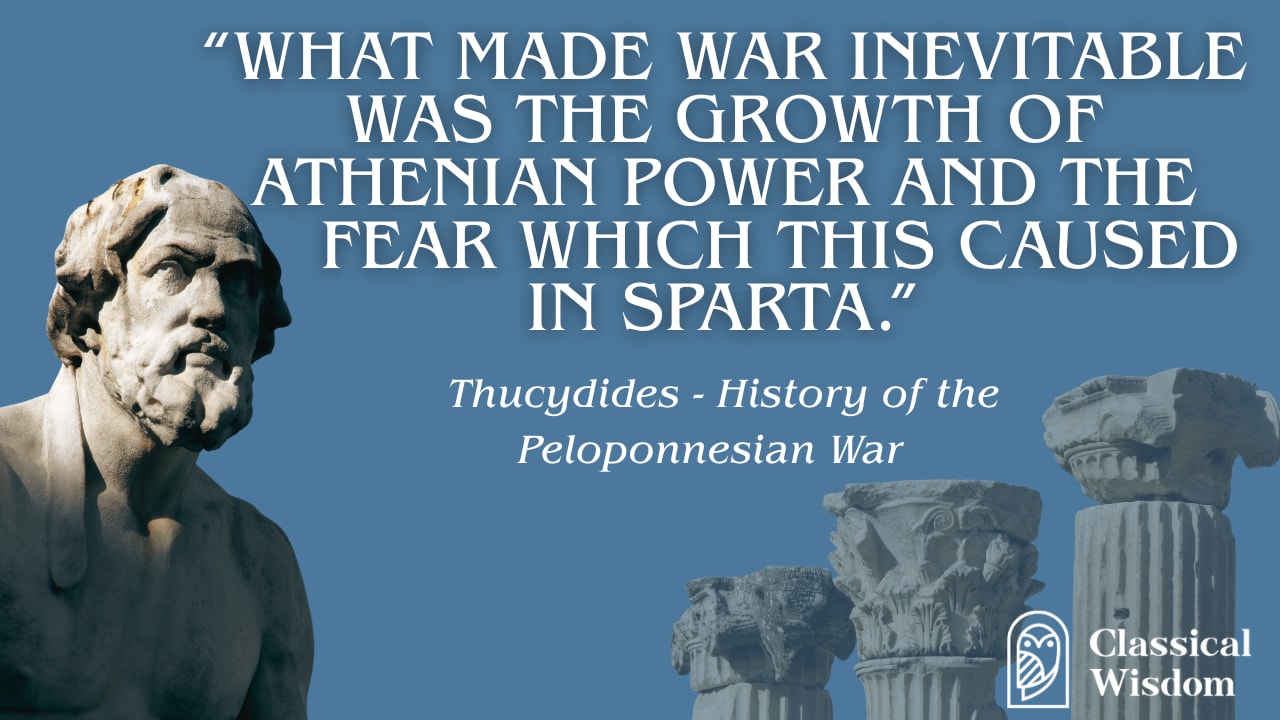
<p>Dear Classical Wisdom Reader,</p><p>It is not often that an ancient Greek historian finds himself at the center of modern geopolitical headlines...much less in discussions involving arguably the two most powerful men in the world!</p><p>And yet that is precisely what happened... and so we would, of course, be remiss to not discuss it in these humble pages.</p><p>You see, during the recent meeting between US President Donald Trump and the General Secretary of the Chinese Communist Party Xi Jinping, Xi referenced the question of whether the two nations could avoid falling into the so-called “Thucydides Trap.”</p><p>The phrase, drawn from the ancient Greek historian Thucydides, describes the dangerous dynamic that emerges when a rising power threatens to displace an established one. More than 2,400 years after Athens challenged Sparta, Thucydides’ observations on fear, ambition, and geopolitical rivalry remain more relevant than ever.</p><p><strong>But what exactly is the Thucydides Trap?</strong></p><p><strong>What did Thucydides actually mean?</strong></p><p><strong>And are we truly doomed to repeat the same destructive patterns that consumed the ancient Greek world?</strong></p><p>To answer those questions, we must return to the historian himself... and to the brutal war that inspired one of history’s most enduring political ideas.</p><p>Please read the article below on the Thucydides trap and discuss in the comments your thoughts on the topic...</p><p><strong>Classical Wisdom Members:</strong> this week we will also be exploring the idea of the statesman. What separates a true statesman or stateswoman from an ordinary politician? And what can we learn from figures such as Pericles, Alcibiades, Cicero, and Cato the Younger?</p><p>Make sure to become a member to receive this special issue of <em>Classical Wisdom Litterae Magazine</em>, along with access to our ebooks, podcasts, courses, and more:</p><p><a href="https://classicalwisdom.substack.com/subscribe"><span>Become a Member</span></a></p><p>And now, onto Thucydides... and his famous trap...</p><p>All the best,<br>Anya Leonard</p><p>Founder and Director<br>Classical Wisdom</p><h1>What Is the Thucydides Trap?</h1><p><em>By Anya Leonard</em></p><p>The ancient Greeks understood something uncomfortable about power... it is rarely static.</p><p>Empires rise... Rivals emerge... Fear grows.... and all too often, war follows.</p><p>This grim pattern lies at the heart of what we now call the “Thucydides Trap,” a phrase popularized by political scientist Graham Allison to describe the dangerous tension that emerges when a rising power threatens to displace an established one.</p><p>Of course dedicated classicists will recognize that the term refers to the ancient historian Thucydides, whose account of the Peloponnesian War remains one of the most penetrating studies of human conflict ever written.</p><p>It was in this work that Thucydides famously observed what happens when a rising power threatens an established one. As he wrote in Book I.23 of <em>History of the Peloponnesian War</em>:</p><blockquote><p>“What made war inevitable was the growth of Athenian power and the fear which this caused in Sparta.” - Thucydides </p></blockquote><p>Essentially, Thucydides is saying that Athens’ rise in power is what caused the Peloponnesian War...the previous power feels threatened and doesn’t manage the emerging empire well, resulting in conflict.</p><div><figure><a href="https://substackcdn.com/image/fetch/%24s_!gMDS!,f_auto,q_auto:good,fl_progressive:steep/https%3A%2F%2Fsubstack-post-media.s3.amazonaws.com%2Fpublic%2Fimages%2F0a669841-2f1d-4a4a-af97-45224dc3fa13_1280x720.png"></a><div><a href="https://substackcdn.com/image/fetch/%24s_!gMDS!,f_auto,q_auto:good,fl_progressive:steep/https%3A%2F%2Fsubstack-post-media.s3.amazonaws.com%2Fpublic%2Fimages%2F0a669841-2f1d-4a4a-af97-45224dc3fa13_1280x720.png"></a><source type="image/webp"><a href="https://substackcdn.com/image/fetch/%24s_!gMDS!,f_auto,q_auto:good,fl_progressive:steep/https%3A%2F%2Fsubstack-post-media.s3.amazonaws.com%2Fpublic%2Fimages%2F0a669841-2f1d-4a4a-af97-45224dc3fa13_1280x720.png"><img src="https://substackcdn.com/image/fetch/%24s_!gMDS!,w_1456,c_limit,f_auto,q_auto:good,fl_progressive:steep/https%3A%2F%2Fsubstack-post-media.s3.amazonaws.com%2Fpublic%2Fimages%2F0a669841-2f1d-4a4a-af97-45224dc3fa13_1280x720.png" width="1280" height="720" alt=""></a></source><a href="https://substackcdn.com/image/fetch/%24s_!gMDS!,f_auto,q_auto:good,fl_progressive:steep/https%3A%2F%2Fsubstack-post-media.s3.amazonaws.com%2Fpublic%2Fimages%2F0a669841-2f1d-4a4a-af97-45224dc3fa13_1280x720.png"></a><div><a href="https://substackcdn.com/image/fetch/%24s_!gMDS!,f_auto,q_auto:good,fl_progressive:steep/https%3A%2F%2Fsubstack-post-media.s3.amazonaws.com%2Fpublic%2Fimages%2F0a669841-2f1d-4a4a-af97-45224dc3fa13_1280x720.png"></a><div><a href="https://substackcdn.com/image/fetch/%24s_!gMDS!,f_auto,q_auto:good,fl_progressive:steep/https%3A%2F%2Fsubstack-post-media.s3.amazonaws.com%2Fpublic%2Fimages%2F0a669841-2f1d-4a4a-af97-45224dc3fa13_1280x720.png"></a></div><a href="https://substackcdn.com/image/fetch/%24s_!gMDS!,f_auto,q_auto:good,fl_progressive:steep/https%3A%2F%2Fsubstack-post-media.s3.amazonaws.com%2Fpublic%2Fimages%2F0a669841-2f1d-4a4a-af97-45224dc3fa13_1280x720.png"></a></div><a href="https://substackcdn.com/image/fetch/%24s_!gMDS!,f_auto,q_auto:good,fl_progressive:steep/https%3A%2F%2Fsubstack-post-media.s3.amazonaws.com%2Fpublic%2Fimages%2F0a669841-2f1d-4a4a-af97-45224dc3fa13_1280x720.png"></a></div><a href="https://substackcdn.com/image/fetch/%24s_!gMDS!,f_auto,q_auto:good,fl_progressive:steep/https%3A%2F%2Fsubstack-post-media.s3.amazonaws.com%2Fpublic%2Fimages%2F0a669841-2f1d-4a4a-af97-45224dc3fa13_1280x720.png"></a></figure></div><p><a href="https://classicalwisdom.substack.com/p/what-is-the-thucydides-trap-and-should?utm_source=substack&utm_medium=email&utm_content=share&action=share"><span>Share</span></a></p><p>While Thucydides was writing specifically about the catastrophic war between Athens and Sparta in the fifth century BC, his work has endured precisely because it speaks to something larger than a single conflict. He discusses the battles and speeches, sure, but also explores the ideas of ambition, insecurity, pride, and the fragile psychology of nations.</p><p>Indeed, more than two millennia later, world leaders and political theorists still turn to his insights when trying to understand tensions between modern superpowers...</p><p>But let’s return to the exact conflict Thucydides was recording.</p><p>The 27-year Peloponnesian War erupted in 431 BCE after Athens transformed itself from a victorious city-state into an imperial maritime power. Flush with wealth, naval dominance, and cultural confidence, Athens expanded aggressively throughout the Aegean.</p><p>Sparta, meanwhile, had long been the dominant military force in Greece. Conservative, land-based, and deeply wary of change, Sparta increasingly viewed Athenian growth not merely as competition, but as an existential threat...This is what was at the heart of the ‘trap’.</p><p>What makes Thucydides so compelling is that he does not reduce war to simple morality. There are no cartoon villains in his history. Instead, he reveals how even rational actors can stumble toward catastrophe through fear, miscalculation, pride, and mutual suspicion.</p><p>This is one reason his work continues to resonate today.</p><p><strong>War with Words</strong></p><p>One of the most unsettling moments in his history occurs during the civil strife at Corcyra, where political chaos corrodes language itself. Words began to change meaning; violence became virtue and moderation became weakness. Thucydides writes:</p><blockquote><p>“Words had to change their ordinary meaning and to take that which was now given them.”<br>— Thucydides, <em>History of the Peloponnesian War</em>, Book III.82</p></blockquote><p>This certainly feels like something we can relate to today... As culture wars rage, each side employs language as its battlefield.</p><p><a href="https://classicalwisdom.substack.com/p/what-is-the-thucydides-trap-and-should?utm_source=substack&utm_medium=email&utm_content=share&action=share"><span>Share</span></a></p><p>The enduring power of Thucydides lies not simply in his analysis of war, but in his recognition that civilizations are often undone from within as much as from without. During the plague at Athens, social order collapsed almost overnight. Laws lost authority while citizens abandoned restraint. The idealized image of Athens as democratic, enlightened, and exceptional disintegrated under this crushing pressure.</p><p>Thucydides deliberately juxtaposes Pericles’ glorious Funeral Oration with the chaos of the plague that immediately follows. The contrast is devastating... beneath the rhetoric of greatness lies the fragility of human society itself.</p><blockquote><p>“Men, not knowing what was to become of them, became utterly careless of everything, whether sacred or profane.”<br>— Thucydides, <em>History of the Peloponnesian War</em>, Book II.52</p></blockquote><p>Thucydides forces us to confront uncomfortable truths about ourselves. We like to imagine that history moves steadily toward progress, that technological advancement naturally produces moral advancement...But the Greeks were never so optimistic. They understood that prosperity can breed arrogance, complacency, and instability as easily as wisdom.</p><p>Thucydides himself hints at this darker realism in one of the most famous exchanges in ancient literature, the Melian Dialogue, when the Athenians coldly declare:</p><blockquote><p>“The strong do what they can and the weak suffer what they must.”<br>— Thucydides, <em>History of the Peloponnesian War</em>, Book V.89</p></blockquote><p>Indeed, one of the great ironies of the Peloponnesian War is that both Athens and Sparta emerged diminished. Athens lost its empire and while Sparta gained temporary dominance, it ultimately exhausted itself as well. The war devastated the Greek world so thoroughly that it paved the way for outside powers, first Macedon, then Rome, to dominate Greece altogether.</p><p>In other words, victory can sometimes resemble defeat.</p><p>This is perhaps the most important lesson of the Thucydides Trap. The danger is not simply that war occurs when powers shift. The greater danger is that fear itself becomes self-fulfilling and Nations begin preparing so intensely for conflict that they make conflict inevitable.</p><div><div><div><p>Learn the lessons from History! Become a Member to enjoy our full podcasts, magazines and more…</p></div><div><div></div><div></div></div></div></div><p></p><p><strong>Thucydides Then, Not Now</strong></p><p>Modern discussions of the Thucydides Trap inevitably circle around the relationship between the United States and China. America has been the dominant global power for decades, while China’s rapid economic and military rise has fundamentally altered the international balance. The parallels to Athens and Sparta are tempting: a confident rising power challenging an anxious established hegemon.</p><p>But history is never quite so tidy....</p><p>While human nature may remain relatively constant, every historical moment contains its own unique institutions, technologies, and political realities, so it doesn’t behoove us to treat Thucydides as a prophetic blueprint. Indeed, the danger of the “Thucydides Trap” framework is that it can oversimplify the complexities of history and encourage fatalistic thinking.</p><p>After all, Athens and Sparta existed in a world without nuclear weapons, international organizations, economic interdependence, or instant communication. Ancient wars were brutal, direct, and personal. Entire cities could be enslaved or annihilated. Modern geopolitical conflict unfolds within vastly more complicated systems.</p><p>Yet despite these differences, the emotional dynamics remain familiar.</p><p>Rising powers still seek recognition...</p><p>Established powers still struggle to adapt...</p><p>Politicians still invoke honor, security, and national destiny...</p><p>And perhaps most importantly...societies still convince themselves that escalation is unavoidable.</p><p>But it is important to remember that history is not destiny...</p><p><a href="https://classicalwisdom.substack.com/p/what-is-the-thucydides-trap-and-should?utm_source=substack&utm_medium=email&utm_content=share&action=share"><span>Share</span></a></p><p>Thucydides does not offer easy solutions, nor does he promise that humanity will learn from the past. But by studying him, we can recognize recurring patterns and can become more skeptical of political certainty. We understand that civilizations, however advanced, remain vulnerable to the same passions that shaped the ancient world... </p><p>But above all, by considering this ancient war, we gain something immensely valuable: perspective.</p>
<p><a href="https://classicalwisdom.substack.com/p/what-is-the-thucydides-trap-and-should" target="_blank">- Enlace a artículo -</a></p>
<p>Más info en https://ift.tt/3avK7wr / Tfno. & WA 607725547 Centro MENADEL (Frasco Martín) Psicología Clínica y Tradicional en Mijas.
#Menadel #Psicología #Clínica #Tradicional #MijasPueblo</p>
<p>*No suscribimos necesariamente las opiniones o artículos aquí compartidos. No todo es lo que parece.</p>

No hay comentarios:
Publicar un comentario