
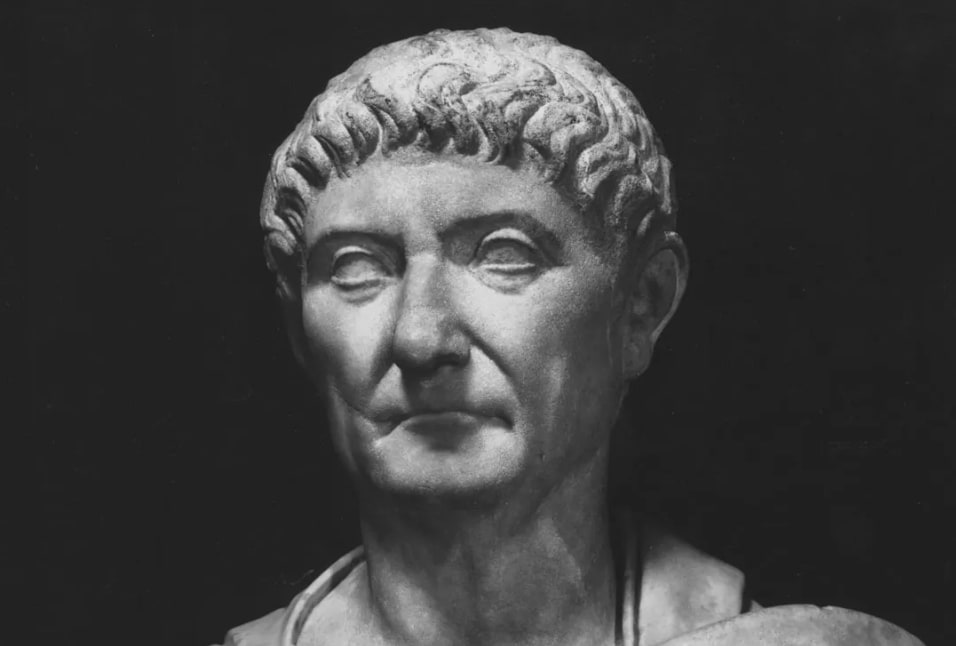
<p>Dear Classical Wisdom Reader,</p><p>Rarely does history move at an easy pace, with one era transitioning cleanly into the next. When we are young, we are instructed to draw neat timelines, marked by small perpendicular dashes dividing one age from another.</p><p>But history is seldom so orderly. Sometimes one era crashes violently into the next, or the old world slowly crumbles until almost nothing remains.</p><p>Sometimes civilization itself seems to survive by a thread.</p><p>The rise of Christianity inside the Roman Empire was one of those moments.</p><p>Long before Constantine marched beneath the sign of the cross, Christians had already begun weaving themselves into the fabric of Roman life...adopting its language, borrowing its customs, and trying to reconcile their faith with the overwhelming power of empire.</p><p>Yet the relationship was never entirely comfortable, and beneath the grandeur of Rome, something deeper was shifting...</p><p>In today’s special guest column, generously provided by former Princeton scholar and one of America’s leading historians, Allen C. Guelzo, we embark on an important journey through the early persecution, and eventual ascendancy, of Christianity... tracing how the world moved from Roman power to Christian conquest.</p><p>What is remarkable is that the Romans living through these events did not know they were standing at the edge of a new world. They were simply trying to make sense of rapid change, political instability, shifting values, and a society that no longer felt quite as solid as it once had.</p><p>Read on and consider: how does a culture hold together when its old assumptions begin to fade?</p><p>What do people cling to in moments of uncertainty?</p><p>And how do ideas once dismissed slowly become powerful enough to reshape an entire civilization?</p><p>All the best,<br>Anya Leonard<br>Founder and Director<br>Classical Wisdom</p><p>P.S. You can find part one below, and<a href="https://goldenthread.substack.com/p/constantines-conquest-part-2"> part two on </a><em><a href="https://goldenthread.substack.com/p/constantines-conquest-part-2">The Golden Thread</a></em>, a new Substack created by Allen and longtime Classical Wisdom contributor James Hankins, the renowned Renaissance historian formerly of Harvard and now affiliated with the Hamilton Center for Classical and Civic Education at the University of Florida alongside Allen.</p><p>If you are not yet familiar with <em>The Golden Thread</em>, I highly recommend exploring it. The publication approaches the Western tradition not as something frozen in the past, but as a living inheritance... one that continues to shape how we think about politics, culture, faith, and society today.</p><p><a href="https://goldenthread.substack.com/"><span>Explore the Golden Thread</span></a></p><p></p><h1>Constantine’s Conquest – Part 1</h1><p><em>by Allen C. Guelzo</em></p><p>The emperor Diocletian – or, to give him his full names, Gaius Aurelius Valerius Diocletianus – was the last Roman emperor to inflict a system-wide persecution on the Christians of the Roman empire. The most important legacy of that persecution was its failure to stamp out Christianity in the empire; what is more ironic is how much of a surprise that persecution came to the Christians in the first place.</p><p>Diocletian assumed the imperial purple in 284 ad, mostly on the shields of the soldiers he commanded. He reigned for nineteen years without seeming to give much thought to the Christians, who were allowed to flourish and spread to the point where a church held open and public services across the street from Diocletian’s palace in Nicomedia.</p><p>So there was no hint of what was to come when, in February 303, Diocletian abruptly ordered the shuttering of Christian churches and destruction of Christian scriptures; the church in Nicomedia was demolished. </p><p><a href="https://classicalwisdom.substack.com/p/the-christians-who-changed-the-roman?utm_source=substack&utm_medium=email&utm_content=share&action=share"><span>Share</span></a></p><p>The suddenness of the onslaught caught Christians flatfooted, and many caved-in to the demands of imperial officials to offer the symbolic pinch of incense on the altar of the emperor’s <em>genius</em> – his divine spirit.</p><p>But the impact of the Diocletianic persecution may have been due to something more fundamental than mere unpreparedness. Given the long history of persecution in the empire, the Christian Church ought not to have been surprised that a common-born traditionalist like Diocletian would, sooner or later, try to turn the empire’s clock back to some more traditional homage to the ancient gods.</p><div><figure><a href="https://substackcdn.com/image/fetch/%24s_!BdPW!,f_auto,q_auto:good,fl_progressive:steep/https%3A%2F%2Fsubstack-post-media.s3.amazonaws.com%2Fpublic%2Fimages%2F14c5ce09-b2fa-4e90-8b15-0b892068fd41_956x646.png"></a><div><a href="https://substackcdn.com/image/fetch/%24s_!BdPW!,f_auto,q_auto:good,fl_progressive:steep/https%3A%2F%2Fsubstack-post-media.s3.amazonaws.com%2Fpublic%2Fimages%2F14c5ce09-b2fa-4e90-8b15-0b892068fd41_956x646.png"></a><source type="image/webp"><a href="https://substackcdn.com/image/fetch/%24s_!BdPW!,f_auto,q_auto:good,fl_progressive:steep/https%3A%2F%2Fsubstack-post-media.s3.amazonaws.com%2Fpublic%2Fimages%2F14c5ce09-b2fa-4e90-8b15-0b892068fd41_956x646.png"><img src="https://substackcdn.com/image/fetch/%24s_!BdPW!,w_1456,c_limit,f_auto,q_auto:good,fl_progressive:steep/https%3A%2F%2Fsubstack-post-media.s3.amazonaws.com%2Fpublic%2Fimages%2F14c5ce09-b2fa-4e90-8b15-0b892068fd41_956x646.png" width="956" height="646" alt=""></a></source><a href="https://substackcdn.com/image/fetch/%24s_!BdPW!,f_auto,q_auto:good,fl_progressive:steep/https%3A%2F%2Fsubstack-post-media.s3.amazonaws.com%2Fpublic%2Fimages%2F14c5ce09-b2fa-4e90-8b15-0b892068fd41_956x646.png"></a><div><a href="https://substackcdn.com/image/fetch/%24s_!BdPW!,f_auto,q_auto:good,fl_progressive:steep/https%3A%2F%2Fsubstack-post-media.s3.amazonaws.com%2Fpublic%2Fimages%2F14c5ce09-b2fa-4e90-8b15-0b892068fd41_956x646.png"></a><div><a href="https://substackcdn.com/image/fetch/%24s_!BdPW!,f_auto,q_auto:good,fl_progressive:steep/https%3A%2F%2Fsubstack-post-media.s3.amazonaws.com%2Fpublic%2Fimages%2F14c5ce09-b2fa-4e90-8b15-0b892068fd41_956x646.png"></a></div><a href="https://substackcdn.com/image/fetch/%24s_!BdPW!,f_auto,q_auto:good,fl_progressive:steep/https%3A%2F%2Fsubstack-post-media.s3.amazonaws.com%2Fpublic%2Fimages%2F14c5ce09-b2fa-4e90-8b15-0b892068fd41_956x646.png"></a></div><a href="https://substackcdn.com/image/fetch/%24s_!BdPW!,f_auto,q_auto:good,fl_progressive:steep/https%3A%2F%2Fsubstack-post-media.s3.amazonaws.com%2Fpublic%2Fimages%2F14c5ce09-b2fa-4e90-8b15-0b892068fd41_956x646.png"></a></div><a href="https://substackcdn.com/image/fetch/%24s_!BdPW!,f_auto,q_auto:good,fl_progressive:steep/https%3A%2F%2Fsubstack-post-media.s3.amazonaws.com%2Fpublic%2Fimages%2F14c5ce09-b2fa-4e90-8b15-0b892068fd41_956x646.png"></a><figcaption>Detail of a bust of Diocletian in the Capitoline Museum, Rome.</figcaption></figure></div><p>However, as Christianity claimed more and more converts in the second and third centuries, it also received an influx of more wealthy and affluent Romans who were not willing to leave <em>entirely </em>behind them the cultural trappings of <em>romanitas </em>(or Roman culture). Tertullian, whose gasconades against the philosophers of the Augustan age are among the best known early Christian writings, was still a Roman, and there were moments when his eagerness to prove that becoming a Christian did not make him less a Roman led him to protest a quixotic loyalty to the empire.</p><blockquote><p>“Without ceasing, for all our emperors we offer prayer,” he protested in his <em>Apologeticus</em> (sometime around the year 200 AD). “We pray for life prolonged; for security to the empire; for protection to the imperial house; for brave armies, a faithful Senate, a virtuous people, the world at rest, whatever, as man and Caesar, an emperor would wish.”<sup> </sup></p><p>- “Apologeticus,” in <em>The Writings of Quintus Sept. Flor. Tertullianus</em>, eds. A. Roberts et al. (Edinburgh, 1872), 1:110.</p></blockquote><p>A similar note was struck by Origen of Alexandria, who swerved from the initial Christian dismissal of Roman deities as δαίμονες (demons) to the suggestion that the pagan gods were simply manifestations of a universal revelation God had given to all humanity. The Jews, admittedly, had the benefit of a direct communication from God in the form of the Ten Commandments and the Mosaic Law. But the Greeks had not been far behind philosophically, and Platonism could really be considered a forerunner of the true Christian παιδεία (teaching). The Christian was not one who rejected Platonism, but one who used it as a stepping stone to a truer παιδεία.</p><blockquote><p>“I would wish that you should take with you on the one hand those parts of the philosophy of the Greeks which are fit, as it were, to serve as general, or preparatory studies for Christianity,” Origen argued in 235, “and in the same way we might speak of philosophy itself as being ancillary to Christianity.”</p><p>- “Letter of Origen to Gregory,” <em>Ante-Nicene Christian Library: Additional Volume</em>, ed. A. Menzies (Edinburgh, 1903), 295.</p></blockquote><p>Christians found other, subtler ways of accommodating the spirit of Roman culture.</p><p>Christians now began to appear among the ranks of the Roman legions, and Roman military terminology cropped up in Christian theological usage. For instance: the term <em>sacramentum</em> originally described the oath taken by soldiers to the emperor and the empire, but it soon become the term used by Christians to describe the rites which give them their Christian identity. </p><p>And the term <em>paganus</em>, which once referred simply to civilians, now came into use by Christians, who described themselves as <em>milites Christi</em>, to speak of non-believers.</p><p>On the tombs of third-century Christians, there began to appear carvings of Jesus the Divine Schoolmaster, “dressed in the simple robes of a professor of literature.” In the basilicas of many a Roman town, the bishop’s chair became a <em>cathedra</em> – the professor’s seat.</p><p>Christians who assumed that they had safely and quietly assimilated themselves into the Roman world received a terrific shock from the Diocletianic persecution, which made it as clear as transparency that in fact they were aliens to the Roman world, and subject to the most hostile inquiries and actions. </p><div><div><div><p><em>Looking to Level Up your love of the ancient world? Subscribe and unlock all our resources, from Ebooks and Podcasts to Magazines and More. Bring Classical Wisdom into your life:</em></p></div><div><div></div><div></div></div></div></div><p>Some, like Sts. Felix and Audacta, defied the imperial enforcers and were executed. But so many surrendered to the demands of imperial officials for gestures of loyalty to paganism that the recriminations within Christian ranks would echo for decades.</p><p>More damage might have been done had not Diocletian come to their aid with a miscalculation of colossal political proportions. In an effort to make sure that all the far-flung provinces of the empire were being supervised with sufficient care, and fearful that assassinations of single emperors had been the signal for chaos and civil war, Diocletian proceeded to divide his imperial authority.</p><p>He retained the traditional title of <em>Augustus</em> for himself, but he created another <em>Augustus</em> who would be responsible for governing the vast regions of the empire that stretched west of the Adriatic Sea, and appointed his loyal but unimaginative lieutenant, Maximian to that post. </p><div><figure><a href="https://substackcdn.com/image/fetch/%24s_!lT--!,f_auto,q_auto:good,fl_progressive:steep/https%3A%2F%2Fsubstack-post-media.s3.amazonaws.com%2Fpublic%2Fimages%2Fef143994-23ea-47c6-a342-df1909b0eb9f_950x1068.png"></a><div><a href="https://substackcdn.com/image/fetch/%24s_!lT--!,f_auto,q_auto:good,fl_progressive:steep/https%3A%2F%2Fsubstack-post-media.s3.amazonaws.com%2Fpublic%2Fimages%2Fef143994-23ea-47c6-a342-df1909b0eb9f_950x1068.png"></a><source type="image/webp"><a href="https://substackcdn.com/image/fetch/%24s_!lT--!,f_auto,q_auto:good,fl_progressive:steep/https%3A%2F%2Fsubstack-post-media.s3.amazonaws.com%2Fpublic%2Fimages%2Fef143994-23ea-47c6-a342-df1909b0eb9f_950x1068.png"><img src="https://substackcdn.com/image/fetch/%24s_!lT--!,w_1456,c_limit,f_auto,q_auto:good,fl_progressive:steep/https%3A%2F%2Fsubstack-post-media.s3.amazonaws.com%2Fpublic%2Fimages%2Fef143994-23ea-47c6-a342-df1909b0eb9f_950x1068.png" width="950" height="1068" alt=""></a></source><a href="https://substackcdn.com/image/fetch/%24s_!lT--!,f_auto,q_auto:good,fl_progressive:steep/https%3A%2F%2Fsubstack-post-media.s3.amazonaws.com%2Fpublic%2Fimages%2Fef143994-23ea-47c6-a342-df1909b0eb9f_950x1068.png"></a><div><a href="https://substackcdn.com/image/fetch/%24s_!lT--!,f_auto,q_auto:good,fl_progressive:steep/https%3A%2F%2Fsubstack-post-media.s3.amazonaws.com%2Fpublic%2Fimages%2Fef143994-23ea-47c6-a342-df1909b0eb9f_950x1068.png"></a><div><a href="https://substackcdn.com/image/fetch/%24s_!lT--!,f_auto,q_auto:good,fl_progressive:steep/https%3A%2F%2Fsubstack-post-media.s3.amazonaws.com%2Fpublic%2Fimages%2Fef143994-23ea-47c6-a342-df1909b0eb9f_950x1068.png"></a></div><a href="https://substackcdn.com/image/fetch/%24s_!lT--!,f_auto,q_auto:good,fl_progressive:steep/https%3A%2F%2Fsubstack-post-media.s3.amazonaws.com%2Fpublic%2Fimages%2Fef143994-23ea-47c6-a342-df1909b0eb9f_950x1068.png"></a></div><a href="https://substackcdn.com/image/fetch/%24s_!lT--!,f_auto,q_auto:good,fl_progressive:steep/https%3A%2F%2Fsubstack-post-media.s3.amazonaws.com%2Fpublic%2Fimages%2Fef143994-23ea-47c6-a342-df1909b0eb9f_950x1068.png"></a></div><a href="https://substackcdn.com/image/fetch/%24s_!lT--!,f_auto,q_auto:good,fl_progressive:steep/https%3A%2F%2Fsubstack-post-media.s3.amazonaws.com%2Fpublic%2Fimages%2Fef143994-23ea-47c6-a342-df1909b0eb9f_950x1068.png"></a><figcaption>Bust of Maximian, Diocletian’s co-ruler in the Western Roman Empire</figcaption></figure></div><p>To support the work of imperial administration, he took the additional step in 293 of appointing an assistant, a <em>Caesar</em>, for both <em>Augusti</em>. As his own <em>Caesar</em>, he appointed a reliable soldier, Galerius; for Maximian, in the west, he selected as <em>Caesar </em>another loyalist, Constantius, who was then stationed in Roman Britain.</p><p>This <em>tetrarchy</em> (four-ruler) system worked reasonably well so long as Diocletian was on hand to make it work. But when, after a terrible bout of sickness, he announced his retirement on May 1, 305, he made the mistake of requiring Maximian to join him in retirement. In a further mistake, Galerius was promoted to Augustus in the east, and Constantius in the west, while Diocletian appointed Maximin Daia as Caesar for Galerius and Severus as Caesar for Constantius.</p><p>I call this a mistake, because these promotions came as unwelcome news to two ambitious individuals – Constantine, the handsome and commanding son of Constantius, and Maxentius, the son of Maximian, both of whom had expected that they would become the next respective Caesar in east and west, and both of whom suspected that Galerius had been the whisperer-in-the-ear of Diocletian, leading to their exclusion.</p><p>Constantine and his father were particularly alienated from Galerius because both worshipped <em>Sol Invictus</em> – the “All-Conquering Sun” – which put them out of Diocletian’s favor, since <em>Sol Invictus</em> was not among the traditional Roman deities. </p><p><a href="https://classicalwisdom.substack.com/p/the-christians-who-changed-the-roman?utm_source=substack&utm_medium=email&utm_content=share&action=share"><span>Share</span></a></p><p>And on the premise that anyone else outside the circle of those deities had to be a friend, Constantius did little to press Diocletian’s anti-Christian decrees, apart from pulling down a few old churches.</p><p>When Constantius died in July of 306, Constantine was unwilling to see Diocletian’s pick as the western Caesar rise to claim the title of Augustus. The legions, which had been loyal to Constantius and to Constantine, now proclaimed Constantine as their Augustus. Meanwhile in Italy, the army in Rome mutinied and deposed Severus, hailing Maxentius as its new Augustus.</p><p>Thus, the stage was set for a three-way contest: Galerius refused to acknowledge either Constantine or Maxentius as a legitimate Augustus, and neither of those two would concede to the other. And at that unlikely moment, the single group which emerged holding the real cards to success would turn out to be the Christians...</p><div><hr></div><p><em><strong>Read Part Two of Allen C. Guelzo’s “Constantine’s Conquests” on The Golden Thread Here:</strong></em></p><p><a href="https://goldenthread.substack.com/p/constantines-conquest-part-2"><span>Read Part 2</span></a></p><p></p>
<p><a href="https://classicalwisdom.substack.com/p/the-christians-who-changed-the-roman" target="_blank">- Enlace a artículo -</a></p>
<p>Más info en https://ift.tt/RA7nQtL / Tfno. & WA 607725547 Centro MENADEL (Frasco Martín) Psicología Clínica y Tradicional en Mijas.
#Menadel #Psicología #Clínica #Tradicional #MijasPueblo</p>
<p>*No suscribimos necesariamente las opiniones o artículos aquí compartidos. No todo es lo que parece.</p>

No hay comentarios:
Publicar un comentario