
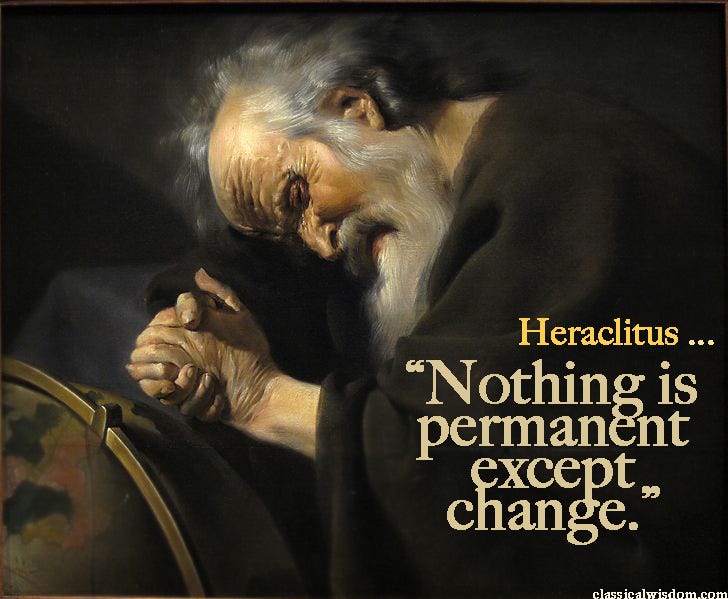
“Time is a game played beautifully by children.” - Fragment 52
“Much learning does not teach understanding.” - Fragment 40
“The road up and the road down is one and the same.” - Fragment 60
“Dogs, also, bark at what they do not know.” - Fragment 97
“It is better to conceal ignorance than to expose it.” - Fragment 109
Dear Classical Wisdom Reader,
Cold becomes hot, life becomes death...and strife brings about harmony.
Yes, dear reader, we are wading in the contemplative and contradictory world of the weeping philosopher, Heraclitus. Known for his misanthropic ways, he was regularly uncomplimentary about his fellow men, criticizing fools for being, "put in a flutter by every word" (Plutarch) and, according to Sextus Empiricus, stated that, "though reason is common, most people live as though they had an understanding peculiar to themselves."
He purposefully made his ideas obscure and dense like the prophetic oracles, believing that, “a hidden connection is stronger than an obvious one.” (Hippolytus). Perhaps, as a man who never felt the need to veil his contempt for the unwashed masses, this was done so that only those ‘capable’ attempted to understand his ideas...or perhaps it was to ensure that the student does the work and seeks the answer in the same vein and tradition of the philosopher himself.
A HUGE thank you to our wonderful members who make this Substack possible! If you aren’t already, consider subscribing today to support the Classics and enjoy ALL our resources.
Either way, Heraclitus’ monumental ability to comprehend and appreciate both macro and micro movements in physics, life and politics, influenced an untold number of philosophers from the ancient era onwards. Indeed, the (not always reliable) biographer, Diogenes Laërtius relays a fantastic story concerning the playwright Euripides who once gave Socrates a copy of Heraclitus' work and asked for his opinion. The gadfly of Athens replied:
"The part I understand is excellent, and so too is, I dare say, the part I do not understand; but it needs a Delian diver to get to the bottom of it."
Praise... and confusion from Socrates himself! But what exactly were Heraclitus’ brilliant ideas?
At the very foundation, the Ephesus born philosopher believed that the universe is governed by a divine reason, or logos, that holds everything in harmony. Moreover, this unity is composed of a balancing of opposites. The continuous changing of reality, that day becomes night and hot becomes cold, is the one fundamental constant within the cosmos.
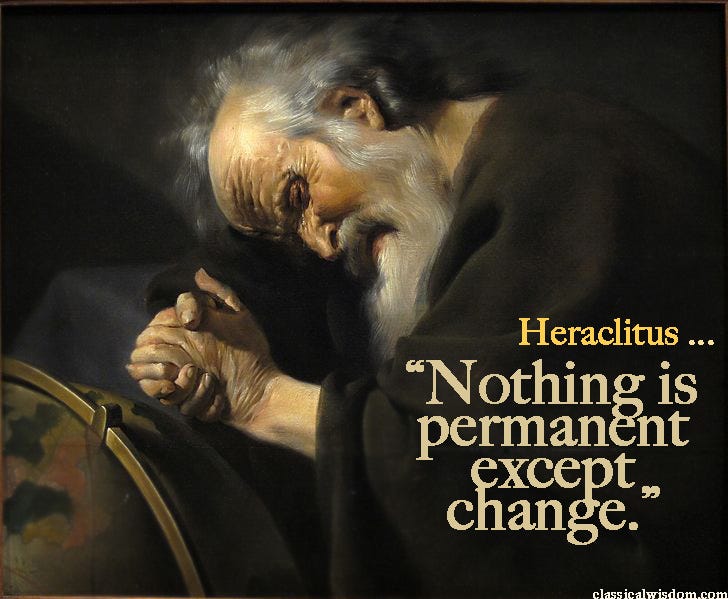
This insight led to arguably his most well known idea, that everything is in a continuous state of flux and that the only constant is change itself. Most likely at this moment, you are considering the famous quote that no man can step in the same river twice... for both the man and the river have changed.
While this metaphor of a forever flowing river conveys a gentle, calming idea of variation and vicissitude, to Heraclitus the reality of fluctuation was ἔρις (eris) or "strife". Moreover, this conflict of opposites is not only good, but essential for justice and harmony.
"There would be no harmony without high and low notes, and no animals without male and female, which are opposites" (Heraclitus, according to Aristotle in Eudemian Ethics.)
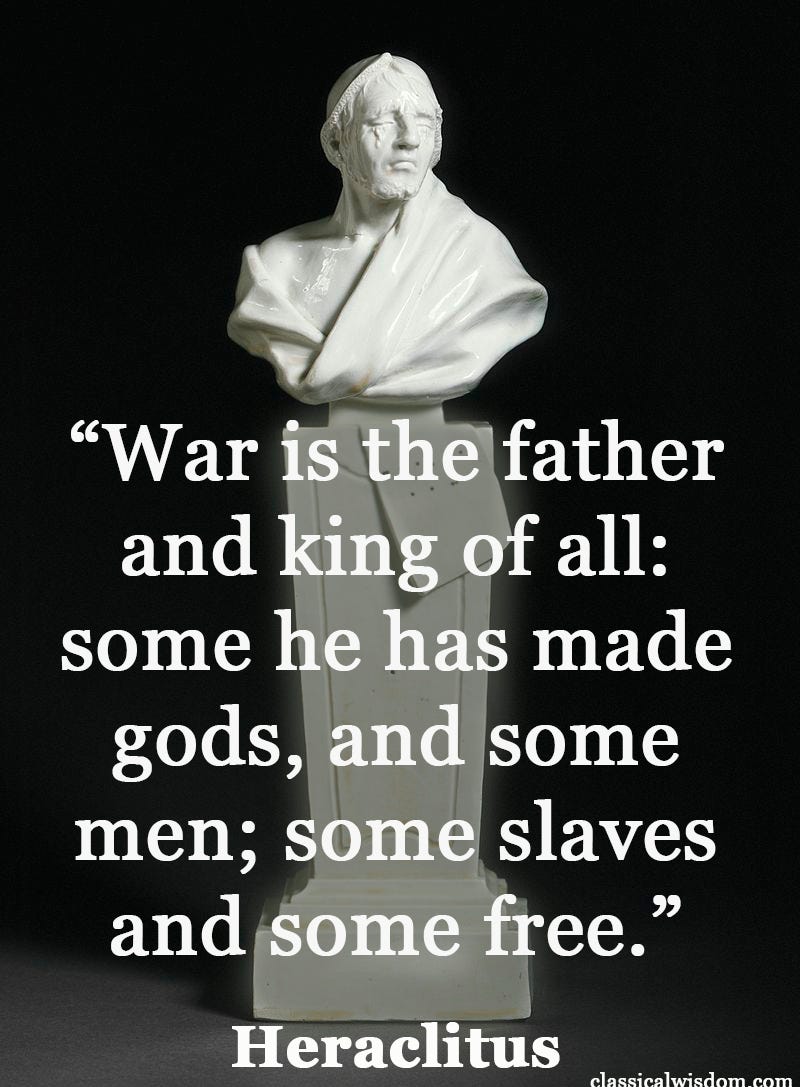
This need of clashing contrasts and extreme tension is epitomized in war, which Heraclitus famously remarked is, “the father and king of all, and has produced some as gods and some as men, and has made some slaves and some free.” (Hippolytus, Ref. haer. ix. 9 (Fragment 53). G. T. W. Patrick, 1889).
Modern readers may bristle at the idea of war being a ‘creative tension’, recalling nightly news reels which clearly demonstrate the all too tragic reality of destruction. So perhaps instead of wading into the emotive realm of geopolitical violence, we will take a step back and consider Heraclitus’ premise: that everything is always becoming its opposite...and ask if contemporary trends substantiate or invalidate his theory?
Let’s take, for instance, sweeping cultural movements and perspectives which are constantly changing. Consider the role of women in society (from girl boss to trad wife), societal attitudes towards the police and military (from heroic protectors to violent aggressors), to norms and expectations on health and lifestyle (from rockstar envy to fit bit monitoring).
Likewise, have the ideas of what constitutes a Democrat or Republican reversed over the decades and centuries in regards to demographics (from the factory floor to the corner office, middle America to the coastal elite), in terms of foreign policy (isolationism vs interventionism), right down to the very role of the state itself, in that eternal debate between security on the one hand, and liberty on the other?
Everyone is welcome to take part in the great conversation and enjoy the wisdom of the ancients… If you think this discussion is important, make sure share it.
What about the rise and fall of global powers, the shifts from West to East and the prominence and prevalence of advanced technologies? (See Chinese drone light shows for evidence...)
But perhaps most importantly of all, how does this understanding of Enantiodromia, the idea that everything makes way for its opposite, help us make sense of ourselves and our current events? What can we take away from Heraclitus’ ideas? And what would that solitary man think about the world today?
Let me know your thoughts below!
All the best,
Anya Leonard
Founder and Director
Classical Wisdom
P.S. While Heraclitus was accused of linguistic density, he was also celebrated for his clever use of literary devices, and his ability to convey philosophy via poetry. After all, the ancient world was not so prone to separating subjects into academic silos, but rather enjoyed what we today would consider an interdisciplinary approach…
So it’s very appropriate that underpinning dear husband's second novel of literary fiction, Night Drew Her Sable Cloak, is the very concept of enantiodromia...where opposites collide in a poignant story of contemporary and the past, East and West, and life and death. Check it out here:
Más info en https://ift.tt/CdH9Xob / Tfno. & WA 607725547 Centro MENADEL (Frasco Martín) Psicología Clínica y Tradicional en Mijas. #Menadel #Psicología #Clínica #Tradicional #MijasPueblo
*No suscribimos necesariamente las opiniones o artículos aquí compartidos. No todo es lo que parece.

No hay comentarios:
Publicar un comentario