
Dear Classical Wisdom Reader,
What does it really mean to live with discipline?
Today, the word makes us think of alarm clocks, elaborate planners, or the exhausting push for productivity.
Yet in the ancient world, discipline was something much deeper: a way of shaping the soul, fortifying the body, and preparing the mind for life’s inevitable battles. From the harsh training grounds of Sparta to the relentless drills of Rome’s legions, discipline was the very foundation of strength, courage, and resilience.
Fortunately today our battles don't involve a spear and shield, but the need for discipline has not diminished. If anything, it has grown... In an age of constant distraction, uncertainty, and upheaval, the timeless wisdom of the ancients offers more than just historical curiosity; it offers guidance.
What can the Spartans, the Romans, and the Stoics teach us about finding clarity, cultivating resilience, and holding fast to virtue when the world feels chaotic?
Read on, and let the ancients remind us why discipline is not merely about restraint...but about freedom, strength, and the art of living well.
All the best,
Anya Leonard
Founder and Director
Live well with the ancients! Become a member to unlock all the lessons from the ancient world:
Discipline: Lessons from the Ancient World
Written by David Hooker
Derived from the Latin discipulus, “discipline” has several shades of meaning. It can mean a branch of knowledge or learning, or “a training that develops self-control, character, or efficiency,” or submission to an authority and a system of rules, such as those for military purposes, or a monastic order, to name a few.
Today I’m going to focus on the kind of discipline that instills in us those methods and practices that help to increase our personal self-control and efficiency, with the aim to make us better human beings and improve our psychology. Moreover, as we discipline ourselves in these ways, we become better at our chosen endeavors in life; maximizing our personal abilities, achievements, and productivity.
Discipline is one aspect of human life that is SO necessary, and one I believe is the bedrock characteristic of every successful human being. It is that aspect that helps us – both individually and corporately – get through very tough times, from pandemics to political upheaval.
How can we achieve better discipline? What methods can we look to and follow? How can we inculcate these methods and practices into our innermost beings to get our emotions under control? Importantly, what can we learn from the classical wisdom tradition and its world that can enlighten us? As our wise readers know, the answer is: quite a lot!
There is much we can learn from taking a brief look at the military traditions of the Spartans and Romans.
Spartan Military Discipline
Like many of you I’m sure, I loved the 2007 film “300.” (Admit it – you loved that lobster claw guy – in the initial wave of Persian invaders – as much as I did!)
With much artistic license, it chronicles the story of the Battle of Thermopylae (“the Hot Gate”) in 480 BC between the “300” Spartans, led by King Leonidas, and the vast invading Persian army led by King Xerxes. (“Spartans – prepare for Glory”!) The Spartans were famous for the degree of discipline their young military recruits were exposed to, and this is touched on in the film.
Spartan legislator Lycurgus (8th century BC) is credited with first founding the Spartan army, and proposed to reform Spartan society to develop a military-focused lifestyle in order to enhance the austerity, fitness, and strength (physical and mental) of Spartan males.
Beginning in infancy, the males were inspected by the Gerousia (the Spartan Council of Elders) and those deemed fit entered the agoge regime at the age of seven, through which these young boys underwent intense and rigorous military training.
At age 12, the young men had to undergo harsher training and conditions, including going barefoot and allowed to wear only a tunic – in both summer and winter – to build resistance to climatic extremes.
At age 20, after jumping through several “hoops” of the Spartan training regimen, the young men could become eligible soldiers and assigned to a barracks with a specified unit. Those passing the several years of thorough, multi-disciplinary training achieved full Spartan citizenship at age 30. Finally, for these elite warriors, military service could last all the way up to age 60!
Plutarch made the amazing statement that the Spartiates (successful warriors achieving citizenship post-training) were “the only men in the world with whom war brought a respite from the training for war”!
Bravery and undivided focus in battle were ultimate virtues for these men, and dying in battle was an honor. Their perfection as Spartan soldiers was obviously a product of many years of thorough and rigorous discipline.
Roman Military Discipline
The Romans also maintained a rigorous system for the training of their elite military. An extant work, the De re militari, by late 4th century AD Roman writer Publius Flavius Vegetius Renatus, describes the training regimen of the early Roman legionnaires.
First, the recruits were immersed in strength and conditioning training. Before ever handling a weapon, the potential legionnaires were taught gymnastics and swimming skills to build strength and fitness. This intense training then was enhanced through the teaching of marching skills, which the legionnaires took great pains to master.
Recruits were expected to first master marching twenty Roman miles (roughly 29.5 kilometers/18.5 U.S. miles) within five hours (in the summer heat). That’s an incredible pace! They then graduated to marching (“full pace”) 24 Roman miles (ca. 35.5 km/22 miles) in five hours while carrying a load of 20.5 kg. (ca. 45lb).
After these impressive physical skills were mastered, the legionnaires then turned to the skills of handling their armor, shields, and weapons. They first practiced thrusting with wooden swords and throwing their wooden spears (pilum) into a wooden dummy or stake, while wearing their full armor and carrying their shields (scuta).
Mastering the initial skills of the handling of these practice weapons, they then engaged in tactical sparring, or one-on-one training, with another legionnaire. Finally, they graduated to the handling of real swords (the gladius) and spears (pilum) along with their armor and shields in practice battle formations.
After months of practice in all weather conditions, the Roman soldier became a well-oiled fighting machine in his own right. In addition to the long marches in full armor, they could swim across rivers if need be. Moreover, when they arrived at their destination of the day after a long march, they could build camps complete with a surrounding ditch and a wall of wooden, spiked stakes.
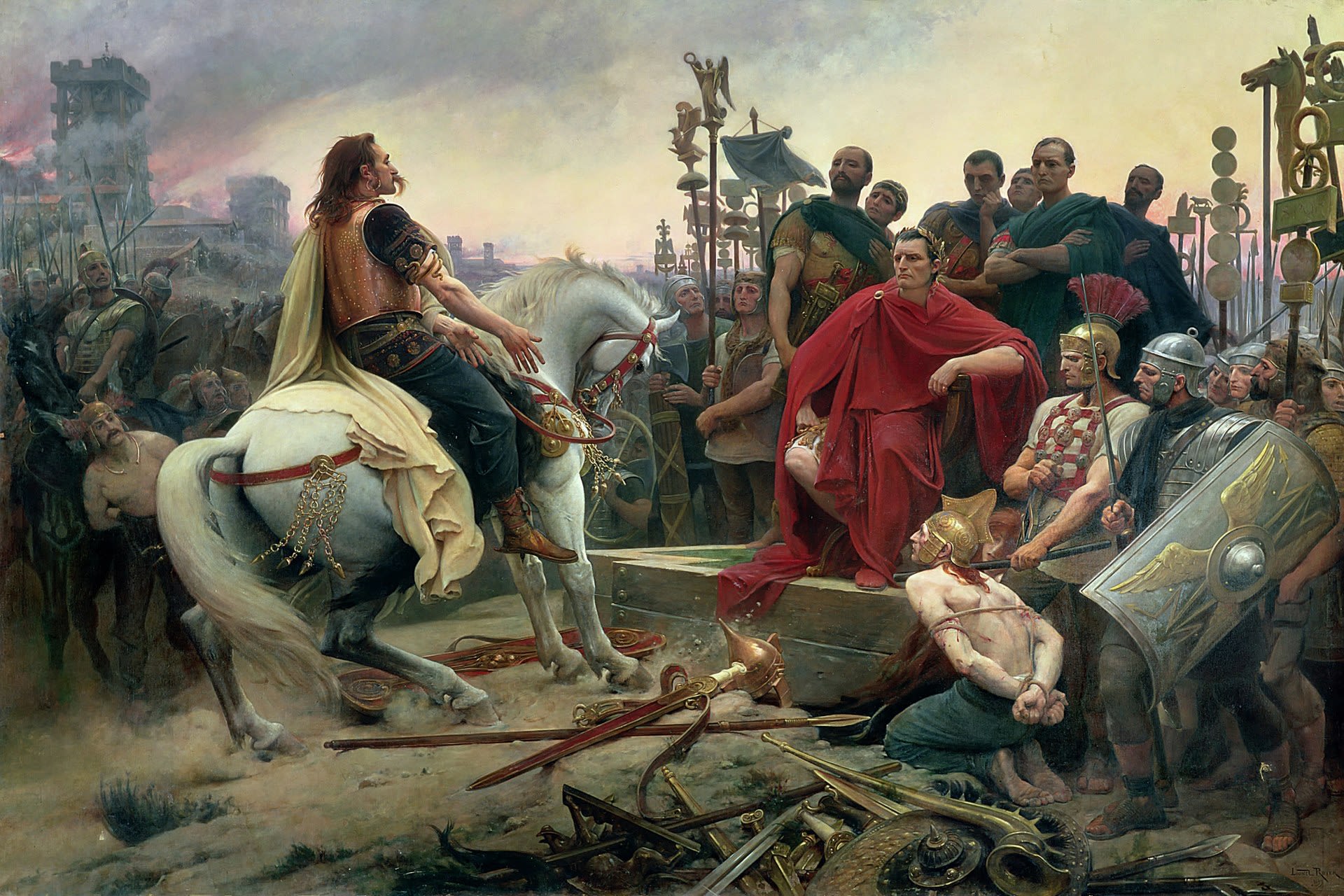
If you’ve read Julius Caesar’s book The Conquest of Gaul (De Bello Gallico), you’ve gotten a vivid picture of the skills of the highly disciplined and trained Roman legionnaires; specifically Caesar’s famous Tenth Legion. Each Legionnaire swore an oath to honor and protect the Emperor and the glory of Rome. Much like the Spartans, fighting – and very possibly dying – brought great honor to the Legionnaire.
The Need for Mental Discipline
No doubt, military training – throughout the ages – has proven a great means to instill discipline, especially physical discipline into our lives. However, physical discipline is just one aspect of obtaining the personal discipline which allows us to succeed fully in our lives and chosen professions.
It is mental discipline which most of us really need to master. In fact, this “mastering” is an ongoing process. Are we not all maturing (at different rates, to be sure) and growing into the people we need to be in order to succeed? Readers of Classical Wisdom know what the answer should be, and it is a resounding “Yes.”
Become a Member to continue growing, learning and enjoying the lessons of the ancient world with Classical Wisdom:
One of the reasons I enjoy reading the Stoics is because they focus so much on mental discipline. While we can’t have control over all the physical, environmental, and circumstantial stresses that life throws at us, we can practice – at our own pace – the difficult art of disciplining our minds to respond to these stresses in a positive way—weightlifting for our minds, if you will.
We can all go on our very own mental “twenty mile marches” as we contemplate, meditate, and concentrate our thoughts to respond to life’s challenges.
“If you are distressed by anything external, the pain is not due to the thing itself, but to your estimate of it; and this you have the power to revoke at any moment.” ~ Marcus Aurelius
As I so often do, I turn to Marcus Aurelius for inspiration as to mental toughness and discipline. In his Meditations, recorded over the years 161-180 AD, he wrote 12 chapters of his thoughts, or “meditations,” on the vicissitudes and lessons of life in the arenas of relationships, fortune, leadership, and personal philosophy.
They are a treasure trove of observations that can sharpen our vision, resolve, and responses to the seemingly random happenings in our lives. It is indeed how we respond to them that makes all the difference.
We have choices: we can sink to the level of the mundane, we can be defeated, or we can rise above. I always want to choose the latter, no matter how difficult it can be at the time. Perhaps my response will at first be unsatisfactory, but, with personal discipline, I can remedy that and seek a better outcome. The important thing is to get in – and stay in – the arena.
“Life is like a game of cards. The hand that is dealt you is determinism; though the way you play it is free will.” ~ Jawaharlal Nehru (Prime Minister of India, 1947-64)
“That all is as thinking makes it so – and you control your thinking. So remove your judgments whenever you wish and then there is calm…” ~ Marcus Aurelius, Meditations, Book 12:22
Ever since human beings began to reflect critically on their ability to choose, the opposition of “free will” vs. determinism has loomed as one of the major philosophical conundrums. I suppose we will continue to debate this issue for a long time to come.
I will admit that sometimes, when I’ve had to write a paper about the subject, or perhaps have read a challenging book or article, I go to bed at night still thinking about it and wrestling with it. I conclude that we live in a universe where both aspects are part of its warp and woof. Things do seem to happen in deterministic fashion, and yet how we humans respond to these events most often is explained by our free will.

A simple example: I could choose to jump out of a fourth story window if I was daredevil enough. Having free will and being a reasonable person, however, I choose not to do that. I know beforehand, due to deterministic laws, that I would risk serious injury. I’m definitely going to fall quite a ways, and the outcome will not be good.
It could very well be argued that “free will” is something that exists only from our human perspectives, anyway (alluding to the above quotes from Nehru and Marcus). I believe this is precisely what much of Stoic thought was centered on.
Plagues, political upheavals, economic catastrophes, and personal reverses will happen, but we have to have the mental discipline – worked out assiduously beforehand – to respond to these things in a positive way.
“Never let the future disturb you. You will meet it, if you have to, with the same weapons of reason which today arm you against the present.” ~ Marcus Aurelius, Meditations
Más info en https://ift.tt/FEr4KIm / Tfno. & WA 607725547 Centro MENADEL (Frasco Martín) Psicología Clínica y Tradicional en Mijas. #Menadel #Psicología #Clínica #Tradicional #MijasPueblo
*No suscribimos necesariamente las opiniones o artículos aquí compartidos. No todo es lo que parece.

No hay comentarios:
Publicar un comentario