
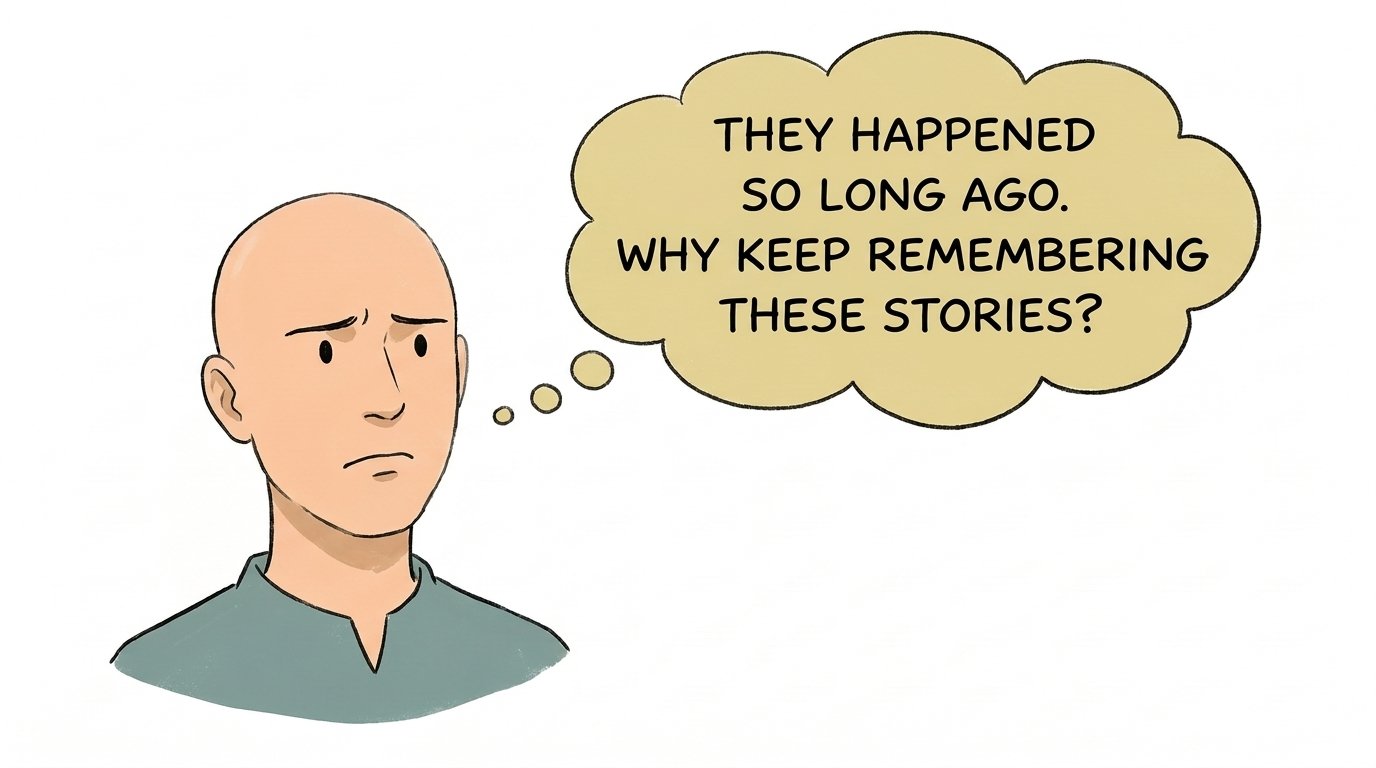
<p>I remember when I was studying the Quran more seriously, trying to read it critically and see how I could make it useful in my own life.</p><p>One question kept coming up for me: <strong>why is it important for me to remember all these stories</strong> the Quran tells, and to keep reminding myself of them? These stories happened thousands of years ago, and we're living in 2026.</p><p>Is it really helpful, or even valuable, to keep remembering them?</p><p>And it's not only the Quran. The Bible and the Bhagavad Gita are full of stories from the past too, retold and relived, and often tied to a point in the calendar so that a whole community returns to them together at the same time each year.</p>
<figure>
<img alt="" src="https://images.squarespace-cdn.com/content/v1/63d61feb4f536a40da776e10/34aff63e-327f-43c9-aa16-0e5233a0d54d/03a-why-remember.png?format=2500w" width="2500" height="1395">
</figure>
<p>For a long time this puzzled me.</p><p>Then I read a book called <em>The Vision of Islam</em>, by Sachiko Murata and William Chittick, which I'll say more about later in this post. It helped me take a step back, and I realized <strong>the question only troubled me because of how I was looking at time.</strong></p><p>We usually see time as linear, one thing after another in sequence. We measure it by breaking it into small parts, and we've tied our economic life to it too, so much that we say time is money. Seeing time as a line is useful, and it's how I plan most of my days.</p>
<figure>
<img alt="" src="https://images.squarespace-cdn.com/content/v1/63d61feb4f536a40da776e10/4119002c-313b-4c83-9e84-94861ca8b178/01a-clock-time-line.png?format=2500w" width="2500" height="1395">
</figure>
<p>But on a straight line, <strong>the further back an event is, the less relevant it feels.</strong> Because we're always moving in one direction, we assume the new is automatically better than the old, like software updates, where the latest version replaces the last.</p><p>Read scripture with that mindset and ancient stories start to look like outdated versions of human history. So I could understand why my question kept coming up.</p><p>Traditional societies saw time very differently. They saw another dimension to it: cyclical time.</p><p>In cyclical time, <strong>the past comes round again</strong> in cycles. Once I started to see time that way, the question about the scriptures answered itself.</p><h2>What is cyclical time?</h2><p>The easiest way to understand cyclical time is to look at the seasons. If you're standing in the middle of one season, time can still feel linear, because the days go by one after another. But step back and you see the repetition, as one season follows another until the first one returns.</p><p>When I'm in one season, I know the next one is coming, so I plan for it and I brace for it, and I can only do that because I remember how the last one went.</p><p>With the seasons, <strong>remembering the past is how we prepare for what's coming.</strong></p>
<figure>
<img alt="" src="https://images.squarespace-cdn.com/content/v1/63d61feb4f536a40da776e10/992ea976-79d5-44ac-b565-ccce35419cd1/01b-circle-of-seasons.png?format=2500w" width="2500" height="1395">
</figure>
<h2>We go through seasons too</h2><p>Similarly, a human life moves through seasons:</p><ul><li><p>You're a child, then a teenager, then a young adult.</p></li><li><p>Then you get married (inshallah), and that's a season of its own.</p></li><li><p>After that come your forties and fifties, your sixties, seventies and eighties.</p></li></ul><p>Each of those is a different season, with its own struggles and its own lessons.</p>
<figure>
<img alt="" src="https://images.squarespace-cdn.com/content/v1/63d61feb4f536a40da776e10/150ff6d5-2aea-4c25-a253-c6b6adc63922/01d-life-as-a-line.png?format=2500w" width="2500" height="1395">
</figure>
<p>Because we all go through the same cycles, <strong>the lives of the people who came before us are still useful to us.</strong> If you're young and struggling with something, other people have walked through that same season before you, and if you read their biographies, you can see how they dealt with it and learn from them. The same is true when you cross forty or start to grow old.</p>
<p>For most people, the cycle becomes visible when they become a parent. Until then, you've been the child in the story, and it's easy to see time as a line with you moving along it. Then you have a child of your own, and <strong>you see the cycle repeat, visually and viscerally.</strong></p>
<figure>
<img alt="" src="https://images.squarespace-cdn.com/content/v1/63d61feb4f536a40da776e10/25553758-56fe-41a1-883c-073a4c527a75/01c-seasons-of-a-life.png?format=2500w" width="2500" height="1395">
</figure>
<p>I feel this constantly with my own kids. Whether I'm watching them wrestle with a question I remember asking at their age, or catching myself repeating a piece of advice my own mother once gave me, I realize I'm not standing at a brand-new point on a line. I'm standing on the other side of the circle.</p><h2>Why the scriptures keep returning to the past</h2><p>Which brings me back to where I started.</p><p>When a scripture tells a story from the past, it isn't just recording history. <strong>It's pointing to a pattern that comes round again</strong>, the way a season does, and remembering the story is how we recognize the pattern when it returns and take the lesson from it.</p><p>That's why the same stories are retold year after year. The Quran says as much itself:</p><blockquote><p><em>So tell the tale — perhaps they will reflect.</em></p><p>Quran 7:176</p></blockquote>
<figure>
<img alt="" src="https://images.squarespace-cdn.com/content/v1/63d61feb4f536a40da776e10/97e136c6-fb25-4472-963f-a5d780caa77a/02-story-line-vs-circle.png?format=2500w" width="2500" height="1395">
</figure>
<p>Some traditions put this view of time right into the scripture itself. In the Hindu tradition, history moves through great ages, the yugas, including the age called Kali Yuga, that turn in a vast cycle rather than running in a straight line. Time itself is understood to come round again.</p><p>Other stories are shared across traditions. Jews, Christians and Muslims all remember the sacrifice of Abraham, each in their own way, and each returns to it again and again.</p><p>In Islam, we go further than reading about Abraham's willingness to sacrifice what he loved most: every year, during the Hajj and Eid al-Adha, we re-enact his family's story. The cycle comes round on the calendar to ask us a present-tense question. What attachment in my life right now do I need to let go of?</p><p>The Quran's own stories work the same way. In <em>The Vision of Islam</em>, Murata and Chittick point to stories like these, each one describing a pattern that comes round again:</p><ul><li><p><strong>Moses and Pharaoh: truth versus tyranny.</strong> Pharaoh is the ultimate symbol of human evil and arrogance, accusing Moses of ruining society simply for speaking the truth (40:26). <em>Today:</em> this shows up whenever leaders or systems act above moral law and label honest reformers as "troublemakers."</p></li><li><p><strong>Adam and Satan: soul versus ego.</strong> Satan refused to bow to Adam, boasting "I am better than he" (7:12), because he saw only Adam's outward clay and missed the divine spirit inside. <em>Today:</em> we repeat this mistake whenever we judge people by their material status and appearance rather than their inner humanity.</p></li><li><p><strong>The Golden Calf: statues versus whims.</strong> The Israelites asked Moses for a physical idol to worship (7:138), and the Quran connects this to worshipping our own shifting "caprice," or whims (25:43). <em>Today:</em> we may not bow to statues, but we worship modern idols whenever we let our ego, passing moods or need for validation rule our lives.</p></li><li><p><strong>Ancient superpowers: comfort and collapse.</strong> The Quran points to the ruins of mighty past civilizations (30:9) that grew wealthy, arrogant and corrupt until they collapsed (17:16–17). <em>Today:</em> it is a reminder that technological and military strength never saves a comfortable society that abandons moral justice.</p></li></ul><p>Across all these traditions, remembering keeps the pattern alive. The stories give people meaning and courage, and they help people understand the events of their own lives and their place in the world.</p><h2>So what is the value in remembering?</h2><p>So let me come back to the question I began with. If these events are gone and done, why do the scriptures keep returning to them?</p><p>If time is only a line, there isn't much reason to.</p><p>But in cyclical time, <strong>each time a story comes round again, its pattern is there for us to use.</strong> Remembering gives us meaning today, and it brings out deeper qualities that are already latent inside us, like courage, which we can draw on when we need them.</p><p>Of course, this is much easier to see on paper than in the middle of a hard season. When a project falls apart or you're dealing with a personal loss, time feels less like a circle and more like a dead end.</p><p>Imam Ali once said, "Time is two days: a day for you, and a day against you." When it's a day against me, my instinct is still to zoom in on the immediate pain and forget that I've been through winters before, and that spring followed.</p>
<figure>
<img alt="" src="https://images.squarespace-cdn.com/content/v1/63d61feb4f536a40da776e10/7e4b4403-64dd-4a50-a7d2-7e6a17125b8e/sufi-comics-key-to-inner-peace.png?format=2500w" width="2500" height="4017">
</figure>
<p>And that's exactly when remembering the old stories helps most. When I recall Moses standing before Pharaoh, or Abraham being asked to give up what he loved most, I'm reminded that this season has come round before, to people far greater than me, and it didn't have the last word.</p><p>The story changes how I look at my situations.</p>
<figure>
<img alt="" src="https://images.squarespace-cdn.com/content/v1/63d61feb4f536a40da776e10/f642f89f-fe76-4522-b7bd-f14512bd73b7/03b-meaning-today.png?format=2500w" width="2500" height="1395">
</figure>
<p>So the next time you come across a story from thousands of years ago, ask which season of your life it's describing right now.</p>
<p><a href="https://www.suficomics.com/blog/understanding-quran-stories" target="_blank">- Enlace a artículo -</a></p>
<p>Más info en https://ift.tt/9jxgAst / Tfno. & WA 607725547 Centro MENADEL (Frasco Martín) Psicología Clínica y Tradicional en Mijas.
#Menadel #Psicología #Clínica #Tradicional #MijasPueblo</p>
<p>*No suscribimos necesariamente las opiniones o artículos aquí compartidos. No todo es lo que parece.</p>

No hay comentarios:
Publicar un comentario