
Welcome to our newsletter, dear readers.
• We open our monthly selection with a page on St Francis of Assisi’s 13th-century “Canticle of the Creatures” (Laudes Creaturarum), also known as “Canticle of Brother Sun,” including a bilingual text, an audio reading of the original and an interpretative essay. This beautiful and brief poem has been recognised through the centuries as a distilled formulation of the Christian contemplative attitude towards the natural world.
Only when we move from an ecology based on the fear of dying (a matter of survival) to one grounded in living like “mortals”, will we be able to practice integral ecology. In fact, those who understand life as a praeparatio mortis and death as an Easter/passage will be much more environmentally friendly and “brotherly” to all. If Francis’s final Canticle has the morning splendor, it is precisely because it appears in the evening of a life profoundly lived. As such, it can be the song of all humans, which must end, after all violence, with the final stanza of all pardons.
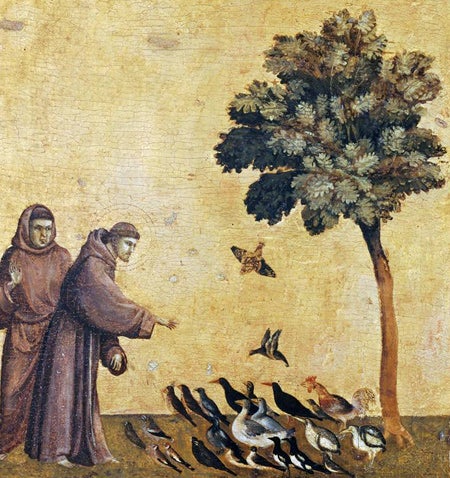
Giotto, Saint Francis Preaching to the Birds, Musée du Louvre
• We continue with an article by Ananda K. Coomaraswamy, Nirukta = Hermeneia, on the traditional Hindu science of language, and in particular on the primordial sense of etymology, or the relation between the form and the meaning of words, through their psychological, theological and even their metaphysical reality.
What this amounts to is the conception of a single living language, not knowable in its entirety by any individual principle but in itself the sum of all imaginable articulations, and in the same way corresponding to all imaginable acts of being: the “Spoken Word” of God is precisely this “sum of all language” (vacikam sarvanmayam). All existing languages are partially remembered and more or less fragmented echoes of this universal tongue.
• And we complete our selection with an extraordinary “Address at al-Azhar al-Sharif”, Cairo, given by the then Archbishop of Canterbury, Rowan Williams, in 2004. In this lecture, given at one of the major centres of Islamic theological teaching, Dr Williams addresses head on some central theological issues in the understanding of the Abrahamic God. We include also an original audio recording of the lecture.
As our Christian scriptures say, we must not be conformed to this world but transformed, with our minds renewed (Romans 12.2). If we truly understand the nature of our God, our minds will be renewed. We do not only teach truths about God, we allow those truths to change our lives.
The post Canticle of the Creatures, Etymologies, and an Azhar Lecture first appeared on The Matheson Trust.
Más info en https://ift.tt/vsTC5ak / Tfno. & WA 607725547 Centro MENADEL (Frasco Martín) Psicología Clínica y Tradicional en Mijas. #Menadel #Psicología #Clínica #Tradicional #MijasPueblo
*No suscribimos necesariamente las opiniones o artículos aquí compartidos. No todo es lo que parece.

No hay comentarios:
Publicar un comentario