
Welcome to our newsletter, dear reader.
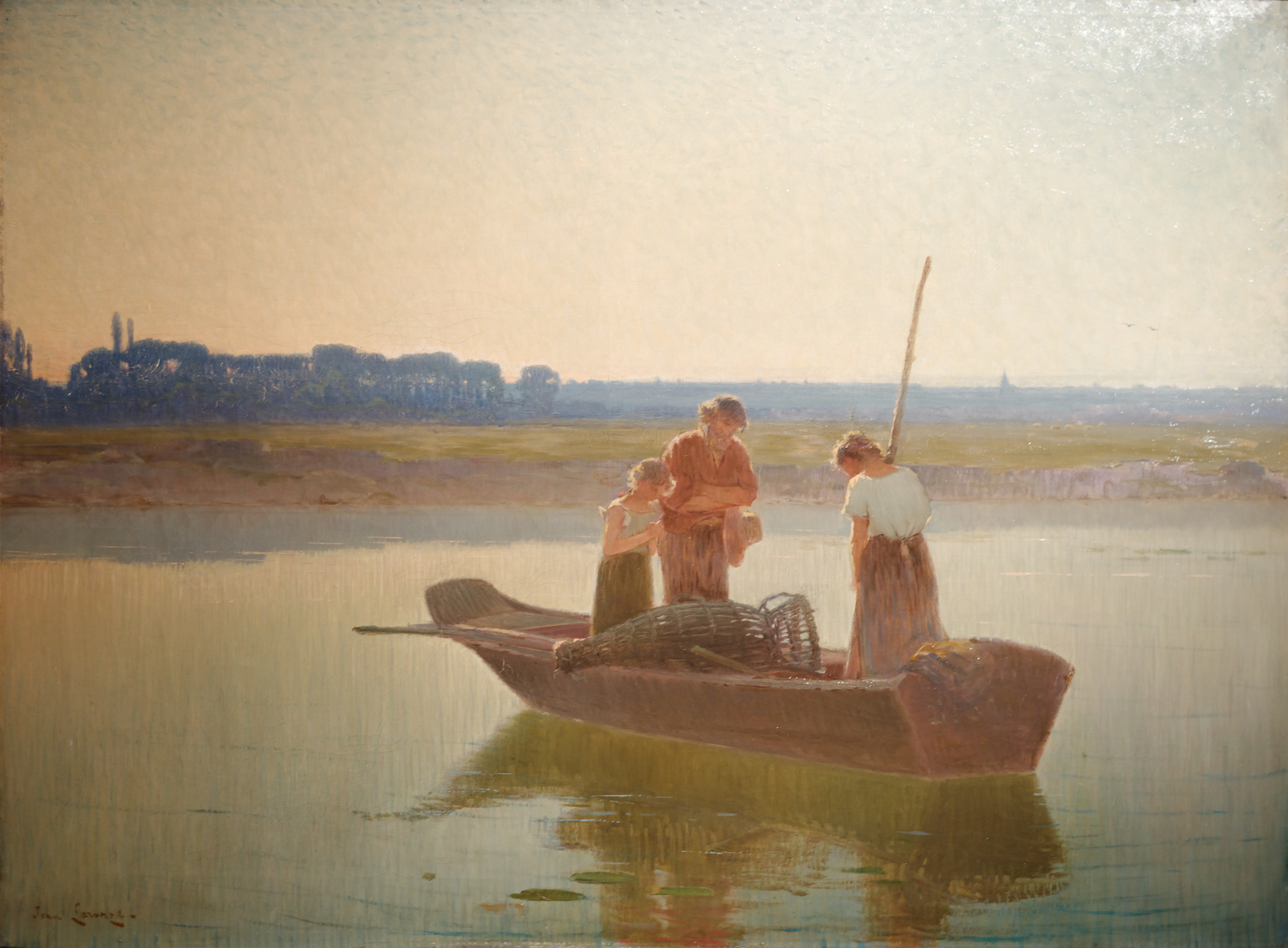
• We begin our monthly selection with the latest addition to our Sacred Audio Library, a page on the Angelus prayer. Hearing the bells throughout a medieval town or city was an integral part of marking time for monastic and civil life, but a unique ring pattern was assigned to signal the Angelus. This particular triple ring created moments of the day which were at once public and private, intended for both monastics and laity alike. We present audio recordings of the Angelus and an article on its symbolism.
It cannot be overlooked that the daily life of medieval lay people—both in rural areas as well as the towns and cities—had a background sound of monastic bells which might recall to them in a general way that “someone somewhere is at prayer.”
L’Angélus by Jean Laronze.
• Next we bring an insightful chapter on “What Sincerity Is and Is Not”, by Frithjof Schuon, drawing from the world’s religious traditions to delineate and articulate the subtleties of spiritual psychology.
Cynics believe that sincerity consists in exhibiting shortcomings and passions and that to hide them is to be a hypocrite… Hypocrites believe, on the contrary, that it is virtuous to make a display of virtuous attitudes or that the appearances of faith suffice for faith itself… Pride is overestimating oneself and underestimating others, and this is what the cynic does just as much as the hypocrite, in a blatant or subtle way as the case may be.
• Finally we present a chapter by Mircea Eliade, “Smiths, Shamans, and Mystagogues”, studying the mythical roots of the crafts of metallurgy, especially in the light of ethnology and archaeology, and their essential connection to faith and initiatic life.
The words of a song possess considerable creative power. One “creates” objects by “chanting” the necessary words. Väinämöinen “chants” a boat, i.e. builds it by chanting a song composed of magic words; and as he does not know the last three words he goes to enquire for them to a famous magician, Antero Vipunen. “To make” something means that you know the magic formula which will enable you to “invent” it, or make it appear spontaneously. The craftsman is therefore one who knows secrets, he is a magician. And so all crafts require initiation and are handed down by an occult tradition. He who “makes” efficiently is he who knows the secrets by which they are made.
We would like to draw our readers’ attention to The Schuon Lectures, an international series of lectures co-sponsored by The Matheson Trust.
The post Angelus, Sincerity, and a Sacred Craft first appeared on The Matheson Trust.
Más info en https://ift.tt/RmVkX3p / Tfno. & WA 607725547 Centro MENADEL (Frasco Martín) Psicología Clínica y Tradicional en Mijas. #Menadel #Psicología #Clínica #Tradicional #MijasPueblo
*No suscribimos necesariamente las opiniones o artículos aquí compartidos. No todo es lo que parece.

No hay comentarios:
Publicar un comentario