
Dear Classical Wisdom Readers,
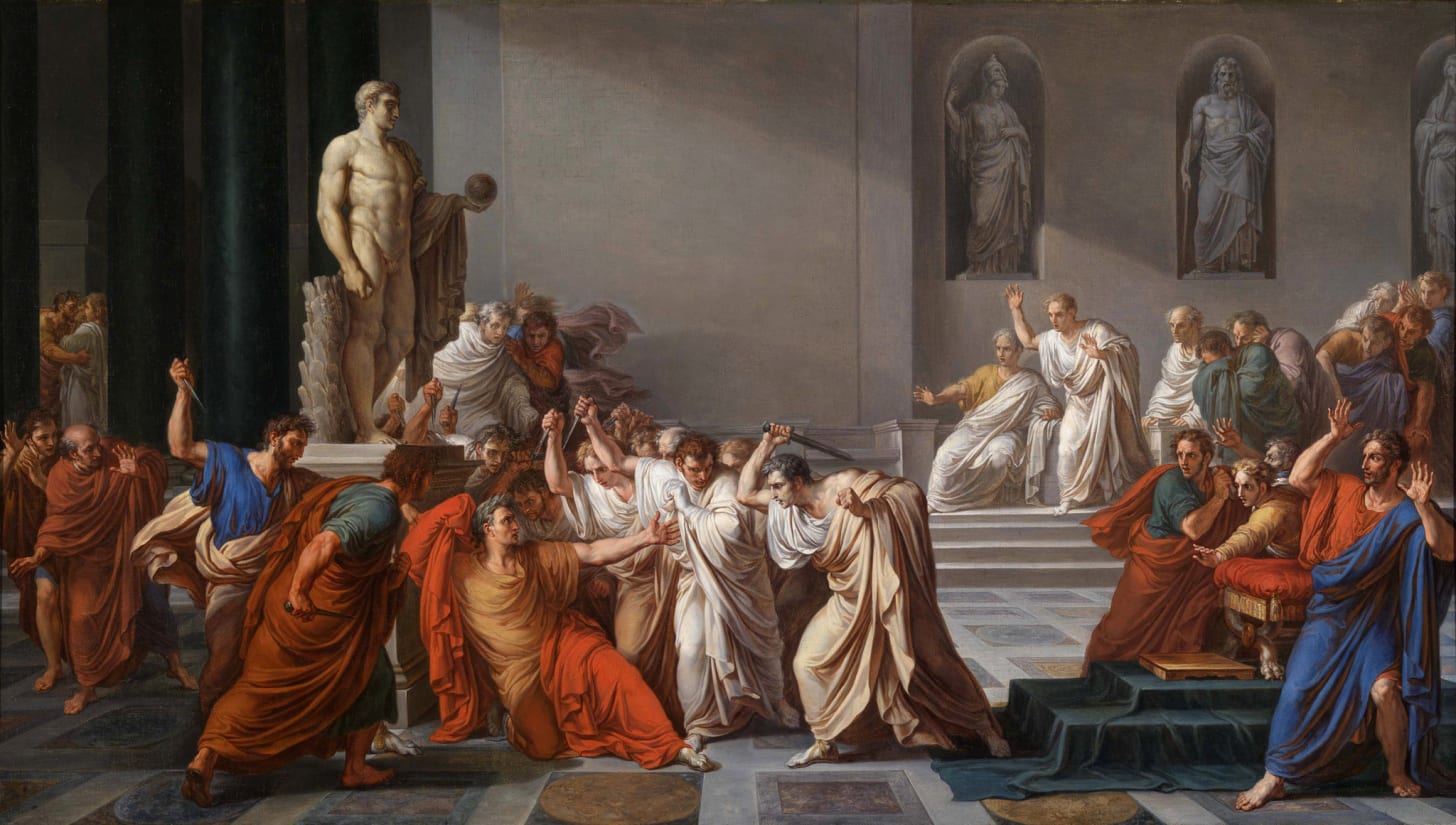
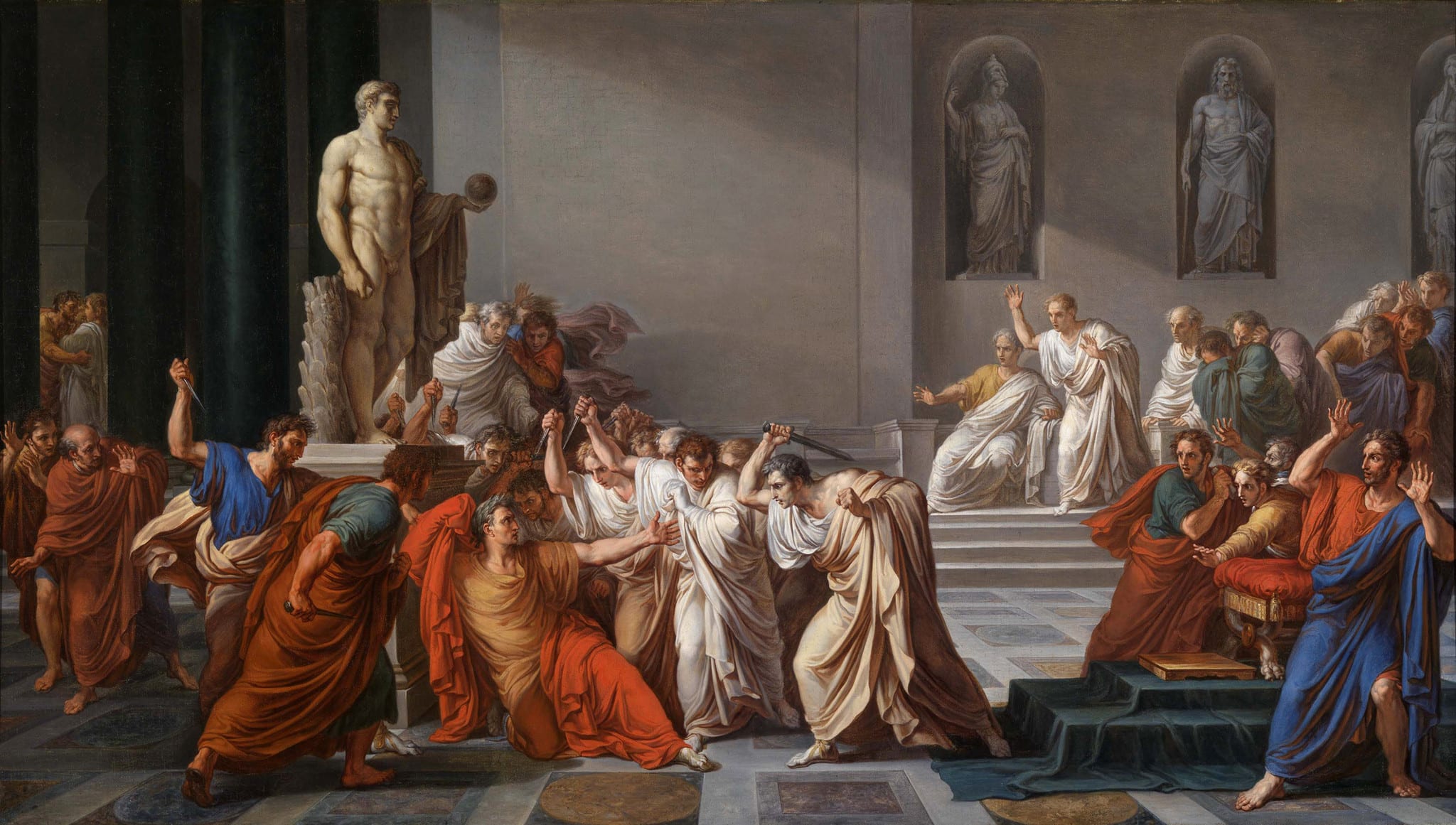
Beware the Ides of March! This upcoming Sunday is always a big day in the world of ancient history lovers, because traditionally it marks the anniversary of the assassination of Julius Caesar in 44 BC.
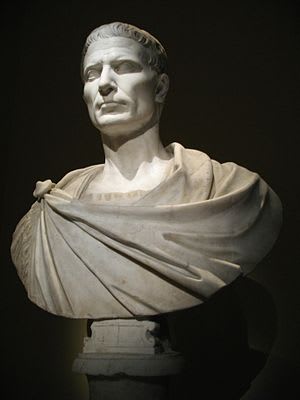
Gaius Julius Caesar was a Roman general, Consul, statesman, and notable author of Latin prose. He was both a conquering hero… and a dictator.
He played an essential role in the history of Ancient Rome, acting out pivotal parts in events that led to the demise of the Republic and the rise of the Empire. He invaded Britain, he changed the calendar, he wrote extensive histories, just to name a few of his accolades.
He also managed to upset enough people off to get himself seriously stabbed in the back.
It’s this latter point that folks seem to forget. Not the fact that he was assassinated (pretty sure no one forgets that), but that he was so unpopular as to warrant assassination in the first place…
In fact, over the years there have been plenty of comparisons between Caesar and potential contemporary parallels that seem to bring out everyone’s ire, no matter where they stand on the political spectrum. I’m sure you are thinking of at least one contender...
But this week, as we remember Caesar, I would like to discuss not whether he is worthy of our praise or our fury, but rather whether his very existence was bound to happen.
And by natural extension, whether more like him are destined to arise...
After all, it was none other than Plato himself who suggested that political systems deteriorate in a predictable cycle.
Excessive freedom, he argued, eventually destabilizes democratic societies. Citizens begin rejecting authority and expertise. Political leaders compete by flattering the masses. Economic inequality breeds resentment between rich and poor.
At this point, the table is set, the game is stacked, and a charismatic “protector of the people” emerges.
This leader promises to defend the people, but gradually consolidates power and, after eliminating rivals and relying on loyal supporters and mercenaries, he or she becomes a tyrant.
Did Caesar cross that line? It’s difficult to say…
But I am fairly confident that his assassins were aware of Plato’s warnings… even if those ideas did not directly inspire their actions.
So this Ides of March, I ask:
Was Caesar, and those like him, inevitable?
Are they destined to appear again and again?
Comment below and join the conversation!
And to get you started, today’s column will give you a brief introduction to the man himself and asks: Just how far did the ruler push his own perceived mortality?
Read on to discover not only Julius Caesar, but his exact spot in an incredibly pivotal moment in history…
All the best,
Anya Leonard
Founder and Director
Classical Wisdom
ALL HAIL CAESAR
By Jocelyn Hitchcock
Julius Caesar is no stranger in history books. He has been encapsulated in plays, songs, parodies, and even Hollywood movies that paint him as a revered war general, a fearsome ruler, and one of the staunchest Romans you are sure to meet in antiquity.
He represents a catapultic change in the Roman government, serving as an emblematic figure of the Fall of the Republic (though he would personally never admit to that, of course). His successor, Octavian Augustus, was Rome’s first emperor, and ushering in centuries of single hand rule.
However, Augustus’ position would not have been possible had it not been for Caesar’s careful and meticulous testing of Roman ideals and values in the 50’s and 40’s BCE. During his life, and certainly after, speculation swirled around the General about whether or not he was touting himself as a God and/or a king. Even though the ruling style of Rome turned imperial and monarchical, during Caesar’s time the title of “King” was highly offensive and considered dangerous to the Romans. They had a sharp objection to monarchy, as they still believed their precious Republic was not dead yet.
But let’s look at how the Republic started in the first place. After the fabled seven kings of Rome, the people set up a Republic to represent the people’s needs and wishes for their land. The kings were thought of as abusive, power hungry, and corrupt. The king held absolute power and was the chief magistrate in religion, law, and military matters.
The last king, Tarquinius Superbus, was overthrown after the rape of Lucretia and her subsequent suicide. Lucretia was the wife of Lucius Tarquinus Collatinus, and the daughter of Spurius Lucretius, a Roman noble. The rape and death of Lucretia was a tipping point for the Roman monarchy, seeing as Lucretia’s rapist was the king’s son.
The uprising of Romans was a direct response to the power, greed, and corrupt nature of the existing noble family- and the forceful theft of a noble woman’s virtue was the last straw. Romans saw to it that the royal family and government were stripped and destroyed, and in its place a representative government with separation of powers would rise. The title Rex or king, was preserved only as far as religion was concerned: the rex sacrorum. The Romans harbored a hatred for the title king in any other sense.
When Caesar came into the political sphere centuries later, he was smart and cunning, and his timing was perfect. While we wish we had personal journal entries outlining Caesar’s ambitions and hopes for his political career, we are unfortunately amiss. What we do have, however, is documentation in literature and archaeology that allows us to piece together Caesar’s agenda and programmatic scheme.
Like people in antiquity, we still find ourselves questioning, “Was Caesar considered a god by Romans while he was still alive?” “Did he want to be called a king- outright?” “Was his assassination justified in the face of the Republic?”
It is no convoluted analysis of the facts that Caesar was an excellent politician. Now, whether or not he started his career with the intent to be crowned king and deified is a whole different story.
As his power and his reputation grew during the beginning of his military career in Gaul, so did his ambition. Caesar was well aware that demanding or expecting to be made a king or living god would have been outrageous and met with indignation.
So, as any motivated politician would do, he began to create personal stepping stones and setting up certain “tests” along the way to gauge his power in Rome, presumably to lay the groundwork for posthumous deification at the least.
The first thing Caesar did was establish his military competence. After stints in Asia, Bithynia, and a victory of Mithridates VI, Caesar was elected military tribune in 72 BC. He went on to be quaestor and aedile, in which he won over the favor of both the people and his soldiers through public shows and spectator events. In 63 BC, Caesar was appointed pontifex maximus, which was secured through flagrant bribery according to Suetonius.
In 61 BC Caesar was sent to Further Spain as proprietor and returned in 60 BC, joining Pompey and Crassus in a loose coalition that would help Caesar secure the Consulship of 59 BC. This particular election was a turning point for Caesar’s career. He wanted to stand for consul in absentia and had to rely on the alliance of Pompey and Crassus to secure his interests while he was away in Gaul.
Over the next decade, this alliance was both a source of support as well as contention, ultimately leading to the civil war in 49 BC that lasted until 45 BC when Caesar returned to Rome and celebrated four triumphs (the Gallic, the Alexandrian, the Pontic, the African). The political climate in Rome at the time of Caesar’s success was defined by confusion and residual political distrust between the optimates and Caesar.

During the tumultuous years surrounding the civil war and unrest, the Roman people and the Senate grasped for any sort of normalcy and stability. To do this, what can only be referred to as dire measures were taken in order to “restore” the Republic. Caesar, as a leading politician, charismatic figure, and motivated beyond measure, received honors, both mortal and divine, that were an attempt to stabilize Rome.
To them, Caesar was a constant and a strong defending hand. These honors are what makes us question whether or not Caesar was a god, a king, and if he himself was the one to promote these.
The mortal honors, bestowed upon him by the Senate, really show just how above the rest Caesar was considered. All of these had “legitimate” political motivation behind them, but when viewed in a group, it really does seem quite suspicious. Caesar was awarded a continual consulship in the months preceding his assassination (possibly in February 44 BC), censorship for life, and the role of dictator for life. All of these were granted right before his assassination in March of 44 BC, and all of this went against the very heart and ideals of Rome.
One man held the power of the military, the people, and all of Rome. Sounds like a king so far, doesn’t it?
What’s more, Caesar was honored with a number of divine honors. These honors, that were far beyond what would be bestowed on a politician, granted a flamen, vowed to build a temple to Clementia, and declared public sacrifices be made on his birthday for his safekeeping.
We do know that Caesar wasn’t officially deified by the Senate until after his death- however, combine these divine honors with his mortal honors and we have to question:
WHAT was Caesar?
Clearly, seeing as Caesar was killed weeks after receiving his highest honors, his position was not one of “republican” values and enough people were threatened and bothered by his position to call an end to his rule. Caesar’s position was unprecedented in Rome and that cannot be overstated.
He did not call himself a king or a god…. But when looking at his honors and his rule, didn’t he? He tested the people over and over, putting out feelers for what he could get away with and then judged the crowd’s reaction. He was smart to never go over a line without sketching it out first and softly nudging the people towards it.
After his death and by the time Augustus succeeded him, the stage was set and the people were ready: Rome was no longer a Republic. And shockingly, they were okay with that.
Más info en https://ift.tt/UGZYoDk / Tfno. & WA 607725547 Centro MENADEL (Frasco Martín) Psicología Clínica y Tradicional en Mijas. #Menadel #Psicología #Clínica #Tradicional #MijasPueblo
*No suscribimos necesariamente las opiniones o artículos aquí compartidos. No todo es lo que parece.

No hay comentarios:
Publicar un comentario