
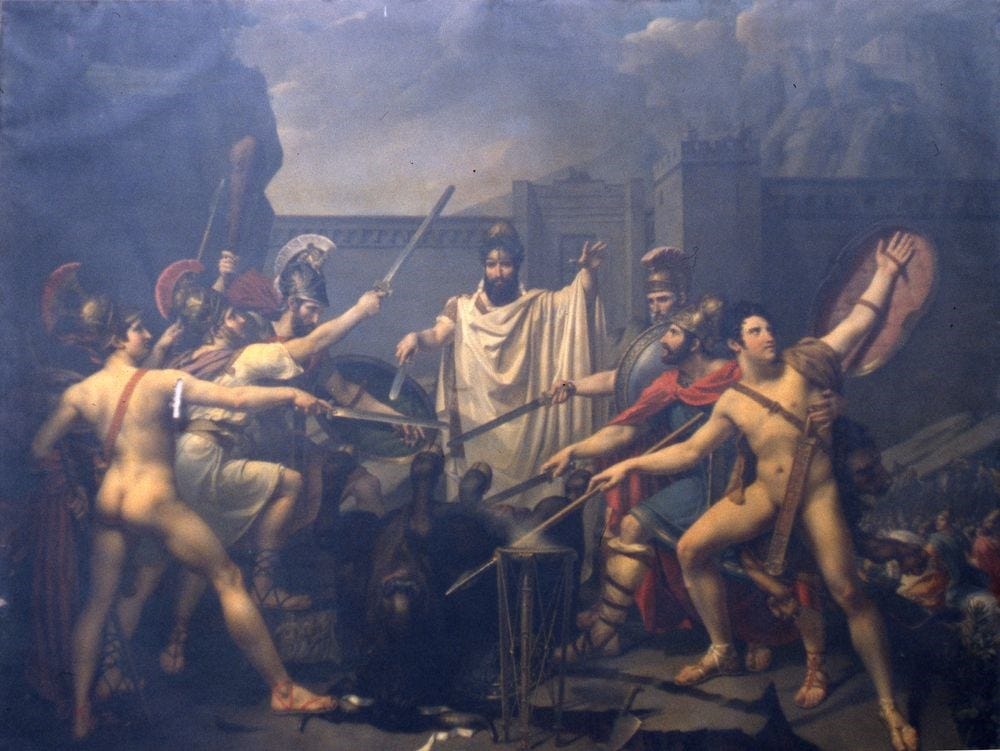
<p>Dear Classical Wisdom Reader,</p><p>Edward Snowden, Julian Assange, Mikhail Khodorkovsky…</p><p>Exile, asylum, and the struggle to return home still make headlines. After all, nothing is new under the sun… it is just that nowadays, we often associate these stories with journalists, dissidents, and whistleblowers.</p><p>But this wasn’t always the case.</p><p>Recently (or at least recently by these pages’ standards), those enduring what Ovid called a “living death” included politicians, conquerors, and authors.</p><p>Men like Napoleon, Victor Hugo, and Dante.</p><p>But in the ancient world, exile was a familiar punishment... and for all sorts of folks. It was often dealt capriciously, or imposed only temporarily.</p><p>An important theme in mythology, such as in Euripides’ <em>Medea</em> and the stories of Oedipus, it was also a systematic part of democracy in ancient Athens, one meant to curb ambitions, a sort of checks and balances of yore.</p><p>Either way, it’s particularly fascinating to look at those who were exiled: the people who went against those in power, who thought differently, who were disgraced, or who made unfortunate enemies...</p><p>Find out what they did, or didn’t do, to deserve such punishment…as well as those who succumbed to their ill fate, or flourished because of it…in our <em>Classical Wisdom Litterae</em> issue on Exiles, exclusive for Members, below today’s article.</p><p>And to get us started, we’ll look at one exile who refused to stay away.</p><p>Polynices returned to Thebes with an army... and six other commanders.</p><p>Why seven? That’s where the story gets interesting.</p><p>Enjoy!</p><p>All the best,<br>Anya Leonard<br>Founder and Director</p><p>Classical Wisdom</p><p>P.S. Not a member? Subscribe today to enjoy our full article as well as our <em>Classical Wisdom Litterae</em> issue, dedicated to the Exiles of the Ancient World. It makes a fascinating list, including names such as Ovid, Seneca, Cicero and Julia the Elder... to highlight a few.</p><p><a href="https://classicalwisdom.substack.com/subscribe?"><span>Subscribe now</span></a></p><p>The full issue is below today’s article, accessible exclusively for Members. </p><h1>The Unlucky Seven Against Thebes</h1><p><em>By Anya Leonard</em></p><p>Seven warriors facing seven defenders before seven gates.</p><p>You’d think that story would forever condemn the number to infamy... that seven would, from then on, go hand in hand with the word unlucky.</p><p>But Aeschylus’ famed play, <em>Seven Against Thebes</em>, isn’t particularly concerned with whether seven brings good luck or bad. First performed in 467 BC, it was the final tragedy in a trilogy that won first prize at the city <em>Dionysia</em>. Its conspicuous symmetry, however, requires a bit of contemplation…seven commanders attack seven gates, and seven champions are chosen to defend them.</p><p><em>Why seven???</em></p><div><figure><a href="https://substackcdn.com/image/fetch/%24s_!mkeR!,f_auto,q_auto:good,fl_progressive:steep/https%3A%2F%2Fsubstack-post-media.s3.amazonaws.com%2Fpublic%2Fimages%2Fbffd425b-53e1-4363-8d36-69c026b17cc7_1000x751.jpeg"></a><div><a href="https://substackcdn.com/image/fetch/%24s_!mkeR!,f_auto,q_auto:good,fl_progressive:steep/https%3A%2F%2Fsubstack-post-media.s3.amazonaws.com%2Fpublic%2Fimages%2Fbffd425b-53e1-4363-8d36-69c026b17cc7_1000x751.jpeg"></a><source type="image/webp"><a href="https://substackcdn.com/image/fetch/%24s_!mkeR!,f_auto,q_auto:good,fl_progressive:steep/https%3A%2F%2Fsubstack-post-media.s3.amazonaws.com%2Fpublic%2Fimages%2Fbffd425b-53e1-4363-8d36-69c026b17cc7_1000x751.jpeg"><img src="https://substackcdn.com/image/fetch/$s_!mkeR!,w_1456,c_limit,f_auto,q_auto:good,fl_progressive:steep/https%3A%2F%2Fsubstack-post-media.s3.amazonaws.com%2Fpublic%2Fimages%2Fbffd425b-53e1-4363-8d36-69c026b17cc7_1000x751.jpeg" width="1456" height="1093" alt=""></a></source><a href="https://substackcdn.com/image/fetch/%24s_!mkeR!,f_auto,q_auto:good,fl_progressive:steep/https%3A%2F%2Fsubstack-post-media.s3.amazonaws.com%2Fpublic%2Fimages%2Fbffd425b-53e1-4363-8d36-69c026b17cc7_1000x751.jpeg"></a><div><a href="https://substackcdn.com/image/fetch/%24s_!mkeR!,f_auto,q_auto:good,fl_progressive:steep/https%3A%2F%2Fsubstack-post-media.s3.amazonaws.com%2Fpublic%2Fimages%2Fbffd425b-53e1-4363-8d36-69c026b17cc7_1000x751.jpeg"></a><div><a href="https://substackcdn.com/image/fetch/%24s_!mkeR!,f_auto,q_auto:good,fl_progressive:steep/https%3A%2F%2Fsubstack-post-media.s3.amazonaws.com%2Fpublic%2Fimages%2Fbffd425b-53e1-4363-8d36-69c026b17cc7_1000x751.jpeg"></a></div><a href="https://substackcdn.com/image/fetch/%24s_!mkeR!,f_auto,q_auto:good,fl_progressive:steep/https%3A%2F%2Fsubstack-post-media.s3.amazonaws.com%2Fpublic%2Fimages%2Fbffd425b-53e1-4363-8d36-69c026b17cc7_1000x751.jpeg"></a></div><a href="https://substackcdn.com/image/fetch/%24s_!mkeR!,f_auto,q_auto:good,fl_progressive:steep/https%3A%2F%2Fsubstack-post-media.s3.amazonaws.com%2Fpublic%2Fimages%2Fbffd425b-53e1-4363-8d36-69c026b17cc7_1000x751.jpeg"></a></div><a href="https://substackcdn.com/image/fetch/%24s_!mkeR!,f_auto,q_auto:good,fl_progressive:steep/https%3A%2F%2Fsubstack-post-media.s3.amazonaws.com%2Fpublic%2Fimages%2Fbffd425b-53e1-4363-8d36-69c026b17cc7_1000x751.jpeg"></a><figcaption>The Seven Chiefs against Thebes, history painting by Angelique Mongez exhibited at the Salon of 1827.</figcaption></figure></div><p>Perhaps the most obvious explanation </p>
<p>
<a href="https://classicalwisdom.substack.com/p/why-seven">
Read more
</a>
</p>
<p><a href="https://classicalwisdom.substack.com/p/why-seven" target="_blank">- Enlace a artículo -</a></p>
<p>Más info en https://ift.tt/5hQiJok / Tfno. & WA 607725547 Centro MENADEL (Frasco Martín) Psicología Clínica y Tradicional en Mijas.
#Menadel #Psicología #Clínica #Tradicional #MijasPueblo</p>
<p>*No suscribimos necesariamente las opiniones o artículos aquí compartidos. No todo es lo que parece.</p>

No hay comentarios:
Publicar un comentario