

Dear Classical Wisdom Reader,
Can something be un-invented?
I saw a clip the other day of a college student on his graduation day, proudly holding up his laptop to show the AI program that he got to write his college work for him.
Truthfully, it was a very unedifying display, and it makes me wonder about what’s being lost as AI writing becomes more and more prominent.
For me, personally, writing is both a pleasure and a vital part of the human experience. Writing forces us to finesse and focus our thoughts, and at its best, creates works of true beauty that deepen our minds and expand the parameters of our inner lives. Seeing people’s increasing reliance on machines for this essential skill is a sad development of the modern world.
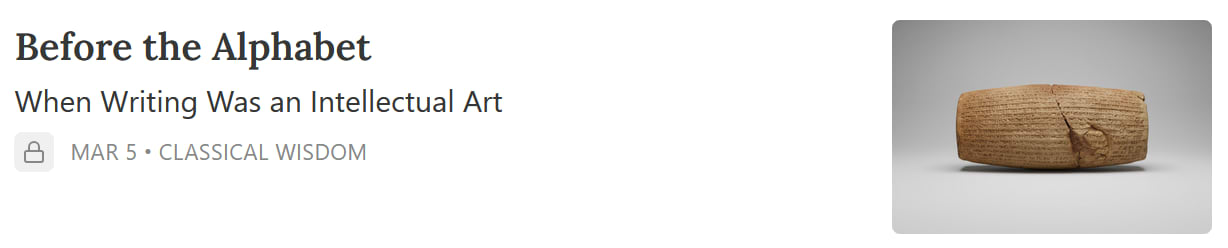
So this week we looked at the other end of history, when writing was a new and revolutionary advancement for humankind, opening up endless possibilities.
Members can discover the very origins of writing itself in ancient Mesopotamia with an exclusive article, written by one of the world’s few scholars able to read cuneiform script.
It’s a fascinating piece, so don’t miss out: Members can find it HERE!
Not already Member? Join today and gain access to this week’s article on the history of writing.
Membership helps support the Classics, and unlocks our archives of exclusive podcasts, e-books, magazines, in-depth articles and more! So join our ever-growing community today:
Of course, once again, it’s time for the Weekly Wisdom Quiz.
As always, all questions are based on articles and resources published this week here at Classical Wisdom (including this week’s piece on writing).
You can find a full roundup of them just after the quiz, alongside the answers.
But now, no more delay… Let’s go!
1. Which ancient philosopher wrote: “It is impossible for a man to learn what he thinks he already knows.”
A. Epictetus
B. Socrates
C. Marcus Aurelius
D. Plato
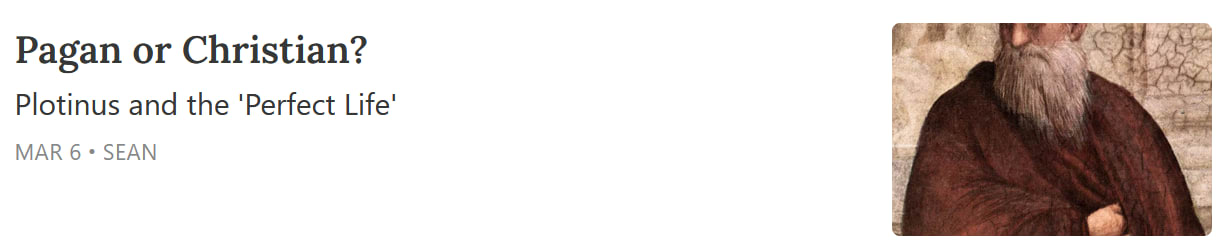
2. Plotinus is most often described as the founder of which philosophical tradition?
A. Stoicism
B. Epicureanism
C. Neoplatonism
D. Skepticism
3. In the Sumerian poem Enmerkar and the Lord of Aratta, why is writing invented?
A. To record religious hymns
B. Because a messenger could not remember a long message
C. To keep temple accounts
D. To write down laws
4. By the time of Ashurbanipal in the seventh century BC, how long had cuneiform been in use?
A. About 500 years
B. About 1000 years
C. Around 2500 years
D. Nearly 5000 years
5. Plotinus joined Emperor Gordian on a campaign against which region?
A. Gaul
B. Persia
C. Egypt
D. Germania
6. How did Mesopotamian scholars often interpret similarities between signs or sounds in writing?
A. As scribal mistakes
B. As poetic devices only
C. As accidental similarities
D. As insights into connections in the universe
7. What term describes the mystical union of the human soul with ultimate reality in Plotinus’ philosophy?
A. Ataraxia
B. Logos
C. Henosis
D. Catharsis
8. In which of Plato’s dialogues does Socrates say, “I am wiser than this man; it is likely that neither of us knows anything worthwhile, but he thinks he knows something when he does not.”
A. Apology
B. Crito
C. The Symposium
D. Phaedo
Stumped by the Questions? Become a Member to never miss a post & gain access to ALL our resources, including exclusive podcasts, e-books and more!

Answer Key
-
A. Epictetus (The Philosophy of Getting Lost)
-
C. Neoplatonism (Plotinus: Pagan or Proto-Christian?)
-
B. Because a messenger could not remember a long message (The Scribal Art
-
C. Around 2500 years (The Scribal Art)
-
B. Persia (Plotinus: Pagan or Proto-Christian?)
-
D. As insights into connections in the universe (The Scribal Art)
-
C. Henosis (Plotinus: Pagan or Proto-Christian?)
-
A. Apology (The Philosophy of Getting Lost)
🏛️ The Wisdom Scale:
🧠 0-2 correct: Novice Philosopher – The journey of wisdom begins with a single step. Keep reading!
📜 3-4 correct: Aspiring Sophos – You’re on your way! More scrolls and symposiums await you.
🏛 5-7 correct: Agora Adept – Your grasp of ancient wisdom is growing. The ancients would nod in approval.
⚡ 8 correct: Master of the Classics – You are a true sage! The spirits of Plato and Aristotle smile upon you.
So, how did it go? As always, let us know in the comments below!
All the best,
Sean Kelly
Managing Editor
Classical Wisdom
Más info en https://ift.tt/LYc5ag0 / Tfno. & WA 607725547 Centro MENADEL (Frasco Martín) Psicología Clínica y Tradicional en Mijas. #Menadel #Psicología #Clínica #Tradicional #MijasPueblo
*No suscribimos necesariamente las opiniones o artículos aquí compartidos. No todo es lo que parece.

No hay comentarios:
Publicar un comentario