
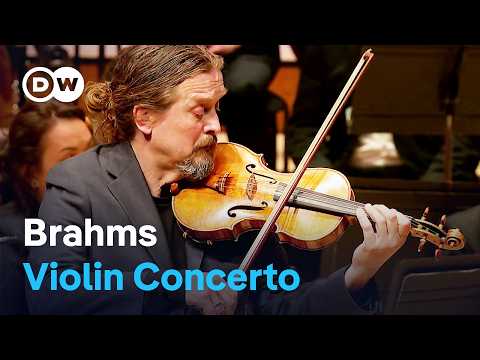
<p><iframe allowfullscreen="allowfullscreen" width="640" height="390" src="https://www.inoreader.com/yt-embed/?v=iraimKYe0cM" referrerpolicy="strict-origin-when-cross-origin" style="width:100%;aspect-ratio:16/9;height:auto;display:block;border:0;" frameborder="0"></iframe></p><p>Today celebrated as a cornerstone of the violin repertoire, Johannes Brahms' Violin Concerto in D major, Op. 77 had a surprisingly turbulent reception when it premiered, with some violinists deeming it too challenging to perform. In this performance from the Barbican Centre in London on May 21, 2023, Christian Tetzlaff takes on the concerto’s virtuosic solo part, joined by the London Symphony Orchestra under the direction of Michael Tilson Thomas.<br>
<br>
(00:00) I. Allegro non troppo<br>
(21:40) II. Adagio<br>
(30:22) III. Allegro giocoso, ma non troppo vivace<br>
<br>
When Johannes Brahms (1833–1897) vacationed at idyllic Lake Wörthersee in southern Austria in the summer of 1878, he was at the peak of his fame. Yet the northern German composer was not above asking his friend Joseph Joachim (1831–1907) to help him compose his Violin Concerto. Joachim, who was born in Hungary, was considered the most important — and virtuosic — violinist of his time. The two prominent musicians exchanged letters, discussing drafts of the concerto. Although Brahms didn't accept all of violinist's critical feedback, he still dedicated the concerto to Joachim. The collaboration between the two musicians could be imagined as a struggle between musical greats. <br>
<br>
The concerto premiered on January 1, 1879, at Leipzig's Gewandhaus, with Joachim as soloist and the composer conducting. But the reactions to Brahms's only violin concerto were mixed. Some considered it a success, while others felt that it was written not for but against the violin. Critics lamented that it was almost impossible for the soloist to master technically. They also took issue with the fact that the wonderfully melodic theme of the second movement was first presented in great detail by the oboe before the entrance of the violin — the actual solo instrument of the concerto. After the challenging compositional collaboration with Joachim and the negative feedback, Brahms continued to refine his D major Concerto until he published it in its final form in October 1878.<br>
<br>
Today, the Violin Concerto Op. 77 is one of the best-known works of its kind and is performed and recorded frequently. Joseph Joachim himself even called it one of the four most important violin concertos written by a German composer. Famous violinists have repeatedly played new cadenzas, although Joachim's cadenza is still the one most frequently performed today.<br>
<br>
Brahms had initially planned a four-movement concerto, which was more akin to a symphony for orchestra and solo violin. However, while composing, he changed his mind and deleted the planned scherzo and another movement in the middle. Ultimately, the concerto took on a classical three-movement form with a slow movement in the center. Yet his Violin Concerto is not a virtuoso concerto in which the orchestra plays a supporting role to the violin. Rather, the solo violin can be described as first among equals. The soloist and orchestra drive the various motives forward in equal measure. At times, one even gets the impression that the solo violin needs to assert itself to stand out amidst the orchestra.<br>
<br>
A striking feature of Brahms' Violin Concerto is the disproportionate length of the first movement, which takes up almost two-thirds of the entire work. Brahms' friend Clara Schumann (1819–1896) said the monumental opening movement was reminiscent of the first movement of his Second Symphony. Only once the orchestra has fully developed the three themes does the violin make its solo entrance. In the second movement — a lyrical adagio — the violin only comes into its own after the musical theme has been introduced by a solo oboe. In the cheerful final movement, however, the violin finally enters playing the main motive. The last movement is a rousing rondo with Hungarian-reminiscent dance themes that develop in the interplay between the violin and the orchestra. <br>
<br>
Christian Tetzlaff (born in Hamburg in 1966) has performed with leading orchestras and conductors worldwide since his international breakthrough in 1988. His repertoire spans from Bach and the Classical and Romantic traditions to contemporary music, and he has premiered works by a number of living composers. Alongside his solo career, chamber music plays a central role in his musical life; in 1994, he founded the Tetzlaff Quartet.<br>
<br>
Text: Rita Kass<br>
<br>
© 2023 C Major Entertainment<br>
<br>
Watch more concerts here: <a href="https://www.youtube.com/playlist?list=PL_SdnzPd3eBV5A14dyRWy1KSkwcG8LEey">https://www.youtube.com/playlist?list=PL_SdnzPd3eBV5A14dyRWy1KSkwcG8LEey</a><br>
<br>
Find more violin music: <a href="https://www.youtube.com/playlist?list=PL_SdnzPd3eBWJ5t7LxFkBRlcTu4qHdo67">https://www.youtube.com/playlist?list=PL_SdnzPd3eBWJ5t7LxFkBRlcTu4qHdo67</a><br>
<br>
Famous pieces from the Romantic era: <a href="https://www.youtube.com/playlist?list=PL_SdnzPd3eBUCHNKKxIIM88sntDk1TVih">https://www.youtube.com/playlist?list=PL_SdnzPd3eBUCHNKKxIIM88sntDk1TVih</a><br>
<br>
And more great music from Brahms: <a href="https://www.youtube.com/playlist?list=PL_SdnzPd3eBU5_GAu2NLbH0fBf6CEX8kQ">https://www.youtube.com/playlist?list=PL_SdnzPd3eBU5_GAu2NLbH0fBf6CEX8kQ</a><br>
<br>
Subscribe to DW Classical Music: <a href="https://www.youtube.com/dwclassicalmusic">https://www.youtube.com/dwclassicalmusic</a><br>
<br>
#romanticeramusic #violinconcerto #brahms</p>
<p><a href="https://www.youtube.com/watch?v=iraimKYe0cM" target="_blank">- Enlace a artículo -</a></p>
<p>Más info en https://ift.tt/FdX5uvt / Tfno. & WA 607725547 Centro MENADEL (Frasco Martín) Psicología Clínica y Tradicional en Mijas.
#Menadel #Psicología #Clínica #Tradicional #MijasPueblo</p>
<p>*No suscribimos necesariamente las opiniones o artículos aquí compartidos. No todo es lo que parece.</p>

No hay comentarios:
Publicar un comentario