
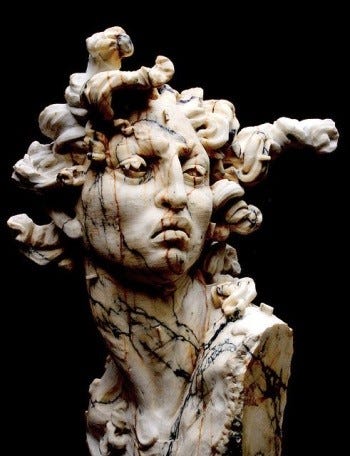
<p>Dear Classical Wisdom Reader,</p><p>It’s all the talk these days…</p><p>So, we’re only a week away from the release of this year’s blockbuster version of the <em>Odyssey</em>!</p><p>And well, naturally, there’s been a lot of hand-wringing about how faithful it is going to be to the original. After all, there’s been no shortage of, shall we say, <em>questionable</em> adaptations of beloved works of literature across Hollywood’s history.</p><p>It’s definitely an understandable impulse, yet I can’t help but think some of the worrying is misplaced.</p><p>You see, to the ancient Greeks, myth was a fluid thing; changes to mythology were embraced rather than feared. Homer’s work, after all, is a product of an ever-shifting oral storytelling culture, and that’s not to mention the frequent radical departures to well-known myths in the world of Greek tragedy. Plays like Euripides’ <em>Helen</em>, for example, offered <em>totally </em>different versions of key mythic stories.</p><p>An excellent example of all this is Medusa, the snake-haired gorgon with the power to turn people to stone.</p><p>She gets a shout out in the <em>Odyssey</em>, but her tale from that point onward takes on an odyssey-like journey of its own.</p><p>So when I say that today’s Members’ article looks at the myth of Medusa… Perhaps I should say the <em>myths.</em></p><p>Read on below to discover how Medusa was reinterpreted again and again across antiquity from Homer and Hesiod to Ovid, and how those various reinterpretations and changes have echoed across centuries, to right now in our modern world.</p><p><em>Not a Member? Unlock ALL our resources and go deeper into the world of ancient history and mythology, by joining our ever-growing community of Classics lovers today.</em></p><p><a href="https://classicalwisdom.substack.com/subscribe"><span>Become A Member</span></a></p><p>It all reminds me of something Natalie Haynes said at one of our events with her: that when it comes to myth, ‘there is no original version’.</p><p>All the best,</p><p>Sean Kelly</p><p>Managing Editor</p><p>Classical Wisdom</p><div><hr></div><div><div><div><p><em>Not a Member? Sign up today to support the Classics and unlock ALL of our resources, including exclusive podcasts, in-depth articles, and more!</em></p></div><div><div></div><div></div></div></div></div><div><hr></div><h1>The Many Myths of Medusa</h1><p><em>By Nicole Saldarriaga</em></p><p>What does it take to feel sympathy for a monster? In the case of Medusa, it may not be much. Though she is considered one of the most horrifying creatures of Ancient Greek mythology, her origin story is much more complex than many people realize.</p><p>This may be simply because the sources available to us today differ so widely in the telling of Medusa’s story. The tale is a brilliant example of the way in which myths evolve over time to suit changing societal needs. Though the myth started out simple, it quickly grew and, in some ways, changed drastically, leading to a great deal of confusion when modern readers and researchers attempt to put the pieces together into an accurate representation of ancient thought.</p><p>There is, of course, some information about Medusa that never changes no matter what source you choose to look at. These are details that are incredibly well known, and seem to be passed along through a process of natural cultural osmosis. Medusa is a kind of creature called a Gorgon, she has hundreds of wild, venomous snakes for hair, and she can turn any person to stone with a single look. This concept has fascinated people for centuries, and various kinds of paintings, sculptures, cartoons, video games, and even brand labels have explored Medusa as a subject and character.</p><div><figure><a href="https://substackcdn.com/image/fetch/%24s_!c06C!,f_auto,q_auto:good,fl_progressive:steep/https%3A%2F%2Fsubstack-post-media.s3.amazonaws.com%2Fpublic%2Fimages%2F3dee0053-f835-4bda-8dbc-0032597bde63_350x456.jpeg"></a><div><a href="https://substackcdn.com/image/fetch/%24s_!c06C!,f_auto,q_auto:good,fl_progressive:steep/https%3A%2F%2Fsubstack-post-media.s3.amazonaws.com%2Fpublic%2Fimages%2F3dee0053-f835-4bda-8dbc-0032597bde63_350x456.jpeg"></a><source type="image/webp"><a href="https://substackcdn.com/image/fetch/%24s_!c06C!,f_auto,q_auto:good,fl_progressive:steep/https%3A%2F%2Fsubstack-post-media.s3.amazonaws.com%2Fpublic%2Fimages%2F3dee0053-f835-4bda-8dbc-0032597bde63_350x456.jpeg"><img src="https://substackcdn.com/image/fetch/%24s_!c06C!,w_1456,c_limit,f_auto,q_auto:good,fl_progressive:steep/https%3A%2F%2Fsubstack-post-media.s3.amazonaws.com%2Fpublic%2Fimages%2F3dee0053-f835-4bda-8dbc-0032597bde63_350x456.jpeg" width="350" height="456" alt="Medusa statue" title="Medusa statue"></a></source><a href="https://substackcdn.com/image/fetch/%24s_!c06C!,f_auto,q_auto:good,fl_progressive:steep/https%3A%2F%2Fsubstack-post-media.s3.amazonaws.com%2Fpublic%2Fimages%2F3dee0053-f835-4bda-8dbc-0032597bde63_350x456.jpeg"></a><div><a href="https://substackcdn.com/image/fetch/%24s_!c06C!,f_auto,q_auto:good,fl_progressive:steep/https%3A%2F%2Fsubstack-post-media.s3.amazonaws.com%2Fpublic%2Fimages%2F3dee0053-f835-4bda-8dbc-0032597bde63_350x456.jpeg"></a><div><a href="https://substackcdn.com/image/fetch/%24s_!c06C!,f_auto,q_auto:good,fl_progressive:steep/https%3A%2F%2Fsubstack-post-media.s3.amazonaws.com%2Fpublic%2Fimages%2F3dee0053-f835-4bda-8dbc-0032597bde63_350x456.jpeg"></a></div><a href="https://substackcdn.com/image/fetch/%24s_!c06C!,f_auto,q_auto:good,fl_progressive:steep/https%3A%2F%2Fsubstack-post-media.s3.amazonaws.com%2Fpublic%2Fimages%2F3dee0053-f835-4bda-8dbc-0032597bde63_350x456.jpeg"></a></div><a href="https://substackcdn.com/image/fetch/%24s_!c06C!,f_auto,q_auto:good,fl_progressive:steep/https%3A%2F%2Fsubstack-post-media.s3.amazonaws.com%2Fpublic%2Fimages%2F3dee0053-f835-4bda-8dbc-0032597bde63_350x456.jpeg"></a></div><a href="https://substackcdn.com/image/fetch/%24s_!c06C!,f_auto,q_auto:good,fl_progressive:steep/https%3A%2F%2Fsubstack-post-media.s3.amazonaws.com%2Fpublic%2Fimages%2F3dee0053-f835-4bda-8dbc-0032597bde63_350x456.jpeg"></a></figure></div><p>But these are the details almost everyone knows. Almost everyone knows who Medusa is, or at least what she can do. What is more interesting is how Medusa became the monster she is considered to be, and this is where the myth begins to warp and change as sources begin to disagree.</p>
<p>
<a href="https://classicalwisdom.substack.com/p/the-many-myths-of-medusa">
Read more
</a>
</p>
<p><a href="https://classicalwisdom.substack.com/p/the-many-myths-of-medusa" target="_blank">- Enlace a artículo -</a></p>
<p>Más info en https://ift.tt/KNXGxbF / Tfno. & WA 607725547 Centro MENADEL (Frasco Martín) Psicología Clínica y Tradicional en Mijas.
#Menadel #Psicología #Clínica #Tradicional #MijasPueblo</p>
<p>*No suscribimos necesariamente las opiniones o artículos aquí compartidos. No todo es lo que parece.</p>

No hay comentarios:
Publicar un comentario