
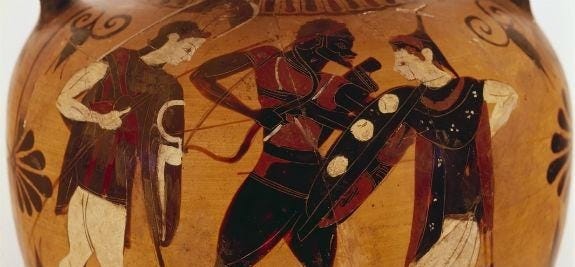
<p><span>Dear Classical Wisdom Reader,</span></p><p><span>We’ve been writing a lot about the </span><em><span>Odyssey</span></em><span>, I know. It might seem like too much, and honestly, if it were just about </span><em><span>any</span></em><span> other text in history, it probably would be...</span></p><p><span>But there is just so much to Homer’s epic! </span></p><p><span>Whether it’s </span><a href="https://classicalwisdom.substack.com/p/the-bad-the-good-and-the-odyssey"><span>my recent review of the movie,</span></a><span> the </span><a href="https://classicalwisdom.substack.com/p/who-was-helen-of-troy"><span>historicity of Helen</span></a><span>, whether </span><a href="https://www.youtube.com/watch?v=Ikdn-nAXc3g"><span>Odysseus is a hero (our podcast featuring Stephen Fry),</span></a><span> or </span><a href="https://classicalwisdom.substack.com/p/who-were-the-sea-peoples"><span>the importance of the Sea Peoples</span></a><span> in the Bronze Age Collapse, the discussion seems almost endless.</span></p><p><span>Perhaps that’s precisely why the </span><em><span>Odyssey</span></em><span> has endured for nearly three thousand years. It speaks to us on so many different levels. It explores hospitality, homecoming, coming of age, marriage, fathers and sons, war and trauma... and so, so much more.</span></p><p><span>Indeed, we covered only a small fragment of the epic in </span><a href="https://classicalwisdom.substack.com/p/odysseus-the-antihero"><span>our recent conversation with Joel Christensen</span></a><span>, as well as in these humble pages. In fact, if you’d like to catch up on this week’s articles, you can do so below.</span></p><p><span>One thing we </span><em><span>didn’t</span></em><span> discuss, however (and I’m surprised more people haven’t been writing about it either, at least that I’ve seen), is the remarkable cast of characters who appear elsewhere in the Trojan Cycle but not in the </span><em><span>Odyssey </span></em><span>itself. Many might think of the Amazons, for example, and the tragic death of their queen, Penthesilea, at the hands of Achilles.</span></p><p><span>Another immensely important figure who didn’t feature in the recent film is the Ethiopian king, Memnon. That omission is perhaps surprising, as he was one of the most celebrated heroes of the Trojan tradition. </span></p><p><span>I mean, there’s no need to invent new characters when the ancient sources already offer so many fascinating ones!</span></p><p><span>So, for those who have never encountered Memnon, a man greatly admired by both the Greeks and the Romans, and no doubt remembered proudly in the traditions associated with Ethiopia, you can discover his story in lieu of our regular quiz below…</span></p><p><span>Have a great weekend!</span></p><p><span>All the best,</span></p><p><span>Anya Leonard</span></p><p><span>Founder and Director</span></p><p><span>Classical Wisdom</span></p><p><strong><span>P.S. Classical Wisdom Members, make sure to check out your special invitation </span><a href="https://classicalwisdom.substack.com/p/the-wind-that-powered-greek-civilization"><span>HERE</span></a><span>. We want to make you saw it while there it space… </span></strong></p><p><strong><span>And if you aren’t a member, join us today to enjoy all our in-depth articles, Ebooks, podcasts and more!</span></strong></p><p><a href="https://classicalwisdom.substack.com/subscribe?"><span>Subscribe now</span></a></p><div><hr></div><h1><span>This Week’s Articles: </span></h1><div></div><div></div><div></div><div><hr></div><div><figure><a href="https://substackcdn.com/image/fetch/%24s_!11_O!,f_auto,q_auto:good,fl_progressive:steep/https%3A%2F%2Fsubstack-post-media.s3.amazonaws.com%2Fpublic%2Fimages%2F496475c8-d4f3-4e03-941e-2ff51b39235f_575x267.jpeg"></a><div><a href="https://substackcdn.com/image/fetch/%24s_!11_O!,f_auto,q_auto:good,fl_progressive:steep/https%3A%2F%2Fsubstack-post-media.s3.amazonaws.com%2Fpublic%2Fimages%2F496475c8-d4f3-4e03-941e-2ff51b39235f_575x267.jpeg"></a><source type="image/webp"><a href="https://substackcdn.com/image/fetch/%24s_!11_O!,f_auto,q_auto:good,fl_progressive:steep/https%3A%2F%2Fsubstack-post-media.s3.amazonaws.com%2Fpublic%2Fimages%2F496475c8-d4f3-4e03-941e-2ff51b39235f_575x267.jpeg"><img src="https://substackcdn.com/image/fetch/%24s_!11_O!,w_1456,c_limit,f_auto,q_auto:good,fl_progressive:steep/https%3A%2F%2Fsubstack-post-media.s3.amazonaws.com%2Fpublic%2Fimages%2F496475c8-d4f3-4e03-941e-2ff51b39235f_575x267.jpeg" width="575" height="267" alt="Memnon" title="Memnon"></a></source><a href="https://substackcdn.com/image/fetch/%24s_!11_O!,f_auto,q_auto:good,fl_progressive:steep/https%3A%2F%2Fsubstack-post-media.s3.amazonaws.com%2Fpublic%2Fimages%2F496475c8-d4f3-4e03-941e-2ff51b39235f_575x267.jpeg"></a><div><a href="https://substackcdn.com/image/fetch/%24s_!11_O!,f_auto,q_auto:good,fl_progressive:steep/https%3A%2F%2Fsubstack-post-media.s3.amazonaws.com%2Fpublic%2Fimages%2F496475c8-d4f3-4e03-941e-2ff51b39235f_575x267.jpeg"></a><div><a href="https://substackcdn.com/image/fetch/%24s_!11_O!,f_auto,q_auto:good,fl_progressive:steep/https%3A%2F%2Fsubstack-post-media.s3.amazonaws.com%2Fpublic%2Fimages%2F496475c8-d4f3-4e03-941e-2ff51b39235f_575x267.jpeg"></a></div><a href="https://substackcdn.com/image/fetch/%24s_!11_O!,f_auto,q_auto:good,fl_progressive:steep/https%3A%2F%2Fsubstack-post-media.s3.amazonaws.com%2Fpublic%2Fimages%2F496475c8-d4f3-4e03-941e-2ff51b39235f_575x267.jpeg"></a></div><a href="https://substackcdn.com/image/fetch/%24s_!11_O!,f_auto,q_auto:good,fl_progressive:steep/https%3A%2F%2Fsubstack-post-media.s3.amazonaws.com%2Fpublic%2Fimages%2F496475c8-d4f3-4e03-941e-2ff51b39235f_575x267.jpeg"></a></div><a href="https://substackcdn.com/image/fetch/%24s_!11_O!,f_auto,q_auto:good,fl_progressive:steep/https%3A%2F%2Fsubstack-post-media.s3.amazonaws.com%2Fpublic%2Fimages%2F496475c8-d4f3-4e03-941e-2ff51b39235f_575x267.jpeg"></a></figure></div><h1><strong><span>Memnon: the Mythical King of the Ethiopians</span></strong></h1><p><em><span>by Ed Whelan, Contributing Writer, Classical Wisdom</span></em></p><p><span>One of the most remarkable figures in all of ancient mythology is Memnon. He was a great hero, neither Greek nor Roman, but an African. He was a king of the Ethiopians, and he played a critical role in the Trojan War.</span></p><h2><strong><span>Origin of Memnon</span></strong></h2><p><span>Memnon was the son of Tithonus, a prince of Troy, and Eos, the goddess of the Dawn. According to legend, the goddess swept the Trojan prince away and took him to the farthest reaches of the earth, known as Oceanus in Greek mythology. There, the goddess of the Dawn bore Tithonus a son. He was known as “bronze-armed” Memnon, and he grew up to be a great warrior.</span></p><p><span>Memnon enjoyed the favor of the gods throughout his life. At some point, he became the king of the Ethiopians. This was a region south of Egypt that, in Greek geography, encompassed not only modern Ethiopia but also parts of what is now northern Sudan. Memnon ruled a great kingdom and commanded a large army.</span></p><p><span>As a warrior, he was considered superior to all the Greek heroes except Achilles. Some traditions claimed that he conquered great swathes of the East. He was renowned for his beauty and possessed all the masculine virtues admired by the ancient Greeks. </span></p><p><a href="https://classicalwisdom.substack.com/p/the-great-african-in-the-trojan-war?utm_source=substack&utm_medium=email&utm_content=share&action=share"><span>Share</span></a></p><p></p><p><span>It appears that he maintained close ties with the homeland of his father. According to some later traditions, Memnon married a Trojan woman, sometimes identified as Troana.</span></p><div><figure><a href="https://substackcdn.com/image/fetch/%24s_!g86N!,f_auto,q_auto:good,fl_progressive:steep/https%3A%2F%2Fsubstack-post-media.s3.amazonaws.com%2Fpublic%2Fimages%2F7ac4a730-75d8-40c0-bb70-1162beab79a8_2048x1536.webp"></a><div><a href="https://substackcdn.com/image/fetch/%24s_!g86N!,f_auto,q_auto:good,fl_progressive:steep/https%3A%2F%2Fsubstack-post-media.s3.amazonaws.com%2Fpublic%2Fimages%2F7ac4a730-75d8-40c0-bb70-1162beab79a8_2048x1536.webp"></a><source type="image/webp"><a href="https://substackcdn.com/image/fetch/%24s_!g86N!,f_auto,q_auto:good,fl_progressive:steep/https%3A%2F%2Fsubstack-post-media.s3.amazonaws.com%2Fpublic%2Fimages%2F7ac4a730-75d8-40c0-bb70-1162beab79a8_2048x1536.webp"><img src="https://substackcdn.com/image/fetch/%24s_!g86N!,w_1456,c_limit,f_auto,q_auto:good,fl_progressive:steep/https%3A%2F%2Fsubstack-post-media.s3.amazonaws.com%2Fpublic%2Fimages%2F7ac4a730-75d8-40c0-bb70-1162beab79a8_2048x1536.webp" width="1456" height="1092" alt=""></a></source><a href="https://substackcdn.com/image/fetch/%24s_!g86N!,f_auto,q_auto:good,fl_progressive:steep/https%3A%2F%2Fsubstack-post-media.s3.amazonaws.com%2Fpublic%2Fimages%2F7ac4a730-75d8-40c0-bb70-1162beab79a8_2048x1536.webp"></a><div><a href="https://substackcdn.com/image/fetch/%24s_!g86N!,f_auto,q_auto:good,fl_progressive:steep/https%3A%2F%2Fsubstack-post-media.s3.amazonaws.com%2Fpublic%2Fimages%2F7ac4a730-75d8-40c0-bb70-1162beab79a8_2048x1536.webp"></a><div><a href="https://substackcdn.com/image/fetch/%24s_!g86N!,f_auto,q_auto:good,fl_progressive:steep/https%3A%2F%2Fsubstack-post-media.s3.amazonaws.com%2Fpublic%2Fimages%2F7ac4a730-75d8-40c0-bb70-1162beab79a8_2048x1536.webp"></a></div><a href="https://substackcdn.com/image/fetch/%24s_!g86N!,f_auto,q_auto:good,fl_progressive:steep/https%3A%2F%2Fsubstack-post-media.s3.amazonaws.com%2Fpublic%2Fimages%2F7ac4a730-75d8-40c0-bb70-1162beab79a8_2048x1536.webp"></a></div><a href="https://substackcdn.com/image/fetch/%24s_!g86N!,f_auto,q_auto:good,fl_progressive:steep/https%3A%2F%2Fsubstack-post-media.s3.amazonaws.com%2Fpublic%2Fimages%2F7ac4a730-75d8-40c0-bb70-1162beab79a8_2048x1536.webp"></a></div><a href="https://substackcdn.com/image/fetch/%24s_!g86N!,f_auto,q_auto:good,fl_progressive:steep/https%3A%2F%2Fsubstack-post-media.s3.amazonaws.com%2Fpublic%2Fimages%2F7ac4a730-75d8-40c0-bb70-1162beab79a8_2048x1536.webp"></a><figcaption><em>Memnon and Achilles fighting on a 4th-century BC Greek vase</em></figcaption></figure></div><p><span>Little is known about the early life of the great hero because the epic poems devoted to him have sadly been lost.</span></p><h2><strong><span>Memnon and the Trojan War</span></strong></h2><p><span>When Achilles killed Hector, it appeared that Troy, without its greatest champion, was doomed. Priam, the king of Troy, implored the gods to help him and his people in their darkest hour. The gods heard his pleas, and, in later traditions, Memnon was called upon to leave Ethiopia and fight the Achaeans.</span></p><p><span>According to post-Homeric accounts of the Trojan War, the Ethiopian king traveled to Troy with a huge army. This included specialist units and soldiers who all had “a terrifying warlike appearance.” He and his men were so numerous that they had to camp outside the walls of the city because Troy could not accommodate them all.</span></p><p><span>Memnon and the Trojans attacked the Greeks, and a brutal battle ensued. The Ethiopian king was described as riding in a chariot and killing many Greeks. In many accounts, Memnon dueled with Antilochus, the son of Nestor. After fierce single combat, Memnon killed Antilochus, who was considered one of the greatest warriors in Greece.</span></p><p><span>After the death of Antilochus, the Greek army panicked and was driven back almost to its ships. It seemed that the Greeks were on the verge of complete defeat. Then mighty Achilles arrived and challenged Memnon to single combat. The two great heroes were evenly matched. Although both were favorites of the gods, the Olympians agreed not to intervene on behalf of either warrior.</span></p><p><span>In the fight, Achilles ultimately proved too quick and too strong for Memnon. </span></p><p><span>He thrust his spear through the Ethiopian king’s shield, pierced his side, and finally killed him with a thrust of his sword to the throat. With the death of their leader, the mighty Ethiopian army fled in terror. According to one legend, some remained behind to bury their king and were transformed into birds that forever removed the dust from their dead lord’s tomb.</span></p><div><div><div><p><strong>Bring the legends, as well as the history and the philosophy of the ancients into your world! Subscribe for full access to our articles and resources:</strong></p></div><div><div></div><div></div></div></div></div><p></p><p><span>One story relates that the gods gathered the spilled blood of the hero and transformed it into a mighty river that turned red each year on the anniversary of his death.</span></p><p><span>According to another tradition, Zeus, king of the gods, was so moved by the tears of Eos that he granted Memnon immortality.</span></p><h2><strong><span>The Legend of Memnon</span></strong></h2>
<p>
<a href="https://classicalwisdom.substack.com/p/the-great-african-in-the-trojan-war">
Read more
</a>
</p>
<p><a href="https://classicalwisdom.substack.com/p/the-great-african-in-the-trojan-war" target="_blank">- Enlace a artículo -</a></p>
<p>Más info en https://ift.tt/CmRj9bG / Tfno. & WA 607725547 Centro MENADEL (Frasco Martín) Psicología Clínica y Tradicional en Mijas.
#Menadel #Psicología #Clínica #Tradicional #MijasPueblo</p>
<p>*No suscribimos necesariamente las opiniones o artículos aquí compartidos. No todo es lo que parece.</p>

No hay comentarios:
Publicar un comentario