
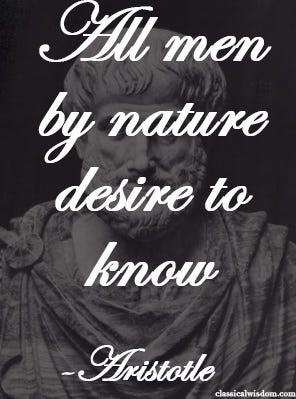
<p><span>Dear Classical Wisdom Reader,</span></p><p><span>I keep having Odyssey-related dreams... sometimes it’s just the crashing of the waves and the shouts of the crew rocking me to sleep.</span></p><p><span>Or an abstract sense of needing to go somewhere... a longing for a return, though I don’t know where.</span></p><p><span>A few nights ago, I was trying to teach the ancient Greek alphabet... unsuccessfully.</span></p><p><span>Another time (and this is where it gets weird), I was conducting a scientific study on how the beating of drums during a bard’s recitation of the Trojan War somehow brings everyone’s heartbeat into sync.</span></p><p><span>Yes, dear reader, I clearly appear to have become obsessed!</span></p><p><span>The activities of the past few weeks... the </span><em><span>Odyssey</span></em><span> movie, the discussions, the articles, the notes, and the debates... have clearly suffused my mind. It’s been a period of intense focus resulting in me thinking about the Classics all of the time.</span></p><p><span>Now, this might simply be part and parcel of the job. Especially with my big project of the year being a book for St. Martin’s Essentials (</span><em><span>Socrates and the Sphinx!</span></em><span>), I need to be constantly steeped in the history, philosophy, and mythology of the ancients... which sounds wonderful... until you can’t get wily Odysseus out of your head!</span></p><p><span>Even </span><a href="https://joelbowman.substack.com/"><span>my dear husband</span></a><span> has gently recommended that I read... a different book.</span></p><p><span>But should I?</span></p><p><span>In our highly specialized and fiercely competitive world, it often seems that, to accomplish something truly exceptional, one needs to be intensely focused...to the point, almost, of single-mindedness. It is an image that has been romanticized time and again, with figures such as Tiger Woods, Magnus Carlsen, and Yo-Yo Ma embodying the celebrated specialist.</span></p><p><span>To be fair, there’s a good reason for this. Human knowledge has expanded so dramatically that no one can hope to master more than a tiny fraction of it. Specialization has become almost inevitable.</span></p><p><span>Nonetheless, I began to wonder whether the ancients would have considered such single-minded devotion a virtue... or a vice. Would Aristotle or Plato have considered obsession the path to excellence... or something to be resisted?</span></p><div><div><div><p><em><strong>Enjoy the Virtue of Ancient Wisdom! Subscribe for full access to our articles, podcasts, magazines and more:</strong></em> </p></div><div><div></div><div></div></div></div></div><p></p><h3><strong><span>The Greek Ideal</span></strong></h3><p><span>The Greeks generally admired the person who cultivated many aspects of themselves. They even had a word for this ideal: </span><em><span>paideia</span></em><span>. It was an education that sought to form the whole person, intellectually, morally, physically, rhetorically, and aesthetically.</span></p><p><span>Knowledge was not simply about accumulating information. It was about becoming excellent (</span><em><span>aretē</span></em><span>).</span></p><p><span>Surely, none capture this broadmindedness better than Aristotle. He wrote on biology, zoology, politics, ethics, poetry, rhetoric, logic, psychology, astronomy, and metaphysics...You know, to name but a few.</span></p><p><span>If he were teaching at a modern university, he would belong to a dozen different departments... forever attempting to run between buildings and navigate entirely separate administrations!</span></p><p><span>Yet Aristotle never saw these seemingly diverse subjects as truly separate. </span></p><p><span>They were all part of a single investigation into reality. Ethics informed politics; politics depended upon an understanding of human nature; the study of living things illuminated broader questions about nature itself. Everything was connected, because specialization without an understanding of the whole would have seemed incomplete.</span></p><div><figure><a href="https://substackcdn.com/image/fetch/%24s_!4pl4!,f_auto,q_auto:good,fl_progressive:steep/https%3A%2F%2Fsubstack-post-media.s3.amazonaws.com%2Fpublic%2Fimages%2F6295e4c6-f5f1-48c7-970f-769f02ac96b3_296x399.jpeg"></a><div><a href="https://substackcdn.com/image/fetch/%24s_!4pl4!,f_auto,q_auto:good,fl_progressive:steep/https%3A%2F%2Fsubstack-post-media.s3.amazonaws.com%2Fpublic%2Fimages%2F6295e4c6-f5f1-48c7-970f-769f02ac96b3_296x399.jpeg"></a><source type="image/webp"><a href="https://substackcdn.com/image/fetch/%24s_!4pl4!,f_auto,q_auto:good,fl_progressive:steep/https%3A%2F%2Fsubstack-post-media.s3.amazonaws.com%2Fpublic%2Fimages%2F6295e4c6-f5f1-48c7-970f-769f02ac96b3_296x399.jpeg"><img src="https://substackcdn.com/image/fetch/%24s_!4pl4!,w_1456,c_limit,f_auto,q_auto:good,fl_progressive:steep/https%3A%2F%2Fsubstack-post-media.s3.amazonaws.com%2Fpublic%2Fimages%2F6295e4c6-f5f1-48c7-970f-769f02ac96b3_296x399.jpeg" width="296" height="399" alt=""></a></source><a href="https://substackcdn.com/image/fetch/%24s_!4pl4!,f_auto,q_auto:good,fl_progressive:steep/https%3A%2F%2Fsubstack-post-media.s3.amazonaws.com%2Fpublic%2Fimages%2F6295e4c6-f5f1-48c7-970f-769f02ac96b3_296x399.jpeg"></a><div><a href="https://substackcdn.com/image/fetch/%24s_!4pl4!,f_auto,q_auto:good,fl_progressive:steep/https%3A%2F%2Fsubstack-post-media.s3.amazonaws.com%2Fpublic%2Fimages%2F6295e4c6-f5f1-48c7-970f-769f02ac96b3_296x399.jpeg"></a><div><a href="https://substackcdn.com/image/fetch/%24s_!4pl4!,f_auto,q_auto:good,fl_progressive:steep/https%3A%2F%2Fsubstack-post-media.s3.amazonaws.com%2Fpublic%2Fimages%2F6295e4c6-f5f1-48c7-970f-769f02ac96b3_296x399.jpeg"></a></div><a href="https://substackcdn.com/image/fetch/%24s_!4pl4!,f_auto,q_auto:good,fl_progressive:steep/https%3A%2F%2Fsubstack-post-media.s3.amazonaws.com%2Fpublic%2Fimages%2F6295e4c6-f5f1-48c7-970f-769f02ac96b3_296x399.jpeg"></a></div><a href="https://substackcdn.com/image/fetch/%24s_!4pl4!,f_auto,q_auto:good,fl_progressive:steep/https%3A%2F%2Fsubstack-post-media.s3.amazonaws.com%2Fpublic%2Fimages%2F6295e4c6-f5f1-48c7-970f-769f02ac96b3_296x399.jpeg"></a></div><a href="https://substackcdn.com/image/fetch/%24s_!4pl4!,f_auto,q_auto:good,fl_progressive:steep/https%3A%2F%2Fsubstack-post-media.s3.amazonaws.com%2Fpublic%2Fimages%2F6295e4c6-f5f1-48c7-970f-769f02ac96b3_296x399.jpeg"></a><figcaption>Notice Aristotle does not say "to know chemistry" or "to know politics." </figcaption></figure></div><p><a href="https://classicalwisdom.substack.com/p/should-we-be-well-rounded-or-hyper?utm_source=substack&utm_medium=email&utm_content=share&action=share"><span>Share</span></a></p><p><span>Plato similarly outlines his thoughts on the matter in the </span><em><span>Republic</span></em><span>. In what is perhaps the most famous educational curriculum in history, he advocates that future philosopher-kings spend decades studying gymnastics, music, and poetry, alongside mathematics, geometry, astronomy, harmonics, and dialectic.</span></p><p><span>Interestingly, Plato delays practical political leadership until around the age of fifty. Only after mastering this broad education are they considered fit to govern.</span></p><p><span>The Stoics, meanwhile, divided philosophy into the three branches of Logic, Physics, and Ethics, yet repeatedly insisted that they could not truly be separated.</span></p><p><span>Chrysippus reportedly compared them to an egg. The shell was viewed as logic, the white physics, while the yolk represented ethics. Distinct though they were, each formed part of a single living whole. To understand one properly required an understanding of the others.</span></p><h3><strong><span>Well-Rounded Romans</span></strong></h3><p><span>The Romans inherited this Greek ideal... and no Roman embodied it more fully than Cicero, the quintessential eclectic! In his </span><em><span>De Oratore</span></em><span>, the great statesman criticizes the narrow specialist, arguing that the ideal orator and leader should be well versed in philosophy, history, law, rhetoric, and literature.</span></p><div><figure><a href="https://substackcdn.com/image/fetch/%24s_!Ebhn!,f_auto,q_auto:good,fl_progressive:steep/https%3A%2F%2Fsubstack-post-media.s3.amazonaws.com%2Fpublic%2Fimages%2Fcb005801-6472-444c-a11e-3db021228947_473x355.jpeg"></a><div><a href="https://substackcdn.com/image/fetch/%24s_!Ebhn!,f_auto,q_auto:good,fl_progressive:steep/https%3A%2F%2Fsubstack-post-media.s3.amazonaws.com%2Fpublic%2Fimages%2Fcb005801-6472-444c-a11e-3db021228947_473x355.jpeg"></a><source type="image/webp"><a href="https://substackcdn.com/image/fetch/%24s_!Ebhn!,f_auto,q_auto:good,fl_progressive:steep/https%3A%2F%2Fsubstack-post-media.s3.amazonaws.com%2Fpublic%2Fimages%2Fcb005801-6472-444c-a11e-3db021228947_473x355.jpeg"><img src="https://substackcdn.com/image/fetch/%24s_!Ebhn!,w_1456,c_limit,f_auto,q_auto:good,fl_progressive:steep/https%3A%2F%2Fsubstack-post-media.s3.amazonaws.com%2Fpublic%2Fimages%2Fcb005801-6472-444c-a11e-3db021228947_473x355.jpeg" width="473" height="355" alt="" title=""></a></source><a href="https://substackcdn.com/image/fetch/%24s_!Ebhn!,f_auto,q_auto:good,fl_progressive:steep/https%3A%2F%2Fsubstack-post-media.s3.amazonaws.com%2Fpublic%2Fimages%2Fcb005801-6472-444c-a11e-3db021228947_473x355.jpeg"></a><div><a href="https://substackcdn.com/image/fetch/%24s_!Ebhn!,f_auto,q_auto:good,fl_progressive:steep/https%3A%2F%2Fsubstack-post-media.s3.amazonaws.com%2Fpublic%2Fimages%2Fcb005801-6472-444c-a11e-3db021228947_473x355.jpeg"></a><div><a href="https://substackcdn.com/image/fetch/%24s_!Ebhn!,f_auto,q_auto:good,fl_progressive:steep/https%3A%2F%2Fsubstack-post-media.s3.amazonaws.com%2Fpublic%2Fimages%2Fcb005801-6472-444c-a11e-3db021228947_473x355.jpeg"></a></div><a href="https://substackcdn.com/image/fetch/%24s_!Ebhn!,f_auto,q_auto:good,fl_progressive:steep/https%3A%2F%2Fsubstack-post-media.s3.amazonaws.com%2Fpublic%2Fimages%2Fcb005801-6472-444c-a11e-3db021228947_473x355.jpeg"></a></div><a href="https://substackcdn.com/image/fetch/%24s_!Ebhn!,f_auto,q_auto:good,fl_progressive:steep/https%3A%2F%2Fsubstack-post-media.s3.amazonaws.com%2Fpublic%2Fimages%2Fcb005801-6472-444c-a11e-3db021228947_473x355.jpeg"></a></div><a href="https://substackcdn.com/image/fetch/%24s_!Ebhn!,f_auto,q_auto:good,fl_progressive:steep/https%3A%2F%2Fsubstack-post-media.s3.amazonaws.com%2Fpublic%2Fimages%2Fcb005801-6472-444c-a11e-3db021228947_473x355.jpeg"></a><figcaption>Cicero… not in hyper focus</figcaption></figure></div><p><span>Indeed, he writes that the perfect speaker should possess knowledge of “all important subjects.”</span></p><p><span>However, there is a natural limit to all of this. After all, it’s easy to say we should know everything... it’s considerably harder to do. And how can we achieve excellence, </span><em><span>aretē</span></em><span>, if we spread ourselves too thin?</span></p><div><div><div><p><em><strong>Achieve your own excellent with wisdom from the ancient world! Subscribe to bring the Classics into your inbox & into your life:</strong></em> </p></div><div><div></div><div></div></div></div></div><p></p><p><span>To this, the Stoic philosopher Seneca the Younger offers a more nuanced answer. There is little value in pursuing knowledge simply for its own sake or as an ornament to impress others. True learning should be transformative, not ornamental; it should shape one’s character rather than merely expand one’s store of facts.</span></p><p><span>In </span><em><span>De Tranquillitate Animi</span></em><span> (</span><em><span>On Tranquility of Mind</span></em><span>) 9.4, Seneca writes:</span></p><blockquote><p><span>“What avails countless books and libraries, whose titles their owner can scarcely read through in his whole lifetime? The student is oppressed by the mass of books, not instructed; and so, since you cannot read all the books that you may possess, it is enough to possess only as many books as you can read.”</span></p><p><span>— John W. Basore, </span><em><span>Moral Essays</span></em><span>, Loeb Classical Library, Vol. II (1932)</span></p></blockquote><p><span>Plutarch captures this same idea beautifully with a powerful metaphor, comparing learning to bees gathering nectar. Bees visit many flowers... but they do not merely collect nectar, they transform it into honey. Likewise, we should read many authors and encounter many ideas, but more importantly, we should transform them into wisdom of our own. The goal is to synthesize rather than merely accumulate.</span></p><p><a href="https://classicalwisdom.substack.com/p/should-we-be-well-rounded-or-hyper?utm_source=substack&utm_medium=email&utm_content=share&action=share"><span>Share</span></a></p><p></p><h3><strong><span>What About Experts?</span></strong></h3><p><span>Of course, the ancients certainly recognized expertise, what the Greeks called </span><em><span>technē</span></em><span>. After all, a physician should specialize in medicine, a sculptor should master sculpture, and a shipbuilder should understand ships.</span></p><p><span>Indeed, Plato often uses craftsmen as examples of specialized knowledge. However, when discussing the highest human life, the examined life, the emphasis shifts.</span></p><p><span>The philosopher, statesman, or educated citizen should not become intellectually narrow. Nor, it seems, should physicians, mathematicians, or historians. One need only think of the many remarkable polymaths of antiquity, including Hippocrates, Pythagoras, Herodotus, Thucydides, Xenophon, and, above all, Aristotle.</span></p><p><span>This was not, however, a form of dilettantism, the practice of engaging with subjects in a flippant or superficial way. The ancients drew an important distinction between sampling everything superficially and integrating many fields into a coherent understanding. The goal was not to know a little about everything, but to understand how everything fit together.</span></p><h3><strong><span>The Purpose of Wisdom</span></strong></h3><p><span>Perhaps wisdom consists not in knowing more isolated facts than anyone else, but in understanding the causes and principles that connect them. This is one reason the modern term “polymath” fits so many ancient thinkers. Their intellectual ambitions did not fit neatly into the silos of our modern curricula, in part because their aim was not to know a little about everything, but to see how everything fit together.</span></p><p><span>Philosophy, history, science, mathematics, politics, literature, and art all illuminate one another... and a life of genuine wisdom depends upon that conversation between disciplines. Even our specialization can be enriched by occasionally broadening our interests and pursuits.</span></p><p><span>So... I suppose all of this is to say... does anyone have any recommendations for a completely non-Classics book?</span></p>
<p><a href="https://classicalwisdom.substack.com/p/should-we-be-well-rounded-or-hyper" target="_blank">- Enlace a artículo -</a></p>
<p>Más info en https://ift.tt/aMBGKQA / Tfno. & WA 607725547 Centro MENADEL (Frasco Martín) Psicología Clínica y Tradicional en Mijas.
#Menadel #Psicología #Clínica #Tradicional #MijasPueblo</p>
<p>*No suscribimos necesariamente las opiniones o artículos aquí compartidos. No todo es lo que parece.</p>

No hay comentarios:
Publicar un comentario