
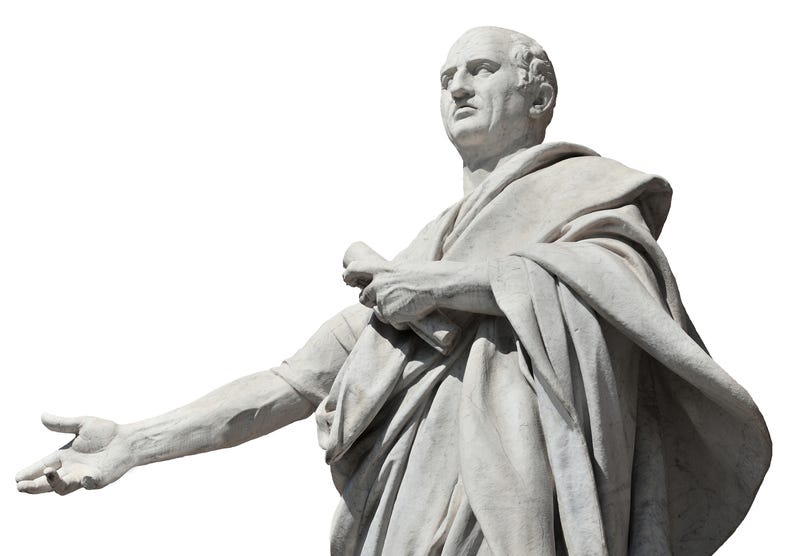
<p>Dear Classical Wisdom Reader,</p><p>When someone is described as a skeptic, most folks have a very clear image that comes to mind. The blue glow reflecting in forlorn eyes, long from staring too much at darknet sites; they are invariably in a basement, somewhere the sun doesn’t reach. The tinfoil hat is optional.</p><p>Almost never (except perhaps in these humble pages) does one instead conjure the proud, thoughtful bearing of an eloquent orator addressing an august collection of thinkers and statesmen... someone like Cicero.</p><div><figure><a href="https://substackcdn.com/image/fetch/%24s_!sHHZ!,f_auto,q_auto:good,fl_progressive:steep/https%3A%2F%2Fsubstack-post-media.s3.amazonaws.com%2Fpublic%2Fimages%2F04cc9a56-ac75-4fe8-9510-60800c2c4cf7_800x556.jpeg"></a><div><a href="https://substackcdn.com/image/fetch/%24s_!sHHZ!,f_auto,q_auto:good,fl_progressive:steep/https%3A%2F%2Fsubstack-post-media.s3.amazonaws.com%2Fpublic%2Fimages%2F04cc9a56-ac75-4fe8-9510-60800c2c4cf7_800x556.jpeg"></a><source type="image/webp"><a href="https://substackcdn.com/image/fetch/%24s_!sHHZ!,f_auto,q_auto:good,fl_progressive:steep/https%3A%2F%2Fsubstack-post-media.s3.amazonaws.com%2Fpublic%2Fimages%2F04cc9a56-ac75-4fe8-9510-60800c2c4cf7_800x556.jpeg"><img src="https://substackcdn.com/image/fetch/%24s_!sHHZ!,w_1456,c_limit,f_auto,q_auto:good,fl_progressive:steep/https%3A%2F%2Fsubstack-post-media.s3.amazonaws.com%2Fpublic%2Fimages%2F04cc9a56-ac75-4fe8-9510-60800c2c4cf7_800x556.jpeg" width="800" height="556" alt=""></a></source><a href="https://substackcdn.com/image/fetch/%24s_!sHHZ!,f_auto,q_auto:good,fl_progressive:steep/https%3A%2F%2Fsubstack-post-media.s3.amazonaws.com%2Fpublic%2Fimages%2F04cc9a56-ac75-4fe8-9510-60800c2c4cf7_800x556.jpeg"></a><div><a href="https://substackcdn.com/image/fetch/%24s_!sHHZ!,f_auto,q_auto:good,fl_progressive:steep/https%3A%2F%2Fsubstack-post-media.s3.amazonaws.com%2Fpublic%2Fimages%2F04cc9a56-ac75-4fe8-9510-60800c2c4cf7_800x556.jpeg"></a><div><a href="https://substackcdn.com/image/fetch/%24s_!sHHZ!,f_auto,q_auto:good,fl_progressive:steep/https%3A%2F%2Fsubstack-post-media.s3.amazonaws.com%2Fpublic%2Fimages%2F04cc9a56-ac75-4fe8-9510-60800c2c4cf7_800x556.jpeg"></a></div><a href="https://substackcdn.com/image/fetch/%24s_!sHHZ!,f_auto,q_auto:good,fl_progressive:steep/https%3A%2F%2Fsubstack-post-media.s3.amazonaws.com%2Fpublic%2Fimages%2F04cc9a56-ac75-4fe8-9510-60800c2c4cf7_800x556.jpeg"></a></div><a href="https://substackcdn.com/image/fetch/%24s_!sHHZ!,f_auto,q_auto:good,fl_progressive:steep/https%3A%2F%2Fsubstack-post-media.s3.amazonaws.com%2Fpublic%2Fimages%2F04cc9a56-ac75-4fe8-9510-60800c2c4cf7_800x556.jpeg"></a></div><a href="https://substackcdn.com/image/fetch/%24s_!sHHZ!,f_auto,q_auto:good,fl_progressive:steep/https%3A%2F%2Fsubstack-post-media.s3.amazonaws.com%2Fpublic%2Fimages%2F04cc9a56-ac75-4fe8-9510-60800c2c4cf7_800x556.jpeg"></a><figcaption>Questions?</figcaption></figure></div><p>Indeed, <em>Skeptic</em> and its eponymous philosophy are just two of many ancient terms that have been co-opted and corrupted by modern society.</p><p>Of course, if we return to the ancients, this epistemological line of inquiry goes way back, all the way to the Pre-Socratics (whom I like to call the natural philosophers), such as Xenophanes (c. 570–475 BCE) and Democritus (c. 460–370 BCE), as well as by the Ajñana thinkers of ancient India. It could range from questioning the topics <em>du jour</em> to trying to understand whether or not we can ever know anything at all.</p><p>Xenophanes, for instance, challenged accepted ideas about the gods, famously observing that if horses or oxen could draw, they would depict divine beings in their own image. His point was a profound one: how often do we mistake our assumptions for reality?</p><p>Democritus, meanwhile, argued that the universe consisted of atoms moving through empty space, yet also reflected on the limitations of the senses that must interpret that world for us.</p><div><div><div><p><strong>One thing is for certain, the importance of ancient wisdom! Bring the classics into your inbox and into your life:</strong></p></div><div><div></div><div></div></div></div></div><p></p><p>The Ajñana thinkers pushed the inquiry further still, questioning whether certainty was possible in matters of religion, ethics, and metaphysics. Though separated by geography and tradition, these thinkers shared a common concern with the limits and reliability of human knowledge.</p><p>Skepticism, however, reached its height in both the Greek and Roman worlds with Pyrrhonism, founded by Pyrrho of Elis (c. 360–270 BCE), and Academic Skepticism, which we know largely through <em>Academica</em>, written by the Academic skeptic philosopher Cicero (106 BCE - 43 BCE).</p><p>Pyrrho took skepticism to its most radical conclusion. Because our perceptions and judgments are so often unreliable, he argued, we should refrain from making firm assertions about the true nature of things. By suspending judgment (<em>epoché</em>), the Pyrrhonists maintained that one could arrive, almost unexpectedly, at a state of tranquility (<em>ataraxia</em>), freed from the anxieties that so often accompany certainty.</p><div><figure><a href="https://substackcdn.com/image/fetch/%24s_!d5GK!,f_auto,q_auto:good,fl_progressive:steep/https%3A%2F%2Fsubstack-post-media.s3.amazonaws.com%2Fpublic%2Fimages%2F49edfcc7-0808-43f4-9e36-fc3dbc47bdb3_734x540.png"></a><div><a href="https://substackcdn.com/image/fetch/%24s_!d5GK!,f_auto,q_auto:good,fl_progressive:steep/https%3A%2F%2Fsubstack-post-media.s3.amazonaws.com%2Fpublic%2Fimages%2F49edfcc7-0808-43f4-9e36-fc3dbc47bdb3_734x540.png"></a><source type="image/webp"><a href="https://substackcdn.com/image/fetch/%24s_!d5GK!,f_auto,q_auto:good,fl_progressive:steep/https%3A%2F%2Fsubstack-post-media.s3.amazonaws.com%2Fpublic%2Fimages%2F49edfcc7-0808-43f4-9e36-fc3dbc47bdb3_734x540.png"><img src="https://substackcdn.com/image/fetch/%24s_!d5GK!,w_1456,c_limit,f_auto,q_auto:good,fl_progressive:steep/https%3A%2F%2Fsubstack-post-media.s3.amazonaws.com%2Fpublic%2Fimages%2F49edfcc7-0808-43f4-9e36-fc3dbc47bdb3_734x540.png" width="734" height="540" alt=""></a></source><a href="https://substackcdn.com/image/fetch/%24s_!d5GK!,f_auto,q_auto:good,fl_progressive:steep/https%3A%2F%2Fsubstack-post-media.s3.amazonaws.com%2Fpublic%2Fimages%2F49edfcc7-0808-43f4-9e36-fc3dbc47bdb3_734x540.png"></a><div><a href="https://substackcdn.com/image/fetch/%24s_!d5GK!,f_auto,q_auto:good,fl_progressive:steep/https%3A%2F%2Fsubstack-post-media.s3.amazonaws.com%2Fpublic%2Fimages%2F49edfcc7-0808-43f4-9e36-fc3dbc47bdb3_734x540.png"></a><div><a href="https://substackcdn.com/image/fetch/%24s_!d5GK!,f_auto,q_auto:good,fl_progressive:steep/https%3A%2F%2Fsubstack-post-media.s3.amazonaws.com%2Fpublic%2Fimages%2F49edfcc7-0808-43f4-9e36-fc3dbc47bdb3_734x540.png"></a></div><a href="https://substackcdn.com/image/fetch/%24s_!d5GK!,f_auto,q_auto:good,fl_progressive:steep/https%3A%2F%2Fsubstack-post-media.s3.amazonaws.com%2Fpublic%2Fimages%2F49edfcc7-0808-43f4-9e36-fc3dbc47bdb3_734x540.png"></a></div><a href="https://substackcdn.com/image/fetch/%24s_!d5GK!,f_auto,q_auto:good,fl_progressive:steep/https%3A%2F%2Fsubstack-post-media.s3.amazonaws.com%2Fpublic%2Fimages%2F49edfcc7-0808-43f4-9e36-fc3dbc47bdb3_734x540.png"></a></div><a href="https://substackcdn.com/image/fetch/%24s_!d5GK!,f_auto,q_auto:good,fl_progressive:steep/https%3A%2F%2Fsubstack-post-media.s3.amazonaws.com%2Fpublic%2Fimages%2F49edfcc7-0808-43f4-9e36-fc3dbc47bdb3_734x540.png"></a><figcaption>Pyrrho, ancient Greek philosopher. From Thomas Stanley, (1655)</figcaption></figure></div><p>The Academics, however, adopted a somewhat more practical approach.</p><p>While agreeing that absolute certainty remained beyond our grasp, they argued that some conclusions were nevertheless more probable than others. This allowed skepticism to become not merely a philosophical position but a method of inquiry, one that could be applied to politics, ethics, religion, and everyday life. It is largely through Cicero that this more pragmatic form of skepticism would leave its mark on the Western tradition.</p><p>Indeed, the influence of this tradition extended far beyond antiquity...</p><p>David Hume would later use skeptical reasoning to challenge some of philosophy’s most cherished assumptions, particularly our confidence in causation. We may observe one event following another countless times, he argued, but can we ever truly perceive the necessary connection that makes one the cause of the other?</p><p><a href="https://classicalwisdom.substack.com/p/should-we-question-everything?utm_source=substack&utm_medium=email&utm_content=share&action=share"><span>Share</span></a></p><p></p><p>Such questions helped reshape modern philosophy and encouraged a more rigorous examination of how knowledge itself is formed.</p><p>The scientific community likewise embraced skepticism as a virtue. Every hypothesis must be tested, every conclusion challenged, every result subjected to scrutiny and possible revision. In many ways, the scientific method is skepticism formalized...</p><p>...Yet despite this distinguished pedigree, the modern iteration has often descended into the caricature described at the very beginning.</p><p>Of course skepticism has always had its critics. If every claim is open to question, how do we ever commit ourselves to a course of action? How do we build institutions, form convictions, or place trust in one another?</p><p>Taken too far, skepticism can paralyze decision-making, erode confidence, and leave us perpetually suspended between competing possibilities. Even in antiquity, many philosophers worried that excessive doubt could become as dangerous as excessive certainty.</p><p>So... where does this leave us?</p><p>When does healthy skepticism become destructive cynicism?</p><p>And in an age overflowing with information, certainty, and doubt, how skeptical should we really be?</p><p><strong>From addressing wisdom itself to understanding current events, from the causes of war and climate change to the origins of disease, should we question everything?</strong></p><p><strong>Or are there some things we must simply trust?</strong></p><p>As always, comment below to discuss the value of skepticism today...</p><p>And if these questions intrigue you, you’ll definitely want to join us this Thursday at 11am ET for our live Classical Wisdom debate on Skepticism</p><p>In this special live discussion, <strong>Massimo Pigliucci, Robin Reames, and</strong> <strong>Vittorio Bufacchi </strong>will debate some of life’s biggest questions through the lenses of Stoicism, Skepticism, rhetoric, ethics, and classical philosophy.</p><p><a href="https://Good-life.eventbrite.ie"><span>Register Here</span></a></p><p><em>Please note, as long as you register in advance, you can receive the recording, even if you can’t join us live!</em></p><p><strong>Classical Wisdom Members, you have a special reserved spot for this month’s event. I’ll be sending you the link before and you will also receive the recording and transcript afterwards.</strong></p><p>If you aren’t a member, but would like to enjoy our VIP access, as well as our growing resources and supportive community, make sure to do so here:</p><p><a href="https://classicalwisdom.substack.com/subscribe?"><span>Subscribe now</span></a></p><p>All the best,</p><p>Anya Leonard<br>Founder and Director<br>Classical Wisdom</p>
<p><a href="https://classicalwisdom.substack.com/p/should-we-question-everything" target="_blank">- Enlace a artículo -</a></p>
<p>Más info en https://ift.tt/7FtydwA / Tfno. & WA 607725547 Centro MENADEL (Frasco Martín) Psicología Clínica y Tradicional en Mijas.
#Menadel #Psicología #Clínica #Tradicional #MijasPueblo</p>
<p>*No suscribimos necesariamente las opiniones o artículos aquí compartidos. No todo es lo que parece.</p>

No hay comentarios:
Publicar un comentario