
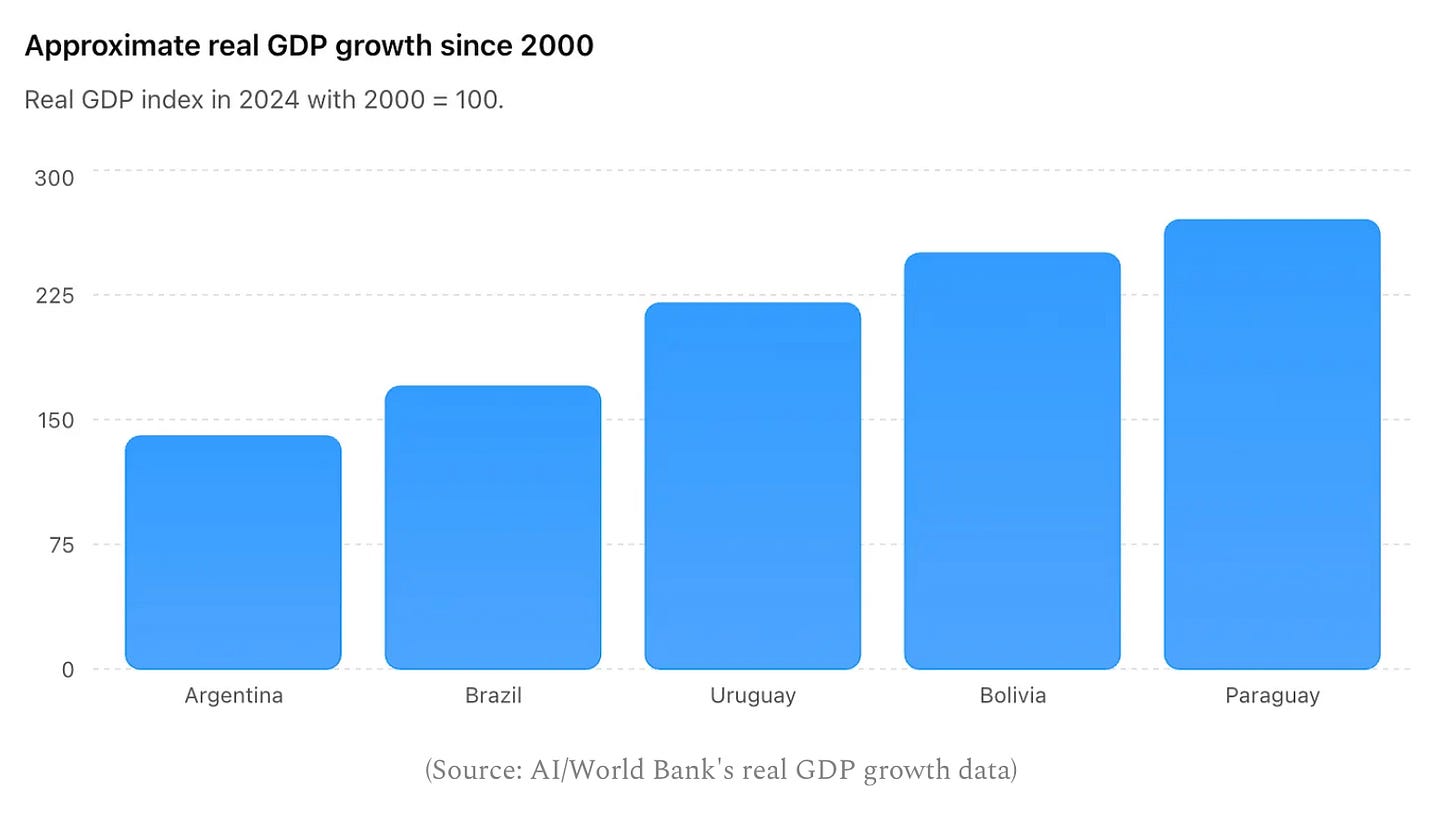
<p>Dear Classical Wisdom Reader,</p><p>Those who know me know that I am not a fan of winter.</p><p>I have sufficiently done my “time” in colder climes after many years in Scotland and Norway, and so it is around this time of year that we usually embark on our annual journey to the Northern Hemisphere. I had happily avoided the frigid discomfort for quite some time... that is, until my Southern Hemisphere-born-and-raised family threatened mutiny. </p><p>Apparently they wanted a change. And coats.</p><p>And so, here we are, enduring the grey, dreary days one finds at the end of the world at this time of year.</p><p>Fortunately, I was granted a brief reprieve from the cold in honor of my birthday. And so it was that last week our little family of three found ourselves in the tropical climate of Asunción, Paraguay.</p><p>For those unfamiliar with this landlocked republic in the heart of South America, Paraguay is a fascinating place, one caught between two worlds.</p><p>It is in the midst of an economic boom, stimulated in part by its wealthier neighbors, who flock to its malls lured by low tariffs and duty-free shopping. Its relatively open borders welcome digital nomads and passport collectors seeking low taxes and economic refuge. The vast western plains teem with cattle and Mennonite-managed farms, fueling growing trade and renewed prosperity.</p><div><figure><a href="https://substackcdn.com/image/fetch/%24s_!FhMx!,f_auto,q_auto:good,fl_progressive:steep/https%3A%2F%2Fsubstack-post-media.s3.amazonaws.com%2Fpublic%2Fimages%2F499eb4d5-9f80-431a-bd89-5dce0e98795f_1572x878.png"></a><div><a href="https://substackcdn.com/image/fetch/%24s_!FhMx!,f_auto,q_auto:good,fl_progressive:steep/https%3A%2F%2Fsubstack-post-media.s3.amazonaws.com%2Fpublic%2Fimages%2F499eb4d5-9f80-431a-bd89-5dce0e98795f_1572x878.png"></a><source type="image/webp"><a href="https://substackcdn.com/image/fetch/%24s_!FhMx!,f_auto,q_auto:good,fl_progressive:steep/https%3A%2F%2Fsubstack-post-media.s3.amazonaws.com%2Fpublic%2Fimages%2F499eb4d5-9f80-431a-bd89-5dce0e98795f_1572x878.png"><img src="https://substackcdn.com/image/fetch/%24s_!FhMx!,w_1456,c_limit,f_auto,q_auto:good,fl_progressive:steep/https%3A%2F%2Fsubstack-post-media.s3.amazonaws.com%2Fpublic%2Fimages%2F499eb4d5-9f80-431a-bd89-5dce0e98795f_1572x878.png" width="1456" height="813" alt=""></a></source><a href="https://substackcdn.com/image/fetch/%24s_!FhMx!,f_auto,q_auto:good,fl_progressive:steep/https%3A%2F%2Fsubstack-post-media.s3.amazonaws.com%2Fpublic%2Fimages%2F499eb4d5-9f80-431a-bd89-5dce0e98795f_1572x878.png"></a><div><a href="https://substackcdn.com/image/fetch/%24s_!FhMx!,f_auto,q_auto:good,fl_progressive:steep/https%3A%2F%2Fsubstack-post-media.s3.amazonaws.com%2Fpublic%2Fimages%2F499eb4d5-9f80-431a-bd89-5dce0e98795f_1572x878.png"></a><div><a href="https://substackcdn.com/image/fetch/%24s_!FhMx!,f_auto,q_auto:good,fl_progressive:steep/https%3A%2F%2Fsubstack-post-media.s3.amazonaws.com%2Fpublic%2Fimages%2F499eb4d5-9f80-431a-bd89-5dce0e98795f_1572x878.png"></a></div><a href="https://substackcdn.com/image/fetch/%24s_!FhMx!,f_auto,q_auto:good,fl_progressive:steep/https%3A%2F%2Fsubstack-post-media.s3.amazonaws.com%2Fpublic%2Fimages%2F499eb4d5-9f80-431a-bd89-5dce0e98795f_1572x878.png"></a></div><a href="https://substackcdn.com/image/fetch/%24s_!FhMx!,f_auto,q_auto:good,fl_progressive:steep/https%3A%2F%2Fsubstack-post-media.s3.amazonaws.com%2Fpublic%2Fimages%2F499eb4d5-9f80-431a-bd89-5dce0e98795f_1572x878.png"></a></div><a href="https://substackcdn.com/image/fetch/%24s_!FhMx!,f_auto,q_auto:good,fl_progressive:steep/https%3A%2F%2Fsubstack-post-media.s3.amazonaws.com%2Fpublic%2Fimages%2F499eb4d5-9f80-431a-bd89-5dce0e98795f_1572x878.png"></a><figcaption>A chart from Joel Bowman’s <em><a href="https://joelbowman.substack.com/p/a-little-liberty">Notes from the End of the World</a></em></figcaption></figure></div><p>As a result, the visitor to this historic city can enjoy elegant boutiques, gourmet restaurants tucked into lush courtyards, and fashionable hotels where Paraguayans and foreigners alike gather for business meetings and evening cocktails.</p><p>You can even spot luxury cars gliding through the streets.</p><p>And yet, more often than not, those same cars are driving along dirt roads, beneath poorly lit street lamps, and past abandoned lots. Indeed, just as Paraguay’s political borders bear witness to wars both disastrous and triumphant, its historic downtown still carries the scars of poverty and decades of dictatorship.</p><p>But what is truly remarkable is that between Paraguay’s tragic yesterday and its hopeful tomorrow, its ancient past remains ever present.</p><p><a href="https://classicalwisdom.substack.com/p/why-do-some-cultures-survive-while?utm_source=substack&utm_medium=email&utm_content=share&action=share"><span>Share</span></a></p><p>Paraguay is one of the few countries in the world where an ancient indigenous language remains a major language of everyday life across much of society. It is not confined to museums, classrooms, or ceremonial occasions. It is embedded in modern life. You hear it in conversations on the street, among shopkeepers and waiters, in homes and markets.</p><p>It is the echo of an ancient world that never disappeared...it is the language Guaraní.</p><p>In fact, recent statistics indicate that more than 70 percent of Paraguay’s population speaks Guaraní, often alongside Spanish. For many Paraguayans, it remains not merely a symbol of heritage but a living language, spoken much as it has been for generations.</p><p>And this is truly remarkable... because so many ancient cultures and languages disappeared whether under imperial expansion, demographic collapse, or gradual linguistic evolution.</p><p>And yet, after more than two thousand years, Guaraní did not.</p><div><figure><a href="https://substackcdn.com/image/fetch/%24s_!6_BM!,f_auto,q_auto:good,fl_progressive:steep/https%3A%2F%2Fsubstack-post-media.s3.amazonaws.com%2Fpublic%2Fimages%2Ffd0305d2-28da-46ec-a0b1-b5571e1e2e11_770x614.png"></a><div><a href="https://substackcdn.com/image/fetch/%24s_!6_BM!,f_auto,q_auto:good,fl_progressive:steep/https%3A%2F%2Fsubstack-post-media.s3.amazonaws.com%2Fpublic%2Fimages%2Ffd0305d2-28da-46ec-a0b1-b5571e1e2e11_770x614.png"></a><source type="image/webp"><a href="https://substackcdn.com/image/fetch/%24s_!6_BM!,f_auto,q_auto:good,fl_progressive:steep/https%3A%2F%2Fsubstack-post-media.s3.amazonaws.com%2Fpublic%2Fimages%2Ffd0305d2-28da-46ec-a0b1-b5571e1e2e11_770x614.png"><img src="https://substackcdn.com/image/fetch/%24s_!6_BM!,w_1456,c_limit,f_auto,q_auto:good,fl_progressive:steep/https%3A%2F%2Fsubstack-post-media.s3.amazonaws.com%2Fpublic%2Fimages%2Ffd0305d2-28da-46ec-a0b1-b5571e1e2e11_770x614.png" width="770" height="614" alt=""></a></source><a href="https://substackcdn.com/image/fetch/%24s_!6_BM!,f_auto,q_auto:good,fl_progressive:steep/https%3A%2F%2Fsubstack-post-media.s3.amazonaws.com%2Fpublic%2Fimages%2Ffd0305d2-28da-46ec-a0b1-b5571e1e2e11_770x614.png"></a><div><a href="https://substackcdn.com/image/fetch/%24s_!6_BM!,f_auto,q_auto:good,fl_progressive:steep/https%3A%2F%2Fsubstack-post-media.s3.amazonaws.com%2Fpublic%2Fimages%2Ffd0305d2-28da-46ec-a0b1-b5571e1e2e11_770x614.png"></a><div><a href="https://substackcdn.com/image/fetch/%24s_!6_BM!,f_auto,q_auto:good,fl_progressive:steep/https%3A%2F%2Fsubstack-post-media.s3.amazonaws.com%2Fpublic%2Fimages%2Ffd0305d2-28da-46ec-a0b1-b5571e1e2e11_770x614.png"></a></div><a href="https://substackcdn.com/image/fetch/%24s_!6_BM!,f_auto,q_auto:good,fl_progressive:steep/https%3A%2F%2Fsubstack-post-media.s3.amazonaws.com%2Fpublic%2Fimages%2Ffd0305d2-28da-46ec-a0b1-b5571e1e2e11_770x614.png"></a></div><a href="https://substackcdn.com/image/fetch/%24s_!6_BM!,f_auto,q_auto:good,fl_progressive:steep/https%3A%2F%2Fsubstack-post-media.s3.amazonaws.com%2Fpublic%2Fimages%2Ffd0305d2-28da-46ec-a0b1-b5571e1e2e11_770x614.png"></a></div><a href="https://substackcdn.com/image/fetch/%24s_!6_BM!,f_auto,q_auto:good,fl_progressive:steep/https%3A%2F%2Fsubstack-post-media.s3.amazonaws.com%2Fpublic%2Fimages%2Ffd0305d2-28da-46ec-a0b1-b5571e1e2e11_770x614.png"></a><figcaption><a href="https://pulchritudosite.wordpress.com/2016/05/04/tribu-guarani/">Guarani Woman</a></figcaption></figure></div><p>Turning for a moment to the ancient world that we explore in these humble pages, the record is mixed. Indeed, most ancient languages have died out, meaning there are no longer native speakers nor living communities that use them in daily life. The list is long and tragic: Sumerian, Akkadian, Etruscan, Gaulish, Gothic, Hittite, and Ancient Egyptian, among many others.</p><p>The language of the pharaohs, for instance, gradually evolved into Coptic before eventually disappearing from everyday speech as Arabic spread through Egypt after the seventh century CE. While it survived within the liturgy of the Coptic Orthodox Church, its written forms remained a mystery for centuries until the decipherment of the Rosetta Stone by Jean-François Champollion in 1822.</p><p>Latin followed a different path.</p><p>Far from disappearing overnight, it remained the language of administration, scholarship, diplomacy, and the Church long after the fall of the Western Roman Empire. Medieval scholars wrote in Latin, scientists published in Latin, universities taught in Latin... </p><div><div><div><p>Keep the ancient world alive! Support the Classics and enjoy all our resources, including Ebooks, Magazines, in-depth articles and exclusive podcasts:</p></div><div><div></div><div></div></div></div></div><p></p><p>But while the language survived among elites, ordinary people increasingly spoke local vernaculars that gradually evolved into the Romance languages we know today: Italian, Spanish, French, Portuguese, and Romanian.</p><p>In this sense, Latin never truly vanished... but it did transform, leaving descendants across the continent while preserving a parallel existence in scholarship and religion.</p><p>Greek offers yet another story.</p><p>Unlike Latin, Greek maintained an unbroken chain of native speakers from antiquity to the present day.... But continuity should not be confused with permanence, as the language evolved considerably over the centuries. The Greek spoken in Athens today is incredibly different from that of Pericles, Plato, or Sophocles. The vocabulary shifted while grammar simplified and pronunciation changed. Modern Greeks can still trace a direct linguistic lineage to the ancient world, but it is a lineage shaped by centuries of adaptation and transformation.</p><p><em>[As a quick side note I would also like to acknowledge and appreciate the efforts of people such as <span></span>, whose commitment to the preservation and teaching of Classical Greek is both admirable and inspiring!]</em></p><div><figure><a href="https://images.unsplash.com/photo-1693768874854-18cf4a8a6691?crop=entropy&cs=tinysrgb&fit=max&fm=jpg&ixid=M3wzMDAzMzh8MHwxfHNlYXJjaHwxNHx8YW5jaWVudCUyMGdyZWVrJTIwd3JpdGluZ3xlbnwwfHx8fDE3ODA5NDY1OTl8MA&ixlib=rb-4.1.0&q=80&w=1080"></a><div><a href="https://images.unsplash.com/photo-1693768874854-18cf4a8a6691?crop=entropy&cs=tinysrgb&fit=max&fm=jpg&ixid=M3wzMDAzMzh8MHwxfHNlYXJjaHwxNHx8YW5jaWVudCUyMGdyZWVrJTIwd3JpdGluZ3xlbnwwfHx8fDE3ODA5NDY1OTl8MA&ixlib=rb-4.1.0&q=80&w=1080"></a><source type="image/webp"><a href="https://images.unsplash.com/photo-1693768874854-18cf4a8a6691?crop=entropy&cs=tinysrgb&fit=max&fm=jpg&ixid=M3wzMDAzMzh8MHwxfHNlYXJjaHwxNHx8YW5jaWVudCUyMGdyZWVrJTIwd3JpdGluZ3xlbnwwfHx8fDE3ODA5NDY1OTl8MA&ixlib=rb-4.1.0&q=80&w=1080"><img src="https://images.unsplash.com/photo-1693768874854-18cf4a8a6691?crop=entropy&cs=tinysrgb&fit=max&fm=jpg&ixid=M3wzMDAzMzh8MHwxfHNlYXJjaHwxNHx8YW5jaWVudCUyMGdyZWVrJTIwd3JpdGluZ3xlbnwwfHx8fDE3ODA5NDY1OTl8MA&ixlib=rb-4.1.0&q=80&w=1080" width="3916" height="2611" alt="a close up of a stone pillar with writing on it" title="a close up of a stone pillar with writing on it"></a></source><a href="https://images.unsplash.com/photo-1693768874854-18cf4a8a6691?crop=entropy&cs=tinysrgb&fit=max&fm=jpg&ixid=M3wzMDAzMzh8MHwxfHNlYXJjaHwxNHx8YW5jaWVudCUyMGdyZWVrJTIwd3JpdGluZ3xlbnwwfHx8fDE3ODA5NDY1OTl8MA&ixlib=rb-4.1.0&q=80&w=1080"></a><div><a href="https://images.unsplash.com/photo-1693768874854-18cf4a8a6691?crop=entropy&cs=tinysrgb&fit=max&fm=jpg&ixid=M3wzMDAzMzh8MHwxfHNlYXJjaHwxNHx8YW5jaWVudCUyMGdyZWVrJTIwd3JpdGluZ3xlbnwwfHx8fDE3ODA5NDY1OTl8MA&ixlib=rb-4.1.0&q=80&w=1080"></a><div><a href="https://images.unsplash.com/photo-1693768874854-18cf4a8a6691?crop=entropy&cs=tinysrgb&fit=max&fm=jpg&ixid=M3wzMDAzMzh8MHwxfHNlYXJjaHwxNHx8YW5jaWVudCUyMGdyZWVrJTIwd3JpdGluZ3xlbnwwfHx8fDE3ODA5NDY1OTl8MA&ixlib=rb-4.1.0&q=80&w=1080"></a></div><a href="https://images.unsplash.com/photo-1693768874854-18cf4a8a6691?crop=entropy&cs=tinysrgb&fit=max&fm=jpg&ixid=M3wzMDAzMzh8MHwxfHNlYXJjaHwxNHx8YW5jaWVudCUyMGdyZWVrJTIwd3JpdGluZ3xlbnwwfHx8fDE3ODA5NDY1OTl8MA&ixlib=rb-4.1.0&q=80&w=1080"></a></div><a href="https://images.unsplash.com/photo-1693768874854-18cf4a8a6691?crop=entropy&cs=tinysrgb&fit=max&fm=jpg&ixid=M3wzMDAzMzh8MHwxfHNlYXJjaHwxNHx8YW5jaWVudCUyMGdyZWVrJTIwd3JpdGluZ3xlbnwwfHx8fDE3ODA5NDY1OTl8MA&ixlib=rb-4.1.0&q=80&w=1080"></a></div><a href="https://images.unsplash.com/photo-1693768874854-18cf4a8a6691?crop=entropy&cs=tinysrgb&fit=max&fm=jpg&ixid=M3wzMDAzMzh8MHwxfHNlYXJjaHwxNHx8YW5jaWVudCUyMGdyZWVrJTIwd3JpdGluZ3xlbnwwfHx8fDE3ODA5NDY1OTl8MA&ixlib=rb-4.1.0&q=80&w=1080"></a><figcaption>Photo by Ignat Kushnarev on Unsplash</figcaption></figure></div><p>Hebrew presents perhaps the most fascinating case of all.</p><p>While it retained immense prestige and cultural importance, it largely ceased to be an everyday spoken language for many Jewish communities after antiquity. Instead, Jewish populations spoke Aramaic, Arabic, Yiddish, Ladino, and other local languages. Yet Hebrew remained alive in prayer, scholarship, and literature.</p><p>Then, in the late nineteenth and early twentieth centuries, it underwent one of the most remarkable linguistic revivals in human history, becoming once again a living vernacular and eventually the dominant spoken language of modern Israel.</p><p>Hebrew survived because people never stopped valuing it.... But, back here in Paraguay, Guaraní survived because people never stopped speaking it.</p><p><a href="https://classicalwisdom.substack.com/p/why-do-some-cultures-survive-while?utm_source=substack&utm_medium=email&utm_content=share&action=share"><span>Share</span></a></p><p>Which makes us wonder, what preserves a language? Because when one begins compare the histories of these languages, simple explanations quickly begin to unravel.</p><p>After all, some languages disappeared despite being backed by powerful states and empires. Others survived centuries of conquest and political marginalization. Some persisted through religious tradition, others through daily use, and still others transformed so dramatically that they became something new altogether.</p><p>The more examples one encounters, the harder it becomes to identify a single rule.</p><p>What is particularly striking is that history often assumes powerful civilizations endure while weaker ones disappear. Yet the fate of ancient languages does not always seem to follow that pattern. The languages of Babylon, Assyria, and the Etruscans vanished despite the might of their states. Guaraní survived despite conquest and colonization.</p><p>Which raises a fascinating question:</p><p><strong>Why do some cultures survive while others do not?</strong></p><p><strong>What allows a language, a tradition, or an identity to endure across centuries...or even millennia...while others fade into history?</strong></p><p><strong>Is it political power? Geography? Religion? Education? Community? Chance?</strong></p><p><strong>Or something else entirely?</strong></p><p><strong>And what lessons might their stories hold for the cultures and languages of our own age?</strong></p><p>As always, I’d love to hear your thoughts, dear reader, on this question... Add your two cents in the comments below.</p><p>All the best,</p><p>Anya Leonard</p><p>Founder and Director<br>Classical Wisdom</p><p>P.S. This month’s Podcast with Professors is with Selena Wisnom, an Assyriologist and Lecturer in Ancient Middle Eastern History at the University of Leicester, and author of <em>The Library of Ancient Wisdom: Mesopotamia and the Making of the Modern World</em>. </p><p>We discuss the rich (& surprising!) history we have received from Mesopotamia, the incredible ways in which texts have been preserved and the continued relevance of the Epic of Gilgamesh… </p><p><strong>If you aren’t a member already, make sure to subscribe to access this Podcast, coming out on Wednesday:</strong></p><p><a href="https://classicalwisdom.substack.com/subscribe?"><span>Subscribe now</span></a></p><p>In fact, Classical Wisdom is enjoyed and appreciated by ancient history lovers around the world… Currently we are read across all 50 states and in 202 countries, including Paraguay! </p><div><figure><a href="https://substackcdn.com/image/fetch/%24s_!LDZQ!,f_auto,q_auto:good,fl_progressive:steep/https%3A%2F%2Fsubstack-post-media.s3.amazonaws.com%2Fpublic%2Fimages%2Fc02a300d-6b12-4e2e-88b6-e4a10f167880_832x526.png"></a><div><a href="https://substackcdn.com/image/fetch/%24s_!LDZQ!,f_auto,q_auto:good,fl_progressive:steep/https%3A%2F%2Fsubstack-post-media.s3.amazonaws.com%2Fpublic%2Fimages%2Fc02a300d-6b12-4e2e-88b6-e4a10f167880_832x526.png"></a><source type="image/webp"><a href="https://substackcdn.com/image/fetch/%24s_!LDZQ!,f_auto,q_auto:good,fl_progressive:steep/https%3A%2F%2Fsubstack-post-media.s3.amazonaws.com%2Fpublic%2Fimages%2Fc02a300d-6b12-4e2e-88b6-e4a10f167880_832x526.png"><img src="https://substackcdn.com/image/fetch/%24s_!LDZQ!,w_1456,c_limit,f_auto,q_auto:good,fl_progressive:steep/https%3A%2F%2Fsubstack-post-media.s3.amazonaws.com%2Fpublic%2Fimages%2Fc02a300d-6b12-4e2e-88b6-e4a10f167880_832x526.png" width="602" height="380" alt=""></a></source><a href="https://substackcdn.com/image/fetch/%24s_!LDZQ!,f_auto,q_auto:good,fl_progressive:steep/https%3A%2F%2Fsubstack-post-media.s3.amazonaws.com%2Fpublic%2Fimages%2Fc02a300d-6b12-4e2e-88b6-e4a10f167880_832x526.png"></a><div><a href="https://substackcdn.com/image/fetch/%24s_!LDZQ!,f_auto,q_auto:good,fl_progressive:steep/https%3A%2F%2Fsubstack-post-media.s3.amazonaws.com%2Fpublic%2Fimages%2Fc02a300d-6b12-4e2e-88b6-e4a10f167880_832x526.png"></a><div><a href="https://substackcdn.com/image/fetch/%24s_!LDZQ!,f_auto,q_auto:good,fl_progressive:steep/https%3A%2F%2Fsubstack-post-media.s3.amazonaws.com%2Fpublic%2Fimages%2Fc02a300d-6b12-4e2e-88b6-e4a10f167880_832x526.png"></a></div><a href="https://substackcdn.com/image/fetch/%24s_!LDZQ!,f_auto,q_auto:good,fl_progressive:steep/https%3A%2F%2Fsubstack-post-media.s3.amazonaws.com%2Fpublic%2Fimages%2Fc02a300d-6b12-4e2e-88b6-e4a10f167880_832x526.png"></a></div><a href="https://substackcdn.com/image/fetch/%24s_!LDZQ!,f_auto,q_auto:good,fl_progressive:steep/https%3A%2F%2Fsubstack-post-media.s3.amazonaws.com%2Fpublic%2Fimages%2Fc02a300d-6b12-4e2e-88b6-e4a10f167880_832x526.png"></a></div><a href="https://substackcdn.com/image/fetch/%24s_!LDZQ!,f_auto,q_auto:good,fl_progressive:steep/https%3A%2F%2Fsubstack-post-media.s3.amazonaws.com%2Fpublic%2Fimages%2Fc02a300d-6b12-4e2e-88b6-e4a10f167880_832x526.png"></a></figure></div><p>Join our growing community and be part of our mission to preserve Classical Wisdom, including ancient philosophy, history, mythology, literature and language. Make sure to subscribe here:</p><p><a href="https://classicalwisdom.substack.com/subscribe?"><span>Subscribe now</span></a></p>
<p><a href="https://classicalwisdom.substack.com/p/why-do-some-cultures-survive-while" target="_blank">- Enlace a artículo -</a></p>
<p>Más info en https://ift.tt/1Slpt4g / Tfno. & WA 607725547 Centro MENADEL (Frasco Martín) Psicología Clínica y Tradicional en Mijas.
#Menadel #Psicología #Clínica #Tradicional #MijasPueblo</p>
<p>*No suscribimos necesariamente las opiniones o artículos aquí compartidos. No todo es lo que parece.</p>

No hay comentarios:
Publicar un comentario