
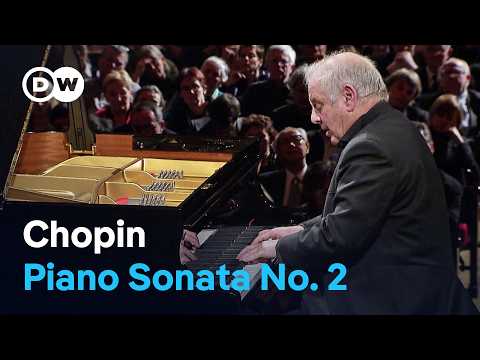
<p><iframe allowfullscreen="allowfullscreen" width="640" height="390" src="https://www.inoreader.com/yt-embed/?v=I6ariVeZP9g" referrerpolicy="strict-origin-when-cross-origin" style="width:100%;aspect-ratio:16/9;height:auto;display:block;border:0;" frameborder="0"></iframe></p><p>Chopin’s Piano Sonata No. 2 in B-flat minor, Op. 35, featuring the legendary Funeral March ("Marche funèbre"), stands among the defining masterpieces of nineteenth-century piano literature. This compelling performance by Daniel Barenboim was recorded at Warsaw Philharmonic Concert Hall in 2010 during a special recital devoted to Chopin.<br>
<br>
(00:00) I. Grave<br>
(05:30) II. Scherzo <br>
(12:36) III. Marche funèbre (Funeral March)<br>
(20:13) IV. Finale<br>
<br>
Composed between 1837 and 1839, the Piano Sonata in B-flat minor, Op. 35 is one of Frédéric Chopin's (1810-1849) most ambitious works. Rooted in the Classical sonata tradition, it expands the form with striking contrasts of mood and character — combining moments of dramatic intensity with passages of lyrical introspection — and ending in one of the most unconventional finales in the piano repertoire. <br>
<br>
When Chopin completed the sonata, he was living in France and had recently returned from a difficult winter spent on the island of Majorca with his partner, feminist novelist George Sand. During their stay on the island, his health deteriorated significantly — the composer is now believed to have been suffering from tuberculosis — yet it was also a remarkably productive period during which he finished several major compositions. <br>
<br>
Over the years, the sonata has been interpreted by some as a meditation on death. Since the Funeral March is followed by a mysterious and somewhat ghostly finale, some nineteenth- and twentieth-century commentators imagined the work as depicting a funeral procession followed by musical themes that represent the dissolution of life. This idea was famously suggested by the pianist and conductor Hans von Bülow, although Chopin himself never indicated that the sonata was intended as such.<br>
<br>
The opening movement introduces a turbulent musical argument before a broad, expressive second theme. A lively scherzo follows, balancing brilliant virtuosity with a calm and poetic central section. The famous third movement, the Funeral March (12:37), was composed several years before the rest of the sonata and became one of Chopin's best-known works. Its solemn procession surrounds a serene, hymn-like middle episode. The brief finale sweeps past in restless unison writing, creating an eerie and elusive conclusion that has long fascinated listeners. <br>
<br>
Argentinian-born pianist and conductor Daniel Barenboim has maintained a deep connection with Chopin’s music throughout his career. Even after establishing himself as one of the world’s leading conductors, he continued to perform Chopin’s piano works, appreciating them not only as vehicles for virtuosity, but also for their emotional depth. <br>
<br>
Author: Sarah Hucal<br>
<br>
© 2010 Accentus Music<br>
<br>
Discover more concert recordings: <a href="https://www.youtube.com/playlist?list=PL_SdnzPd3eBV5A14dyRWy1KSkwcG8LEey">https://www.youtube.com/playlist?list=PL_SdnzPd3eBV5A14dyRWy1KSkwcG8LEey</a><br>
<br>
Explore our collection of solo piano masterpieces: <a href="https://www.youtube.com/playlist?list=PL_SdnzPd3eBV8VQOtGGTUYSryvB_k8Wl">https://www.youtube.com/playlist?list=PL_SdnzPd3eBV8VQOtGGTUYSryvB_k8Wl</a>-<br>
<br>
Browse more music by Frédéric Chopin: <a href="https://www.youtube.com/playlist?list=PLJUklObWymw4">https://www.youtube.com/playlist?list=PLJUklObWymw4</a><br>
<br>
Enjoy more great works from the Romantic era: <a href="https://www.youtube.com/playlist?list=PL_SdnzPd3eBUCHNKKxIIM88sntDk1TVih">https://www.youtube.com/playlist?list=PL_SdnzPd3eBUCHNKKxIIM88sntDk1TVih</a><br>
<br>
Subscribe to DW Classical Music: <a href="https://www.youtube.com/dwclassicalmusic">https://www.youtube.com/dwclassicalmusic</a> <br>
<br>
#chopin #pianosonata #solopiano</p>
<p><a href="https://www.youtube.com/watch?v=I6ariVeZP9g" target="_blank">- Enlace a artículo -</a></p>
<p>Más info en https://ift.tt/bdru30a / Tfno. & WA 607725547 Centro MENADEL (Frasco Martín) Psicología Clínica y Tradicional en Mijas.
#Menadel #Psicología #Clínica #Tradicional #MijasPueblo</p>
<p>*No suscribimos necesariamente las opiniones o artículos aquí compartidos. No todo es lo que parece.</p>

No hay comentarios:
Publicar un comentario