
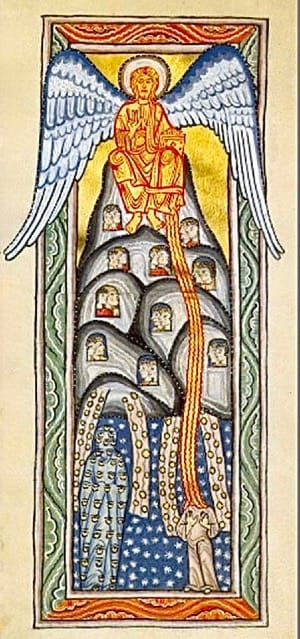
<div> <figure><blockquote><a href="https://open.spotify.com/embed/episode/0se6mlkyiKkN6pPha5hBji?utm_source=oembed"></a></blockquote></figure><p>Every discourse concerning holiness begins already in error, for discourse presupposes that the holy may be rendered into the economy of predicates. Yet the holy is precisely that before which predication suffers an ontological insufficiency. Language names beings; holiness precedes every determination by which beings become nameable. Consequently, the first affirmation concerning holiness is already too much, while every negation remains too little. One must therefore speak and unspeak simultaneously, allowing thought to advance only by the continual renunciation of its own adequacy.</p><p>Holiness is not a property inhering within a subject <em>per se</em>, but in the Transcendent pervading all, nor is it an accidental perfection superadded to substance. Such formulations merely transpose the sacred into Aristotelian categories that cannot sustain its metaphysical weight. Rather, holiness is the excess whereby Being refuses exhaustion by ontology itself. It is not another region of beings, but the inexhaustibility through which being perpetually transcends every horizon established for its disclosure.</p><p>To encounter the holy is therefore not to meet an extraordinary object. It is to suffer the collapse of objectivity altogether within the transcendent Self, who alone is.</p><p>For the distinction between subject and object belongs to finitude. It is the architecture of consciousness operating under conditions of separation. Holiness does not abolish this distinction through confusion, but through an intensity of presence in which both poles are relativized before a transcendent and sempiternal plenitude. The seer does not merely behold the holy; rather, the act of seeing itself becomes seen.</p><p>This is why the prophets consistently report less what they observed than what became impossible to observe after the encounter. Moses veils his face because visibility has become unbearable. Isaiah’s lips require fire because ordinary language cannot survive proximity to the Absolute. Muḥammad returns from the Cave transformed not by simply the audition of words but by the revelation of their inner meaning, as ‘witness’—a mode of knowing in which knowledge itself becomes obedient. The Apostles fall prostrate before the Transfiguration because light has ceased to illuminate objects and instead reveals illumination itself.</p><p>Thus holiness is neither phenomenon nor noumenon. It is the condition under which both distinctions fail. The Sacred is the theophany whereby the phenomenon radiates the noumenon.</p><blockquote>The holy is where contradiction ceases without being annihilated. … holiness continually resists quantification because it belongs to another grammar entirely.</blockquote><p>While Goodness and Beauty embody Truth, one should resist the temptation to identify holiness with morally excellent conduct. Morality concerns rectitude within the order of action. Holiness concerns participation within the order transcending action altogether. A perfectly ethical machine could never become holy, because holiness requires not merely correct operation but ontological receptivity. Likewise, one may possess heroic virtue without yet becoming transparent to transcendence. Virtue disciplines existence; holiness reconstitutes it.</p><p>Here Nicholas of Cusa’s <em>coincidentia oppositorum</em> approaches singular importance. The holy is where contradiction ceases without being annihilated. Justice and mercy remain distinct yet become inseparable. Majesty and humility no longer alternate but mutually imply one another. Distance becomes intimacy. Silence becomes speech. Hiddenness becomes revelation. Death becomes life without ceasing to be death.</p><p>Such paradoxes are not rhetorical ornaments. They are symptoms that thought has reached the threshold beyond which finite logic encounters infinite simplicity.</p><p>One discovers here the peculiar inadequacy of metaphysical substantialism. If holiness were simply a superior substance, then it could be measured. If it were merely greater power, it could be compared. If it were only higher perfection, it would remain susceptible to degrees. Yet holiness continually resists quantification because it belongs to another grammar entirely.</p><p>It is not more. It is otherwise. Indeed, one might say that holiness constitutes the ontological impossibility of indifference. Everything genuinely holy demands response before comprehension.</p><p>The Burning Bush is not first understood and then revered. It is revered before it is understood. The Temple is entered before it is interpreted. The Qur’an is recited before it is analyzed. The Eucharist is adored before it is explained.</p><p>Understanding arrives belatedly because reverence is epistemologically anterior wherever holiness is present.</p><blockquote>theology at its summit does not replace adoration with concepts. It refines adoration by purifying concepts until they become capable of their own surrender.</blockquote><p>Modern consciousness frequently inverts this order. It imagines explanation dissolves mystery. Yet genuine explanation deepens mystery precisely because intelligibility itself becomes increasingly transparent to an inexhaustible ground. The astronomer who comprehends stellar nucleosynthesis does not abolish wonder; wonder becomes more profound because intelligibility reveals dimensions previously concealed. Likewise, theology at its summit does not replace adoration with concepts. It refines adoration by purifying concepts until they become capable of their own surrender.</p><figure><img src="https://storage.ghost.io/c/26/b5/26b5a426-214e-4897-b490-fa1deaa9b7ae/content/images/2026/07/IMG_1564-1.jpeg" alt="" width="300"><figcaption><span>From Hildegard’s </span><i><em>Scivias</em></i></figcaption></figure><p>Here one encounters the supreme irony. The nearer thought approaches holiness, the less confidence it possesses in thought. Not because reason has failed. Because reason has become truthful concerning its own finitude.</p><p>The greatest intellect is therefore recognizable not by the multiplication of propositions but by the increasing precision with which it distinguishes mystery from ignorance. Ignorance lacks answers. Mystery exceeds answers. These are opposite conditions.</p><p>Apophatic theology therefore should never be mistaken for theological agnosticism. To deny that God—or holiness—may be comprehended is not to deny that God may be known. Rather, it affirms a mode of knowledge proportioned to infinitude rather than mastery. One does not possess the holy intellectually any more than one possesses light by opening the eyes. Vision occurs through participation in illumination, not dominion over it.</p><p>If holiness possesses a geometry, it is spherical. Every point upon a sphere simultaneously faces the center without rivalry. Thus the communion of saints is not hierarchical competition but convergent orientation. Nearness to the Center necessarily produces nearness among participants. Rivalry belongs to circumference. At the Center there remains only coincidence.</p><p>One might even risk a phenomenological reformulation. Consciousness ordinarily intends objects. Holiness reverses intentionality. The Absolute becomes that toward which consciousness is always already intended before consciousness discovers its own intention.</p><p>Prayer is therefore not fundamentally speaking. Nor listening. It is remembering the direction in which existence has always secretly been facing.</p><blockquote>The transcendent proves more intimate than immanence because transcendence is not spatial remoteness but ontological priority.</blockquote><p>Augustine’s <em>interior intimo meo</em>—“more inward than my inmost self”—expresses precisely this inversion. The transcendent proves more intimate than immanence because transcendence is not spatial remoteness but ontological priority.</p><p>Hence the saints consistently appear paradoxically absent from themselves. They have not lost individuality. They have ceased mistaking individuality for ultimacy.</p><p>The ego contracts. Personhood expands. One decreases. Presence increases.</p><p>This explains the extraordinary luminosity frequently attributed to holy figures across civilizations. Whether depicted as the Christian nimbus, the Islamic <em>nūr</em>, the Buddhist aureole, the Hindu <em>tejas</em>, or the Zoroastrian <em>khvarenah</em>, light functions not merely as symbol but as metaphysical analogy. Light uniquely gives itself without diminution. It reveals without possessing. It touches without displacement. It remains invisible until reflected by another. Thus holiness resembles light because both are modes of self-diffusive generosity.</p><p>And perhaps this finally approaches the hidden grammar of sanctity. Holiness is not perfection enclosed within itself. It is inexhaustible self-donation. Everything finite survives by acquisition. The holy exists by gift. Creation receives. The holy gives. The Absolute gives even the capacity to receive.</p><p>Therefore every authentic act of sanctity is not an achievement ascending toward God but a transparency through which divine generosity encounters no resistance.</p><p>The saint is not great because the saint has climbed higher than others. The saint is great because almost nothing remains opaque.</p><blockquote>Evil is curvature where existence was intended as radiance.</blockquote><p>One may therefore define sin not primarily as disobedience, though it is certainly that, but as ontological opacity: the refusal of participation through self-enclosure. Evil is curvature where existence was intended as radiance. Hell, in this light, is not principally punishment imposed from without but the consummation of absolute opacity—a consciousness rendered incapable of receiving light because it has become entirely occupied with itself.</p><p>Conversely, beatitude is not reward. It is perfect translucence. The blessed do not merely behold God. They become infinitely beholdable by God.</p><p>Here all metaphysical inquiry must finally surrender its ambition to conclude. For holiness is not the final object of philosophy. It is philosophy’s purification. Nor is it theology’s conclusion. It is theology’s perpetual beginning.</p><p>The holy remains forever anterior to every system because it is the inexhaustible surplus by which Reality eternally exceeds every description of itself. Every concept arrives too late. Every liturgy only begins. Every silence still speaks too much.</p><p>And yet the soul continues. Not because it imagines the Infinite can finally be grasped. But because it gradually discovers that the Infinite has always been the one silently grasping it.</p><p>Thus the consummation of holiness is neither ecstasy nor illumination, neither knowledge nor vision, neither perfection nor power. It is consent. The infinite “Yes” by which finite being relinquishes the illusion of self-subsistence and awakens to the astonishing realization that existence itself has always been an act of unmerited, inexhaustible, and ever-present gift.</p><p>There, at the frontier where language becomes praise and praise becomes silence, holiness no longer appears as an attribute of the Divine. It is perceived as the very atmosphere in which all reality has, from before the beginning of time, already been breathing.</p> </div>
<p><a href="https://www.sacredweb.com/metaphysics/de-sanctitate-abscondita/" target="_blank">- Enlace a artículo -</a></p>
<p>Más info en https://ift.tt/MfxhetY / Tfno. & WA 607725547 Centro MENADEL (Frasco Martín) Psicología Clínica y Tradicional en Mijas.
#Menadel #Psicología #Clínica #Tradicional #MijasPueblo</p>
<p>*No suscribimos necesariamente las opiniones o artículos aquí compartidos. No todo es lo que parece.</p>

No hay comentarios:
Publicar un comentario