
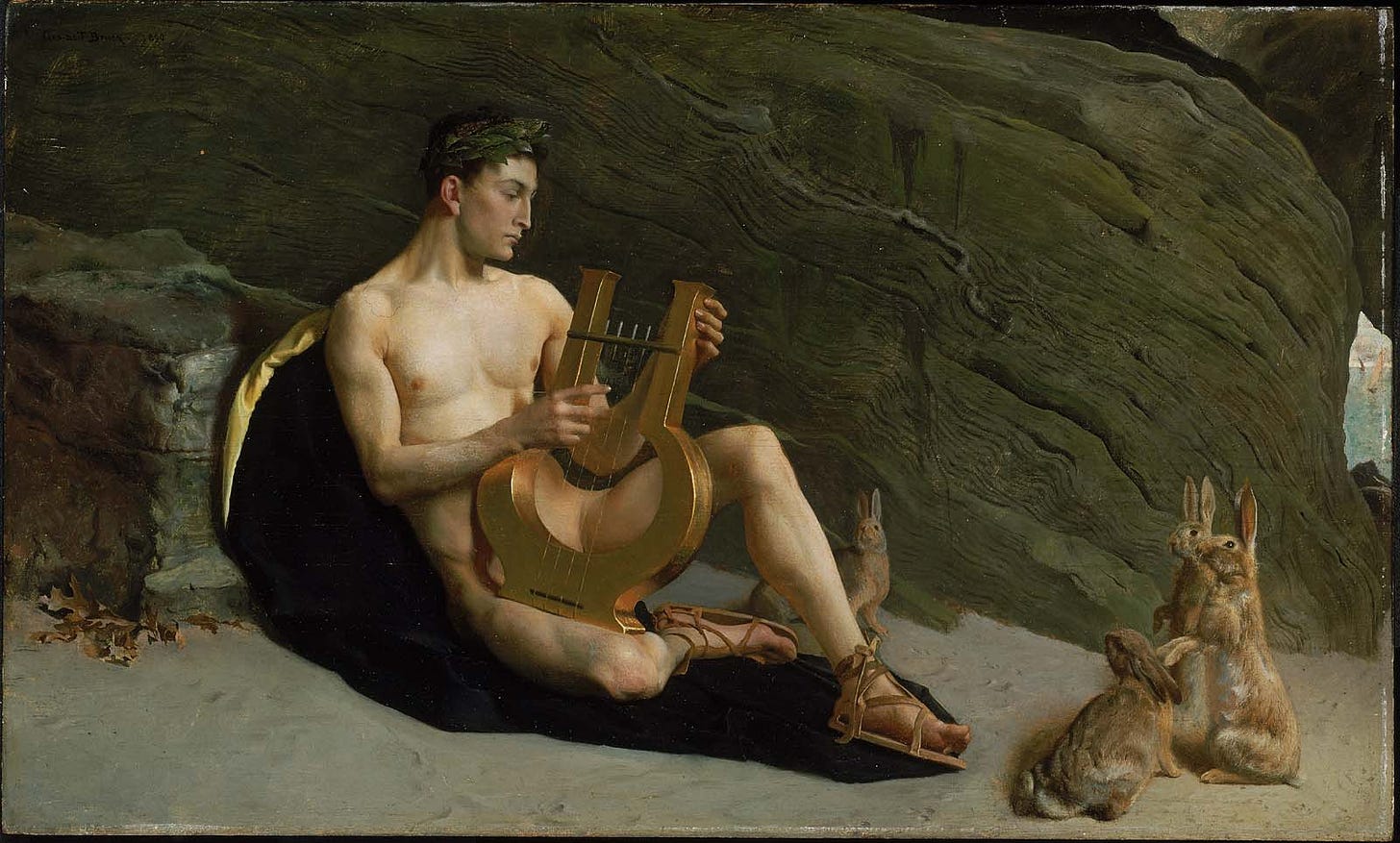
<p><span>Dear Classical Wisdom Reader,</span></p><p><span>The fact that we make music is amazing. It’s simply astounding that melodies, with their tensions and resolutions, exist at all. How remarkable to be exalted by notes that soar high or grounded by trembling lows, to be swept along by tempo and moved by rhythm!</span></p><p><span>Of course, nature provides plenty of inspiration. Birdsong delights us with sweet melodies, repeated motifs, and distinct intervals. Indeed, some birds even produce notes that approximate the harmonic series, the simple mathematical relationships that help explain why certain combinations of sounds are pleasing to the ear. This is especially true of the unassuming state bird of Vermont, the hermit thrush, perhaps nature’s closest approximation to a musician.</span></p><p><span>Those who have the time and patience can also enjoy the long, haunting songs of the humpback whale, drifting through the seas, structured with melody rather than harmony. Gibbons perform duets, while crickets and frogs form a chorus, their rhythms accompanying evening’s arrival. </span></p><p><span>Even among rocks and caves, trees and ice, wind and water can produce resonances and repeating patterns. Sand dunes, too, can miraculously sing when millions of grains of sand synchronize with astonishing precision.</span></p><p><span>Yet music... real, fully formed melodies with beginnings and ends, that is the work of man alone.</span></p><p><a href="https://classicalwisdom.substack.com/p/is-there-too-much-music?utm_source=substack&utm_medium=email&utm_content=share&action=share"><span>Share</span></a></p><p><span>Perhaps it is no surprise, then, that music has always been celebrated and the power it wields appreciated. It occupied a sacred position, playing a critical role in every community. Indeed, there is no known society -past or present- that lacks music. It may even predate civilization itself, as the discovery of bone flutes more than 40,000 years old attests.</span></p><p><span>For what reason it first evolved, we can never fully know, but it soon became enshrined in ritual, religion, and myth. It provided the soundtrack for ceremony, the accompaniment to poetry, the rhythm to creation stories. The gods themselves were said to have given it to humanity: Apollo with his lyre presided over songs that men and women would sing...the very backbone of their beliefs.</span></p><p><span>No example better illustrates this than the story of Orpheus, the hero whose music could literally move the mighty oak and graceful linden, could halt fights and invigorate sailors, could even soften the hardened heart of the queen of the underworld, allowing him to walk the halls of Hades. </span></p><div><figure><a href="https://substackcdn.com/image/fetch/%24s_!MVgV!,f_auto,q_auto:good,fl_progressive:steep/https%3A%2F%2Fsubstack-post-media.s3.amazonaws.com%2Fpublic%2Fimages%2F2b1d65b7-b510-41a0-a1cc-56f23cbffcf3_1600x964.jpeg"></a><div><a href="https://substackcdn.com/image/fetch/%24s_!MVgV!,f_auto,q_auto:good,fl_progressive:steep/https%3A%2F%2Fsubstack-post-media.s3.amazonaws.com%2Fpublic%2Fimages%2F2b1d65b7-b510-41a0-a1cc-56f23cbffcf3_1600x964.jpeg"></a><source type="image/webp"><a href="https://substackcdn.com/image/fetch/%24s_!MVgV!,f_auto,q_auto:good,fl_progressive:steep/https%3A%2F%2Fsubstack-post-media.s3.amazonaws.com%2Fpublic%2Fimages%2F2b1d65b7-b510-41a0-a1cc-56f23cbffcf3_1600x964.jpeg"><img src="https://substackcdn.com/image/fetch/%24s_!MVgV!,w_1456,c_limit,f_auto,q_auto:good,fl_progressive:steep/https%3A%2F%2Fsubstack-post-media.s3.amazonaws.com%2Fpublic%2Fimages%2F2b1d65b7-b510-41a0-a1cc-56f23cbffcf3_1600x964.jpeg" width="1456" height="877" alt=""></a></source><a href="https://substackcdn.com/image/fetch/%24s_!MVgV!,f_auto,q_auto:good,fl_progressive:steep/https%3A%2F%2Fsubstack-post-media.s3.amazonaws.com%2Fpublic%2Fimages%2F2b1d65b7-b510-41a0-a1cc-56f23cbffcf3_1600x964.jpeg"></a><div><a href="https://substackcdn.com/image/fetch/%24s_!MVgV!,f_auto,q_auto:good,fl_progressive:steep/https%3A%2F%2Fsubstack-post-media.s3.amazonaws.com%2Fpublic%2Fimages%2F2b1d65b7-b510-41a0-a1cc-56f23cbffcf3_1600x964.jpeg"></a><div><a href="https://substackcdn.com/image/fetch/%24s_!MVgV!,f_auto,q_auto:good,fl_progressive:steep/https%3A%2F%2Fsubstack-post-media.s3.amazonaws.com%2Fpublic%2Fimages%2F2b1d65b7-b510-41a0-a1cc-56f23cbffcf3_1600x964.jpeg"></a></div><a href="https://substackcdn.com/image/fetch/%24s_!MVgV!,f_auto,q_auto:good,fl_progressive:steep/https%3A%2F%2Fsubstack-post-media.s3.amazonaws.com%2Fpublic%2Fimages%2F2b1d65b7-b510-41a0-a1cc-56f23cbffcf3_1600x964.jpeg"></a></div><a href="https://substackcdn.com/image/fetch/%24s_!MVgV!,f_auto,q_auto:good,fl_progressive:steep/https%3A%2F%2Fsubstack-post-media.s3.amazonaws.com%2Fpublic%2Fimages%2F2b1d65b7-b510-41a0-a1cc-56f23cbffcf3_1600x964.jpeg"></a></div><a href="https://substackcdn.com/image/fetch/%24s_!MVgV!,f_auto,q_auto:good,fl_progressive:steep/https%3A%2F%2Fsubstack-post-media.s3.amazonaws.com%2Fpublic%2Fimages%2F2b1d65b7-b510-41a0-a1cc-56f23cbffcf3_1600x964.jpeg"></a><figcaption>Orpheus playing the lyre in front of an audience of hares. Painting by George de Forest Brush (1855-1941) Credit: Public Domain</figcaption></figure></div><p><span>His is a tragic tale… He suffered the death of his beloved wife, Eurydice, not only once, but twice, when he turned too soon while leading her out of Erebus. Then came his own grisly end at the frenzied hands of the Maenads... </span></p><p><span>And yet, from his legend emerged a powerful religious movement that wove its way through the centuries: the Orphic Mysteries.</span></p><p>Amazingly, it wasn’t until the sixth century BC philosopher and polymath, Pythagoras, that we began to understand the universal mathematical principles underlying the music that moves us so. Through a series of experiments involving a stretched string and simple numerical ratios, Pythagoras (or his followers) demonstrated the mathematics behind musical harmony. </p><p>If you halve the length of a string, for instance, the two notes sound pleasing together, forming an octave (2:1). Other consonant intervals arise from equally elegant ratios, such as the fifth (3:2) and the fourth (4:3).</p><p>To the Pythagoreans, these mathematical formulas behind music revealed an underlying order to the cosmos, a rational explanation for the seeming chaos around us. Music and mathematics were intertwined... but the power of music was not merely intellectual; it was emotional as well. </p><p>Pythagoras, like Orpheus, was said to employ melody to invigorate and stimulate the senses, as well as to calm and soothe anguish or anger.</p><p><em><strong>Learn how the ancient world still shapes us… from music and myth to history and philosophy, the lessons of the past are all around us, if we only know where to look! </strong></em></p><p><em><strong>Bring Classical Wisdom into your inbox and into your life. Subscribe Today:</strong></em></p><p><a href="https://classicalwisdom.substack.com/subscribe?"><span>Subscribe now</span></a></p><p><span>This understanding of music’s power was woven throughout the ancient world, from the driving beat of war drums and the ritualized chants of religion to the stirring sounds of the symposium and the dramatic performances of the theatre. Music was ubiquitous... and everyone was involved. </span></p><p><span>The lowly slave might be commanded to play, just as an elite free-born boy was expected to pluck the lyre. There were professional musicians and everyday singers. Music was simply part and parcel of ancient life.</span></p><p><span>And yet, despite its ubiquity, music was never effortless. It always required another human being, someone to make it. Every performance was unique, existing only for the performer and the audience gathered to hear it. It rose and faded, then was gone. This remained true for thousands of years. Even those fortunate enough to hear the greats, Mozart, Beethoven and Liszt, knew that once the music stopped, only memory remained to preserve it.</span></p><p><span>That was... until Edison’s phonograph in 1877. </span></p><p><span>All of a sudden, music could be repeated exactly, </span><em><span>ad infinitum</span></em><span>. It could be heard by someone who would never meet the musician. The social aspect, the human connection, no longer had to be present, and for the first time the individual could decide what music to hear, and how often.</span></p><p><span>But still, we had to have a record, a CD, a tape, something physical to pick up and associate with a song... until streaming. Now, there is no arc of an album, no thread to the tangible. We can simply click a button and are immersed in continuous music. A playlist with no end, music now fills every crook and cranny of our minds. Our empty mental spaces swim with sounds chosen by an algorithm to play next. Music was an event, but now it’s the environment... it has become the default, making silence something we must seek.</span></p><p><span>Does music still move us? Of course, and now we understand more than ever how it does.</span></p><p><span>Faster tempos, strong rhythms, and major chords are often used to evoke joy and triumph, while minor keys and descending melodies tend to suggest sadness. Dissonance creates tension, resolution brings relief, suspended chords evoke mystery, while low frequencies can provoke fear.</span></p><p><span>This is happening to us all the time, at the movies, in the diner, and on the radio. We feel compelled to dance, sing or cry, and yet we often don’t even choose the music!</span></p><p><span>Which brings me to today’s question, my inquiry into our relationship with music. By liberating it from the musician and recording it for mass consumption, have we made the magic of music available to everyone? Or have we diluted our experience of it? Have we become disconnected from its power? </span></p><p><span>Pythagoras believed music shaped the soul...but what happens when the soul is never without it?</span></p><p><strong><span>Can there be such a thing as too much music?</span></strong></p><p><span>Discuss below, and let’s bring the conversation about music to the fore.</span></p><p><span>All the best,</span></p><p><span>Anya Leonard</span></p><p><span>Founder and Director</span></p><p><span>Classical Wisdom</span></p><p><strong>P.S.</strong> <strong>Dear Reader</strong><span>, it takes time and effort to put together our issues here at Classical Wisdom. If you’re enjoying our work… and you believe good writing deserves to be paid… please take a moment to join our members here, today…</span></p><p><a href="https://classicalwisdom.substack.com/subscribe?"><span>Subscribe now</span></a></p><p></p><p></p>
<p><a href="https://classicalwisdom.substack.com/p/is-there-too-much-music" target="_blank">- Enlace a artículo -</a></p>
<p>Más info en https://ift.tt/30oB9di / Tfno. & WA 607725547 Centro MENADEL (Frasco Martín) Psicología Clínica y Tradicional en Mijas.
#Menadel #Psicología #Clínica #Tradicional #MijasPueblo</p>
<p>*No suscribimos necesariamente las opiniones o artículos aquí compartidos. No todo es lo que parece.</p>

No hay comentarios:
Publicar un comentario