
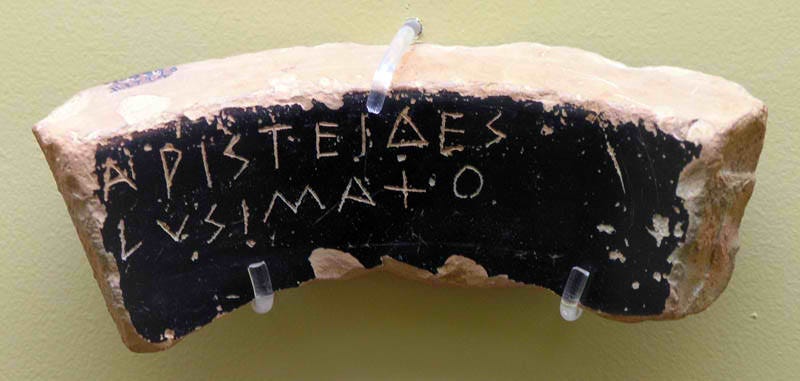
<p><img src="https://substackcdn.com/image/fetch/$s_!Ooyf!,f_auto,q_auto:good,fl_progressive:steep/https://bucketeer-e05bbc84-baa3-437e-9518-adb32be77984.s3.amazonaws.com/public/images/98d67748-ddb7-4ee1-87a5-5fd647818160_800x381.jpeg"></p><p>Dear Classical Wisdom Reader, </p><p>History has a habit of surprising us.</p><p>In our recent Classical Wisdom discussion on <em>Pericles and the Myth of the Golden Age</em>, one detail stood out. For all his influence, achievements, and popularity, Pericles, arguably the most famous statesman in Athenian history, once faced the very real possibility of being cast out of the city he helped shape. </p><p>Not because he had committed a crime… Not because he had lost a war… But because his fellow citizens feared that any individual could become too powerful.</p><p>It’s an idea that feels almost unthinkable today!</p><p>Modern politics often seems trapped between two unsatisfying choices: powerful leaders who are difficult to remove and bitter battles over how, and whether, they should be held accountable. Yet the Athenians approached the problem differently. </p><p>Indeed, their solution was one of the most unusual political experiments ever created by a democracy...</p><p>But then again, the ancient world was filled with institutions that seem strange to modern eyes. Some, I think we can all agree, deserve to remain firmly in the past, while others force us to ask uncomfortable questions about whether our own systems are really any better…</p><p>And then there are those rare ideas that sit somewhere in between, provoking debate more than two thousand years later. </p><p>Let’s just say the jury’s still out with regards to this one. </p><p>Read on to discover the strange process of Ostracism and consider for yourself: is this a historical feature we should bring back?</p><p>Please Note: Classical Wisdom Members can enjoy the full article as well as a special Classical Wisdom Ebook dedicated to <strong>The Men Who Changed the Face of Athens. </strong></p><p>In this Ebook, we take a deep, but diverse, dive into the topic of fifth century BC Athenian hegemony in the Aegean Sea and how this came about due to the formation, and Athens’ manipulation, of the Delian League. </p><p>Focusing on Themistocles, Aristides, Cimon and Pericles, readers will come away with a greater understanding… and appreciation of the men who changed the Face of Athens and the Athenian Golden Age.</p><p>You can find that below the column. </p><p>*<strong>Not a member?</strong> Make sure to subscribe to unlock all our resources, from event transcripts and Ebooks to exclusive podcasts and in-depth articles. </p><p>Each week we explore the ancient world, including history, philosophy, mythology and more… don’t miss your next inspiration, join our growing community today: </p><p><a href="https://classicalwisdom.substack.com/subscribe?"><span>Subscribe now</span></a></p><p>All the best,<br>Anya Leonard</p><p>Founder and Director<br>Classical Wisdom</p><p>P.S. <strong>Members</strong>: you can also access the recording and transcript from our recent event “Pericles: The Myth of the Golden Age” with Paul Cartledge and Armand D’Angour here: </p><p><a href="https://classicalwisdom.substack.com/p/video-pericles-the-myth-of-a-golden-age"><span>VIDEO: Pericles Event</span></a></p><div><hr></div><h1>Ostracism in the Ancient World</h1><p><em>By Van Bryan</em></p><p>In <em>The Politics</em>, Aristotle tells us that ostracism was originally instituted as a means to allow the common people to check the power of the political players who had grown too powerful too fast and were abusing their position.</p><p>It was a way to give claws to the hare when he was going up against a lion.</p><blockquote><p>…democratic states have instituted ostracism; equality is above all things their aim, and therefore they ostracise and banish from the city for a time those who seem to predominate too much through their wealth, or the number of their friends, or through any other political influence.</p><p>–Aristotle (<em>The Politics</em>, Book III)</p></blockquote><p>The procedure was rather simple. </p><p>Plutarch tells us, in his <em>Life of Aristides</em>, that an ostracism vote was held once a year. </p>
<p>
<a href="https://classicalwisdom.substack.com/p/bring-back-ostracism">
Read more
</a>
</p>
<p><a href="https://classicalwisdom.substack.com/p/bring-back-ostracism" target="_blank">- Enlace a artículo -</a></p>
<p>Más info en https://ift.tt/dD94kig / Tfno. & WA 607725547 Centro MENADEL (Frasco Martín) Psicología Clínica y Tradicional en Mijas.
#Menadel #Psicología #Clínica #Tradicional #MijasPueblo</p>
<p>*No suscribimos necesariamente las opiniones o artículos aquí compartidos. No todo es lo que parece.</p>

No hay comentarios:
Publicar un comentario